GPT-5.5’s core value is not that it chats more intelligently, but that it can autonomously execute computer tasks around a goal, generate spreadsheets and presentations, and coordinate across toolchains. It addresses three major pain points: complex prompt engineering, fragmented workflows, and limited enterprise governance. Keywords: GPT-5.5, Agent, end-to-end orchestration.
The technical specification snapshot captures the current picture
| Parameter | Details |
|---|---|
| Topic | GPT-5.5 / Agent Workflows / AI Governance |
| Form | Multi-step autonomous execution model (based on interview interpretation) |
| Language | Natural language interaction, multi-tool invocation |
| Protocol / Interaction | Browser operations, workspace agents, enterprise IT integrations |
| Stars | Not disclosed, not an open-source project |
| Core Dependencies | Pretraining, reinforcement learning, data pipelines, compute clusters, security frameworks |
GPT-5.5 has shifted from answering questions to taking over tasks
The key change is not benchmark scores. It is that the model has crossed the usability threshold. Based on Greg Brockman’s description, GPT-5.5 can now complete browser actions, spreadsheet processing, presentation generation, and complex problem solving with fewer instructions.
This means the interaction paradigm has changed. In the past, users had to break tasks into steps. Now, users are closer to providing a business goal, while the model fills in the execution path. For developers, prompts are no longer the script itself, but rather the constraints, goals, and acceptance criteria.
Goal-driven invocation is replacing step-driven prompting
from openai import OpenAI

client = OpenAI()

goal = "Organize this week's sales data, generate a summary table, and produce three business insights"  # Describe only the goal, not the steps

response = client.responses.create(
    model="gpt-5.5",
    input=goal,
    tools=[
        {"type": "spreadsheet"},   # Allow the model to process spreadsheets
        {"type": "browser"}        # Allow the model to access web pages or system interfaces
    ]
)

print(response.output_text)  # Output the final result or execution summary
This code snippet shows the minimum invocation pattern for replacing a workflow script with a goal.
End-to-end orchestration design is GPT-5.5’s real moat
The interview repeatedly emphasizes that the improvement does not come from a single isolated technique. It is the result of pretraining, mid-training, reinforcement learning, data collection, evaluation, and deployment systems working together.
That explains why distillation cannot fully replicate the experience. Open-source models may approach individual capabilities, but they struggle to match context understanding, tool invocation stability, safety alignment, and long-chain task completion at the same time. The moat is not just the model. It is the closed loop across building, testing, deployment, and feedback.
System capability can be abstracted as a four-layer orchestration stack
system_stack = {
    "model": ["Pretraining", "Mid-training", "Reinforcement Learning"],      # Responsible for baseline intelligence and task alignment
    "runtime": ["Tool Invocation", "Browser Execution", "Sandbox Environment"],  # Responsible for executability
    "safety": ["Policy Filtering", "Risk Evaluation", "Permission Control"],    # Responsible for controllability
    "ops": ["Compute Scheduling", "Log Observability", "Continuous Iteration"]       # Responsible for operation at scale
}

for layer, modules in system_stack.items():
    print(layer, "=>", ", ".join(modules))  # Output the responsibilities of each layer
This abstract code shows that commercially viable agents depend on a complete system stack, not a single-model score.
Prompt engineering has not disappeared, but evolved into goal definition engineering
Saying that prompt engineering is obsolete is not accurate. A better description is that low-level step prompting is losing value, while high-level goal expression is gaining value. Developers still need to provide context, boundaries, permissions, and success criteria, but they no longer need to manually choreograph every click.
The new core skill set becomes three things: define goals, provide context, and review results. The highest-value roles in the future will not be the people who write the best magic prompts, but the engineers who best design task closed loops, control risk, and evaluate outputs.
Enterprise deployment must bind autonomy to governance
When an agent serves only an individual, the cost of mistakes is limited. Once it starts connecting to Slack, documents, code repositories, and internal systems, the question shifts from can it do the work to can it be governed.
The most important point in the interview is the analogy between managing agents and managing employees. Five agents can be watched manually. Fifty thousand agents require observability, layered permissions, audit logs, and secure sandboxes. Without governance, the greater the scale of autonomy, the higher the risk.
A minimum enterprise governance checklist should come before large-scale integration
governance_checklist = [
    "Least-Privilege Access",      # Grant only the permissions required to complete the task
    "Full Audit Logging",          # Record critical operations and decision chains
    "Human Review of Results",     # High-risk tasks must be approved by a person
    "Sandboxed Execution",         # Prevent unauthorized access to production environments
    "Circuit Breakers and Rollback"     # Allow immediate termination when deviation occurs
]

assert "Least-Privilege Access" in governance_checklist  # Governance prerequisite
This checklist summarizes the baseline requirements for moving agents from experimentation into enterprise production.
Iterative deployment is better suited than closed release for real-world defense
On cybersecurity, OpenAI’s proposed path is iterative deployment. The logic is straightforward: model capabilities will enter real environments, defenders need access to the tools early, and the ecosystem needs practice to expose weaknesses and fix them quickly.
This approach does not mean loosening risk controls. Quite the opposite: it requires stronger resilience frameworks, trusted testing, restriction policies, and gradual rollout mechanisms. The core question is not whether to open access, but how to preserve control while opening access.
 AI Visual Insight: This image appears after the argument that “prompting is obsolete” and highlights the narrative shift from text understanding to task ownership in GPT-5.5. Visually, it typically bridges the jump in model capability and helps readers connect intuitive understanding, low-instruction execution, and multi-tool coordination as part of the same generational upgrade.
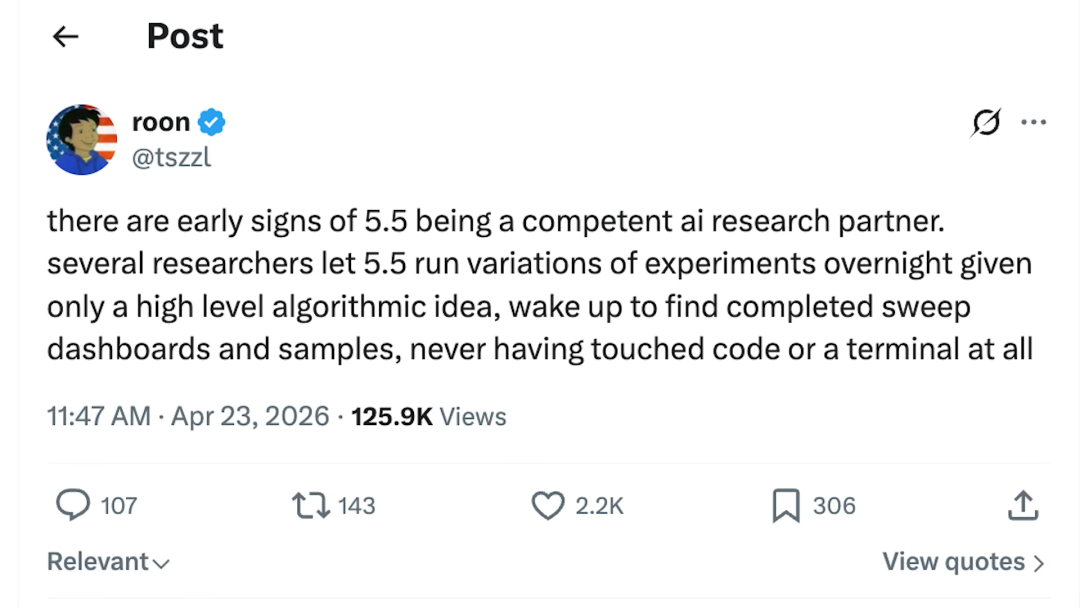 AI Visual Insight: This image corresponds to the latter discussion around moat, safety, and deployment, and serves as a section divider. It reinforces the article’s structural transition from model capability itself to more platform-oriented technical topics such as systems engineering, risk governance, and large-scale operations.
Compute will become the foundational means of production in the agent era
The interview’s conclusion is very clear: the future question is not whether you have AI, but how much compute you can mobilize to solve problems. The more compute available, the larger the task space that can be explored in parallel, and the more the model can take on scientific research, business analysis, and complex automation workflows.
This also explains why frontier model companies continue to invest heavily in infrastructure. As agents become widespread, the cost structure will shift from buying software to continuously consuming compute resources. Development teams will need to optimize model invocation, task layering, and resource budgets simultaneously. Compute management will become a new core engineering discipline.
Developers should adjust how they work
First, reduce dependence on step-by-step prompts and instead design goals, constraints, and acceptance criteria. Second, treat the model as an execution system rather than a pure question-answering interface. Third, prioritize logs, permissions, and evaluation before simply chasing a stronger model.
For teams, the next competitive wave is not just who integrates GPT-5.5 first, but who can place agents into real business workflows and keep them running in a stable, compliant, and auditable way.
FAQ provides structured answers to the key questions
Has GPT-5.5 really made prompt engineering obsolete?
No. The focus has shifted. The value of low-level step orchestration is declining, while high-level goal definition, context organization, and acceptance constraints are becoming more important.
Why is it hard for open-source distilled models to fully replicate the GPT-5.5 experience?
Because the gap is not only in parameters or output samples. It is in the end-to-end orchestration of training, toolchains, deployment, safety, and feedback loops.
Should enterprises deploy agents at scale right now?
Limited pilots make sense. Ungoverned expansion does not. Organizations should first establish permission controls, audit logs, sandboxed execution, and human review before gradually increasing the scope of autonomy.
AI Readability Summary: Based on Greg Brockman’s interview, this article distills GPT-5.5’s core shifts: stronger contextual intuition, end-to-end system orchestration, enterprise governance, and iterative deployment. It explains why giving only the goal is starting to replace verbose prompting, and analyzes the impact on developer workflows, AI safety, and the economics of compute.