Apache IoTDB is an open-source time series database built for Industrial IoT and big data workloads. Its core strengths include high-throughput ingestion, high-compression storage, edge-cloud collaboration, and SQL-based querying. It addresses the write bottlenecks, storage costs, and operational complexity that traditional databases face with massive time series datasets. Keywords: Time Series Database, Apache IoTDB, Industrial IoT
Technical Snapshot
| Parameter | Description |
|---|---|
| Project Name | Apache IoTDB |
| Primary Language | Java |
| License | Apache License 2.0 |
| Typical Interfaces | JDBC, SQL, Session API |
| Core Dependencies | TsFile, LSM-Tree variant, Flink/Spark connectors |
| GitHub | https://github.com/apache/iotdb |
| Best-Fit Scenarios | Industrial IoT, device monitoring, energy, power systems, connected vehicles |
| GitHub Stars | Refer to the live GitHub repository data |
Time series architecture has become infrastructure, not an optional capability
Industry 4.0, energy monitoring, and connected devices have driven an explosion in time series data. High-frequency sampling from individual devices, massive sensor point ingestion, and long-term archival quickly expose the limits of traditional relational databases in write throughput, hot-cold data tiering, and query latency.
The value of a time series database is not just speed. It is whether the system can run reliably 24/7. A sound evaluation framework should cover write stability, compression ratio, query model coverage, ecosystem compatibility, and operational complexity instead of focusing only on peak benchmark numbers.
 AI Visual Insight: This image presents a structured overview of time series database evaluation. It typically summarizes core dimensions such as performance, storage, query patterns, deployment, and operations, helping readers quickly map business requirements to database capabilities.
You should evaluate six dimensions before making a database choice
First, write stability. Focus on P95/P99 latency, batch ingestion capability, and tolerance for out-of-order data. Industrial data flows behave like a continuous flood, not a short-lived stress test.
Second, storage efficiency. Time series retention is often measured in years. Compression algorithms, the TsFile format, hot-cold tiering, and TTL policies directly determine total cost of ownership.
Third, query coverage. Beyond latest-value reads, the database should support time-window aggregation, cross-device alignment, pattern analysis, and anomaly detection.
-- Query the latest values and windowed aggregations
SELECT LAST temperature, pressure FROM root.factory.line1.device001;

-- Calculate the average over 5-minute windows
SELECT AVG(temperature)
FROM root.factory.line1.device001
GROUP BY ([2024-01-01T00:00:00, 2024-01-01T01:00:00), 5m);
This SQL example shows two high-frequency IoTDB capabilities used in monitoring queries and trend analysis.
Mainstream time series databases outside China show clear limits at large scale
InfluxDB is easy to adopt, but clustering in the open-source edition is limited, and high-cardinality tag workloads can degrade quickly. TimescaleDB integrates well with the PostgreSQL ecosystem, but high-frequency writes still inherit the architectural overhead of a relational database.
Prometheus is the de facto standard for cloud-native monitoring, but it is better suited for metrics monitoring than long-term retention and complex analytics. If you need to handle industrial equipment, energy telemetry, or 100 TB-scale historical data, you often need additional components to fill the gaps.
 AI Visual Insight: This image compares time series databases across ingestion performance, query capability, scaling strategy, and ecosystem fit. It emphasizes that database selection should not depend on a single throughput metric, but on stability and cost under real production conditions.
Apache IoTDB forms a complete technical loop for industrial big data
IoTDB was initiated by Tsinghua University and later became an Apache top-level project. It was designed from the start for massive device fleets, hierarchical path-based data models, and highly compressed time series storage. Its advantages come from the integrated design of its data model, storage engine, and ecosystem interfaces.
At the ingestion layer, IoTDB uses MemTable and TsFile to convert random writes into sequential writes, reducing disk amplification. At the storage layer, it applies differential encoding, bitmaps, and specialized compression algorithms to timestamps, floating-point values, and boolean states, significantly lowering storage cost.
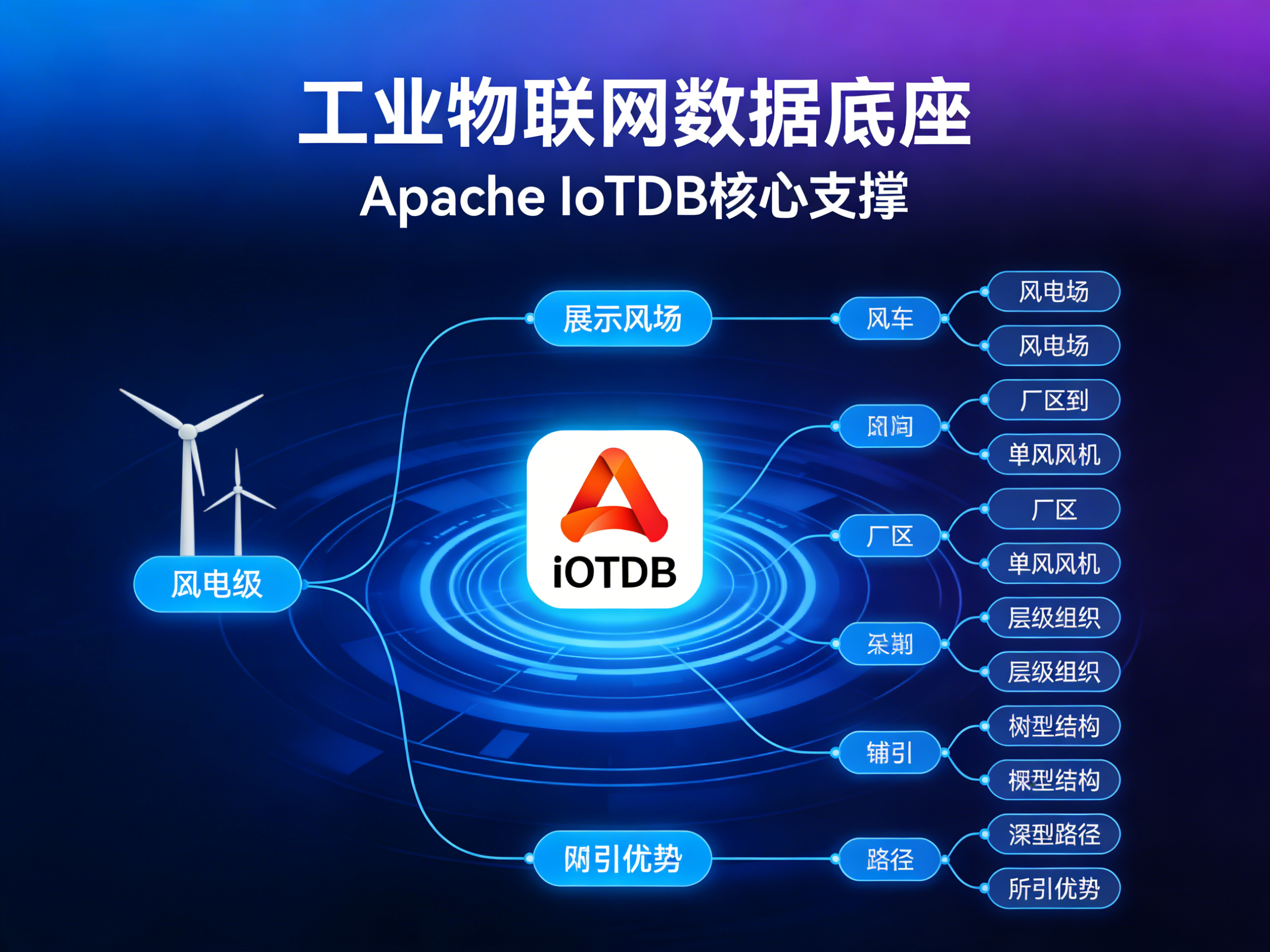 AI Visual Insight: This image illustrates the core IoTDB architecture, typically including the data ingestion path, MemTable, TsFile flushing, the query engine, and cluster scaling units. It highlights IoTDB’s purpose-built design for sequential time series writes and high-compression storage.
IoTDB delivers three critical advantages
First, high-throughput ingestion. A single node can support millions of point writes, and clusters can scale horizontally, making IoTDB well suited for dense sensor networks and concurrent ingestion from multiple production lines.
Second, high-compression storage. TsFile combined with Delta, Gorilla, RLE, and similar encodings takes full advantage of continuity and repetition in time series data. In many workloads, this produces significantly better results than general-purpose compression formats.
Third, edge-cloud collaboration. Through a unified file format and layered node capabilities, IoTDB connects endpoint collection, edge buffering, and cloud analytics into one pipeline. This model fits weak-network environments, low-bandwidth links, and distributed industrial sites.
# Download and start the standalone version of IoTDB
wget https://dlcdn.apache.org/iotdb/1.3.3/apache-iotdb-1.3.3-all-bin.zip
unzip apache-iotdb-1.3.3-all-bin.zip
cd apache-iotdb-1.3.3-all-bin

# Start the service
./sbin/start-standalone.sh

# Connect through the CLI
./sbin/start-cli.sh -h 127.0.0.1 -p 6667 -u root -pw root
These commands let you validate a local IoTDB environment in about 10 minutes.
IoTDB integrates tightly with the big data ecosystem
IoTDB is not an isolated database. It provides connectors for Flink, Spark, and other systems, so you can plug it directly into real-time processing, offline analytics, and machine learning pipelines. That means you do not need to repeatedly export and re-clean data, which reduces system-to-system replication cost.
-- Map an IoTDB table in Flink SQL
CREATE TABLE iotdb_sensor (
  device STRING,
  time TIMESTAMP(3),
  temperature FLOAT,
  pressure FLOAT,
  WATERMARK FOR time AS time - INTERVAL '5' SECOND
) WITH (
  'connector' = 'iotdb',
  'url' = 'jdbc:iotdb://127.0.0.1:6667/',
  'user' = 'root',
  'password' = 'root',
  'sql' = 'select device, time, temperature, pressure from root.factory.line1.device001'
);

-- Filter high-temperature anomalies
SELECT device, time, temperature
FROM iotdb_sensor
WHERE temperature > 28;
This configuration shows that IoTDB can feed directly into a real-time stream processing pipeline for alerting and rule evaluation.
The most common production issues usually come from usage patterns, not the database itself
First, row-by-row writes turn a high-performance database into a low-performance one. Prefer Tablet-based writes or batch APIs for a single device to reduce network round trips and connection setup overhead.
Second, timestamp units must stay consistent. Mixing seconds, milliseconds, and microseconds is a common reason for empty query results or data landing near the year 1970.
Third, out-of-order data cannot grow without limits. IoTDB supports out-of-order ingestion, but repeated large-scale time-slice overlaps increase query merge cost and create memory pressure.
from iotdb.Session import Session
import time
import random

# Create and reuse the connection
session = Session("127.0.0.1", 6667, "root", "root")
session.open()

device_id = "root.factory.line1.device001"
measurements = ["temperature", "pressure"]
data_types = [Session.TSDataType.FLOAT, Session.TSDataType.FLOAT]

timestamps = []
values_list = []
base_time = int(time.time() * 1000)  # Use millisecond timestamps to avoid unit confusion

for i in range(1000):
    timestamps.append(base_time + i * 1000)  # One data point per second
    values_list.append([
        25.0 + random.random(),
        101.3 + random.random()
    ])

# Batch write data for a single device to avoid row-by-row insertion overhead
session.insert_records_of_one_device(
    device_id,
    timestamps,
    measurements,
    data_types,
    values_list
)

session.close()
This Python example shows the correct IoTDB write pattern: connection reuse, millisecond timestamps, and batch submission.
Configuration tuning directly determines whether the write curve stays smooth
If the MemTable threshold is too small, the system flushes too often. If the WAL strategy is too heavy, it can create I/O jitter. High-throughput workloads usually require larger memory thresholds based on machine capacity and a reasonable allocation of write threads.
# Increase the MemTable threshold to reduce frequent flushes
memtable_size_threshold=314572800

# Enable asynchronous WAL to balance reliability and throughput
enable_async_wal=true

# Scale the write thread pool based on CPU cores
write_thread_pool_size=16
This configuration set helps reduce write jitter and works well as a baseline tuning profile for high-frequency industrial data collection.
Scenario-based decisions matter more than generic rankings
For small and mid-sized monitoring workloads, Prometheus or InfluxDB OSS may still offer advantages in cost and ease of adoption. But when data volume grows into Industrial IoT, energy, power systems, or connected vehicle scenarios, IoTDB’s hierarchical model, high compression, and batch ingestion capabilities become more predictable and reliable.
If your business also requires long-term retention, complex analytics, edge-cloud collaboration, and a domestic technology stack, IoTDB offers a more complete solution than databases optimized for a single niche. Database selection is not about finding the strongest database. It is about finding the one that best matches your data path for the next five years.
FAQ
1. Which workloads is Apache IoTDB best suited for?
It is best suited for Industrial IoT, energy monitoring, device telemetry, connected vehicles, and smart manufacturing workloads that require high write throughput, high compression, and long retention periods. It is especially strong when the system has a clear hierarchical device model.
2. Why does IoTDB benchmark well, but production write throughput stays low?
The most likely causes are row-by-row writes, lack of connection reuse, inconsistent timestamp units, or untuned MemTable and WAL parameters. IoTDB performance depends on batch ingestion and correct configuration.
3. How should I choose between IoTDB, Prometheus, and TimescaleDB?
Prometheus is best for cloud-native monitoring. TimescaleDB is a better fit when SQL compatibility is the highest priority for analytical workloads. IoTDB is a stronger choice for massive device connectivity, long-term storage, and industrial-grade time series analytics.
[AI Readability Summary]
This article reframes time series database selection around Apache IoTDB for industrial big data. It covers write stability, compression efficiency, query capability, edge-cloud collaboration, and ecosystem integration, then summarizes the most common production pitfalls involving batch ingestion, timestamps, out-of-order data, WAL tuning, and storage group design.