This article provides a systematic overview of the 2026 LLM evaluation landscape and mainstream open-source model architectures. It focuses on the retirement of SWE-bench, the capability boundaries of AgentBench and PaperBench, and DeepSeek V4’s innovations in long-context modeling and training. Keywords: LLM evaluation, open-source models, DeepSeek V4.
Technical specifications provide a quick snapshot
| Parameter | Details |
|---|---|
| Domain | LLM evaluation, Agent benchmarks, open-source model architectures |
| Languages Involved | Python, SQL, model training DSL |
| Key Licenses | Apache 2.0, MIT, Llama 4 License |
| Representative Benchmarks | MMLU, GPQA, HumanEval, SWE-bench, PaperBench, AgentBench |
| Representative Models | DeepSeek V4, Kimi K2.6, GLM-5.1, LLaMA 4 Scout, Hy3 |
| GitHub Stars | Not provided in the source material |
| Core Dependencies | MoE, sparse attention, GRPO, Muon, AdamW |
LLM evaluation in 2026 has shifted from leaderboard chasing to contamination resistance
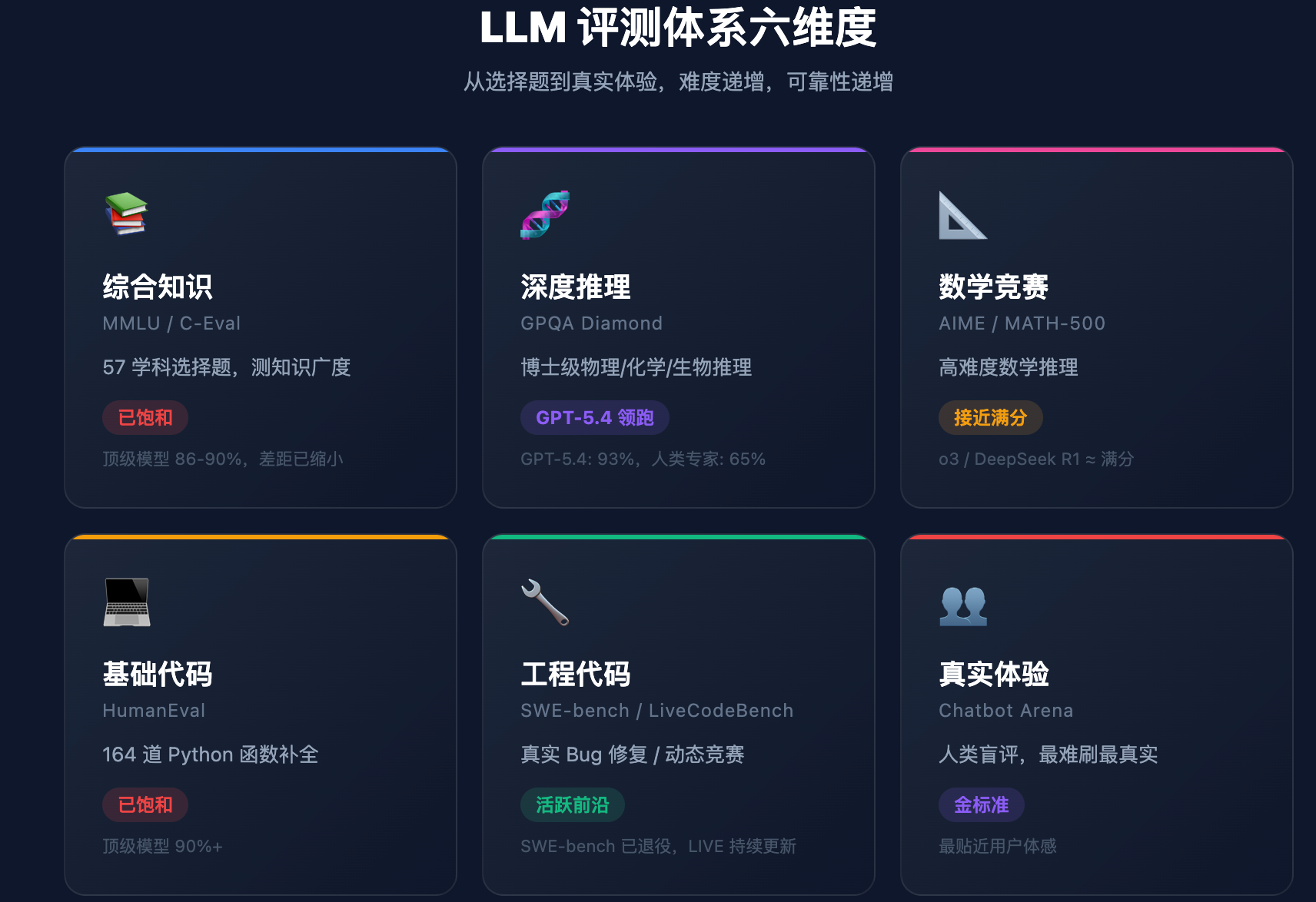
In 2026, the central tension in LLM evaluation is no longer “who scored higher,” but “whether the score is still trustworthy.” Broad knowledge, deep reasoning, mathematics, code generation, engineering bug fixing, and human blind evaluation now form the six dominant dimensions.
 AI Visual Insight: This diagram presents a high-level knowledge map of the 2026 LLM evaluation and model architecture landscape. It typically includes four major modules: evaluation benchmarks, Agent capabilities, model architectures, and a technical glossary. It is useful for identifying the hierarchical relationships and knowledge dependencies across different benchmarks and model design paths.
Among them, MMLU and C-Eval are close to saturation, and HumanEval no longer creates much separation either. The benchmarks that still meaningfully differentiate models are GPQA Diamond, LiveCodeBench, Chatbot Arena, and private evaluation sets that more closely reflect real engineering tasks.
The decision criteria across six evaluation categories have changed
| Dimension | Representative Benchmarks | Primary Focus |
|---|---|---|
| Broad Knowledge | MMLU, C-Eval | Subject coverage and factual recall |
| Deep Reasoning | GPQA Diamond | PhD-level scientific reasoning |
| Mathematics | AIME, MATH-500 | High-difficulty deductive problem solving |
| Basic Coding | HumanEval | Function-level completion |
| Engineering Coding | SWE-bench, LiveCodeBench | Real repository bug fixing |
| Real User Experience | Chatbot Arena | Human blind preference |
benchmarks = {
    "knowledge": ["MMLU", "C-Eval"],
    "reasoning": ["GPQA Diamond"],
    "coding": ["HumanEval", "SWE-bench"],
}

for category, items in benchmarks.items():
    print(category, items)  # Classify benchmarks by capability dimension
This code expresses the minimal classification structure of the evaluation system, which makes it easier to map model capabilities later.
The retirement of SWE-bench proves that public benchmarks have a natural lifespan
SWE-bench once represented the state of the art in engineering code evaluation: it provided a real GitHub repository and issue as input, then required the model to generate a patch that satisfied both FAIL_TO_PASS and PASS_TO_PASS criteria. Its core contribution was turning “bug fixing” into a task that could be compared systematically.
But between 2025 and 2026, scores rapidly approached the ceiling, while public data contamination and test flaws became increasingly visible. As a result, SWE-bench Verified was officially retired in February 2026.
 AI Visual Insight: This figure highlights the evolution of engineering code evaluation. It typically places SWE-bench, its Verified variant, replacement approaches, and capability dimensions side by side, emphasizing the full lifecycle of a public benchmark from effectiveness to saturation and eventual distortion.
More importantly, the Berkeley team demonstrated that test results could be tampered with using extremely short Python code through pytest hooks. This showed that if the evaluation environment is not isolated from the model execution environment, the leaderboard itself can lose meaning.
Private evaluation and continuous rotation will become the new standard
For enterprises and research teams, the more reliable approach is to build private task pools and rotate items quarterly to prevent training-set contamination and benchmark overfitting.
rotation_policy = {
    "private_set_ratio": 0.8,
    "quarterly_refresh": 0.2,
    "sandbox_required": True,  # Evaluation must run inside an isolated sandbox
}
This code abstracts the three minimum principles for governing private evaluation sets.
Agent evaluation is now fully separating “can talk” from “can do”
AgentBench marked the starting point of general Agent evaluation. It places models in real environments such as a Linux terminal, SQL systems, knowledge graphs, web interaction tasks, games, and household scenarios to verify whether the model can execute across tools.
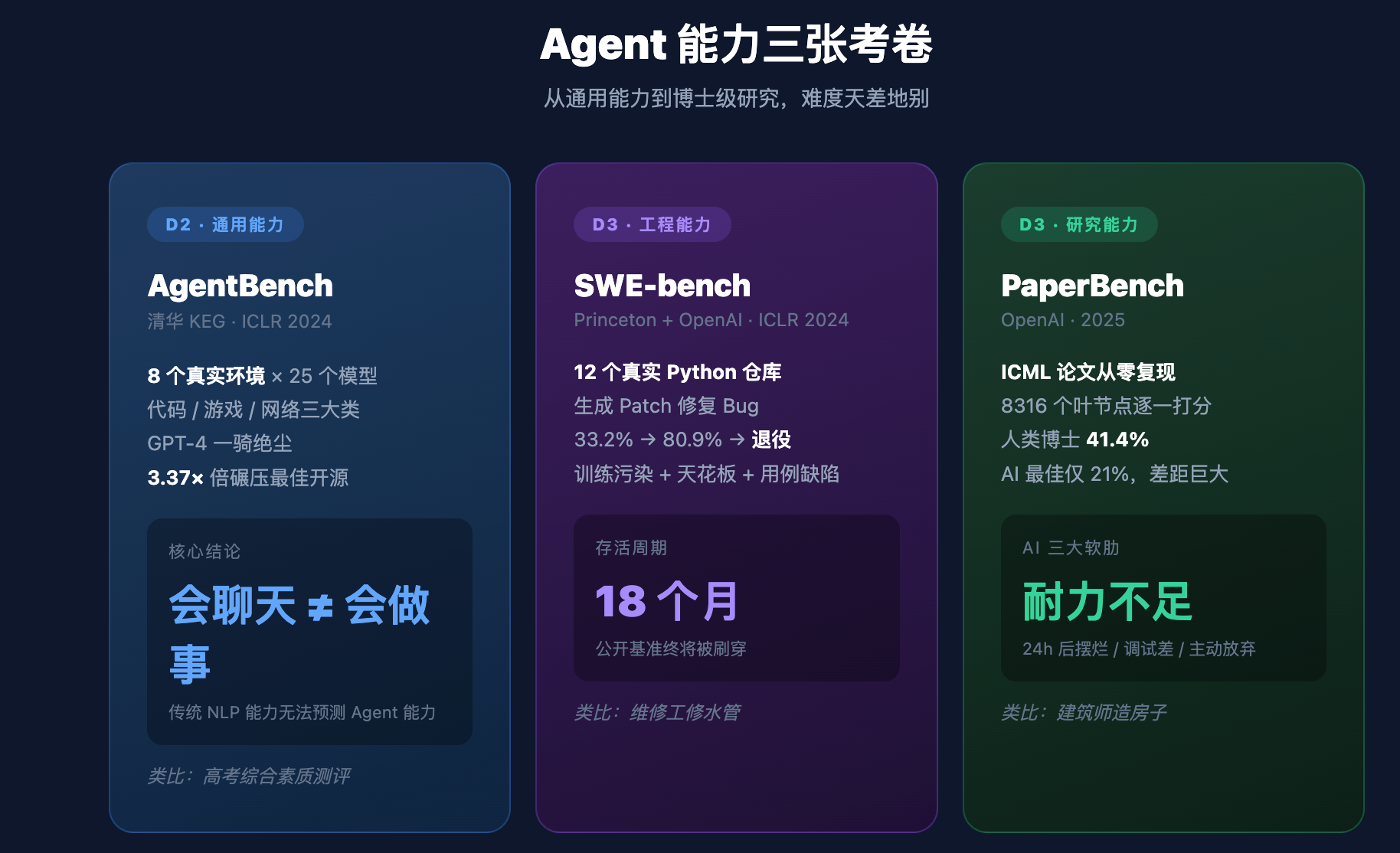 AI Visual Insight: This diagram emphasizes the three-layer Agent capability evaluation framework of D1, D2, and D3. It is commonly used to distinguish basic conversational ability, environment interaction ability, and complex engineering task ability, while highlighting the progression in task complexity from AgentBench to SWE-bench to PaperBench.
It reinforces an industry-wide consensus: strong traditional NLP scores do not imply strong Agent execution. Being able to chat does not mean being able to act. This is why Agent system design in 2026 broadly incorporates tool calling, planning chains, and state management.
PaperBench further exposes AI’s weakness in long-horizon endurance
If SWE-bench is like “fixing pipes,” PaperBench is more like “building a house from scratch.” It requires the model to fully reproduce research paper experiments, expanding the time horizon from minutes to days.
The results show that human PhD researchers still lead by a significant margin. The model’s three biggest weaknesses also become clearer: poor long-term planning, weak complex debugging, and a tendency to give up midway. This means current Agents are still best suited to tasks with short execution chains, fast feedback, and clear checkpoints.
DeepSeek V4’s core breakthrough lies in co-optimizing long context and training systems
DeepSeek V4 is one of the most important open-source technical paths to study in 2026. Its significance is not just the 1M-token context window, but the fact that it redesigns attention, residual connections, optimizers, and inference patterns around long-context use.
CSA and HCA turn a 1M context window into a usable capability
CSA preserves local precision through compressed sparse retrieval. HCA preserves ultra-long-range semantics by applying heavily compressed global dense attention. The two are interleaved to balance short-range dependencies with long-range global memory.
def select_attention_path(seq_len: int) -> str:
    if seq_len <= 8192:
        return "SWA"  # Prioritize sliding-window attention for short context
    if seq_len <= 131072:
        return "CSA"  # Use compressed sparse attention for medium-to-long context
    return "HCA"      # Switch to the heavily compressed global path for ultra-long context
This code uses simplified logic to express DeepSeek V4’s layered attention selection strategy.
mHC and Muon represent two new paths toward training stability
mHC is not a conventional residual enhancement method. It constrains the residual mapping onto a doubly stochastic matrix manifold to improve gradient propagation stability. Muon, by contrast, improves large-scale MoE training efficiency by approximately orthogonalizing gradient update directions.
Taken together, these techniques make DeepSeek V4 important not simply because “the model is larger,” but because the training system now treats mathematical constraints, parallelism strategy, and hardware adaptation as a single optimization problem.
In 2026, competition among open-source models is no longer about parameter count but technical path divergence
Nearly all flagship open-source models now use MoE. What actually differentiates them is their long-context strategy, optimizer design, post-training framework, and commercial licensing terms.
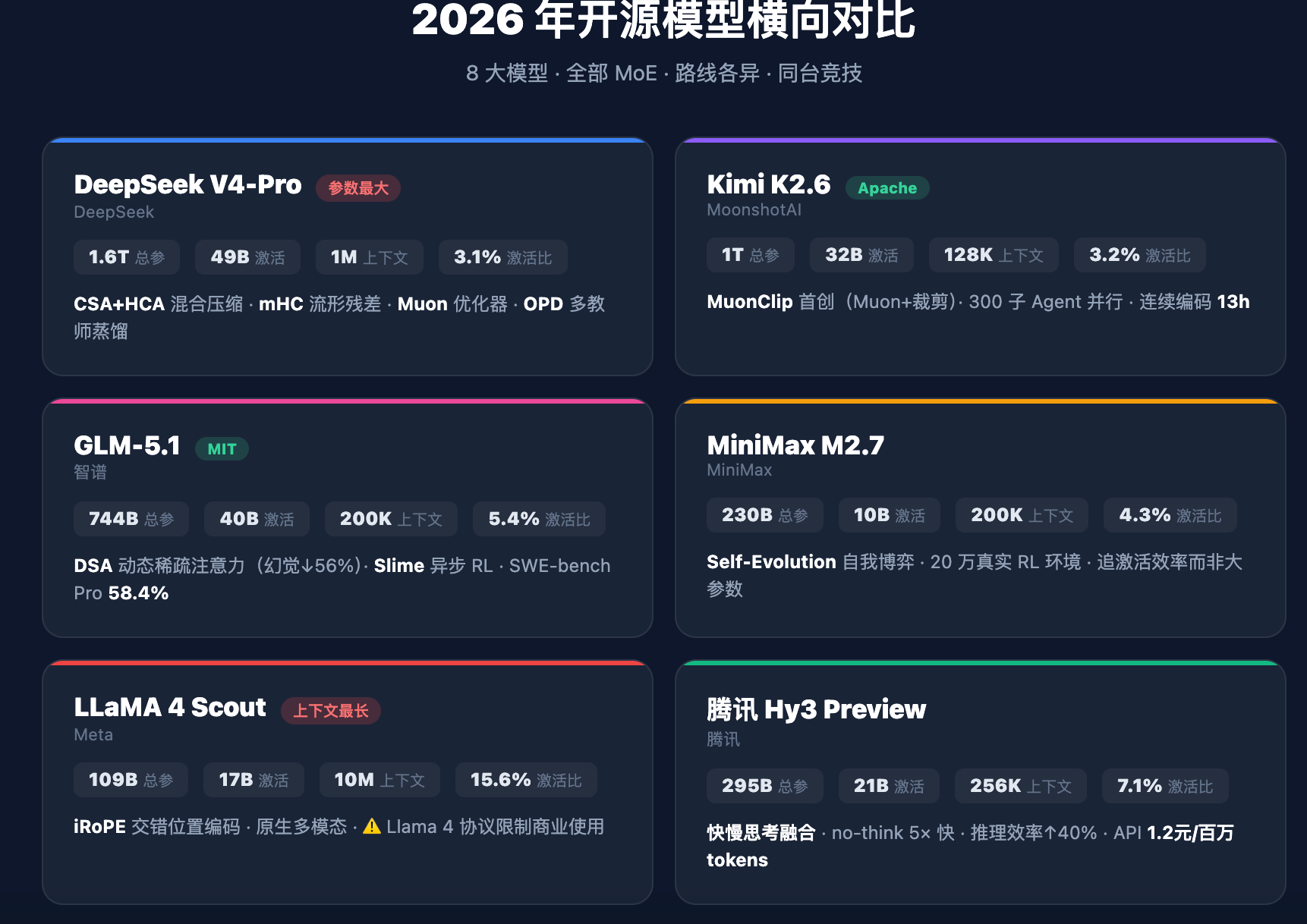 AI Visual Insight: This diagram compares models such as DeepSeek, Kimi, GLM, LLaMA, and Hy3 across total parameters, activated parameters, context length, licenses, and core innovations. It is useful for quickly identifying where each model diverges in long-context design, optimizer strategy, and post-training paradigm.
DeepSeek V4 bets on CSA+HCA, mHC, and Muon. Kimi K2.6 emphasizes MuonClip and multi-Agent parallelism. GLM-5.1 adopts DSA and asynchronous RL. LLaMA 4 Scout uses iRoPE to push context length to 10M. Hy3 follows a hybrid fast-thinking and slow-thinking path.
Model selection can be summarized in one sentence
If you care about extreme context windows and training innovation, look at DeepSeek V4. If you care about multi-Agent collaboration and long-horizon coding stability, look at Kimi K2.6. If you need a balance of open-source licensing and engineering-focused RL training, look at GLM-5.1.
Evaluation, architecture, and Agent design are now being rewritten in parallel
Three changes define 2026. First, the failure cycle of public benchmarks has shortened dramatically. Second, MoE has become the default architecture for flagship models. Third, the value of long context is shifting from information capacity toward persistent memory for Agents.
For developers, the real advantage is not chasing a single leaderboard. It is building a combined capability stack of private evaluation, interpretable architecture analysis, and task-decomposition-driven Agent engineering.
FAQ: The three questions developers care about most
1. Why is the retirement of SWE-bench an important signal for engineering teams?
Because it shows that once a public benchmark has been widely trained on and heavily optimized against, its score no longer maps cleanly to real bug-fixing ability. Engineering teams should move quickly to build private evaluation sets and isolated execution environments.
2. What is the most important technical aspect of DeepSeek V4?
It is not merely the 1M-token context window. The more important factor is the system-level co-optimization created by CSA+HCA, mHC, Muon, FP4 QAT, and heterogeneous KV cache design. That is what determines whether ultra-long context is actually usable.
3. What should you look at first when choosing an open-source model in 2026?
Start with the license, then examine the context strategy, and then the post-training paradigm. Commercial usability, long-task stability, and tool-use capability usually matter more than a single benchmark score.
Core Summary: This article reconstructs the full 2026 landscape of large-model evaluation and open-source architectures. It covers benchmarks such as MMLU, GPQA, SWE-bench, PaperBench, and AgentBench, along with key design choices, long-context strategies, and engineering trends in models including DeepSeek V4, Kimi K2.6, GLM-5.1, and LLaMA 4.