FinceptTerminal is an open-source terminal designed for financial research and trading workflows. Its core capabilities span a native desktop UI, embedded Python analytics, AI agents, and multi-source market data integration, addressing the high cost and closed extension model of Bloomberg-like tools. Keywords: C++20, Qt6, financial analytics.
The technical specification snapshot defines the project at a glance
| Parameter | Details |
|---|---|
| Project Name | FinceptTerminal |
| Positioning | Open-source financial intelligence and analytics terminal |
| Core Languages | C++20, Python 3.11 |
| UI Framework | Qt 6.8.3 |
| Build System | CMake 3.27.7, Ninja 1.11.1 |
| Protocols / Connectivity | REST, WebSocket, MCP |
| Stars | Approx. 15.4k+ |
| Forks | Approx. 2.1k+ |
| Core Dependencies | Qt6, QuantLib, pandas, numpy, scipy |
| Open-Source License | AGPL-3.0 + commercial licensing |
The project rebuilds the financial terminal with a native architecture
FinceptTerminal v4 does not aim to simply replicate Bloomberg Terminal. Instead, it delivers an extensible financial workstation through an open-source architecture. It brings desktop interaction, financial modeling, AI analysis, and multi-source data access into a single application.
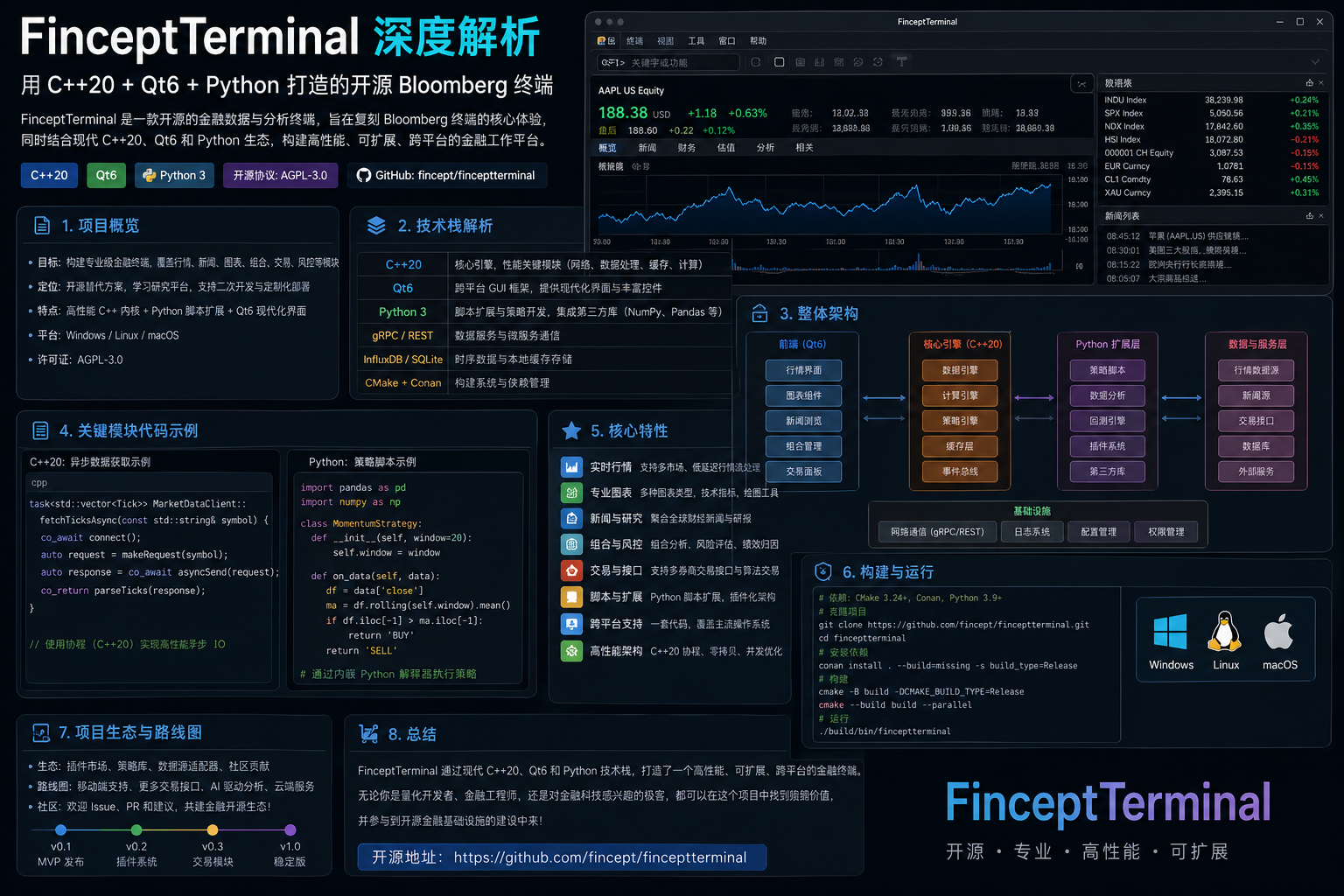 AI Visual Insight: This screenshot shows a multi-panel workspace that typically includes market data, charts, analytics, and navigation areas. It indicates that the product is not a single-page utility, but a professional desktop layout built for high-frequency information consumption.
Its product value centers on three areas: professional financial analytics, AI agent collaboration, and cross-market data aggregation. For developers, the real point of interest is its engineering trade-offs rather than the marketing label of an “open-source Bloomberg.”
The three-layer capability model defines the project boundary
The first layer is the native terminal shell, which handles the interface, charting, networking, and state management. The second layer is the Python analytics engine, which powers valuation, optimization, pricing, and machine learning. The third layer is the connector and agent orchestration layer, which integrates external APIs, model providers, and workflow nodes.
FinceptTerminal/
├── fincept-qt/      # C++/Qt main application
├── docs/            # Documentation and licensing notes
├── images/          # Screenshots and assets
├── Dockerfile       # Linux container environment
├── setup.sh         # One-click installation script
└── CMakeLists.txt   # Build entry point
This directory structure reflects a clear separation of responsibilities: the Qt project focuses on interaction and distribution, while the Python ecosystem handles models and data processing.
The C++20 and Qt6 combination prioritizes performance and desktop experience
Although Python accounts for a larger share of the codebase, the main process still centers on C++20. The reason is straightforward: a financial terminal must reliably handle chart rendering, WebSocket market feeds, and complex interactions, and Electron does not offer a clear advantage in resource overhead or startup cost.
 AI Visual Insight: This banner emphasizes the product brand and its positioning as a “financial intelligence platform.” It is typically used to communicate a platform-level capability set rather than a single feature, suggesting that the project aims to cover the full chain of research, trading, and AI-assisted analysis.
Qt 6.8.3 is strictly pinned, and the project uses CMake Presets to manage builds across all three major platforms. This choice shows that the team values binary consistency more than superficial flexibility in environment compatibility.
# Configure the build environment
cmake --preset win-release      # Windows release configuration
cmake --preset linux-release    # Linux release configuration
cmake --preset macos-release    # macOS release configuration

# Build the project
cmake --build --preset win-release
The core value of these commands is build standardization across platforms, reducing the usual “it works on my machine” environment drift.
Embedded Python allows direct reuse of the mature financial analytics ecosystem
The key architectural move in FinceptTerminal is not merely that “C++ calls Python scripts,” but that the Python interpreter is embedded inside the C++ process. This keeps the UI, networking, and application state under the control of the native main program, while analytics tasks can directly use established financial and machine learning libraries.
This matters especially in finance. Toolchains such as QuantLib, pandas, numpy, scipy, and statsmodels have already become de facto standards on the Python side. Rewriting them in C++ would be expensive and would slow iteration.
Typical analytics tasks fit better in the Python layer
import pandas as pd
import numpy as np

# Load a price series to simulate asset return inputs
prices = pd.Series([100, 102, 101, 105, 107])
returns = prices.pct_change().dropna()  # Calculate daily returns
sharpe = returns.mean() / returns.std() # Simplified Sharpe ratio

print(f"Sharpe Ratio: {sharpe:.4f}")
This kind of code shows why the Python layer is well suited for financial indicators, strategy prototyping, and research logic.
The real moat of a multi-module platform lies in a unified data model and replaceable agents
The project lists 100+ data connectors, 37 AI agents, 16 broker integrations, and 18 QuantLib modules. On the surface, this looks like feature accumulation. Underneath, the hard problems are really just two: a unified data model and a unified invocation interface.
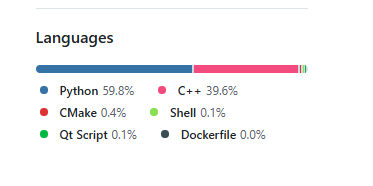 AI Visual Insight: This chart shows the repository language distribution, with Python exceeding C++. It visually confirms the dual-stack pattern of a “native shell + scripting analytics layer” and suggests that data processing and analytics logic make up the larger share of the engineering effort.
Different data sources do not share the same fields, frequencies, units, or timestamps. Without a standard intermediate layer, Yahoo Finance, FRED, AkShare, and Kraken cannot form composable capabilities inside a single workstation. The large Python footprint likely supports this normalization work.
The same applies to the AI agent layer. The project supports OpenAI, Anthropic, Gemini, Groq, DeepSeek, MiniMax, OpenRouter, and Ollama. In essence, it is decoupling the application from model vendors. In professional workflows, replaceability often matters more than the accuracy edge of any single model.
The node workflow connects data and agents into an automated pipeline
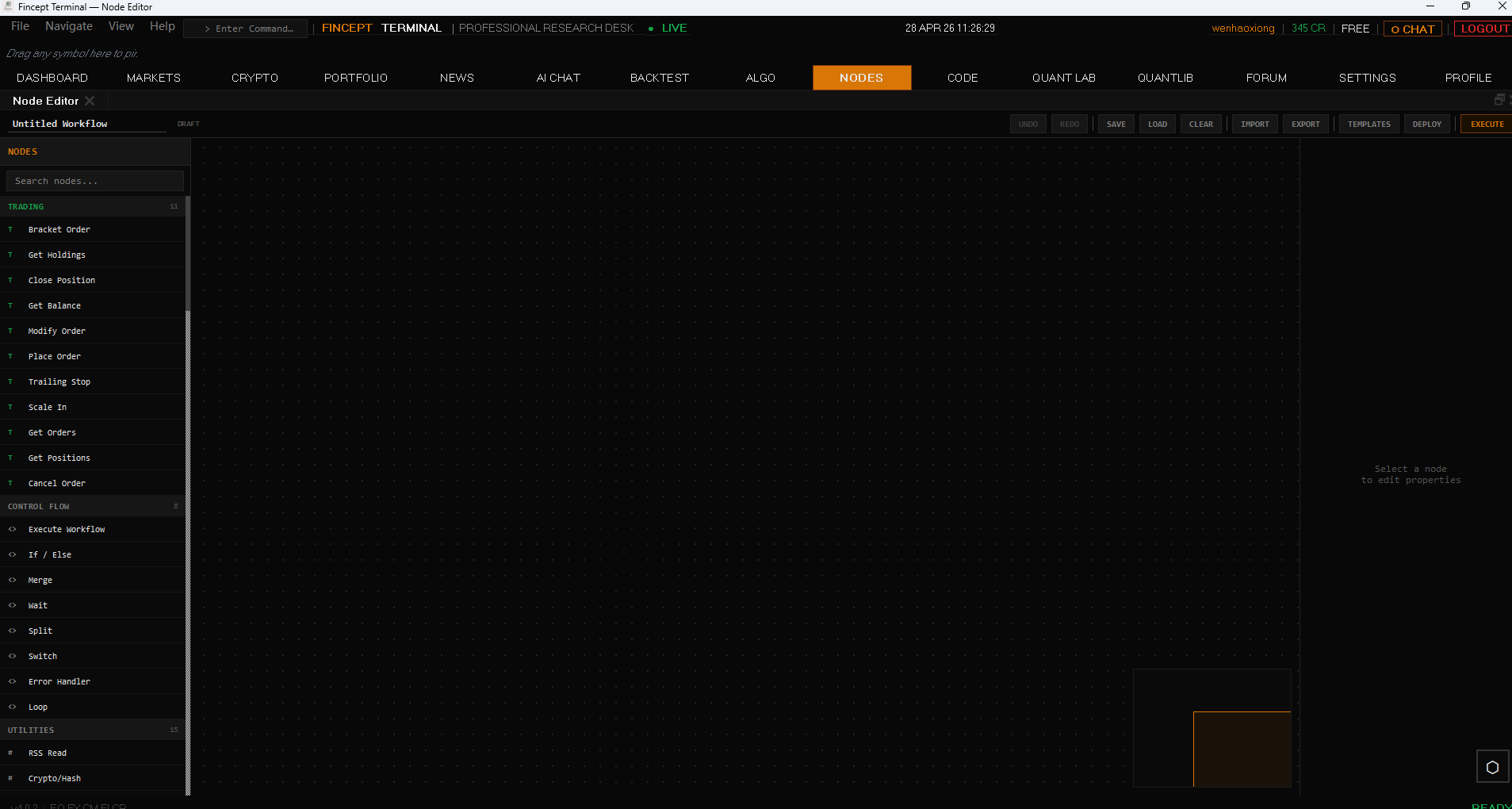 AI Visual Insight: This interface presents a node-based orchestration workflow that typically includes input, processing, model invocation, and output nodes. It suggests that the system supports visual construction of financial analytics pipelines rather than isolated features triggered only through menus.
The Node Editor and MCP integration deserve special attention. They imply that users can organize “fetch data,” “invoke model,” and “generate analysis results” into graphical flows, giving the terminal the characteristics of a low-code automation platform.
agents = ["Buffett", "Macro", "Geopolitics"]
data_sources = ["YahooFinance", "FRED", "Kraken"]

# Combine data sources and agents into analysis tasks
pipeline = [(a, d) for a in agents for d in data_sources]
print(pipeline)
This example abstracts the combinatorial relationship between agents and data connectors, which is the foundational unit of platform capability.
Strict version pinning is the core maintainability strategy
The project requires exact versions of Qt 6.8.3, Python 3.11.9, CMake 3.27.7, and specific compiler versions. This is not conservatism. It is a deliberate way to control ABI behavior, compiler behavior, and dependency drift in a cross-platform native desktop application.
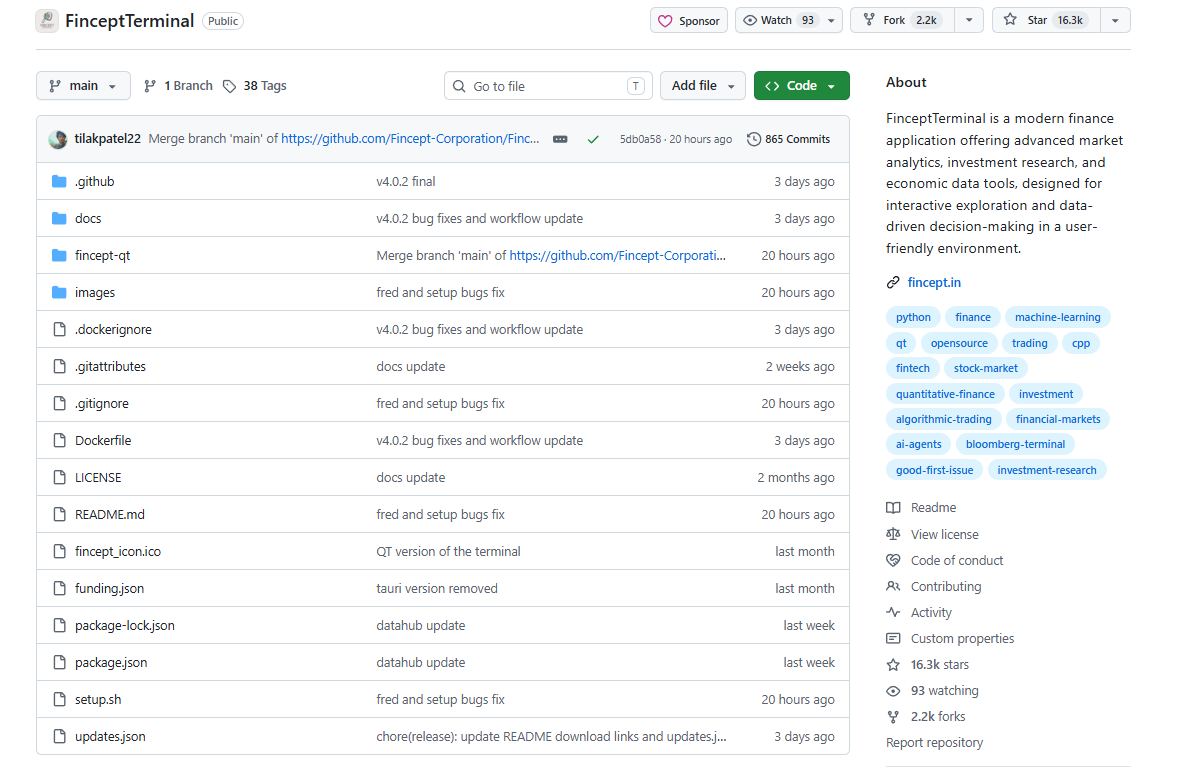 AI Visual Insight: This screenshot likely shows the repository layout or build-related structure. The key point is that the project organizes the main application, documentation, images, and automation scripts in layers, which supports multi-platform builds and collaborative development.
For local experimentation, the project allows a relaxed Qt constraint through -DFINCEPT_ALLOW_QT_DRIFT=ON, but it explicitly discourages using this option for releases or CI. That boundary definition reflects a relatively mature release discipline.
The licensing and installation paths show a project designed for both community adoption and commercial deployment
FinceptTerminal provides four entry paths: installable packages, a one-click setup script, Docker, and source builds. This covers general users, Linux developers, and secondary development scenarios. The current macOS path leans toward Apple Silicon, which also suggests that the team prioritizes mainstream modern desktop environments.
The AGPL-3.0 plus commercial licensing model is equally clear: the community can freely study and use the project for non-commercial purposes, while enterprises that need closed-source integration, network service deployment, or access to commercial data must purchase a commercial license. This allows the project to grow while sustaining long-term development.
FAQ
1. Why does FinceptTerminal not use Electron?
Because a financial terminal places higher value on low-latency rendering, lower memory usage, and a stable native networking stack. Qt6 is a better fit for this class of highly interactive desktop application in both performance and system integration.
2. If Python has a larger share of the codebase, why is C++20 still emphasized?
Because C++20 forms the foundation of the main process and desktop framework, determining the quality of the UI, event loop, and application distribution. Python primarily handles analytics, connectors, and AI ecosystem reuse. The two layers serve different responsibilities.
3. Can this project fully replace Bloomberg Terminal?
Not in the short term. It is better understood as an open alternative whose strengths are extensibility, lower cost, and AI integration. Bloomberg still retains strong moats in proprietary institutional-grade data, compliance services, and commercial support.
Core summary
FinceptTerminal is an open-source financial terminal that uses C++20 and Qt6 for the native desktop layer, while embedded Python handles financial analytics and AI orchestration. This article focuses on its hybrid architecture, 100+ data connectors, 37 agents, strict version pinning, and AGPL-based commercialization path.