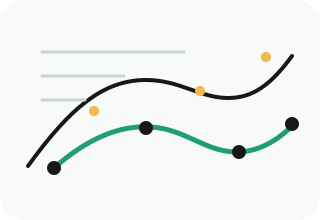
Rate limiting is a critical component for maintaining system stability under variable load. This article explores an adaptive token bucket algorithm implemented in Go that replaces fixed-rate limits with a sliding window estimation mechanism. The key innovation is a compensation strategy that adjusts token refill rates based on recent traffic patterns, reducing the risk of sudden spikes overwhelming the system. Unlike traditional token buckets, this approach dynamically adapts to bursty workloads, making it suitable for microservices and API gateways. The author provides a clear explanation of the algorithm's design, including how the sliding window tracks request history and how compensation smooths out rate adjustments. For Go developers and system architects, this pattern offers a robust foundation for building rate limiters that balance throughput and fairness. The article avoids over-engineering, focusing on practical implementation details that can be integrated into production systems. While the code is not reproduced here, the conceptual framework is valuable for anyone designing adaptive rate limiting solutions.
A deep dive into an adaptive token bucket algorithm using sliding window estimation and compensation for smoother traffic management in Go.