This article focuses on enterprise remote IT operations platform selection in 2026. It systematically compares Sunlogin Enterprise, TeamViewer ONE, AnyDesk, Splashtop, and RustDesk across connectivity, bulk administration, audit compliance, and automation capabilities. It addresses the core challenges of hybrid work: distributed devices, uncontrolled permissions, and incomplete log traceability. Keywords: remote IT operations, compliance auditing, bulk management.
Technical specification snapshot
| Dimension | Information |
|---|---|
| Article topic | Side-by-side comparison of enterprise remote IT operations solutions |
| Applicable environments | Hybrid work, geographically distributed branches, unattended devices |
| Key protocols/capabilities | Remote control, TLS 1.3, AES, Zero Trust access, self-hosting |
| Products covered | Sunlogin Enterprise, TeamViewer ONE, AnyDesk, Splashtop, RustDesk |
| Open-source status | RustDesk is open-source and self-hosted; the others are primarily commercial solutions |
| Core dependencies | Directory services, ITSM, SSO, bulk deployment tools, audit logging systems |
| Data sources | Reconstructed from the original hands-on observations and public vendor materials |
| GitHub stars | Not provided in the original source; RustDesk is a high-profile open-source project |
Enterprise remote IT operations have evolved from support tools into infrastructure
In 2026, enterprise remote IT operations are no longer just about connecting to a device and fixing an issue. Real enterprise requirements now center on bulk onboarding and administration, permission isolation, full-process auditing, and integration with existing ITSM systems, directory services, and asset platforms.
As hybrid work becomes standard, endpoints are more distributed, networks are more complex, and personnel turnover is faster. If a remote access tool solves only connectivity but not authorization, traceability, and automation, it effectively shifts operational risk from offline environments to online ones.
An actionable evaluation model for platform selection
# Tag remote IT operations solutions based on enterprise scenarios
requirements = {
    "compliance": True,      # Whether compliance and auditing are a priority
    "cross_border": False,   # Whether international remote connectivity is required
    "self_hosted": False,    # Whether private self-hosting is required
    "low_latency": True      # Whether low-latency experience is a priority
}

# Core logic: prioritize solutions based on the primary requirement
if requirements["compliance"]:
    choice = "向日葵企业版"
elif requirements["cross_border"]:
    choice = "TeamViewer ONE"
elif requirements["self_hosted"]:
    choice = "RustDesk"
elif requirements["low_latency"]:
    choice = "AnyDesk"
else:
    choice = "Splashtop"

print(choice)  # Output the recommended solution
This code shows that enterprises can use primary constraints as the first-pass filter instead of starting with brand popularity.
The five mainstream solutions show clear segmentation
Sunlogin Enterprise is better suited to control-heavy and compliance-heavy scenarios
The source material suggests that Sunlogin Enterprise does not stand out primarily because of single-session remote control, but because of its closed-loop model of visibility, management, and control. It covers bulk deployment, device grouping, multi-concurrent sessions, script distribution, alert monitoring, and audit traceability, making it well suited to large-scale operations teams.
Its key strength lies in treating permissions and logs as first-class capabilities. By using seat members as the smallest authorization unit, combined with employee offboarding recovery, log retention, and AI-driven auditing, it transforms remote operations from a black-box activity into a traceable process.
TeamViewer ONE is better suited to global enterprises
The core value of TeamViewer ONE lies in its global node network, proactive IT management, and agentless access. For multinational branches, cross-border network environments, and OT device access, its stability and international ecosystem offer clear advantages.
However, it depends more heavily on an existing ITSM ecosystem to unlock full value. In domestic government and enterprise environments with more complex approval chains, organizations often need further API-based integration to build a localized closed-loop process, which increases implementation cost.
# Example: pseudo-workflow for integrating a remote IT operations platform with an internal ITSM system
curl -X POST https://itsm.example.com/api/ticket \
  -H "Authorization: Bearer TOKEN" \
  -d '{
    "title": "Remote IT operations session request",
    "device_group": "branch-office",
    "operator": "ops-admin"
  }'
This command illustrates a common reality: international platforms often need API-level integration to fit into an enterprise’s own ticketing and approval workflows.
AnyDesk and Splashtop target performance-first and cost-first use cases respectively
AnyDesk’s core selling point is the low-latency experience enabled by DeskRT, which makes it a strong fit for scenarios that require fast screen feedback and responsive input. It also supports MSI silent deployment, Group Policy, and command-line interfaces, making it friendly to script-driven operations.
Splashtop, by contrast, is a classic cost-effective option for small and mid-sized teams. Its concurrent-session pricing model is easier to control from a budget perspective, and it has gradually expanded into AI-driven ITSM workflows through partnerships. That said, it is less competitive in scenarios that require strong auditing, strict compliance, and fully closed approval chains.
The open-source self-hosted path is more attractive in data sovereignty scenarios
RustDesk’s value is not just that it is free. Its real appeal is that enterprises can keep relays, connections, and logs entirely within their own network boundary. For organizations in manufacturing, R&D, laboratories, and other environments sensitive to data sovereignty, this is highly compelling.
The tradeoff is equally clear: native enterprise capabilities are still maturing. If an organization needs professional ticketing, mature approval workflows, official compliance assurances, and a complete automation suite, the technical team usually must fill those gaps through custom development and long-term maintenance.
A self-hosted deployment approach looks more like platform engineering
remote_ops_stack:
  relay_server:
    mode: self-hosted  # Deploy a self-managed relay service
  auth:
    type: sso          # Integrate with the enterprise identity provider
  logging:
    target: internal_siemandarchive  # Send logs to the internal audit platform
  policy:
    approval_required: true  # Require approval for privileged operations
This configuration shows that self-hosted remote access is not a single software installation. It is a platform engineering effort that coordinates identity, logging, and auditing.
The comparison chart reflects capability structure rather than an absolute winner
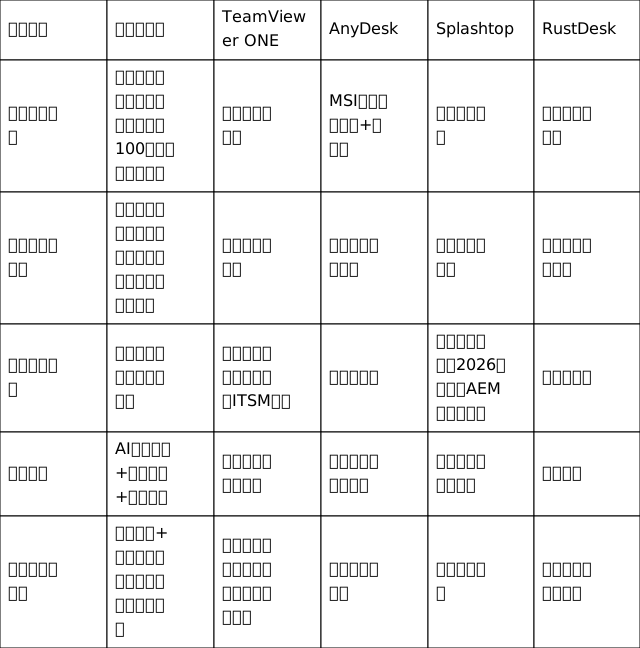 AI Visual Insight: This chart highlights the relative positioning of multiple remote IT operations solutions across dimensions such as connectivity, bulk management, audit compliance, automation, and private deployment. At its core, it reflects the distribution of product capability priorities rather than a single benchmark score. For enterprise selection, the key question is which capability most strongly constrains the business, and then how that requirement maps to the product matrix.
Based on the original information, these products are not competing on exactly the same axis. Sunlogin emphasizes closed-loop operations and local compliance, TeamViewer emphasizes cross-border connectivity and ecosystem reach, AnyDesk emphasizes low-latency experience, Splashtop emphasizes budget efficiency, and RustDesk emphasizes data control.
As a result, the right question is not “Which one is best?” but rather “Which one best matches the organization’s constraints?” When constraints change, the optimal choice changes as well.
Selection recommendations should focus on four decision variables
First, evaluate device scale and distribution. The more devices an organization manages, and the more geographically dispersed they are, the more important capabilities like grouping, bulk deployment, script distribution, and asset monitoring become.
Second, evaluate compliance pressure. If the environment includes regulatory compliance requirements, auditing, permission tiering, or domestic technology compatibility requirements, mature localized solutions are usually the safer choice.
Third, evaluate the geographic scope of connectivity. Cross-border access, multi-region node coverage, and overseas service support are critical evaluation criteria for global enterprises.
A simplified capability scoring template
vendors = {
    "向日葵企业版": {"合规": 5, "跨国": 3, "自动化": 5, "私有化": 4},
    "TeamViewer ONE": {"合规": 2, "跨国": 5, "自动化": 4, "私有化": 3},
    "AnyDesk": {"合规": 2, "跨国": 3, "自动化": 3, "私有化": 2},
    "Splashtop": {"合规": 2, "跨国": 3, "自动化": 3, "私有化": 2},
    "RustDesk": {"合规": 2, "跨国": 2, "自动化": 2, "私有化": 5}
}

# Core logic: calculate total scores based on the dimensions the enterprise cares about most
weights = {"合规": 0.4, "跨国": 0.2, "自动化": 0.2, "私有化": 0.2}
score = {k: sum(v[d] * weights[d] for d in weights) for k, v in vendors.items()}
print(sorted(score.items(), key=lambda x: x[1], reverse=True))
This code turns subjective product selection into a reusable weighted scoring process.
Fourth, evaluate team capability. If the organization does not have sufficient platform engineering, API development, and long-term maintenance capacity, it should avoid paths that require extensive self-build work.
FAQ
Q: What is the most commonly overlooked factor when choosing an enterprise remote IT operations platform?
A: The most commonly overlooked factor is the permission model and audit closed loop. Many teams first evaluate remote control smoothness and only later assess management capabilities, then discover after deployment that they cannot assign accountability, enforce approvals, or centrally revoke access.
Q: Is open-source self-hosted RustDesk always more secure than commercial products?
A: Not necessarily. Self-hosting improves data control, but security ultimately depends on the identity system, patch management, log retention, approval policies, and the capabilities of the operations team. It should not be equated with being inherently more secure.
Q: Why do multinational enterprises often prioritize TeamViewer ONE?
A: Because its global node network, cross-border connection stability, and mature international ecosystem make it a strong fit for large organizations with branches across multiple countries and an existing unified ITSM platform.
Core Summary: Based on public information and scenario characteristics of mainstream remote IT operations products in 2026, this article reconstructs a comparison of the core capabilities of Sunlogin Enterprise, TeamViewer ONE, AnyDesk, Splashtop, and RustDesk. It focuses on bulk management, permission auditing, automated operations, and compliance fit, helping enterprises choose according to scale, cross-border needs, and data sovereignty requirements.