AI-assisted software development reached a new inflection point in 2026: GPT-5.5 is reshaping prompting methods, Copilot is moving to token-based pricing, and quality fluctuations in Claude are magnifying the risk of single-model dependence. The developer’s core challenge has shifted from “Can I use a model?” to “How do I orchestrate models and govern cost?” Keywords: GPT-5.5, token pricing, AI coding.
Technical Specifications Snapshot
| Parameter | Details |
|---|---|
| Source Language | Chinese |
| Focus Areas | AI coding, model selection, cost governance |
| Referenced License | CC 4.0 BY-SA (as declared in the original source) |
| Article Type | Trend analysis + engineering decision guidance |
| Star Count | Not provided in the source material |
| Core Dependencies | GPT-5.5, GitHub Copilot, Claude Opus 4.7, Gemini, Grok |
This shift is fundamentally rewriting the collaboration boundary between developers and models
Three events in April 2026 can be understood as one continuous storyline: models became more capable, pricing became more granular, and risk became more concentrated and visible. These shifts affect three distinct layers: how you prompt, how you pay, and how you reduce risk.
First, GPT-5.5 moves prompt engineering from step-by-step orchestration to goal definition. Second, Copilot’s token-based pricing means AI coding costs now map more precisely to actual compute consumption. Third, Claude’s temporary quality fluctuations remind teams that they cannot place productivity on top of a single model.
GPT-5.5 is turning prompts from process scripts into task contracts
OpenAI’s new signal is clear: write fewer steps, and define more goals, acceptance criteria, and constraints. In the old paradigm, prompts resembled operating manuals that forced the model to execute in sequence. In the new paradigm, prompts look more like task contracts that define the boundaries of the expected outcome.
This directly changes engineering practice. Developers no longer need to scaffold every step in detail. Instead, they need to define more clearly what the output should be, what counts as success, and which behaviors are prohibited. At a fundamental level, the human role is shifting from instruction engineer to goal definer.
Goal: Generate a Node.js file upload module
Success Criteria: Support chunked upload, retry on failure, OSS merge, and observable logging
Constraints: Do not introduce heavyweight frameworks; must include unit tests; error handling must not swallow exceptions
The value of this style of prompting lies in constraining the model’s search space toward the right direction rather than locking down the implementation path.
The original case shows that for the same task, a concise goal-oriented prompt reduced token usage from roughly 2,800 to about 1,200 compared with a detailed step-based prompt, while also producing a higher first-pass success rate. This suggests that stronger models do not always need longer prompts. Instead, they depend more on high-quality constraints.
Token pricing will replace the illusion of “cheap enough” with computable cost
GitHub Copilot’s shift from fixed subscription pricing to token-based billing marks a structural adjustment in the AI coding business model. Previously, developers treated the product more like an all-you-can-eat buffet: after subscribing, they were inclined to maximize usage. Going forward, it will resemble usage-based ordering, where every invocation maps to a real cost.
The root cause behind this shift is not price increases alone, but the compute explosion created by agentic workflows. AI is no longer completing a single line of code. It now reads repositories, plans fixes, runs validation, and generates pull requests. Long-chain tasks naturally consume more context and reasoning budget.
# Simplified example of a model routing strategy
TASK_COST = {
    "autocomplete": "low",   # Route lightweight completion to a low-cost model
    "refactor": "medium",    # Use a mid-tier model for refactoring tasks
    "agent_fix": "high"      # Route end-to-end fixes to a high-capability model
}

def select_model(task_type):
    level = TASK_COST.get(task_type, "medium")
    if level == "low":
        return "cheap-fast-model"   # Control costs for high-frequency small requests
    if level == "high":
        return "gpt-5.5-or-opus"    # Send complex tasks to stronger models
    return "balanced-model"
This example illustrates the core idea of selecting models by task complexity to control token costs for high-frequency calls.
The Claude fluctuation incident proves that stability is now the top engineering metric
The source material notes that Claude Code experienced a period of reduced reasoning intensity, cache-clearing defects, and output-length limitations, leading to a significant drop in accuracy and ranking. Even though the issues were eventually fixed, the engineering lesson is already clear.
When a team depends deeply on one model, any form of capability degradation, context forgetting, or tokenizer change turns directly into schedule variance, higher bills, and erosion of trust. Once token cost becomes the primary billing unit, tokenizer changes are amplified immediately in the budget sheet.
As a result, model capability is only half of the selection decision. Stability, replaceability, and cost volatility matter just as much. Procurement logic must also evolve from “pick the strongest model first” to a portfolio strategy of “primary model + backup model + temporary model.”
Differences among mainstream models are shifting from leaderboard scores to task specialization
The comparison in the article suggests a clear division of labor: GPT-5.5 fits end-to-end task closure and tool use; Claude Opus 4.7 fits rigorous refactoring and deep review; Gemini fits large-context analysis; and Grok fits real-time web-connected information retrieval.
Developers should not build a single-model preference. They should build a task-to-model mapping table. For example, a high-frequency coding assistant can remain on a fixed subscription, while low-frequency but high-value tasks can activate premium models on demand, avoiding long-term payment for idle capability.
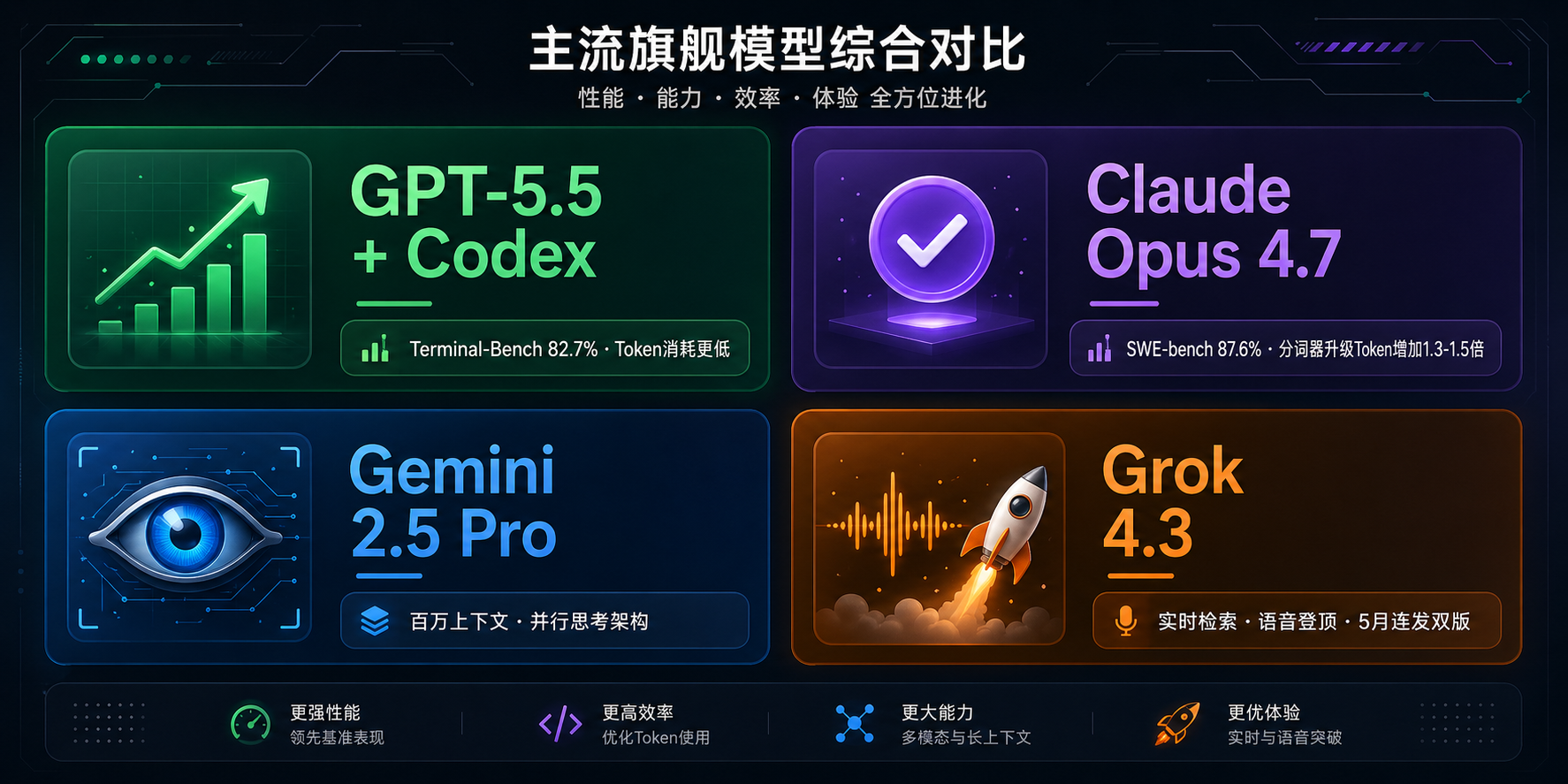
AI Visual Insight: This image appears after the trend analysis section in the original article and serves as an inflection-point cue. In context, it reinforces the idea that the AI coding ecosystem is entering a phase of structural revaluation. It most likely marks a thematic transition related to multi-model competition, cost shifts, or platform strategy changes, rather than serving as decorative artwork.
A more effective team-level solution is to build an observable multi-model governance layer
If AI costs are entering a fine-grained era, teams need to manage model resources the same way they manage cloud resources, including routing, budgeting, degradation policies, and auditing. The most effective strategy is not debating which model is strongest, but building a unified invocation policy.
class ModelGateway:
    def route(self, task, budget_sensitive=False):
        if task == "code_review":
            return "claude-opus-4.7"  # Prefer the rigorous model for deep review
        if task == "repo_agent" and not budget_sensitive:
            return "gpt-5.5"          # Prefer the autonomous model for complex closed-loop tasks
        if task == "doc_search":
            return "grok-or-gemini"   # Split retrieval and long-context workloads
        return "default-low-cost"
This example shows how teams can bind task type, budget constraints, and model capability through a unified gateway.
What developers actually need is a task-oriented multi-model portfolio strategy
For individual developers, the most practical setup is “one high-frequency primary model + one highly reliable backup + several low-frequency on-demand subscriptions.” This preserves day-to-day productivity while allowing fast switching when platform pricing, quality, or availability changes.
For teams, the key question is no longer whether to adopt AI broadly, but whether they have built a governance mechanism where cost is visible, usage is traceable, and models are replaceable. After 2026, AI coding capability will increasingly resemble infrastructure, and the core property of infrastructure is not novelty. It is stability, transparency, and control.
FAQ
What should change first in prompts for the GPT-5.5 era?
Answer: Rewrite prompts into a structure of “goal + success criteria + constraints,” and reduce mechanically detailed step descriptions. Stronger models are better at autonomous planning, and overly rigid process instructions can unnecessarily shrink the solution space.
Who is most affected by Copilot’s move to token-based pricing?
Answer: Teams that rely heavily on agentic workflows are affected the most. Repository scanning, multi-round remediation, and automated validation all amplify context and output consumption, so a flat monthly pricing mindset will no longer hold.
How can teams reduce the risk created by instability in a single model?
Answer: Build a dual-primary or primary-backup model system, and route all invocations through a gateway layer. That makes it possible to switch quickly when quality fluctuates, prices rise, or services fail, while preserving control over both budget and performance.
[AI Readability Summary]
This article reconstructs and analyzes three major shifts in the AI coding ecosystem in April 2026: GPT-5.5 moves prompting from step-driven workflows to goal-driven design, GitHub Copilot’s token-based pricing reshapes the cost model, and Claude’s instability exposes the risk of single-model dependence. It also presents practical strategies for multi-model selection and cost control.