Matter 1.0 is an open smart home interoperability standard led by the CSA. Its core value is enabling cross-brand and cross-platform device collaboration while addressing protocol fragmentation, complex onboarding, and ecosystem silos. Keywords: Matter, Thread, smart home interoperability.
The technical specification snapshot captures the essentials
| Parameter | Description |
|---|---|
| Standard Name | Matter 1.0 |
| Governing Organization | Connectivity Standards Alliance (CSA) |
| Standard Layer | Smart home application-layer protocol |
| Core Network | IPv6 |
| Transport Bearers | Wi-Fi, Thread, Ethernet, BLE (for commissioning) |
| Release Date | 2022-10-04 |
| Alliance Scale | The original source mentions 280+ companies co-developing the standard and 550+ alliance members supporting it |
| Typical Platforms | Apple Home, Google Home, Amazon Alexa, Samsung SmartThings |
| Core Dependencies | IP networking, PKI, device attestation, standardized data models |
| Open Source Ecosystem | Provides reference implementations, SDKs, testing tools, and certification tools |
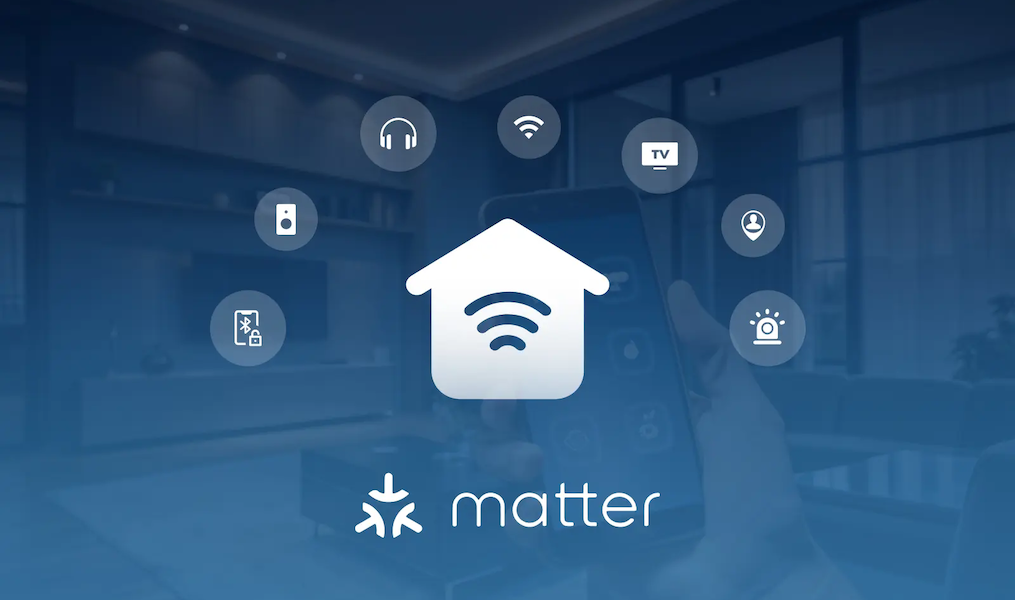 AI Visual Insight: This image serves as a conceptual entry point for Matter as a unified interoperability layer. It typically highlights the connection between multi-brand devices, multiple home platforms, and a single protocol. The visual emphasis is on eliminating protocol silos and expressing a centralized architecture for cross-ecosystem interoperability.
Matter 1.0 effectively marks the beginning of the end for smart home protocol fragmentation
Before Matter, the smart home landscape was split across Wi-Fi, Zigbee, Bluetooth, and other protocols. Users often needed multiple apps, while manufacturers had to repeatedly adapt products for different platforms, driving up both development and maintenance costs.
Matter 1.0 does not attempt to invent yet another low-level wireless technology. Instead, it defines a unified language at the application layer. This allows devices from different vendors to preserve their hardware-specific capabilities while sharing consistent data models, command semantics, and authentication mechanisms.
Matter’s core goals can be reduced to three priorities
- Enable native cross-brand interoperability.
- Let users commission a device once and control it across multiple platforms.
- Make security a built-in standard capability rather than a vendor-added feature.
Device capability = physical connectivity + standardized data model + security authentication + platform interoperability
Matter is responsible for enforcing consistency across the last three components
This structure shows that Matter does not replace wireless chips. It standardizes device onboarding and control semantics.
Matter 1.0 builds network compatibility on top of an IP-based architecture
Matter uses IPv6 as its unified networking foundation, which is one of its most important distinctions from traditional closed home protocols. An IP-based architecture allows devices to integrate more naturally into home networks and the broader internet stack, while also simplifying unified development across vendors.
Wi-Fi suits high-bandwidth devices, Thread fits low-power and mesh networking nodes, Ethernet provides stable wired connectivity, and BLE primarily handles first-time discovery and commissioning. Together, these transports balance performance, power efficiency, and deployment convenience.
The responsibilities of each network in Matter are clearly separated
transport_roles = {
    "Wi-Fi": "Carries high-bandwidth communication, such as TVs and gateways",  # Suitable for always-connected devices
    "Thread": "Carries low-power mesh communication, such as door locks and sensors",  # Emphasizes battery life and self-forming networks
    "Ethernet": "Carries stable wired connectivity",  # Suitable for fixed devices or hubs
    "BLE": "Used only for device discovery and commissioning"  # Not used as a long-term operational channel
}
This code snippet summarizes Matter’s multi-transport coordination strategy.
Matter 1.0 defines how devices are understood and controlled through a unified data model
One of Matter’s most important innovations is not just that devices can connect, but that they behave consistently after they connect. Matter uses a standard model built around nodes, endpoints, and clusters, breaking device capabilities into functional units that can be enumerated, controlled, and subscribed to.
A node can be understood as a physical device, an endpoint represents a functional entity, and a cluster packages attributes, commands, and events. As a result, when platforms control light bulbs from different brands, they do not need to learn each vendor’s private interface. They can simply invoke a common command model.
The node-endpoint-cluster model forms the backbone of protocol interoperability
{
  "node": "smart_bulb_01",
  "endpoint": "lighting",
  "cluster": {
    "attributes": ["on_off", "brightness"],
    "commands": ["turn_on", "turn_off", "set_brightness"],
    "events": ["state_changed"]
  }
}
This example shows why similar devices can preserve a consistent control model across brands.
Matter 1.0 makes security a default protocol capability rather than an afterthought
Matter’s security design covers device identity, communication channels, access control, and firmware updates. Its goal is not isolated encryption at a single point, but a trusted chain across the entire device lifecycle.
PKI-based attestation protects device authenticity, encrypted sessions protect communications from eavesdropping and tampering, multi-admin support and fine-grained permissions fit shared household scenarios, and standardized OTA updates ensure that patches can be delivered continuously.
A minimal security flow can be understood like this
Device powers on
→ Discovery via BLE or QR code
→ Verify device certificate and identity  # Prevent unauthorized or counterfeit devices from joining
→ Establish an encrypted session          # Protect control and state data
→ Write into the home Fabric              # Add the device to the local trusted control domain
→ Continue with standard OTA updates      # Keep fixing vulnerabilities and extending capabilities
This flow shows that Matter security is not bolted on. It is part of the onboarding process itself.
Matter 1.0 prioritizes the most common smart home device scenarios first
The initial release focuses on key device categories such as light bulbs, switches, plugs, door locks, sensors, thermostats, shades, TVs, hubs, and bridge devices. It deliberately prioritizes the home units that appear most often and create the clearest automation value.
Because of this, the best-fit deployment scenarios for Matter 1.0 sit in the foundational layer of home automation, including arrival mode, sleep mode, security coordination, and environmental adjustment. These scenarios are highly sensitive to unified control, low latency, and local execution.
A typical local automation rule looks like this
scene: Arrival Mode
triggers:
  - Door lock unlocked  # Trigger the scene when the user arrives home
actions:
  - Living room light: Turn on
  - Curtains: Open to 50%
  - Air conditioner: Set to 24°C
  - Speaker: Play a welcome prompt
mode: local_first  # Prefer local execution to reduce cloud dependency
This configuration reflects Matter’s emphasis on cross-brand, local-first automation.
Matter 1.0 is reshaping vendor competition and consumer choice
For manufacturers, Matter’s value lies in “build once, adapt across platforms.” This weakens traditional ecosystem lock-in and shifts competition away from protocol ownership toward hardware experience, stability, industrial design, and service quality.
For consumers, Matter certification reduces purchase risk. Users gain more freedom to move across major platforms such as Apple, Google, and Amazon without being locked into a single brand for the long term.
Matter’s industry impact can be summarized as three transitions
- From proprietary protocols to open standards.
- From cloud-centric control to local-first control.
- From ecosystem lock-in competition to product capability competition.
Old model: devices adapt to platforms
New model: platforms adapt to standardized devices
This contrast captures Matter’s direct impact on industry structure.
Matter 1.0 still has the typical coverage and capability boundaries of a first major release
As a 1.0 release, Matter still focuses on relatively foundational device types, and many large appliances and complex scenarios were not yet fully included. Legacy devices often require bridges during the transition, and advanced cross-platform features may still be limited by platform-specific policies.
In addition, Matter depends on the quality of the home network. Although its local-first model improves responsiveness, poor network planning or underpowered border routers can still degrade the overall experience.
Later versions are evolving along three paths: broader device support, richer semantics, and better tooling
- Matter 1.1: Improved stability and more mature developer tooling.
- Matter 1.2: Expanded support for appliances such as refrigerators, dishwashers, and air conditioners.
- Matter 1.3+: Continued expansion into more complex scenarios such as energy management, EV charging, and water management.
FAQ
1. Is Matter a replacement for Zigbee or Wi-Fi?
No. Matter is an application-layer standard, while Wi-Fi and Thread are primarily transport bearers. Matter standardizes control semantics, and the underlying networks can continue to coexist.
2. Why is Matter considered better for cross-brand smart homes?
Because it defines unified data models, standard commands, and consistent authentication workflows. Similar device types can be identified and controlled consistently across platforms, which significantly reduces interoperability costs.
3. Does Matter 1.0 already cover all smart appliances?
No. Matter 1.0 focuses on high-frequency foundational home devices. More large appliances and energy-related devices are being added progressively in later versions.
Core Summary: Matter 1.0 is an open application-layer smart home protocol driven by the CSA alliance. Built on IPv6 and compatible with Wi-Fi, Thread, Ethernet, and BLE commissioning, it aims to solve key pain points such as cross-brand interoperability, complex onboarding, and fragmented security. This article systematically breaks down its architecture model, security mechanisms, device coverage, industry impact, and version evolution.