This article distills the engineering value of Embedded C++ in Practice: Seamlessly Switching from C to Modern C++: how modern C++ solves high coupling, low reuse, and fragile resource management in embedded development without sacrificing performance. Keywords: Embedded C++, RAII, HAL.
Technical Specifications at a Glance
| Parameter | Details |
|---|---|
| Primary Languages | C, C++23 |
| Applicable Scenarios | MCU firmware, driver development, cross-platform embedded systems |
| Integration Interfaces | C/C++ interoperability, HAL, state machines, serializers |
| Star Count | Not provided in the original |
| Core Dependencies | GCC/Keil/IAR, CMake, Docker, ETL, littlefs, Boost SML, Pigweed |
Modern C++ Is Becoming the Primary Upgrade Path for Embedded Engineering
The core message of the source content is not simply a book recommendation. It answers a more important question: when embedded systems evolve from single-chip control logic into multi-module, hard real-time, continuously iterated software systems, why does traditional C development begin to lose momentum?
The pain points are highly concentrated: drivers become tangled with business logic, platform migration creates repetitive work, resource release depends on manual discipline, state transitions lack structure, and team collaboration easily introduces implicit coupling. Once project scope expands, maintenance costs quickly erode delivery efficiency.
Modern C++ Provides Controlled Abstractions, Not Extra Burden
In embedded systems, the most valuable capability of modern C++ is not syntactic sugar. It is zero-cost abstraction. Encapsulation, templates, constexpr, strong typing, RAII, and compile-time polymorphism can deliver much better maintainability and testability while preserving execution efficiency close to C.
class UartGuard {
public:
    explicit UartGuard(UART_HandleTypeDef* h) : handle_(h) {
        uart_open(handle_); // Initialize UART resources
    }

    ~UartGuard() {
        uart_close(handle_); // Automatically release resources when leaving scope
    }

private:
    UART_HandleTypeDef* handle_;
};
This example shows the typical value of RAII in peripheral handle management: resource acquisition and release are bound together, which reduces the risk of leaks.
The Real Value of This Book Is That It Defines Practical C++ Boundaries for Embedded Systems
Many teams resist C++ not because they oppose abstraction, but because they worry about exceptions, RTTI, dynamic memory, and uncontrolled binary growth. The key point emphasized in the original text is this: embedded development does not need to adopt every feature from desktop C++. It should retain the subset that fits real-time and resource-constrained environments.
That means the methodology must be explicit: which features to enable, which to disable, which libraries can replace higher-risk parts of the standard library, and which patterns are better suited for bare-metal targets or RTOS-based systems.
The Practical Capability Map Covers Everything from Drivers to Architecture
The structure of the book can be summarized into four layers: correcting misconceptions, language fundamentals, advanced features, and engineering practice. Rather than stacking isolated knowledge points, it extends from development environments, compilers, and test tools all the way to HALs, file system wrappers, serializers, the Observer pattern, finite state machines, and cross-platform design.
template <typename Reg>
class RegisterWriter {
public:
    static void write(std::uint32_t value) {
        Reg::value() = value; // Encapsulate the register address through types
    }
};
This example demonstrates the role of templates in the hardware abstraction layer: hardware differences are expressed through types, enabling a reusable and optimizable low-level access model.
Three High-Frequency Engineering Patterns Deserve the Most Attention
The first is HAL abstraction. It addresses the problem of keeping business logic largely unchanged when hardware changes. For product lines built on multiple MCUs, this is the foundation of software asset reuse.
The second is wrapping C libraries with RAII. Using littlefs as an example, the original article explains how to preserve a mature C ecosystem while improving interface consistency and resource safety with C++ wrappers.
The third is state machines and serializers. In embedded systems, Bluetooth connections, sensor sampling, and protocol handling naturally fit event-driven models. Replacing scattered switch-case logic with structured finite state machines is a key step in architectural modernization.
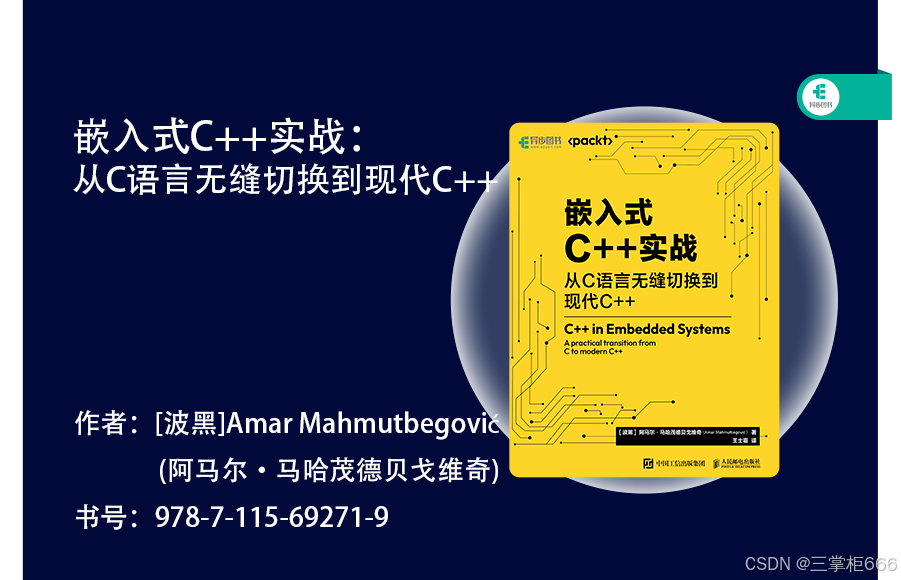 AI Visual Insight: The image presents the book cover and main visual identity, emphasizing the positioning of “switching from C to modern C++.” Visually, it highlights that the book targets practical embedded engineering scenarios and focuses on modern C++23, firmware development, and real-world engineering practices. This signals that the content is not a basic syntax primer, but a guide for project implementation and systematic migration.
Containerization and Toolchain Standardization Are Prerequisites for Engineering Success
The original content also highlights an easily underestimated signal: embedded development is shifting from a locally installed IDE-driven model to a reproducible environment-driven model. Docker, CMake, VS Code, simulators, static analyzers, and unit testing frameworks are being integrated into the same delivery pipeline.
docker run --rm -it \
  -v $(pwd):/workspace \
  embedded-cpp-env \
  cmake -S /workspace -B /workspace/build && cmake --build /workspace/build
This command standardizes the build environment and reduces environment drift issues such as “it builds on my machine.”
The Target Audience for This Book Is Very Clear
If you have spent years maintaining drivers, protocol stacks, boot flows, or control logic in C, the book’s most direct value is that it helps you establish a path for gradual migration instead of forcing a full rewrite.
If you already know C++ but have not defined engineering boundaries for resource-constrained systems, the book shows which modern features generate meaningful benefits and which ones introduce unacceptable runtime uncertainty.
The Full Book Overview Strengthens the Integrity of the Knowledge Chain
 AI Visual Insight: This image shows the full chapter structure and knowledge map of the book. The content progresses from clarifying misconceptions, toolchains, and language fundamentals to templates, compile-time computation, HALs, design patterns, and cross-platform development. Visually, it presents a progression from language capability to engineering capability, making it useful for developers who want to quickly evaluate both the learning path and the implementation direction for real projects.
From an information-density perspective, this is not a C++ book that only teaches you how to write classes. It is a practical guide to building long-term maintainable architectures under embedded constraints. It places performance, reliability, testability, and team collaboration within the same technical framework.
The Final Conclusion Is That Modern C++ Does Not Replace C, but Reshapes Embedded Software Production
The strongest insight from the original text is this: growing from a driver developer into a systems architecture engineer does not primarily depend on learning more syntax. It depends on whether you can use abstraction to manage complexity, use the type system to constrain errors, and use engineering systems to guarantee sustainable delivery.
For teams building industrial control, automotive electronics, low-power devices, medical firmware, and IoT products, this book offers not isolated tricks but a modern embedded development roadmap that can be absorbed incrementally.
FAQ
1. Why should embedded projects stop relying entirely on pure C?
Pure C is still suitable for very small modules or code that is tightly bound to hardware. But in medium and large systems, module coupling, weak reuse, fragile resource management, and architectural rigidity significantly increase maintenance cost. Modern C++ improves abstraction while keeping performance under control.
2. Does using C++ in embedded systems always introduce performance overhead?
Not necessarily. When used properly, encapsulation, templates, constexpr, RAII, and compile-time polymorphism often add no extra runtime cost. The real areas that require caution are exceptions, RTTI, uncontrolled dynamic allocation, and unrestricted use of the standard library.
3. What is the minimum practical path for migrating from C to embedded C++?
A three-step approach is recommended: first, introduce C/C++ interoperability and upgrade the build system; second, refactor driver interfaces and resource management into classes and RAII; third, gradually introduce HALs, template-based reuse, state machines, and testable architecture. This path minimizes risk and delivers the most stable gains.
Core Summary
This article reconstructs the core ideas of Embedded C++ in Practice, focusing on why embedded development needs modern C++, how to adopt it safely in resource-constrained systems, and how to apply HALs, RAII, templates, state machines, and cross-platform design in real engineering work. It is especially useful for firmware and systems engineers who want to move from C to modern C++ with a clear methodology.