Spark 2.0 is World Labs’ browser-first 3DGS rendering engine. Its core value is turning ultra-large 3D scenes—once dependent on high-VRAM hardware—into content that users can access in real time on the web. It addresses three major pain points in 3DGS: slow loading, runaway VRAM usage, and poor cross-device portability. Keywords: 3DGS, WebGL2, streaming rendering.
| Technical Spec | Details |
|---|---|
| Language | JavaScript / TypeScript |
| Rendering Foundation | Three.js + WebGL2 |
| Deployment Targets | Web browsers, mobile devices, VR headsets |
| Core Capabilities | Hundred-million-scale 3DGS streaming rendering, LoD, virtual VRAM |
| Supported Formats | PLY, SPZ, RAD |
| Official Repository | github.com/sparkjsdev/spark |
| Core Dependencies | Three.js, WebGL2 |
| GitHub Stars | Original data not provided; refer to the live GitHub page |
Spark 2.0 redefines what is practical for Web-based 3DGS
Spark 2.0 is World Labs’ open-source browser-side 3D Gaussian Splatting renderer. Its biggest breakthrough is not simply bringing 3DGS to the frontend. It turns massive 3D content into a web-native asset that can be streamed, accessed across platforms, and interacted with in real time.
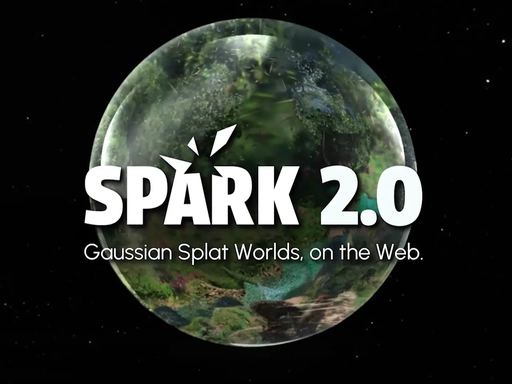 AI Visual Insight: The image presents Spark 2.0’s official launch visual. The key message highlights the productization of web-native 3DGS rendering and emphasizes the browser as a unified runtime for large-scale spatial content.
From an engineering perspective, Spark 2.0 is built on Three.js and WebGL2, which removes the need for native client dependencies. In practice, that means phones, tablets, desktops, and even VR devices can load the same 3DGS scene assets directly.
Spark 2.0 turns offline assets into on-demand data streams
Traditional 3DGS pipelines usually run into three issues: large file sizes, long startup times, and high VRAM pressure. Spark 2.0 rebuilds both the data loading pipeline and the rendering budget model with LoD, the RAD streaming format, and GPU virtual memory management.
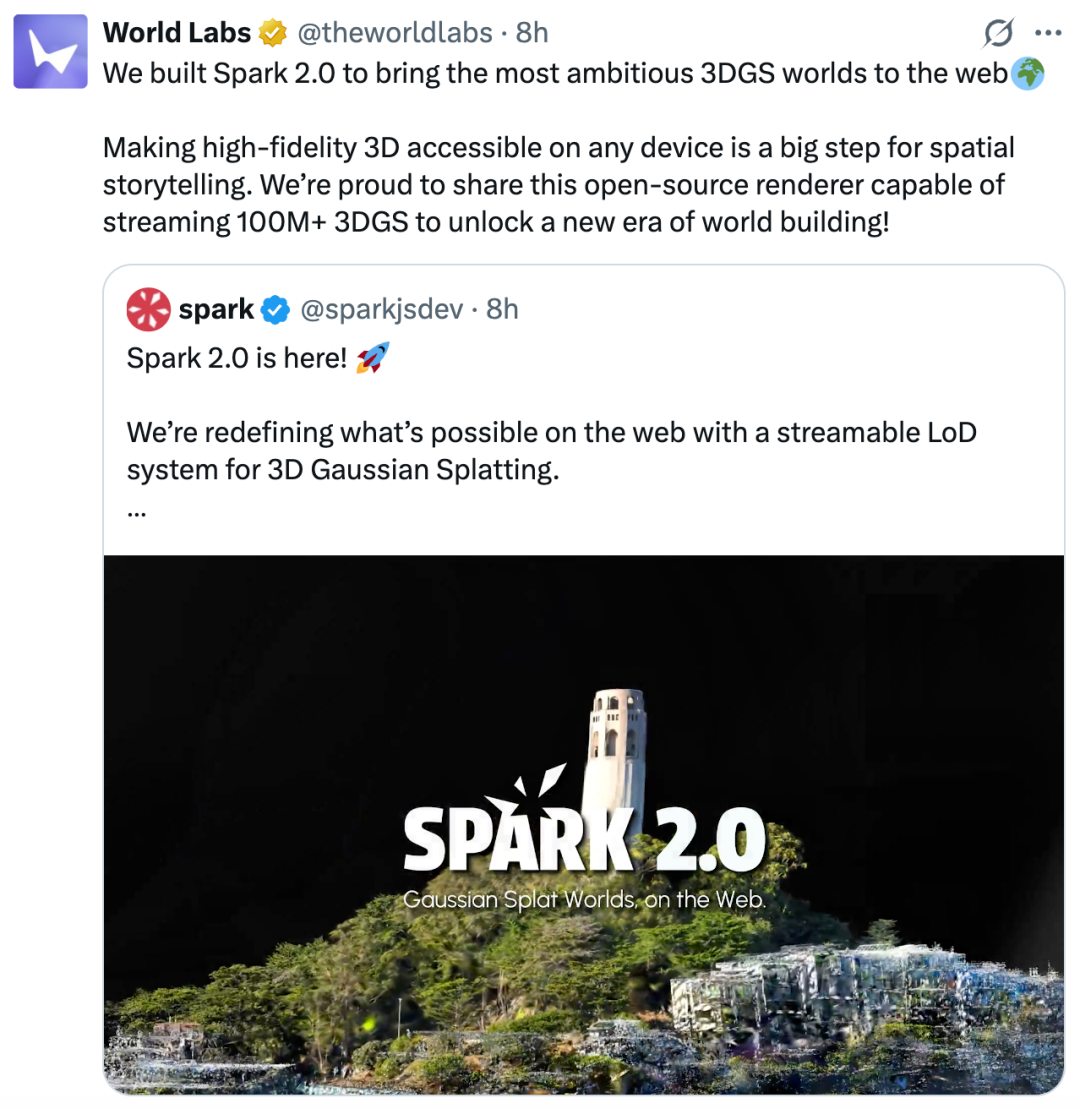 AI Visual Insight: The diagram shows how Spark fits into the web ecosystem. It highlights Spark as a dynamic 3DGS renderer integrated with Three.js and supporting desktop, mobile, and XR devices, which reflects its cross-platform runtime design.
// Pseudocode: decide which Gaussian blocks to load based on the current view
function updateStreaming(camera, lodTree) {
  const visibleNodes = lodTree.query(camera.frustum); // Cull visible nodes by view frustum
  const prioritized = sortByDistance(visibleNodes); // Sort by distance and prioritize nearby detail
  streamBlocks(prioritized); // Request and decode blocks on demand
}
This logic captures the core idea behind Spark 2.0: do not load the entire world at once; continuously load only the part of the world the user currently needs.
The mathematical representation of 3DGS drives Spark 2.0’s rendering efficiency
3D Gaussian Splatting replaces traditional triangle meshes with 3D Gaussian ellipsoids, using probability distributions to represent color, density, and shape information in space. This representation is especially well suited to real-world reconstruction because Gaussian points naturally support soft boundaries, translucency, and continuous view synthesis.
A single Gaussian can be represented as a combination of a position mean and a covariance matrix. The covariance matrix can then be decomposed into rotation and scaling, which makes GPU-side computation and batched rendering more efficient.
Covariance decomposition is the key interface for engineering implementation
In rendering implementations, the covariance matrix is often written as: Σ = R S S^T R^T. This separates orientation control from scale control, which is convenient for training and better suited to projection and screen-space splat expansion in shaders.
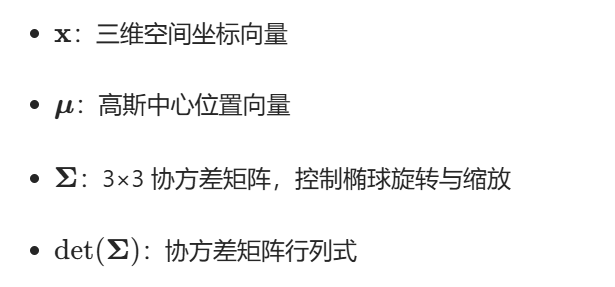 AI Visual Insight: The image illustrates the mathematical structure of a Gaussian distribution or its geometric projection. It shows that a single splat is not a discrete point but an ellipsoid with spatial extent, which determines its coverage area and rendering contribution.
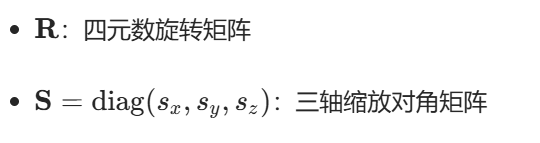 AI Visual Insight: This image emphasizes the relationship between rotation and scaling after covariance decomposition. It shows how a Gaussian ellipsoid adapts to different orientations and scales through linear transformation, forming the basis for efficient projection.
Spark 2.0 resolves the core bottlenecks of web rendering through three mechanisms
Dynamic LoD culling decouples frame rate from total point count
Spark 2.0 organizes massive Gaussian point sets into a multiresolution hierarchy. When the camera moves closer, it loads high-precision nodes; when the camera moves away, it keeps only low-precision approximations. As a result, the renderer works within a fixed budget rather than against an endlessly growing scene.
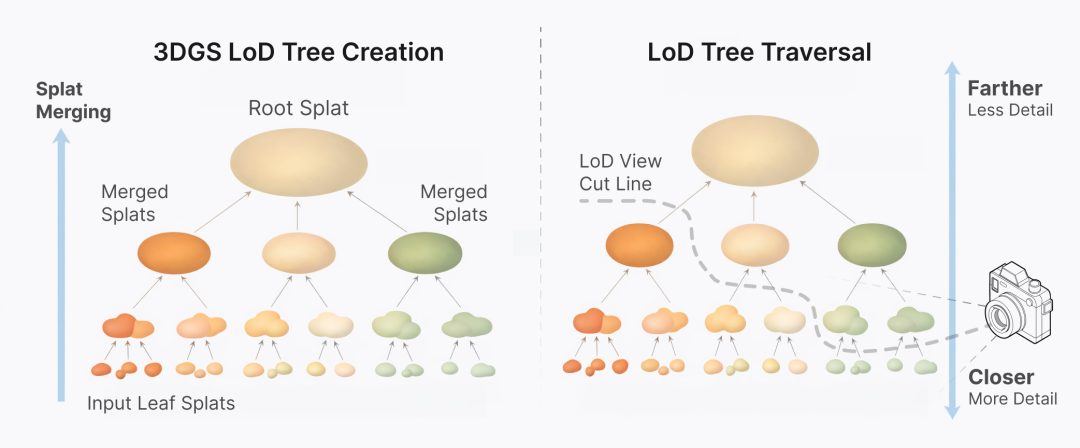 AI Visual Insight: The figure shows hierarchical level-of-detail control logic. Different distance ranges map to Gaussian representations of different densities, demonstrating how the system dynamically balances visual quality and throughput through a spatial hierarchy tree.
The RAD format replaces full-package downloads with progressive visibility
RAD is Spark 2.0’s streaming asset format. It stores Gaussian points in blocks and allows the first blocks to arrive with priority, enabling a “see the silhouette first, then fill in the detail” experience. That makes it much better suited to browser scenarios than downloading a full PLY or SPZ file upfront.
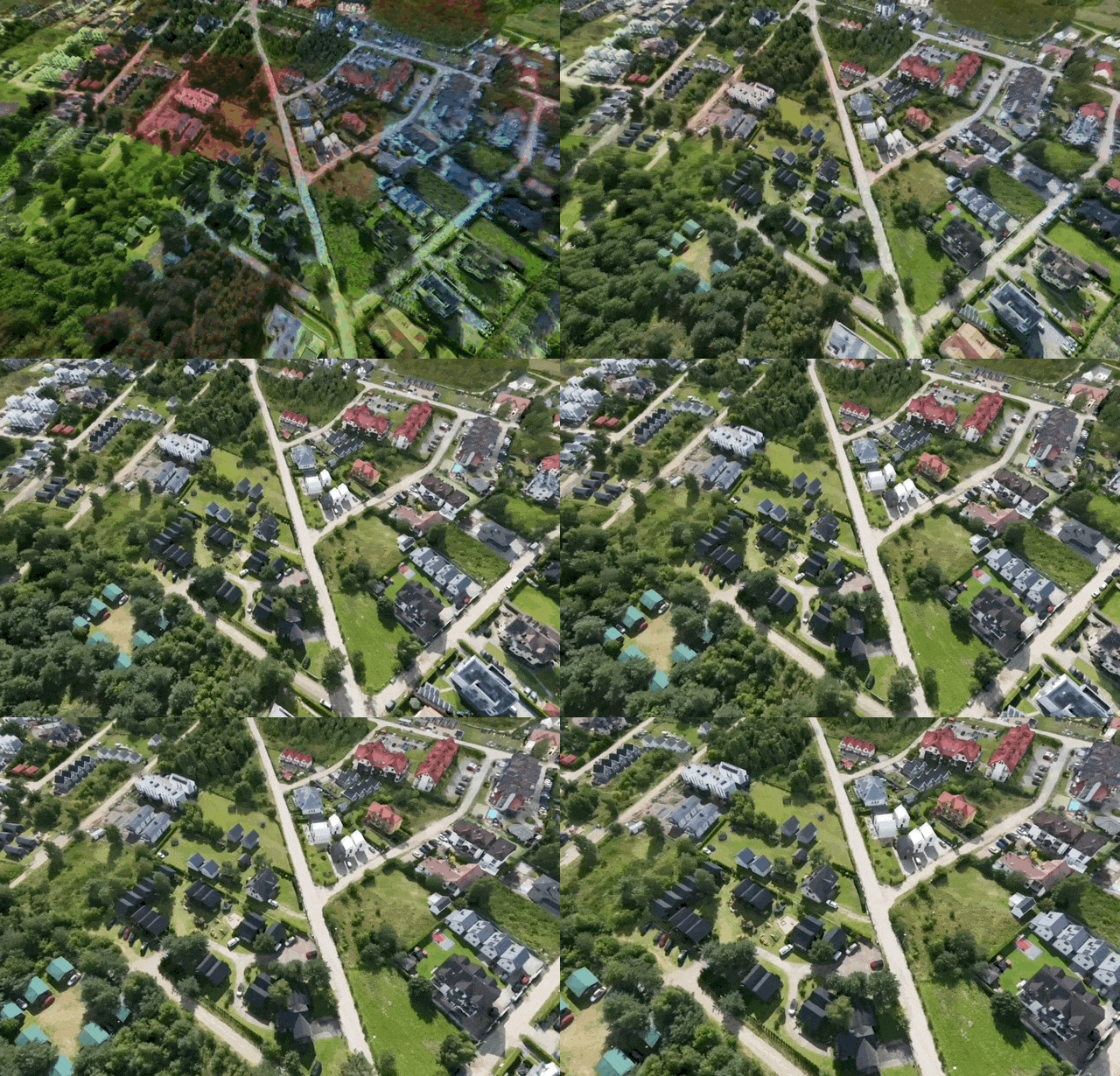 AI Visual Insight: The animation shows a scene becoming progressively clearer from coarse to fine detail. It highlights RAD’s progressive transmission behavior: the first frame becomes visible quickly, and higher-precision local data continues to stream in based on the view.
GPU virtual memory management breaks past hardware limits
Spark 2.0 borrows the idea of paging from operating systems. It splits Gaussian data into fixed pages and uses an LRU strategy for swapping pages in and out. The browser-side GPU keeps only the most valuable pages for the current view, so limited VRAM can still render scenes of effectively unbounded scale.
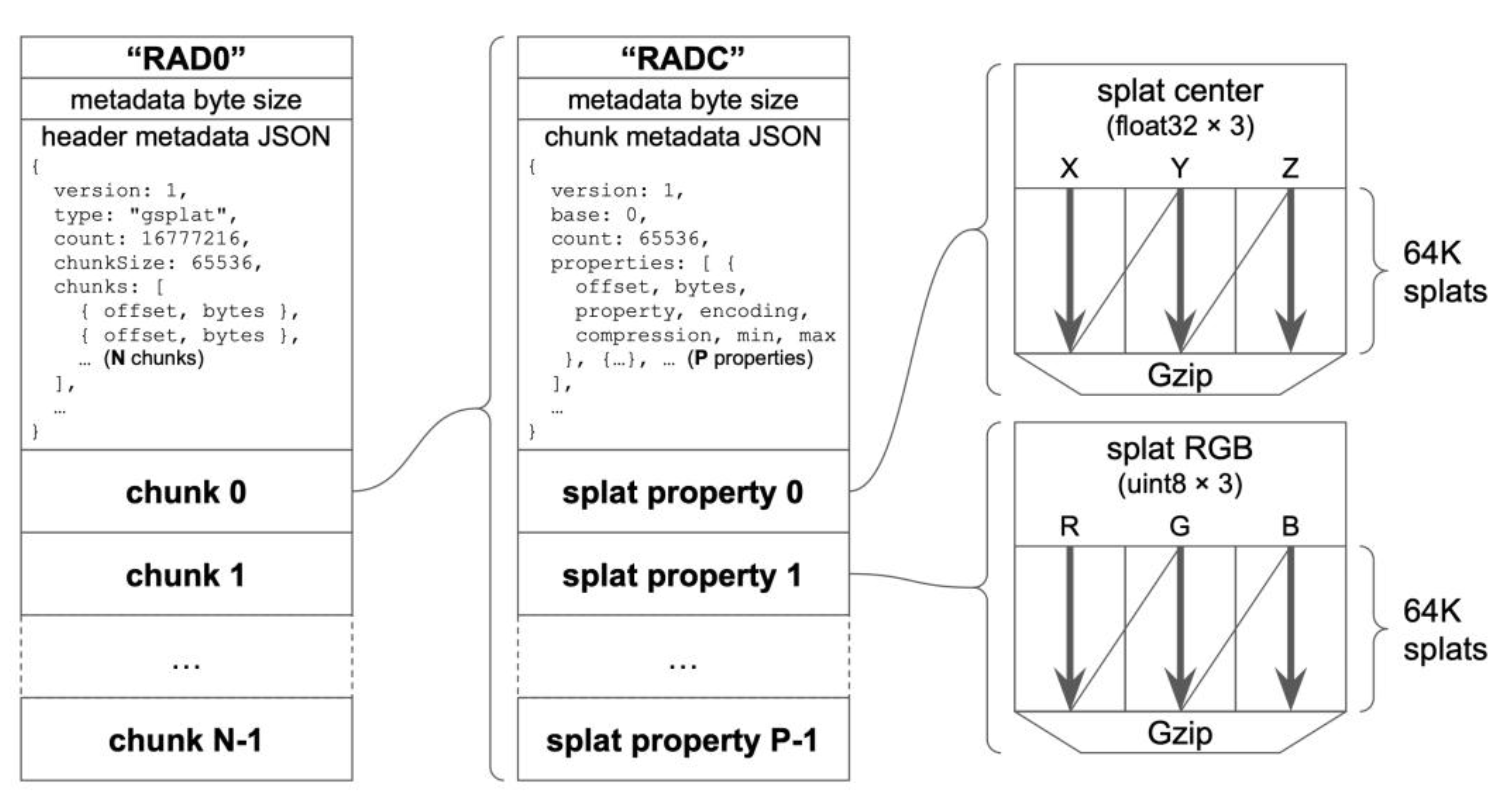 AI Visual Insight: The image shows the relationship between the GPU memory pool and data page management. The main point is that page caching and replacement policies decouple total scene scale from VRAM usage.
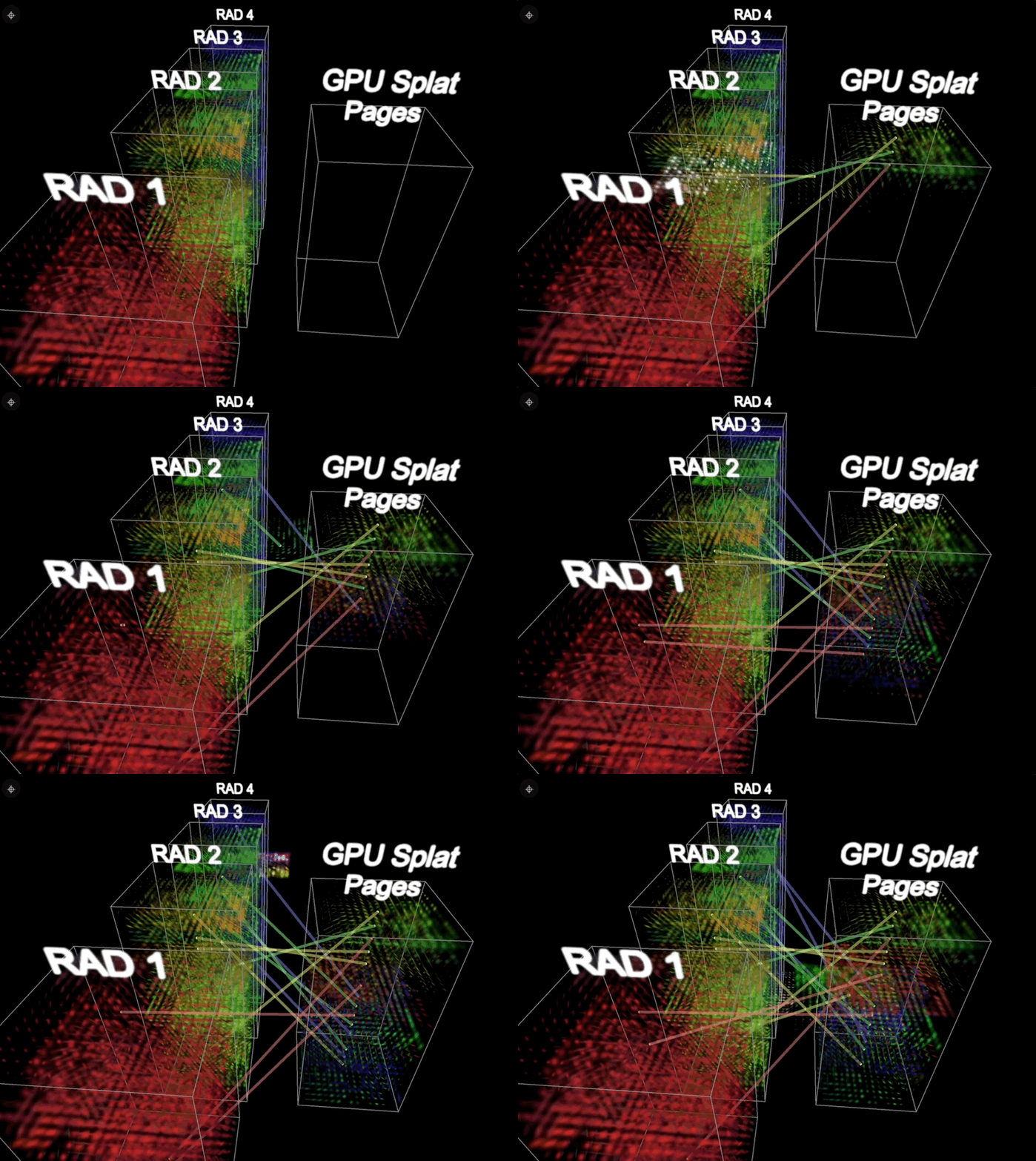 AI Visual Insight: The animation demonstrates continuous background page swapping and visible-data reorganization as the camera moves, showing how the system maintains a stable VRAM budget during interaction and avoids memory spikes.
// Pseudocode: simplified LRU management for a GPU page cache
class PageCache {
  constructor(limit) {
    this.limit = limit; // Maximum number of pages
    this.pages = new Map(); // Store currently resident pages
  }
  touch(id, data) {
    if (this.pages.has(id)) this.pages.delete(id); // Update recency after access
    this.pages.set(id, data);
    if (this.pages.size > this.limit) {
      const oldest = this.pages.keys().next().value; // Evict the least recently used page
      this.pages.delete(oldest);
    }
  }
}
This code shows the essence of the system: it is a paged cache, except the target medium is GPU resources rather than system memory.
Spark 2.0 is already close to production-ready deployment
Based on the original materials, Spark 2.0 already provides an NPM integration path. Developers only need to import @sparkjsdev/spark, specify a RAD scene URL and budget parameters, and they can complete basic rendering directly in the browser.
<!DOCTYPE html>
<html lang="zh-CN">
<head>
  <meta charset="UTF-8" />

<title>Spark 2.0 Demo</title>

<style>
    body { margin: 0; overflow: hidden; }
  </style>
</head>
<body>
  <script type="module">
    import { SparkViewer } from '@sparkjsdev/spark';

    // Initialize the browser-side 3DGS viewer
    const viewer = new SparkViewer({
      container: document.body,
      sceneUrl: 'https://assets.sparkjs.dev/demo/coit-tower.rad', // Specify the RAD scene asset
      maxSplatCount: 2500000, // Control the desktop rendering budget
      enableStreaming: true, // Enable streaming loading
      autoPlay: true // Automatically play camera interaction
    });

    // Handle window resizing to keep the canvas size correct
    window.addEventListener('resize', () => viewer.resize());
  </script>
</body>
</html>
This example delivers the minimum viable deployment: load a RAD file, enable streaming rendering, cap the splat budget, and adapt to window resizing.
The installation command stays minimal
# Install the official Spark 2.0 SDK
npm install @sparkjsdev/spark
This step integrates Spark into a frontend project, after which you can run the sample page from a local HTTP server.
Spark 2.0 is moving from demo-grade technology toward industry-scale value
In digital twins, cultural tourism and museums, virtual commerce, and autonomous driving visualization, developers have long been constrained by one recurring problem: large scenes are hard to distribute efficiently. Spark 2.0’s answer is not to keep throwing more compute at the problem, but to redesign how assets are organized for the web.
If its ecosystem continues to mature, 3DGS will no longer remain only a high-fidelity representation from research papers. It could become a general-purpose content format for web-based spatial applications. For frontend and graphics engineers, that suggests the browser may become the next major entry point for spatial computing.
FAQ
1. What fundamentally distinguishes Spark 2.0 from a standard Three.js scene loader?
A standard loader mainly targets meshes, textures, and static models. Spark 2.0 is built around 3DGS data organization, progressive transport, and GPU paging management. Its focus is real-time rendering of ultra-large Gaussian scenes inside the browser.
2. Why can Spark 2.0 run hundred-million-scale scenes on mobile devices?
The key is not rendering every Gaussian at once. Spark 2.0 uses LoD, RAD block streaming, and virtual VRAM so that it only keeps the data and rendering budget required by the current view. That is why mobile devices can still maintain acceptable frame rates.
3. Is Spark 2.0 suitable for production deployment?
From an architectural perspective, it already shows strong engineering maturity and is particularly well suited to large-scale visualization and interactive presentation. Before shipping to production, you should still evaluate asset format stability, browser compatibility, bandwidth cost, and device-tiering strategy.
Official Resources
- GitHub: https://github.com/sparkjsdev/spark
- Demo: https://sparkjs.dev
- Documentation: https://docs.sparkjs.dev
AI Readability Summary
Spark 2.0 is World Labs’ open-source web-based 3D Gaussian Splatting engine. Built on Three.js and WebGL2, it enables streaming delivery, dynamic LoD culling, and GPU virtual memory management for hundred-million-scale Gaussian scenes, allowing phones, PCs, and VR browsers to access massive 3D environments in real time.