For ESP32-S3 embedded AI Agents, MimiClaw and EmbedClaw demonstrate two distinct main-program architectures: the former prioritizes rapid parallel service startup, while the latter emphasizes dependency validation and conditional boot. This article distills their key differences across startup flow, NVS handling, Wi-Fi provisioning, storage, BSP design, and fault tolerance. Keywords: ESP32-S3, AI Agent, Embedded Architecture
Technical specification snapshot
| Parameter | MimiClaw | EmbedClaw |
|---|---|---|
| Primary language | C | C |
| Runtime framework | ESP-IDF + FreeRTOS | ESP-IDF + FreeRTOS |
| Target chip | ESP32-S3 | ESP32-S3 |
| Network protocols | Wi-Fi, WebSocket, Bot channels | Wi-Fi, Bot channels |
| Storage method | SPIFFS | SD card |
| Boot philosophy | Service-first startup | Dependency-first validation |
| Core dependencies | NVS, event loop, message bus, LLM agent | NVS, BSP, SD card, Wi-Fi configuration |
| Repository popularity | Not provided in the source | Not provided in the source |
 AI Visual Insight: This animated image introduces the topic and emphasizes that the article focuses on engineering practices for embedded AI Agents. It works more as a visual cover than as a detailed technical diagram, so it does not carry quantifiable architectural details.
The two projects represent two different boot paradigms
Both MimiClaw and EmbedClaw run on ESP32-S3 and FreeRTOS, and both target edge-side AI Agent use cases. However, the way they assign responsibilities inside app_main reflects two fundamentally different system design philosophies.
MimiClaw tends to bring up the message bus, memory storage, skill system, network agents, and peripherals first, then deal with connectivity and runtime state. EmbedClaw starts by validating Wi-Fi credentials, board-level initialization, and SD card availability, and only proceeds to core services after those critical dependencies are confirmed.
This difference defines the maintainability boundary of the system
The former fits rapid prototyping: developers can power on the board and quickly see LEDs, motors, and Bot responses. The latter fits delivery-oriented scenarios: the device proves it can stay alive reliably before it spends memory on AI capabilities.
void app_main(void) {
    nvs_flash_init();                 // Initialize persistent configuration
    init_core_services();             // Start core services such as the message bus, memory, and skills
    start_network_and_bots();         // Start networking and multi-channel bots
    init_actuators();                 // Initialize peripherals such as LEDs and motors
}
This pseudocode summarizes MimiClaw’s main pattern: assemble the full capability stack first, then handle state.
 AI Visual Insight: This image corresponds to the project overview. It typically highlights the overall positioning of an ESP32-S3 AI Agent: chip capabilities, offline agent scenarios, and the background that both projects share lower-level components while diverging at the entry-point strategy.
 AI Visual Insight: This image provides a quick project background overview. It emphasizes that both are ESP-IDF/FreeRTOS projects, but their main-program organization differs between a “lab prototype” style and a “productization reference” style. It serves as an architecture comparison guide.
Different boot sequences directly affect resource usage and failure paths
MimiClaw follows a linear expansion model: from NVS and SPIFFS to the message bus, LLM agent, tool registration, Bot channels, and then WS2812 and motor tests, it lays out almost every service during startup.
EmbedClaw follows a gated model: it checks credentials first, then initializes the BSP, then validates the SD card mount, and only starts core services after a successful Wi-Fi callback. It splits the system into two stages: “bootable” and “service-ready.”
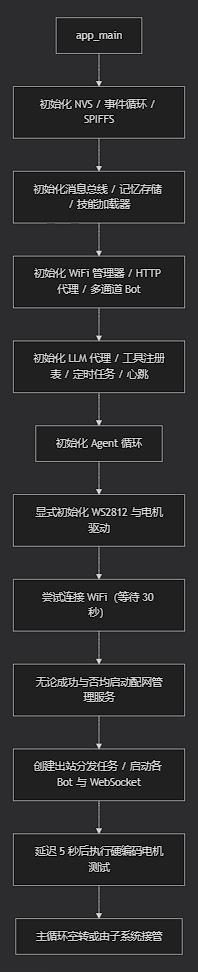 AI Visual Insight: This image shows the MimiClaw startup flowchart. Nodes expand outward from
 app_main to NVS, SPIFFS, the message bus, memory, Wi-Fi, the HTTP agent, the LLM layer, tools, scheduled tasks, the Agent loop, and peripheral tests, clearly reflecting a “parallel service bring-up” architecture.
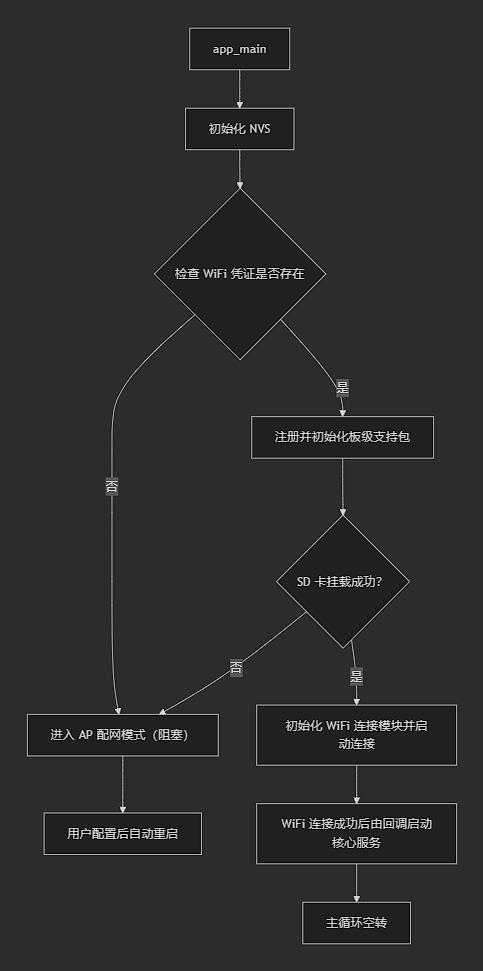 AI Visual Insight: This image shows the EmbedClaw startup flowchart, centered on conditional branches: check Wi-Fi credentials, register the BSP, detect the SD card, start connectivity, and only enter the service phase after a successful connection. It reflects a gated design where the AI stack starts only after dependencies are satisfied.
Dependency-first startup aligns more closely with product thinking than feature-first startup
On a memory-constrained ESP32-S3, creating the LLM context, message queues, and web services before discovering that the SD card is missing or Wi-Fi provisioning is incomplete is expensive. EmbedClaw’s value is not that the flow is shorter, but that failure happens early enough.
if (!check_wifi_configured()) {
    enter_config_mode();              // Enter provisioning mode immediately when credentials are missing
    return;                           // Prevent later AI services from consuming memory
}

if (!ec_board_storage_is_mounted()) {
    enter_config_mode();              // Enter the guided recovery path when the SD card is unavailable
    return;
}
The key idea in this logic is to turn failure into an explicit branch, instead of letting the system crash in a partially initialized state.
Five critical differences define the long-term architectural ceiling
NVS version handling reflects the divide between development mode and product mode
When MimiClaw encounters ESP_ERR_NVS_NEW_VERSION_FOUND, it erases NVS directly. The advantage is a clean reset; the downside is that Wi-Fi configuration may be lost after OTA updates. EmbedClaw records a warning and keeps the data, which clearly prioritizes user continuity.
if (ret == ESP_ERR_NVS_NO_FREE_PAGES || ret == ESP_ERR_NVS_NEW_VERSION_FOUND) {
    nvs_flash_erase();                // Simple and aggressive during development: erase old configuration directly
    ret = nvs_flash_init();           // Reinitialize NVS
}
This strategy works well in experimental environments, but it is not suitable for devices that require a stable upgrade experience.
Wi-Fi provisioning mode reveals the tradeoff between resident services and one-time onboarding
MimiClaw keeps the provisioning page available by default, allowing dynamic network changes at runtime. That gives developers flexibility, but it also continuously consumes memory and ports. EmbedClaw enters AP provisioning mode only when credentials are missing, then reboots after configuration so the main flow starts from a clean state.
Storage dependencies determine board adaptability
MimiClaw uses SPIFFS, so it can run on almost any ESP32-S3 core board, which makes it ideal for open-source adoption. EmbedClaw treats the SD card as a hard dependency, trading that constraint for larger memory and indexing capacity. That model fits delivery hardware with a fixed form factor.
The BSP abstraction layer determines future portability cost
MimiClaw initializes WS2812 and motors directly in the main program, which is practical for quick single-board experiments. EmbedClaw uses board_register() and ec_board_init() to consolidate hardware differences so the main program does not need to understand GPIO details, improving portability.
board_register();                     // Register board-level drivers and device descriptors
esp_err_t ret = ec_board_init();      // Initialize the screen, audio, storage, and buttons through a unified path
if (ret != ESP_OK) {
    enter_config_mode();              // Enter recoverable bootstrap mode when initialization fails
}
This code shows that a well-designed main.c should not become a dumping ground for hardware details. It should act as the startup orchestration center.
The best evolution path is not choosing one side, but combining the strengths of both
If you want to push MimiClaw toward productization, the highest-priority changes are clear: preserve NVS data, validate Wi-Fi and storage dependencies before service startup, introduce a lightweight BSP, and move hard-coded motor tests behind a debug switch or CLI.
If you want to increase EmbedClaw’s capability density, you can absorb MimiClaw’s message bus, skill loader, scheduled tasks, and multi-channel dispatch model so the system evolves from “stable and usable” to “extensible and orchestratable.”
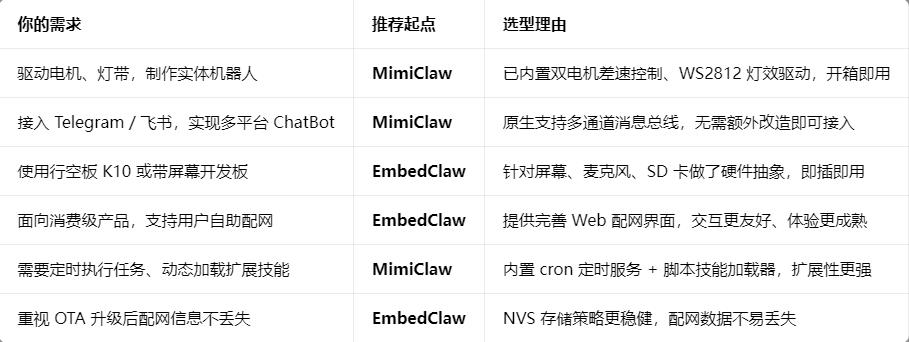 AI Visual Insight: This image appears in the architecture selection section and typically acts as a decision aid. It helps readers understand that the two paths are not mutually exclusive, but can be combined based on resource constraints, hardware rigidity, and product stage.
A more balanced hybrid entry-point example
void app_main(void) {
    init_nvs_safely();                // Initialize conservatively and preserve user configuration whenever possible
    if (!precheck_boot_dependencies()) return;  // Validate Wi-Fi, storage, and board-level resources first
    board_init();                     // Initialize the unified hardware abstraction layer
    start_core_agent_services();      // Then start the message bus, skills, LLM, and Bot services
}
This hybrid structure balances recoverability, extensibility, and long-term portability.
The recommendation for developers is straightforward
If your system is resource-sensitive, hardware-fixed, and delivery-oriented, prioritize EmbedClaw-style gated startup. If you need rapid validation, multi-peripheral experiments, and feature exploration, MimiClaw is more efficient. For long-term projects, the best strategy is to use EmbedClaw’s boot discipline to host MimiClaw’s feature ecosystem.
 AI Visual Insight: This image and the next two form the closing visual group. They mainly serve as a project summary and reference guide, emphasizing that both open-source projects are still evolving and are useful as architecture reference samples.
 AI Visual Insight: This image continues the closing section’s information density. It typically corresponds to project repositories or deployment notes and reinforces the reader’s path to keep tracking source code and version updates.
 AI Visual Insight: As the final supporting image, this visual reinforces the article’s conclusion: embedded AI Agent main-program design is moving from “just make it run” toward a product-grade entry architecture that is recoverable, upgradable, and maintainable.
FAQ
FAQ 1: What should you optimize first in an ESP32-S3 AI Agent main program?
Optimize the boot order first. Check NVS, Wi-Fi credentials, storage, and board-level resources before initializing the LLM, message bus, and web services. That approach significantly reduces OOM conditions, reboot loops, and half-initialized failures.
FAQ 2: Why is MimiClaw well suited for prototyping?
Because it quickly concentrates messaging, skills, peripherals, and network capabilities into the main entry point, developers can validate the end-to-end interactive loop faster. It is especially useful for coordinated testing across LEDs, motors, and Bot channels.
FAQ 3: Does EmbedClaw’s gated startup sacrifice flexibility?
Yes, it gives up some runtime dynamism, such as a permanently resident provisioning service. In return, it delivers lower memory pressure, clearer failure paths, and a more stable deployment experience. For mass-produced devices, that tradeoff is usually worth it.
[AI Readability Summary]
This article compares two ESP32-S3 AI Agent main-program patterns by analyzing how MimiClaw and EmbedClaw handle boot sequence, NVS strategy, Wi-Fi provisioning, storage dependencies, hardware abstraction, and error recovery. It also proposes a hybrid evolution path for teams moving from prototype to production.