For construction site safety and electrical safety training, VR safety training centers use immersive simulation, physical feedback, and data-driven assessment to solve the core limitations of traditional instruction: weak retention, high drill risk, and poor measurability. Keywords: VR safety training, construction safety, electrical safety.
Technical specifications at a glance
| Parameter | Details |
|---|---|
| Solution Type | VR safety training center equipment selection and training solution |
| Core Scenarios | Construction falls from height, confined spaces, electrical step voltage, electric shock rescue, mechanical injuries |
| Technical Stack | VR headset + motion platform + sensors + simulation software |
| Interaction Protocols / Methods | Motion interaction, sensor linkage, audio-video feedback, millisecond-level synchronization |
| Reference Languages | C++, Unity/C#, embedded control logic (common industry implementation) |
| Core Dependencies | VR headset, motion platform, vibration actuator, physics engine, question bank assessment system |
| Reference Deployment Scale | 2,000+ project cases mentioned in the source material |
| Reference Industries | Construction, electric power, firefighting, manufacturing, transportation |
Traditional safety training is losing effectiveness in high-risk scenarios
Construction and electrical industries share the same operational reality: accidents have severe consequences, hands-on drills are expensive, and real-world incident replay is difficult. Traditional methods rely on manuals, posters, and slide decks, creating one-way information delivery that rarely builds muscle memory.
The value of VR is not that it looks impressive. Its value lies in turning abstract risk into repeatable operational workflows. Scenarios such as falls from height, electric shock, and oxygen-deficient confined spaces can be trained repeatedly without causing real harm, while preserving assessment data for analysis.
The core benefits of VR training can be quantified
Traditional training: Review materials -> Listen to explanations -> Passive memorization -> Forget on site
VR training: Review guidance -> Enter the scenario -> Make decisions -> Receive instant feedback -> Store data records
This workflow captures the essence of VR training: it converts “knowing” into “doing.”
Construction and electrical scenarios require different equipment capabilities
Construction safety places greater emphasis on compound risks such as falls, collapses, mechanical injuries, and confined spaces. That makes spatial interaction and motion recognition critical. Electrical safety focuses more on low-tolerance scenarios such as high voltage exposure, step voltage, and electric shock rescue, where rule evaluation and feedback accuracy matter more.
From a procurement perspective, the top priority is usually not brand. It is scenario realism, software and hardware compatibility, and the vendor’s ability to keep content updated over time. Many projects fail not because the hardware is weak, but because the platform, headset, and software stack do not integrate reliably.
Integrated software and hardware is the key standard for high-availability delivery
def evaluate_vendor(software, hardware, update_service):
    score = 0
    if software == "自研场景库":
        score += 40  # Higher scenario realism and better control on the software side
    if hardware == "自有集成平台":
        score += 30  # Reduce multi-vendor compatibility risks
    if update_service == "持续更新":
        score += 30  # Keep content current as regulations evolve
    return score
This code expresses a practical selection principle: prioritize vendors with strong software-hardware integration and sustainable content update capabilities.
Representative devices create a complete risk training loop
Fall-arrest safety harness drop simulation equipment is one of the most representative modules in a construction-focused VR training center. It combines a real physical drop platform with a virtual scenario so trainees can understand the consequences of unsafe work-at-height behavior in a controlled environment, while also closing the learn-test-practice loop through question bank assessments.
Confined-space training equipment is suitable for both construction sites and factories. Its value is not limited to demonstrating accidents. It transforms the standard procedure of “ventilate first, test second, then work” into an interactive task flow, preventing training from stopping at slogans.
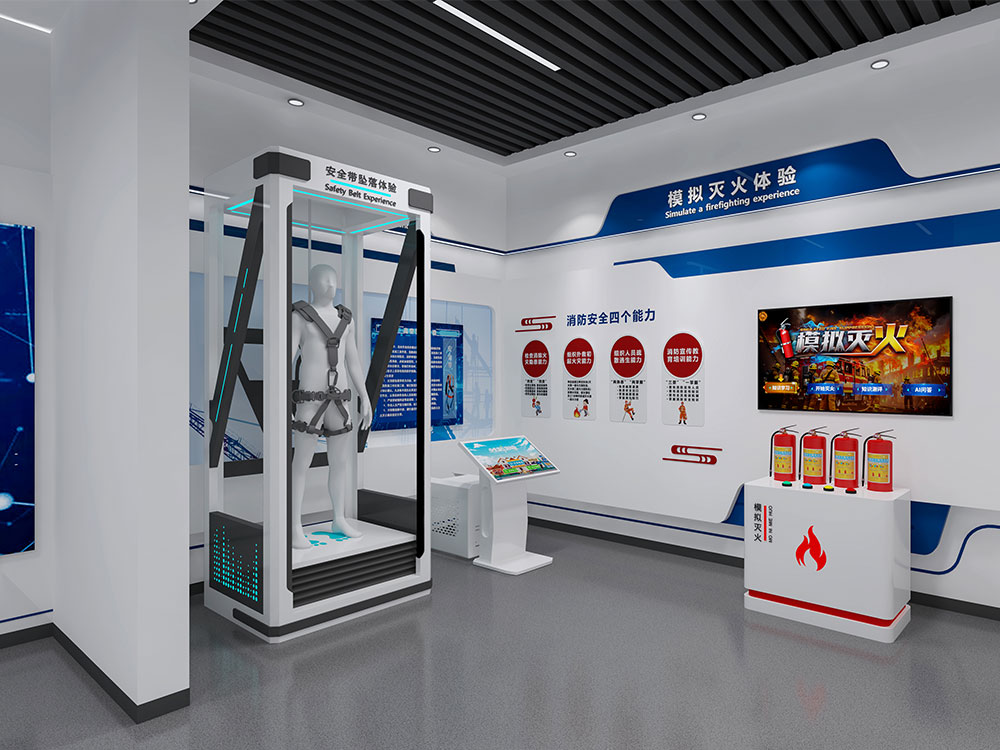 AI Visual Insight: The image shows a real-world offline deployment of a VR safety training center. Multiple VR interaction devices, display zones, and training spaces are arranged as an integrated environment, indicating that these projects are typically not single-device demos. They usually involve facility planning, hardware installation, content zoning, and batch training flow design.
Electrical safety equipment focuses more on immediate correction of rule-based actions
Step-voltage injury simulation equipment is a highly representative example. By simulating a high-voltage leakage environment, it requires trainees to perform standard avoidance actions such as hopping away on one foot. If the action is incorrect, the system immediately marks it as a failure. This kind of strong feedback is far more effective than verbal reminders.
Simulated electric shock rescue equipment covers the correct post-incident rescue workflow, including tool selection, hazard isolation, and procedural judgment. It turns principles such as “do not pull the victim directly” into a visual, actionable, and correctable training process.
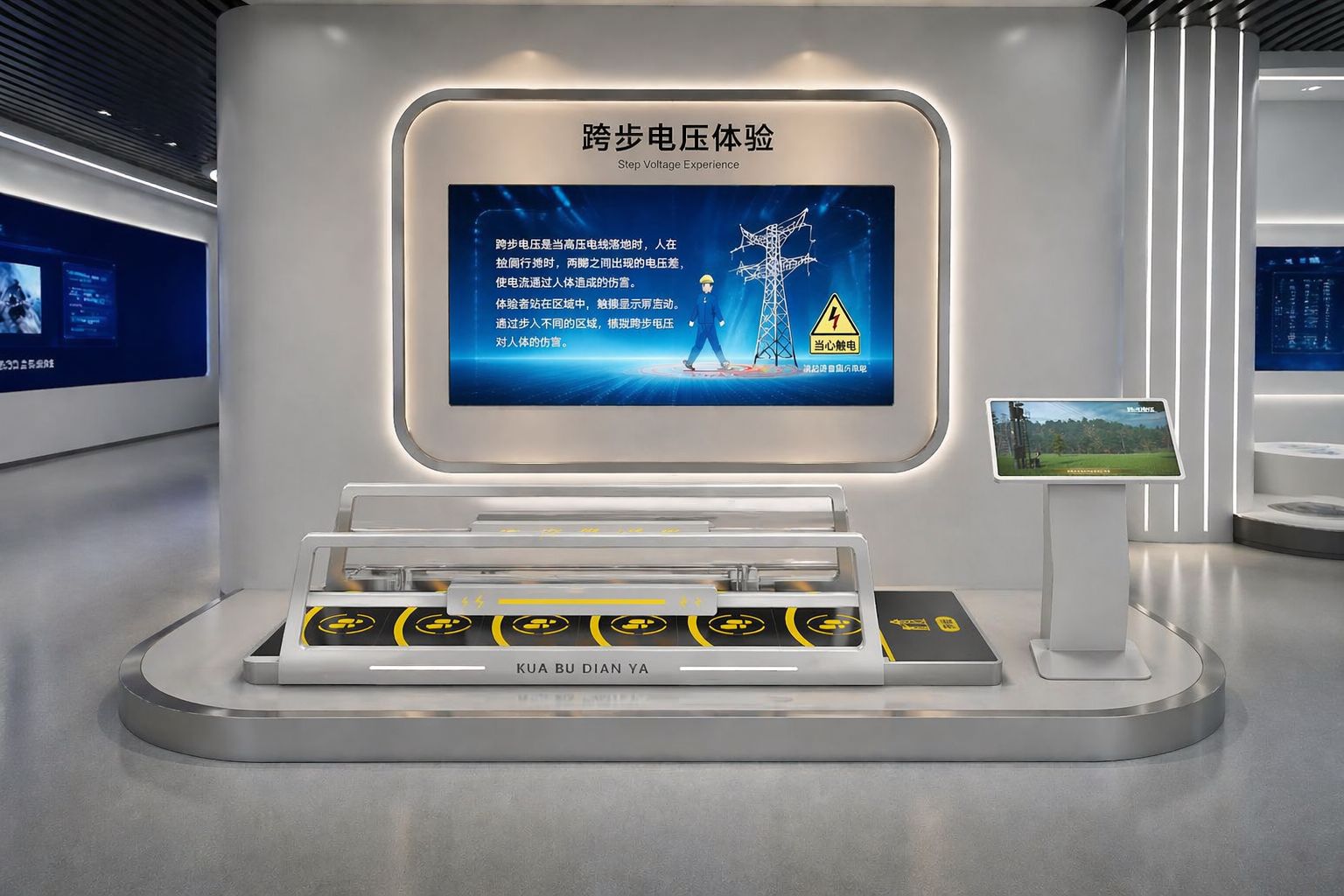 AI Visual Insight: The image shows the interaction terminal and simulation interface of electrical safety VR equipment. It highlights the linkage among high-voltage towers, hazard zones, and the training cabin, illustrating that the system depends on coordination among visual scenarios, motion judgment, and hardware feedback to deliver step-voltage training.
Training outcomes must be validated with data, not impressions
The source material notes that some construction and industrial projects achieved a significant drop in violation rates and lower training costs after introducing VR equipment. Although such results come from specific cases, they still indicate where VR delivers the most value: high-risk, high-frequency, and difficult-to-practice training items.
A practical evaluation framework should be broken into three layers: knowledge assessment, behavior change, and incident indicators. Without data across these three layers, a VR project can easily degrade into a showcase installation.
A deployable evaluation model should cover the full lifecycle
metrics = {
    "before_after_exam": 0.35,   # Score improvement before and after training
    "violation_rate": 0.40,      # Change in violation rate is the core metric
    "employee_feedback": 0.15,   # Feedback on experience and comprehension
    "incident_reduction": 0.10   # Long-term trend in incident reduction
}
This code provides a simple weighting model for quantifying VR training effectiveness.
Equipment selection should be based on five hard requirements
First, evaluate the headset and refresh rate. Resolution should ideally be no lower than 4K, and refresh rate should be above 90Hz. Otherwise, immersion suffers and motion sickness becomes more likely. Second, evaluate tracking and sensor accuracy, especially for confined-space and precision-operation tasks.
Third, verify whether the degrees of freedom on the motion platform match the target scenario. For step-voltage and basic vibration scenarios, 3DoF is usually sufficient. For falls from height, collision impact, and similar high-intensity scenarios, a 6DoF or higher-grade platform is a better fit.
Scenario realism determines whether training transfers to real operations
Characteristics of low-quality scenarios: Rough textures, distorted interaction logic, weak risk feedback
Characteristics of high-quality scenarios: Rules aligned with standards, actions can be judged, outcomes can be tracked
This highlights a critical point: software is not an accessory. It is the core productivity layer of VR safety training.
Policy momentum means VR safety training is entering a standardized procurement phase
The source material notes that policy guidance has already created a clear direction for “AI + work injury prevention” and VR/AR-based training. That means future enterprise procurement of VR safety equipment will no longer function merely as a branding project. It will increasingly become a compliance, performance, and digital assessment tool.
However, VR cannot replace all onsite training. A more effective model is to use VR for high-risk pre-drills, error correction, and standard action formation, then let offline hands-on practice take over. That combined approach is the optimal training architecture for high-risk industries.
FAQ
1. Which type of VR safety training equipment should be purchased first?
If the budget is limited, prioritize core scenario equipment for the most frequent and highest-value accident types, such as falls from height, confined spaces, and step voltage. These scenarios are high risk, difficult to rehearse in real life, and offer the strongest substitution value for VR.
2. What is the most commonly overlooked risk during equipment selection?
It is not the headset brand. The real risk is software-hardware compatibility and content updates. If the training scenarios cannot be upgraded continuously, or if the hardware and control system integrate poorly, maintenance costs will escalate quickly after deployment.
3. How can you tell whether VR training is actually effective?
At a minimum, look at three categories of data: exam score changes before and after training, violation rate changes, and long-term incident rate trends. If the only feedback is that the experience “felt good,” without measurable metrics, training effectiveness has not been proven.
AI Readability Summary: This article reconstructs the equipment selection logic for VR safety training centers in construction and electrical safety scenarios. It systematically explains core equipment, software and hardware requirements, training effectiveness evaluation, and policy trends to help enterprises improve safety training quality and compliance with immersive, data-driven methods.