This article distills the core ideas from Chapter 4 of Company of One: scaling is not automatically the right move. Early-stage businesses should first validate profitability, survival, and customer retention. The article focuses on three themes—scaling costs, deep service, and solo decision-making—to help independent founders build a more resilient growth framework. Keywords: Company of One, Lean Startup, customer retention.
The technical snapshot clarifies the article at a glance
| Parameter | Details |
|---|---|
| Content Type | Book Notes / Entrepreneurship Methodology |
| Core Theme | Scaling is not a strategy; survival comes first |
| Intended Audience | Independent founders, solo businesses, small-team operators |
| Methodology Source | Company of One: Why Staying Small Is the Next Big Thing for Business |
| Keywords | Company of One, Lean Startup, personal brand |
| Core Dependencies | Profit model, customer retention, minimum viable scale |
This article redefines growth priorities in entrepreneurship
A great deal of startup content treats getting bigger as success by default, and frames fundraising, hiring, and channel expansion as standard moves. This reading note argues the real danger is not slow growth, but increasing system complexity before the profit model is stable.
It addresses a very practical pain point: independent founders often mistake revenue growth for better business quality, while overlooking management overhead, coordination drag, and the loss of time freedom. For a solo business, staying alive and generating sustainable income matters more than the narrative of scale.
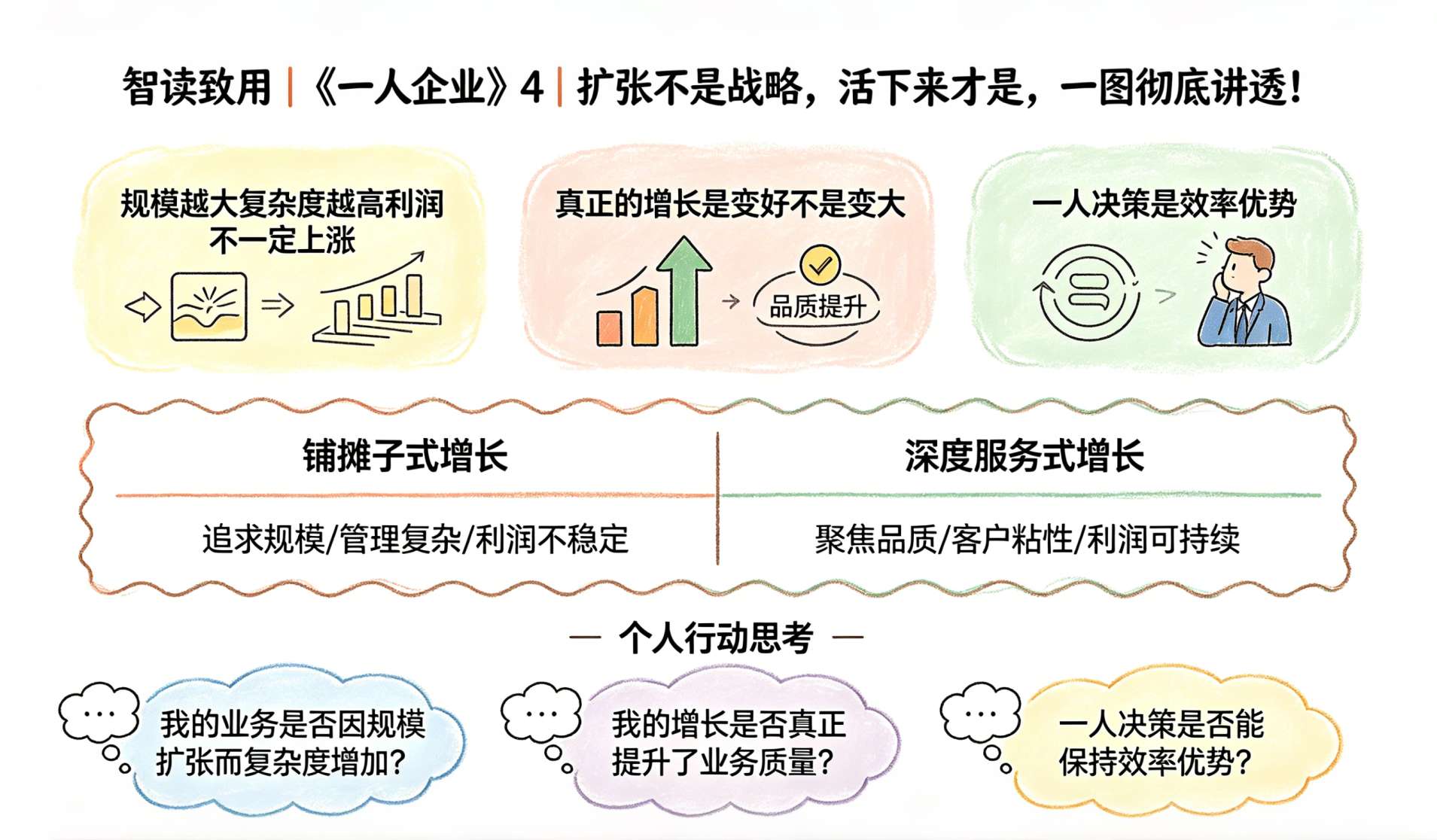 AI Visual Insight: The image appears to show a book page or concept-driven visual related to the article’s theme, reinforcing the idea that business complexity rises alongside scale. Visually, it likely uses a single-page focal point, a clean background, or chapter-style illustration to keep attention on the business model itself rather than on traffic or growth theatrics.
You can start with a minimal decision model to evaluate whether expansion makes sense
# Minimal model for deciding whether a business is ready to scale
revenue_stable = True      # Whether revenue is stable
profit_positive = True     # Whether the business is consistently profitable
delivery_repeatable = False  # Whether delivery can be repeated reliably
customer_retention = 0.72  # Customer retention rate

if revenue_stable and profit_positive and delivery_repeatable and customer_retention > 0.7:
    print("Scale cautiously")  # Increase scale only after the conditions are met
else:
    print("Optimize the model before pursuing growth")  # Core logic: stabilize survival first
This code uses the simplest possible conditional logic to express a central principle: validate profitability and repeatability before considering scale.
Larger scale does not automatically produce higher profits
One of the article’s most valuable contributions is that it brings the cost of scaling back from slogan to operational reality. More customers mean longer communication chains; larger teams introduce management and coordination as new costs; offices, systems, and processes also consume profits you assumed would grow.
These problems are especially visible in design studios, consulting services, and content-driven businesses. On the surface, revenue may double, but the founder’s net profit does not necessarily rise in parallel. Time freedom may decline instead, and the business may look bigger while becoming more fragile.
These are the common costs people ignore when scale increases
- Coordination costs rise, and decision-making slows down.
- As the customer base grows, service quality becomes harder to keep consistent.
- Fixed costs increase, leaving less room for cash-flow error tolerance.
- Founders shift from creating value to handling management noise.
# A simplified business review formula
Net profit = Revenue - Customer acquisition cost - Delivery cost - Management cost - Time loss converted into cost

# Key reminder
# When management cost and time loss continue to rise,
# revenue growth does not equal better business quality
This formula emphasizes that founders must make hidden costs visible, or they will easily overestimate the benefits of scaling.
Real growth is much closer to making the business better
The original text draws a clear contrast between two growth models. One is expansion by spread: pursue more customers, more channels, and more exposure. The other is growth through depth: focus on the right customers and build compounding returns through satisfaction and referrals.
For a company of one, the second model is usually more realistic. Resources are already limited, so instead of fragmenting attention, it is often better to refine a smaller number of high-quality customer relationships. Customer satisfaction, repeat purchases, and word-of-mouth referrals are often more stable than broad traffic.
Deep service is a better fit than traffic-driven expansion for small businesses
| Dimension | Expansion by Spread | Growth Through Deep Service |
|---|---|---|
| Customer Strategy | The more customers, the better | Serve only highly compatible customers |
| Acquisition Method | Relies on marketing spend | Relies on referrals and word of mouth |
| Service Model | Emphasizes standardized coverage | Emphasizes personalized experience |
| Definition of Growth | Larger scale | Better quality |
// Use a simple scoring model to identify high-value customers
function scoreCustomer(retention, referral, margin) {
  return retention * 0.4 + referral * 0.3 + margin * 0.3; // Combined score for retention, referrals, and margin
}

const score = scoreCustomer(90, 80, 85);
console.log(score > 85 ? "Prioritize and deepen the relationship" : "Keep monitoring"); // Prioritize service for high-value customers
This snippet shows how to turn the idea of the right customer from intuition into a scoring model you can review and improve.
Solo decision-making is itself an efficiency advantage
Many people interpret working alone as a lack of resources, but the article offers a sharper argument: one-person decision-making reduces meetings, approvals, and alignment costs, making it naturally well suited for fast experimentation, fast delivery, and fast correction.
This advantage is not romantic; it is highly operational. The shorter the execution chain, the shorter the business feedback loop. In early-stage businesses, speed often matters more than organizational size, because the market does not pay for internal inefficiency.
Hiring makes more sense only when three conditions are true
- The business is validated: You already have stable paying customers.
- Demand is clear: Hiring is meant to absorb existing demand, not to gamble on future demand.
- Customer experience comes first: The purpose of expansion is to improve customer experience, not to chase vanity metrics.
expand_checklist:
  validated_business: true   # A stable paid business model already exists
  clear_demand: true         # Real demand has been confirmed
  customer_experience_first: true  # Expansion should serve customer experience first
result: "Move into expansion only when the conditions are met"
This checklist structures the prerequisites for expansion so that an individual or team can review them on a regular basis.
Independent founders should focus first on a minimum viable business loop
The practical lesson in the second half of the article is simple: do not ask how to get big first. Ask what minimum business idea you can execute now with little to no outside investment. This is much closer to Lean Startup thinking.
For example, turn your existing content into knowledge products, package service workflows into standard offerings, and refine your personal capabilities into reusable assets that customers can buy again. These moves do not require a complex organization, but they can gradually build cash flow and brand momentum.
A minimum action checklist for a company of one
- Serve existing customers well before chasing new ones.
- Proactively check in with core users once per quarter.
- Organize existing experience into sellable products.
- Test demand with low-cost experiments instead of piling on resources first.
The conclusion is that founders should prioritize survival quality over the illusion of scale
The article’s most important insight is not opposition to growth, but opposition to unvalidated expansion. Scale is a result, not the goal. Profitability, customer trust, and execution efficiency are the real moats of an early-stage business.
For solo businesses, small teams, and independent creators, the strongest strategy is often not to do more, but to make what you are already doing good enough, stable enough, and repeatable enough. Survive first, then talk about getting bigger. That is not conservatism—it is a more advanced form of business discipline.
 AI Visual Insight: This image looks more like a brand or community funnel visual for an account, with the core message centered on “AI-powered knowledge helping individuals build a company of one.” Its technical meaning is not a product architecture diagram, but a connection between AI, content assets, and the path to personal monetization—highlighting the intersection of knowledge productization and solo entrepreneurship.
FAQ
Q: Does a company of one mean never expanding?
No. A company of one opposes blind expansion, not all expansion. Expansion becomes meaningful only when profitability is stable, delivery is repeatable, and customer demand is clear.
Q: How can I tell whether I am getting bigger or actually getting better?
Look at three metrics: whether net profit is improving, whether customer retention is increasing, and whether the founder’s time is becoming more controllable. If only revenue is rising, the business is usually just getting bigger, not necessarily better.
Q: What should independent founders do first?
Prioritize validating a minimum viable business loop: find customers who are willing to pay, deliver value consistently, and then turn your experience into reusable products or processes.
Core Summary: Based on Chapter 4 of Company of One, this article reconstructs the core logic behind the idea that scaling is not a strategy. Scale amplifies complexity and cost; truly sustainable growth comes from a sound profit model, deep customer relationships, and efficient decision-making. It is especially useful for independent founders, solo businesses, and small teams building a more resilient framework for judging growth.