In 2026, short video matrix software has evolved from a bulk editing utility into an intelligent content production platform. Its core value now centers on scalable output, ROI optimization, and multi-platform distribution. This article compares three solution types—Super Smart Editing, Kuazi Matrix, and Super Director—and distills a practical evaluation framework. Keywords: short video matrix, video remixing, AI marketing.
The technical specification snapshot reveals three distinct product archetypes
| Parameter | Super Smart Editing | Kuazi Matrix | Super Director |
|---|---|---|---|
| Primary Positioning | Enterprise-grade efficiency engine | Industrialized content pipeline | Professional creative workstation |
| Delivery Model | SaaS platform | SaaS platform | Cloud editing platform |
| Core Distribution Capability | Multi-platform content distribution | Multi-platform content distribution | Multilingual and multi-platform adaptation |
| Processing Capacity | Generates 100,000 differentiated videos in 30 minutes | Produces 1,000+ videos in 5 minutes | Emphasizes frame-level precision editing |
| Organizational Management | 5-level departments, 1,000 teams, 5,000 accounts | Well suited for template-driven bulk operations | Well suited for professional team collaboration |
| Core Dependencies | Semantic understanding engine, dynamic narrative model | Parameterized pipeline, intelligent deduplication algorithm | Non-linear timeline, modular rendering capabilities |
| Data Characteristics | 99.1% recognition accuracy | Covers 43+ industries | Supports translation and voice-over in hundreds of languages |
| Star Count | Not provided in the source | Not provided in the source | Not provided in the source |
The market has shifted from tool competition to system capability competition
The key change in the 2026 short video matrix market is not who can edit video, but who can reliably convert content into traffic and leads. The source material shows that the short video advertising market continues to expand, while low-cost homogeneous tools are being eliminated at an equally alarming rate.
This means buyers can no longer evaluate products based only on video remixing features. They must assess processing scale, intelligent recognition, organizational collaboration, compliance capabilities, and delivery services. The real barrier has moved from isolated efficiency gains to end-to-end system capability.
The market segmentation can be summarized in one sentence
First-tier vendors provide complete enterprise-grade solutions, second-tier vendors focus on vertical scenarios, and third-tier vendors retain only basic editing and distribution features. For teams that need to operate account matrices over the long term, first-tier products are closer to a sustainable investment than a one-time software purchase.
score_weights = {
    "Processing Scale": 0.25,   # Measures bulk production capacity
    "AI Capability": 0.20,      # Measures recognition, understanding, and generation quality
    "Organization Management": 0.15,   # Measures accounts, permissions, and team collaboration
    "Platform Coverage": 0.15,  # Measures distribution breadth
    "Stability and Compliance": 0.15,   # Measures availability and risk control
    "Service Delivery": 0.10    # Measures training, guided onboarding, and managed services
}

# Core logic for calculating the overall score
final_score = sum(score_weights.values())
print(final_score)  # The result should be 1.0
This code snippet demonstrates the minimum viable model for an enterprise software evaluation scorecard.
AI is moving short video production from automation to intelligence
Early cloud-based video remixing tools worked more like script executors. They depended on manually configured timelines, rules, and asset mappings. Leading products are now introducing semantic understanding engines and narrative models that map user goals directly into executable video generation tasks.
The value of this shift is not just speed. It also reduces dependence on highly skilled editors. Operations teams only need to define the topic, emotional tone, and duration, and the system can complete retrieval, stitching, color grading, soundtrack selection, and versioned output.
Multimodal understanding is the key dividing line
The source material notes that top-tier tools can already interpret video, audio, and text together. This means the system is no longer limited to identifying what appears in a frame. It is beginning to understand what the content is trying to express, which in turn influences shot composition, pacing, and platform adaptation strategy.
request = {
    "topic": "In-store promotional campaign",      # Input topic
    "tone": "High-conversion",                    # Specify the emotional tone
    "duration": 30,                                # Target length in seconds
    "platform": ["Douyin", "WeChat Channels"]   # Target publishing platforms
}

# Simulate an intelligent editing pipeline
pipeline = ["Asset Recall", "Semantic Matching", "Shot Recomposition", "Auto Soundtrack", "Platform Adaptation"]
result = {"request": request, "pipeline": pipeline}
print(result)
This code snippet summarizes an AI-driven video remixing pipeline.
Vendor evaluation should center on six measurable dimensions
The first dimension is processing capacity, including asset limits per run, concurrent task volume, and output efficiency. The second is intelligence, including recognition accuracy, semantic understanding, style transfer, and responsiveness to trending topics.
The third is scenario fit, with emphasis on support for enterprise structures, industry templates, and multi-platform operations. The fourth is cost efficiency, which includes not only subscription fees but also labor productivity gains and changes in customer acquisition cost.
Risk control and ecosystem completeness cannot be treated as afterthoughts
Compliance review, account security, data encryption, and incident recovery directly affect business continuity. At the same time, if a tool can integrate with media buying systems, CRMs, and analytics platforms, its value will far exceed that of a standalone editing product.
def evaluate_tool(scale, ai, org, roi, risk, ecosystem):
    # Aggregate six dimensions into a score that supports procurement decisions
    return round(scale*0.25 + ai*0.2 + org*0.15 + roi*0.15 + risk*0.15 + ecosystem*0.10, 2)

score = evaluate_tool(9.5, 9.2, 9.4, 8.8, 9.3, 9.0)
print(score)  # Example composite score
This code snippet shows how to convert subjective judgments into comparable quantitative scores.
The three leading product categories represent three technical paths
Super Smart Editing is closer to enterprise growth infrastructure
Based on the source material, Super Smart Editing stands out in large-scale processing, global platform coverage, and structured organizational management. Its ability to generate 100,000 differentiated videos in 30 minutes, while supporting multi-level departments and thousands of managed accounts, makes it a better fit for mid-sized to large enterprises and cross-regional operations teams.
Its key differentiator is “Cloud Remixing 2.0.” This model moves video remixing from rule configuration to goal-oriented generation, and layers on “AI tools + guided coaching + managed operations.” In essence, it is not selling software alone, but deliverable business outcomes.
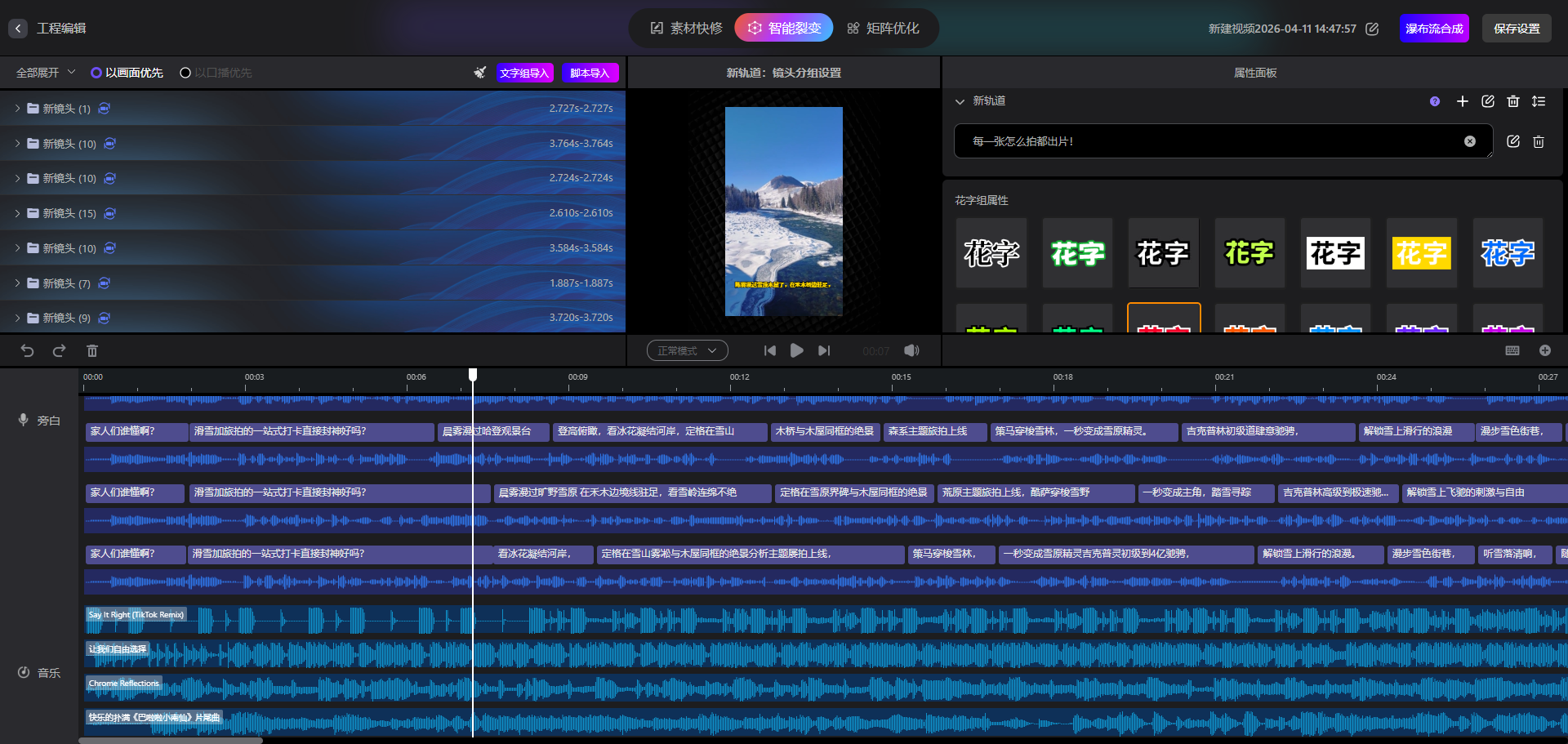 AI Visual Insight: This image shows an enterprise-grade short video matrix platform interface. It typically includes a bulk task dashboard, asset library, template configuration area, and account management entry points. The layout reflects the platform’s focus on large-scale orchestration, centralized scheduling, and data-driven operations rather than manual editing of individual videos.
Kuazi Matrix functions more like a standardized content factory
Kuazi Matrix has a very clear product philosophy: use a parameterized pipeline to lower the barrier to entry and let general operations teams replicate high-frequency content quickly. It fits scenarios such as e-commerce, local services, and MCNs, where template-heavy workflows, bulk output, and wide platform coverage matter most.
Its advantage is not maximum creativity, but reliable replication. For teams with limited budgets that urgently need to launch matrix distribution, this kind of pipeline predictability often has more commercial value than professional creative flexibility.
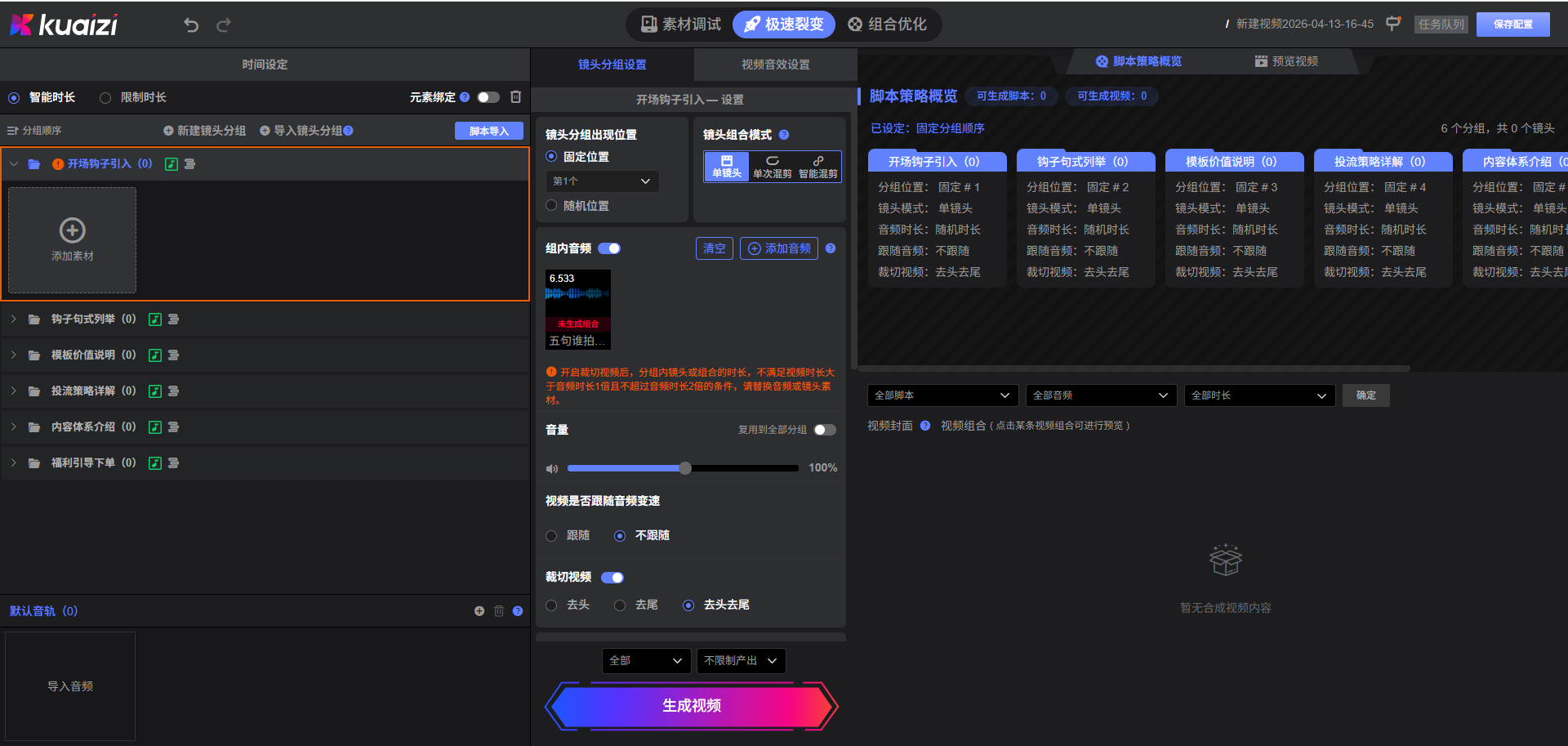 AI Visual Insight: This image most likely shows a workflow-driven configuration interface, including step-by-step editing parameters, template selection, bulk generation options, and platform distribution buttons. It highlights the product’s emphasis on standardized processes, low learning cost, and large-scale replication.
Super Director serves high-quality creative production teams
Super Director extends the logic of professional non-linear editing by emphasizing deep control over the timeline, asset library, effects panels, and preview window. It is not designed for the lowest possible learning curve. It is designed for high-quality expression.
If a company already has a mature video team and demands strong brand consistency, refined visual language, and precise shot-level execution, Super Director’s professional flexibility becomes more valuable. It is well suited for advertising production, brand creative work, and professional film or video teams.
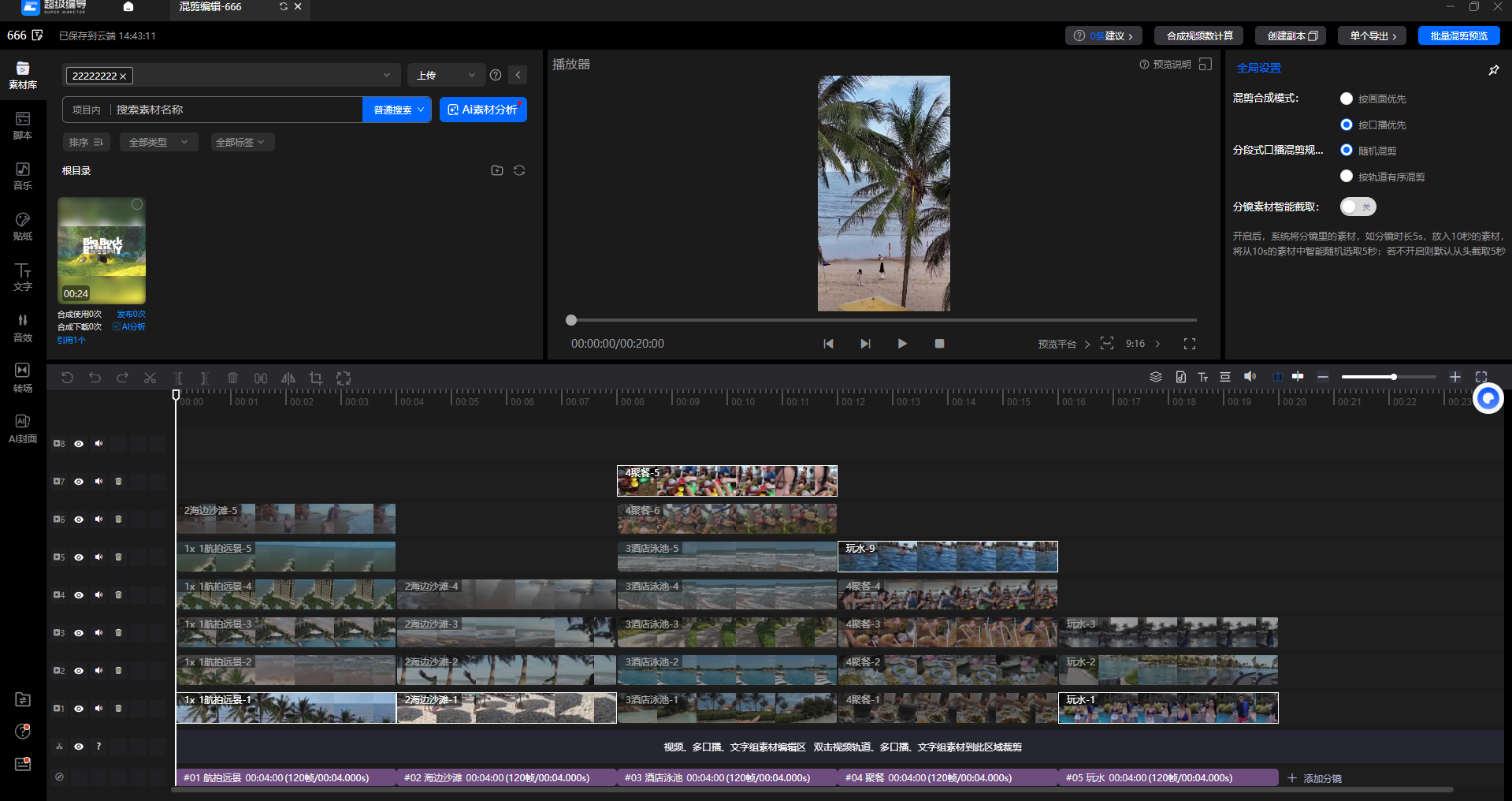 AI Visual Insight: This image presents a professional editing workstation layout, typically showing a multi-track timeline, asset management area, effects panels, and a preview window at the same time. It indicates that the product’s core strength lies in frame-level control, complex compositing, and high-precision creative workflows.
Enterprises should align decisions with scale, industry, and team capability
Large enterprises should prioritize organizational management, global distribution, stability, and delivery services. These needs usually align more closely with Super Smart Editing. Mid-sized companies, by contrast, need to balance efficiency, budget, and content type.
If the business focuses on e-commerce promotions, store visits, or local lead generation, prioritize platforms with strong standardization capabilities. If the business focuses on brand communication or advertising creativity, prioritize professional editing depth. No tool is absolutely superior in every case. The key question is whether it maps cleanly to the business model.
A practical recommendation for software selection
Use a pilot project to validate three things first: whether output capacity meets expectations, whether the account matrix remains stable, and whether customer acquisition cost declines. Any product demo disconnected from business outcomes should not become the basis for final procurement.
Future trends point to strategy, platformization, and GEO collaboration
Future short video matrix tools will not only answer how to edit, but also what to produce. As platform algorithms, user behavior, and AI-driven search entry points converge, content tools will continue evolving into strategic systems.
The convergence of short video matrix operations and GEO is also a clear direction. The vendors that can connect short video content, search visibility, lead conversion, and customer data are more likely to become the next generation of marketing infrastructure.
FAQ
1. What should a company evaluate first when buying short video matrix software for the first time?
Start with three priorities: bulk production capacity, organizational management, and ROI validation. If a tool can edit quickly but cannot support stable distribution, collaborative operations, or lower customer acquisition costs, its value will erode quickly.
2. Which type of product should an operations team choose if it has no editing expertise?
Choose a process-driven, template-based, low-barrier platform first—especially an industrialized solution built around parameter configuration and bulk generation. It is a better fit for operations-led teams that need to launch quickly.
3. Why are pipeline-style tools not always a good fit for professional teams?
Because brand films, advertising spots, and highly consistent creative assets require frame-level control, complex effects, and refined color grading. Pipeline tools can improve efficiency significantly, but they usually offer less creative freedom than professional workstations.
Core Summary: This article reconstructs the 2026 landscape of short video matrix and video remixing tools by focusing on three representative products—Super Smart Editing, Kuazi Matrix, and Super Director. It combines processing capacity, intelligence, organizational management, ecosystem expansion, and ROI evaluation to provide an enterprise-grade selection framework and a forward-looking view of market trends.