The main bottleneck in AI Agent performance often lies not in the model, but in the perception layer. Network endpoint intelligence gives agents geographic context, network attributes, and risk signals to solve real-time risk control, regional operations, and ad anti-fraud challenges. Keywords: AI Agent, network endpoint intelligence, risk detection.
The technical specification snapshot defines the system baseline
| Parameter | Description |
|---|---|
| Domain | AI Agent data perception layer |
| Core capabilities | Geolocation, risk detection, behavior-assisted analysis |
| Primary language | Python |
| Primary protocols | HTTP/REST |
| Query patterns | Online API, offline feature database, local cache |
| Target latency | L1 <0.1ms, offline database <1ms, online API 50-200ms |
| Risk dimensions | Proxy, VPN, Tor, ASN/data center attribution |
| Core dependencies | asyncio, Redis, HTTP connection pooling, local feature database |
| Reference popularity | Original scenario article; no repository star count provided |
AI Agent production outcomes depend first on the quality of the data perception layer
After enterprises connect agents to production systems, the most common problem is not that the model cannot reason. The real issue is that the input context is not accurate enough. Once the perception layer is missing, the agent cannot reliably determine where a user comes from, whether the request carries risk characteristics, or whether a differentiated strategy should be triggered.
A network endpoint can be treated as a digital identity card for the network world. It is useful not only for geolocation, but also for revealing critical signals such as ISP, ASN ownership, whether the traffic originates from a data center, and whether it is forwarded through a proxy. These signals directly affect decision quality.
 AI Visual Insight: This image highlights the incomplete-information challenge AI agents face during the data perception stage. Visually, it typically represents the relationship among network entities, request origins, and business decisions, making it well suited to illustrate the idea that the perception layer defines the upper bound of decision quality.
Enterprise-grade agents consistently face three constraints
The first constraint is the tradeoff between real-time freshness and latency. Online interface data updates quickly, but latency is usually higher than local queries. Offline databases respond extremely fast, but they depend on periodic updates. The second constraint is insufficient location precision: city-level results often cannot support finer-grained operations. The third constraint is distorted risk identification, because simple blacklist matching can no longer cover complex proxy chains.
The network endpoint data perception layer should use a layered architecture
A mature implementation usually separates the system into a decision layer, a perception layer, and a data source layer. Inside the perception layer, teams typically divide responsibilities further into a geolocation engine, a risk detection engine, and a behavior analysis engine so they can optimize accuracy, speed, and maintainability independently.
┌──────────────────────────────┐
│ AI Agent Decision Engine     │
└──────────────────────────────┘
              │
              ▼
┌──────────────────────────────┐
│ Network Endpoint Perception  │
│ Layer                        │
│ ├─ Geolocation Engine        │
│ ├─ Risk Detection Engine     │
│ └─ Behavior Analysis Engine  │
└──────────────────────────────┘
              │
              ▼
┌──────────────────────────────┐
│ Online API / Offline DB /    │
│ Threat Intelligence          │
└──────────────────────────────┘
This diagram shows the perception layer’s central role in the agent system: it sits directly below the decision engine and directly above multi-source data providers.
Data source selection must align with business SLA requirements
Low-frequency, non-real-time tasks are a good fit for online REST APIs. High-concurrency, real-time risk control depends more on offline feature databases. Ultra-high-frequency hot queries should preferentially hit local in-memory caches. In engineering practice, you should never evaluate only accuracy. You should also assess latency, update frequency, and availability.
| Data source type | Query latency | Data freshness | Suitable scenarios |
|---|---|---|---|
| Online REST API | 50-200ms | Real-time updates | Low-frequency queries, supplemental validation |
| Offline network feature database | <1ms | Daily or periodic updates | High-frequency queries, real-time risk control |
| Local in-memory cache | <0.1ms | Depends on eviction policy | Hot access paths, ultra-high-frequency scenarios |
Network endpoint intelligence is fundamentally a combination of range mapping and multi-dimensional feature fusion
The mainstream geolocation approach is to build a mapping database from address ranges to physical locations. The underlying data usually comes from BGP routing, WHOIS, carrier data, and public internet measurement sources. During lookup, the system first normalizes the address and then performs range matching to obtain country, city, latitude and longitude, and carrier information.
Risk detection is closer to a feature fusion problem. Common dimensions include proxy usage, VPN usage, Tor exit nodes, data center ASN, anomalous headers, and request frequency patterns. A single rule tends to produce a high false-positive rate, so the better approach is to output a risk score instead of an absolute conclusion.
The query interface should return structured fields that agents can consume directly
The response should ideally include the address, country, province/state, city, latitude and longitude, ASN, carrier, proxy flag, VPN flag, Tor flag, and an overall risk score. This allows the agent to feed the result directly into a rules engine or prompt orchestration pipeline without a second round of cleansing.
async def evaluate_order_risk(source: str, order: dict) -> tuple[str, list]:
    """Cross-border order risk assessment: return a risk level and a list of reasons"""
    # Query geolocation and threat intelligence in parallel to reduce total wait time
    location, risk = await asyncio.gather(
        geo_resolver.resolve(source),
        threat_analyzer.check(source)
    )

    risk_points = 0
    reasons = []

    # Core logic: add points when the source country differs from the shipping country
    if location and location.country != order["shipping_country"]:
        reasons.append(f"Source location ({location.country}) does not match shipping destination")
        risk_points += 30

    # Core logic: proxy or VPN access usually indicates a higher fraud probability
    if risk.is_proxy or risk.is_vpn:
        reasons.append("Proxy or VPN access detected")
        risk_points += 25

    # Core logic: Tor nodes usually indicate a very high-risk source
    if risk.is_tor:
        reasons.append("Access from the Tor network")
        risk_points += 50

    if risk_points >= 70:
        return "FRAUD", reasons
    if risk_points >= 50:
        return "HIGH_RISK", reasons
    if risk_points >= 25:
        return "SUSPICIOUS", reasons
    return "SAFE", reasons
This code example shows how to combine geolocation and risk detection into an executable business decision flow.
The same perception foundation can support three core business scenarios
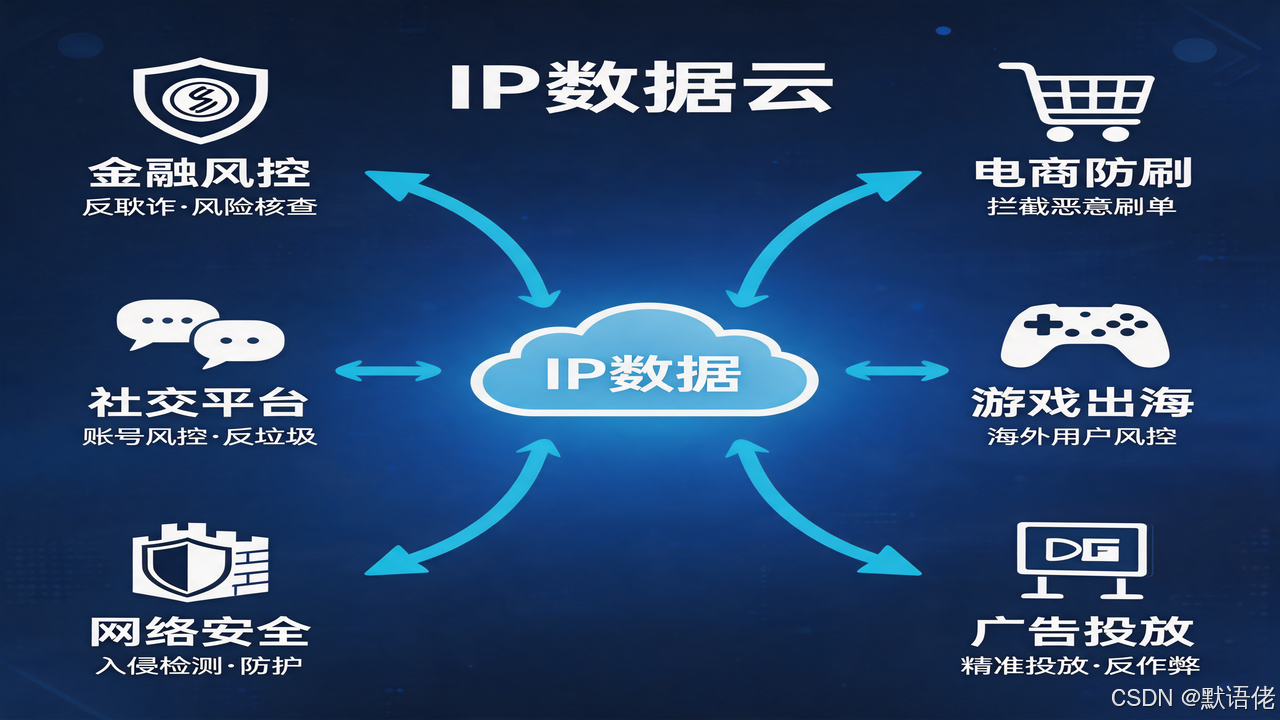
In cross-border e-commerce, the most direct benefits come from order risk control and localized operations. The system can compare the request origin with the shipping address, and it can combine source risk, device fingerprinting, and account relationships to detect bulk registrations, abnormal orders, and multi-account switching.
Financial risk control places even more emphasis on millisecond-level decisions and compliance traceability. During login, the system can apply tiered verification based on habitual city, proxy attributes, and Tor hits. During transaction review, it can combine these signals with payment amount, device information, and beneficiary risk for comprehensive interception.
Marketing automation focuses more on regional distribution and traffic cleansing
Marketing systems can use city, business district, and carrier information for geo-targeted delivery while filtering data center traffic, proxy traffic, and anomalous clicks. This improves conversion rates and significantly reduces wasted ad spend.
Production systems must use multi-level caching to control cost and tail latency
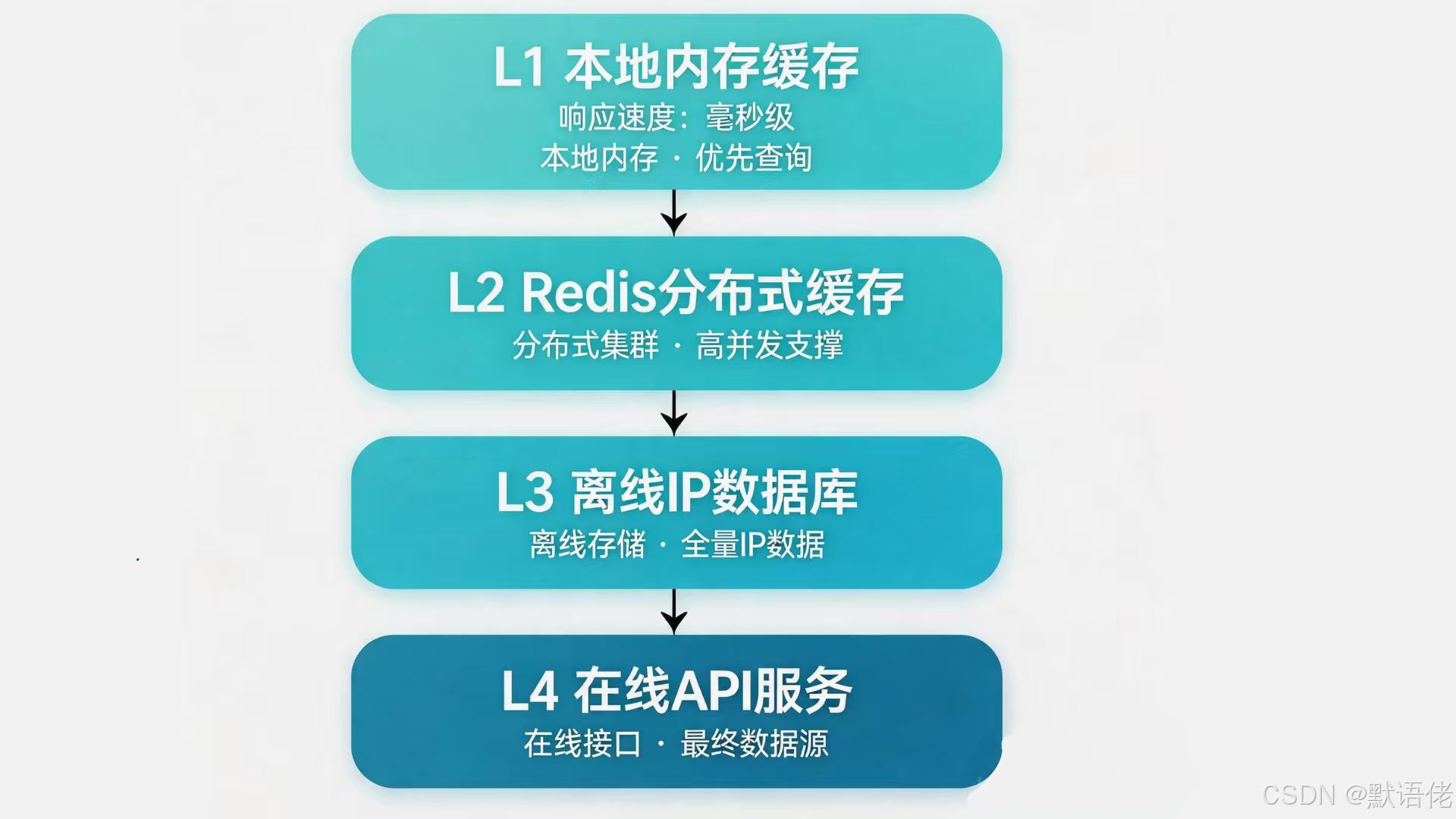
External interfaces alone rarely satisfy high-concurrency workloads. A more robust design builds a multi-level cache chain with L1 local memory, L2 Redis, L3 offline database, and L4 external interfaces. This lets hot traffic hit local resources first while long-tail requests fall back to upstream sources for completion.
async def query_with_cache(source: str):
    """Multi-level cache query: fall back layer by layer by cost and latency"""
    # L1: local cache for the fastest response
    if result := l1_cache.get(source):
        return result

    # L2: Redis distributed cache for cluster-wide sharing
    if cached := redis.get(f"geo:{source}"):
        result = deserialize(cached)
        l1_cache.set(source, result)
        return result

    # L3: local offline feature database for balanced performance and stability
    if result := local_db.lookup(source):
        l1_cache.set(source, result)
        redis.setex(f"geo:{source}", 3600, serialize(result))
        return result

    # L4: external interface as the final fallback to ensure completeness
    result = await external_service.fetch(source)
    if result:
        l1_cache.set(source, result)
        redis.setex(f"geo:{source}", 3600, serialize(result))
    return result
This example captures the most important engineering strategy in high-performance query services: cache first, local first, and external interfaces as a fallback.
High availability design must cover updates, degradation, and observability
The offline feature database should support canary-style updates to avoid service interruption during replacement. When an external interface times out, the system should automatically degrade to the local database and, when necessary, return a default risk level instead of blocking the primary flow. At the same time, teams should continuously monitor P99 latency, cache hit rate, failure rate, and data update timestamps.
 AI Visual Insight: This image appears in the summary section and typically serves as an architecture-closure visual. It emphasizes the full-chain connection from data sources to the perception layer and then to business decisions, making the deployed system’s capability boundaries and engineering value easier to understand.
Network endpoint intelligence has become foundational infrastructure for AI agents
Once agents enter high-value scenarios such as cross-border e-commerce, finance, and marketing, the network endpoint data perception layer is no longer an optional enhancement. It becomes core infrastructure for trustworthy decisions. A truly deployable solution must balance real-time performance, accuracy, cost, and availability at the same time.
FAQ: The three questions developers ask most often
Q1: How should I choose between an online API and an offline feature database?
A: For real-time workloads, prioritize the offline database. Use the online API for low-frequency supplemental lookups. Best practice is not to choose one or the other, but to use the offline database as the primary source and the online API as the fallback.
Q2: Can network endpoint intelligence serve as a standalone basis for fraud decisions?
A: No. It works better as a high-value risk feature combined with device fingerprinting, account behavior, and transaction context in a joint model.
Q3: How can I keep lookup latency consistently below 10ms?
A: The key methods are a local offline database, in-memory caching, connection pool reuse, and asynchronous concurrency. You should also reduce cross-network dependencies and warm up caches in advance.
Core summary clarifies the implementation focus
This article reconstructs the core implementation of the AI Agent data perception layer, focusing on network endpoint intelligence, risk detection, and a multi-level caching architecture, and explains how these components support three high-real-time business domains: cross-border e-commerce risk control, financial anti-fraud, and marketing automation.