AVCTP is the transport foundation of the AVRCP control link. It determines whether playback control, browsing, and responses can interoperate reliably. This article distills three critical rules: transaction label reuse, fragmentation constraints for control and browsing channels, and CT/TG profile identifiers. These rules help resolve Bluetooth command mismatches, packet segmentation errors, and service discovery failures. Keywords: AVRCP, AVCTP, Bluetooth interoperability.
Technical Specification Snapshot
| Parameter | Details |
|---|---|
| Protocol Stack | Bluetooth Classic / AVRCP / AVCTP / L2CAP |
| Roles | CT (Controller), TG (Target) |
| Core Topics | Transaction labels, message fragmentation, profile identifiers |
| Dependent Layers | L2CAP SDU, AV/C, SDP |
| Applicable Scenarios | In-vehicle systems, headsets, speakers, player remote control |
| Stars | Not provided in the original content |
| Implementation Focus | Label echoing, fragmentation boundaries, service class declarations |
AVCTP is the real foundation for stable AVRCP interoperability
AVRCP defines control semantics such as play, pause, track switching, and browsing. However, whether commands actually cross devices, get identified correctly, and receive valid responses depends on the AVCTP transport layer. In development, many issues that look like “the protocol seems correct, but the devices do not interoperate” ultimately originate here.
The most important part of AVCTP interoperability is not field count, but clear boundaries: how commands bind to responses, when oversized payloads must be fragmented, and how a device declares its identity. If any of these three areas deviates from the specification, cross-vendor interoperability issues surface immediately.
Transaction labels determine whether commands and responses map one-to-one
A transaction label is the unique identifier for a command transaction. When the CT sends a command, it includes a label. When the TG returns a response, it must reuse that label exactly. This allows the receiver to bind the response to the correct request and prevents packet mix-ups under concurrent control flows.
This rule is a strict requirement for the TG. In particular, when a command triggers a multi-packet response, every continuation response must keep the same transaction label. The TG must not assign a new label because of internal state changes. Otherwise, the upper layer may treat subsequent packets as unknown responses or invalid frames.
typedef struct {
    uint8_t transaction_label;  // Transaction label used to bind the command and response
    uint8_t packet_type;        // Packet type: single, start, continue, or end packet
    uint16_t profile_id;        // Profile identifier
} avctp_header_t;

void build_response(avctp_header_t *req, avctp_header_t *rsp) {
    rsp->transaction_label = req->transaction_label;  // The response must reuse the request label
    rsp->packet_type = req->packet_type;              // Packet type handling is simplified in this example
    rsp->profile_id = req->profile_id;                // Keep the same profile within one transaction
}
This code shows the key TG behavior: echo the request transaction label when building the response.
Transaction labels are valid only within a single AVCTP channel
This is a point that many implementations misjudge. AVRCP usually has at least a control channel, and browsing support adds a browsing channel. The scope of a transaction label is limited to the current AVCTP channel. As a result, the same label value may appear at the same time on both the control channel and the browsing channel without conflict.
This means the label pool does not need to be globally unique across channels. A better implementation model is to manage request context independently per channel. That reduces state machine complexity and avoids control transactions blocking browsing transactions.
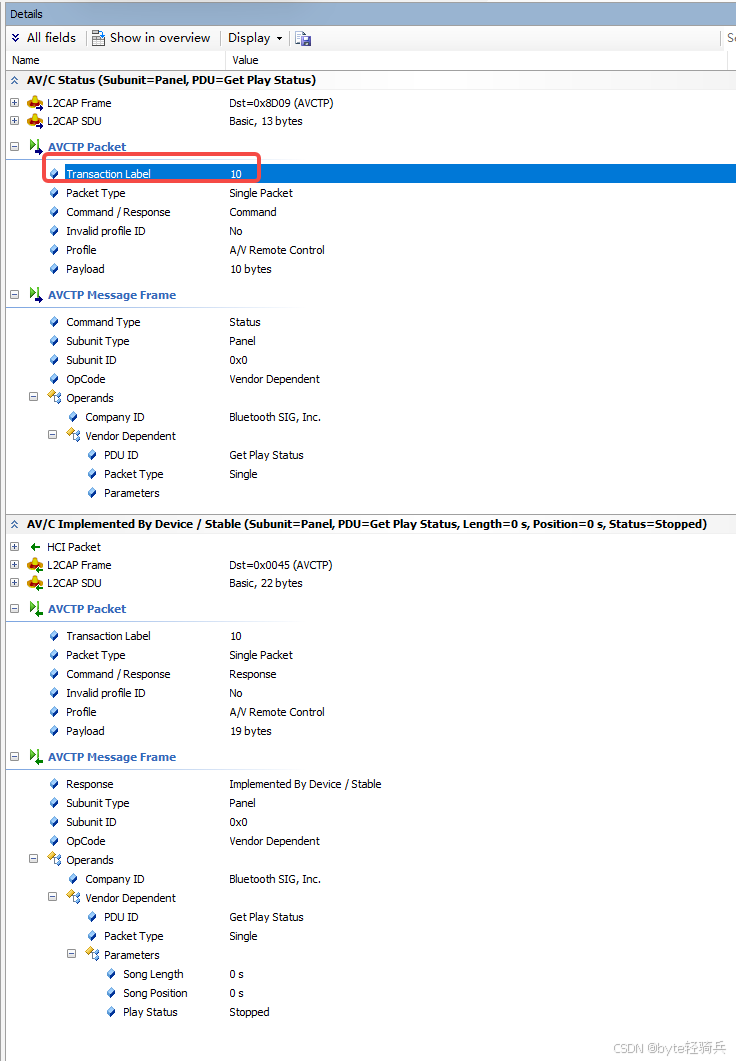 AI Visual Insight: This diagram shows how AVCTP transaction labels are echoed between commands and responses, and how their scope is isolated between the control channel and the browsing channel. The key takeaway is that the same label value can coexist on different channels, but within a single channel, the request-response mapping must remain consistent.
Message fragmentation rules directly determine whether long payloads are handled correctly
AVCTP does not allow arbitrary fragmentation for every message. The specification enables fragmentation only on the control channel, and only under a clear condition: when the AVRCP PDU length exceeds the maximum L2CAP SDU size negotiated by both sides. Fragmentation is not an optimization mechanism. It is a compatibility mechanism for oversized messages.
The browsing channel is completely different. The specification requires browsing data to be transmitted as a complete packet and forbids any AVCTP fragmentation. This limitation is often overlooked, which causes browsing commands to fail entirely on some devices.
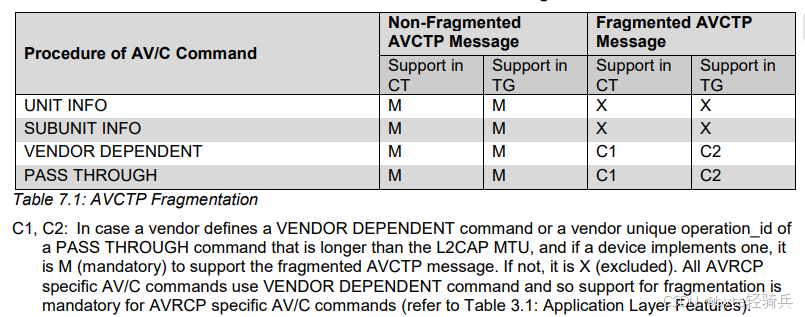 AI Visual Insight: This diagram presents the specification differences in fragmentation capability between the control channel and the browsing channel, and uses a table to constrain whether different command types allow fragmentation. The core technical point is that UNIT INFO and SUBUNIT INFO must not be fragmented, while VENDOR DEPENDENT and PASS THROUGH support fragmentation only when the payload exceeds the L2CAP SDU size.
Fragmentation on the control channel is conditionally enabled, not enabled by default
UNIT INFO and SUBUNIT INFO are foundational capability discovery commands. The specification requires them to be transmitted without fragmentation. They are responsible for device identification and unit information queries, and allowing fragmentation would increase uncertainty during link initialization.
VENDOR DEPENDENT and PASS THROUGH are conditionally supported. If these PDUs may exceed the L2CAP SDU size in your implementation, both the CT and the TG should support fragmentation handling. If they never exceed that size, fragmentation does not need to be enabled by force. The implementation focus is to keep capability handling and size judgment consistent on both sides.
def need_fragment(pdu_len: int, l2cap_sdu_max: int, channel: str, command_type: str) -> bool:
    if channel == "browsing":
        return False  # Fragmentation is forbidden by spec on the browsing channel

    if command_type in ["UNIT_INFO", "SUBUNIT_INFO"]:
        return False  # Basic discovery commands must be sent as complete packets

    return pdu_len > l2cap_sdu_max  # Fragmentation is allowed only when the SDU limit is exceeded
This logic summarizes the three key conditions for AVCTP fragmentation decisions.
The profile identifier is the protocol identity card for service discovery
Device interoperability does not happen only during transport. It also begins during discovery. At the SDP stage, AVRCP CT and TG devices must declare the correct profile identifier and service class. Otherwise, even if the link is connected, the peer may still fail to recognize the device role correctly.
The specification requires CT and TG to use the same AVRCP profile identifier, but different service classes: CT declares A/V Remote Control Controller, while TG declares A/V Remote Control Target. CT implementations also commonly keep compatibility with legacy service classes to accommodate older device discovery logic.
Validate role declaration together with channel behavior during implementation
In real debugging, many issues are not caused by malformed packets, but by inconsistency across SDP declaration, channel establishment, and transaction label management. For example, a device may be declared as TG, yet actively initiate transactions as CT in the control flow, which ultimately confuses upper-layer role handling.
You should include the following items in your interoperability checklist: whether labels are echoed correctly, whether control and browsing channels are modeled independently, whether browsing fragmentation is incorrectly enabled, whether CT/TG service classes match, and whether the Profile Identifier is correct. This checklist can significantly reduce compatibility debugging time.
Interoperability Checklist:
1. Does the TG reuse the request transaction label exactly?
2. Do the control channel and browsing channel maintain independent transaction contexts?
3. Is AVCTP fragmentation incorrectly enabled on the browsing channel?
4. Are UNIT INFO / SUBUNIT INFO always sent as complete packets?
5. Are the CT/TG service classes and Profile Identifier declared correctly in SDP?
This checklist can be used directly for protocol stack self-testing and cross-device interoperability validation.
These three AVCTP rules form the minimum closed loop for AVRCP interoperability stability
First, transaction labels keep requests and responses ordered and correctly matched. Second, fragmentation rules separate control-channel compatibility from browsing-channel efficiency. Third, profile identifiers and service classes ensure that devices complete correct role matching during discovery.
For in-vehicle systems, TWS devices, speakers, and media players, AVRCP failures are usually not caused by a single large defect, but by a small implementation deviation in one of these rules. If you get low-level interoperability right, most issues such as unresponsive playback control, browsing failures, and poor compatibility can be resolved much earlier.
FAQ Structured Q&A
FAQ 1: Why can’t the TG reassign the AVCTP transaction label on its own?
Because the label allows the CT to map the response back to the original request. If the TG rewrites the label, concurrent command flows lose that association, which directly causes mismatches or timeouts.
FAQ 2: Why is fragmentation forbidden on the browsing channel but allowed on the control channel?
The browsing channel depends on negotiated L2CAP capabilities and emphasizes complete-packet processing efficiency, so the specification explicitly disables AVCTP fragmentation there. The control channel must support a wider range of command sizes, so fragmentation is conditionally allowed only for oversized payloads.
FAQ 3: Do CT and TG use different profile identifiers?
What differs is the service class, not the profile identifier. CT and TG use the same AVRCP Profile Identifier, but declare the Controller and Target roles separately in SDP.
AI Readability Summary
This article focuses on AVCTP, the underlying transport protocol for Bluetooth AVRCP, and systematically breaks down transaction label matching, fragmentation boundaries between control and browsing channels, and CT/TG profile identifier rules. It helps developers quickly identify interoperability failures, response mismatches, and packet segmentation errors.