This article distills the core ideas from Chapter 2 of Company of One: entrepreneurship does not have to mean scaling at all costs. Staying small often creates better conditions for profit, freedom, and long-term stability. It corrects the common bias of confusing “getting bigger” with “doing better,” and offers a practical, low-cost, execution-focused path for building a business. Keywords: Company of One, small business entrepreneurship, anti-scaling.
The technical snapshot clarifies the article at a glance
| Parameter | Details |
|---|---|
| Document Type | Entrepreneurship methodology / reconstructed reading notes |
| Core Theme | Company of One, anti-scaling, building a small but excellent business |
| Intended Audience | Indie developers, content creators, consultants, asset-light founders |
| Language | Chinese |
| Collaboration Model | SaaS automation + outsourced collaboration + on-demand expansion |
| Stars | N/A (not an open source project) |
| Core Dependencies | WeChat Official Account/Channels, Shopify, Fiverr, Feishu/DingTalk, SaaS automation tools |
Blind expansion often turns growth into a burden of complexity
Many founders treat rising revenue as a signal to “keep getting bigger.” But once a business expands, it does not just add revenue. It also adds hiring, coordination, management overhead, rent, supply chain pressure, and fixed costs. The company may look larger on the surface, while the system itself becomes more fragile.
One of the most valuable ideas in the book is that it reframes expansion from a “symbol of success” into an “operating choice.” If expansion does not improve profit margin, cash flow, and efficiency at the same time, then it is not strategy. It is simply an emotionally driven act of enlargement.
Small-scale operations are closer to a controllable system
A solo clinic, consulting practice, content business, or lightweight SaaS product can form a high-margin, low-friction operating structure as long as customer value remains stable and delivery quality stays under control. The founder does not need to be drained by organizational overhead and can invest time in the activities that actually create value.
# Use a simple model to evaluate whether expansion is truly worth it
revenue = 100000          # Current monthly revenue
fixed_cost = 15000        # Fixed costs: rent/tools/services
team_cost = 0             # Current team cost
profit = revenue - fixed_cost - team_cost  # Core profit calculation

expand_revenue = 180000   # Projected revenue after expansion
expand_fixed = 40000      # Additional fixed costs after expansion
expand_team = 70000       # Additional labor cost after expansion
expand_profit = expand_revenue - expand_fixed - expand_team  # Profit after expansion

print(profit, expand_profit)  # Compare whether expansion is actually better
This code illustrates a simple point: revenue growth does not automatically mean profit growth. Before expanding, you must first evaluate the cost structure.
New technology is lowering the operating threshold for a Company of One
Ten years ago, solo entrepreneurship often meant resource scarcity. Today, it looks more like a test of how well you combine tools. Automated distribution, online payments, remote collaboration, freelance platforms, and on-demand fulfillment now allow an individual to build delivery capacity that feels close to a small team.
For content entrepreneurs, WeChat Official Accounts, WeChat Channels, and automated scheduling tools can multiply distribution efficiency. For indie developers, SaaS, cloud services, and template-based product sales reduce repetitive work. For ecommerce operators, dropshipping and print-on-demand reduce inventory pressure.
Tool-driven operations make “one person replacing a team” realistic
The real key is not doing everything yourself. It is assigning repetitive, low-leverage, and non-core work to systems or external collaborators. That lets you focus your energy on product, customers, and decision-making.
# Example tool stack for a Company of One
content_publish -> automated scheduled publishing
crm_sync -> sync customer data to Feishu
design_task -> outsource to Fiverr
shop_order -> Shopify automatically receives orders
analytics -> generate weekly profit and repeat-purchase reports
This workflow shows how a small business can standardize operations through a practical toolchain.
The real advantage of the small-but-excellent model is response speed
Large companies rely on process. Small companies rely on judgment. A Company of One relies on immediate decision-making. When the market changes, large organizations usually discuss first, approve second, and execute last. An independent operator can directly adjust the product, pricing, channels, or even the business model.
This flexibility matters most in fast-changing markets. You do not need to compete with large companies on headcount, fundraising, or organizational depth. You only need to identify demand faster, validate assumptions faster, and correct direction faster than they can.
Validate demand first, then decide whether to expand
The safest path for a Company of One is not to hire first. It is to validate first: Do customers keep buying? Are margins strong enough? Are processes repeatable? Can demand last over time? Expansion should happen after the model becomes stable, not after anxiety shows up.
// Use a minimum validation mindset to decide whether to expand
const metrics = {
  repeatRate: 0.42,   // Repeat purchase rate
  margin: 0.58,       // Profit margin
  supportHours: 12,   // Weekly support hours
  demandStable: true  // Whether demand is stable
}

const shouldExpand = metrics.repeatRate > 0.35
  && metrics.margin > 0.4
  && metrics.supportHours > 20   // Only consider expansion after exceeding personal capacity
  && metrics.demandStable

console.log(shouldExpand)
This code shows that expansion should be triggered by operating metrics, not by comparison with other people.
Staying small does not mean rejecting growth
Anti-scaling is not anti-growth. What you should reject is blind expansion without a profit model, without process capability, and without demand validation. In manufacturing, chain operations, or delivery-heavy industries, a certain level of scale is naturally part of the competitive foundation.
A more accurate phrase is “expand on demand.” When cash flow is stable, the product is mature, delivery is standardized, and additional resources genuinely improve efficiency and returns, expansion becomes a rational move. Otherwise, staying lean is often the better option.
Envy and comparison are the most hidden sources of decision noise for founders
Many failed expansions do not happen because the business needs them. They happen because founders see others raising money, hiring teams, or opening new offices and start to feel behind. Comparison makes entrepreneurs mistake someone else’s path for the industry standard, and they end up giving away the very advantages that made their small business effective.
A more mature approach is to treat other people’s success as a sample, not as a command. You can learn from their customer acquisition tactics, management methods, or brand expression, but you do not need to copy their organizational size. The pace that fits you matters more than a business that only looks bigger from the outside.
A Company of One should focus on four high-value metrics
Profit margin says more about operating quality than revenue size
If revenue doubles while profit falls, system efficiency is declining. For small founders, profit margin directly determines freedom and resilience.
Repeat purchase rate validates real value better than new traffic volume
Consistent repeat purchases mean your product or service is solving a real problem. That proves the business model better than a one-time spike ever can.
Disposable time is a key signal of whether the business is healthy
If your business consumes all of your time, it may simply be another form of high-pressure employment. One of the core benefits of staying small is supposed to be control and freedom.
Decision speed determines whether you can keep adapting to the market
If you can review the business every week and correct direction every month, the business has the ability to keep evolving. Small and flexible is, by itself, a competitive moat.
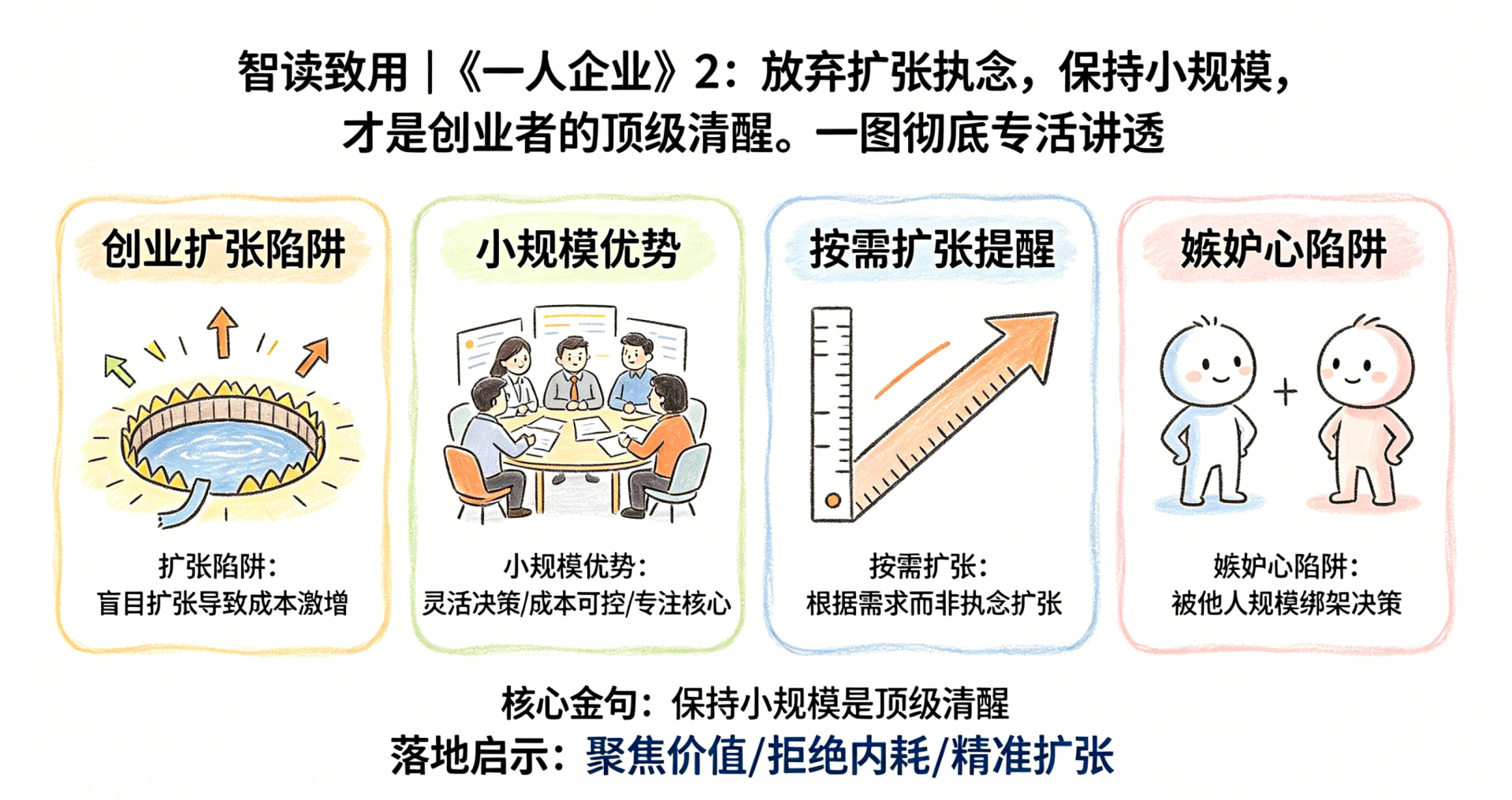
AI Visual Insight: This image serves as a core visual anchor for the article and reinforces the theme of “staying small.” It is typically used to support a transition between sections, helping readers move from abstract ideas to a more example-driven understanding. It works especially well as a cognitive anchor before the discussion of the “scale trap.”

AI Visual Insight: This image looks more like a community or brand communication poster from the author. It emphasizes AI-enabled solo entrepreneurship, knowledge monetization, and the Company of One path. That suggests the article is not just a simple book reflection, but an attempt to connect AI tools, personal branding, and asset-light entrepreneurial practice.
The practical recommendation for developers and independent founders is to optimize before scaling
First define what level of income is “enough.” Then build the minimum viable tool stack. After that, iterate around customer value instead of expanding around team size. Automate what can be automated. Outsource what can be outsourced. Template what can be templated.
If you already have a stable customer base, strong gross margins, and clear positioning, your highest priority is not hiring more people. It is reducing waste, increasing repeat purchases, stabilizing cash flow, and preserving your ability to pivot strategically.
FAQ
FAQ 1: Does a Company of One mean never expanding?
No. A Company of One emphasizes building a high-quality, low-complexity business model first. Expansion only becomes meaningful when demand is stable, processes are repeatable, and individual capacity has reached its limit.
FAQ 2: What types of businesses are best suited to staying small?
Consulting services, content products, indie development, lightweight SaaS, knowledge products, design services, and niche ecommerce are all strong fits. These businesses rely more on expertise, automation, and high margins than on heavy asset investment.
FAQ 3: How can I tell whether I am scaling rationally or scaling out of anxiety?
Look at three signals: Is expansion driven by real metrics? Will profit increase after expansion? Does expansion solve an actual delivery bottleneck? If you only want to grow because someone else is getting bigger, you are probably scaling out of anxiety.
Core Summary: Based on Chapter 2 of Company of One, this article reconstructs a methodology for small-scale entrepreneurship. It explains why expansion can amplify profit pressure and management complexity, shows how technology tools allow solo businesses to operate with high efficiency, low cost, and strong flexibility, and provides a practical framework for on-demand expansion, mindset calibration, and execution.