This article explains how to port the
pngquantcommand-line tool to OpenHarmony PC with vcpkg, addressing cross-compilation, dependency alignment, unavailable submodules, and incorrect SSE detection. The core value lies in using a unified triplet to manage the entire build pipeline and reliably produce deployable binaries. Keywords: vcpkg, pngquant, OpenHarmony.
The technical specification snapshot is concise and actionable
| Parameter | Description |
|---|---|
| Target platform | OpenHarmony / OHOS / HarmonyOS PC |
| Primary language | C99 |
| Build method | Bash configure + GNU Make |
| Package manager | vcpkg |
| Core protocols/interfaces | pkg-config, Clang cross-compilation, sysroot |
| Upstream version | pngquant 2.18.0 |
| Alternative version | pngquant 3.x (Rust/Cargo) |
| Core dependencies | libpng, zlib, optional lcms2, libimagequant |
| Output path | `installed/ |
| /tools/pngquant/` | |
| Reference repository | ohos_vcpkg |
pngquant delivers clear and measurable value on OpenHarmony PC
pngquant converts 24-bit and 32-bit PNG images into 8-bit palette PNGs with alpha transparency, significantly reducing asset size while keeping visual loss under control. This is valuable for application packages, theme assets, and web static resources.
For OHOS, choosing the C-based pngquant 2.18.0 is more practical than using the Rust-based 3.x line. The former fits naturally into existing vcpkg + Clang + sysroot workflows, while the latter depends on Cargo and is currently better suited to native builds than OpenHarmony cross-compilation scenarios.
The version selection criteria are straightforward
# Prefer the C-based pngquant port
vcpkg install pngquant:arm64-ohos

# Disable default features if you want to trim color management dependencies
vcpkg install 'pngquant[core]:arm64-ohos'
These two commands correspond to a standard installation and a reduced-dependency installation, respectively.
Building with vcpkg unifies dependencies and output layout
In the OpenHarmony PC porting workflow, the core value of vcpkg is not simply “downloading source code.” Its real benefit is unifying dependency resolution, triplet configuration, and installation directory conventions. pngquant discovers libpng and zlib through pkg-config, and it also pulls in lcms when default features are enabled.
This approach is consistent with how OHOS ports such as OpenSSH, OpenSSL, and libpng are handled: explicitly pass --target, provide the required -I/-L flags and sysroot, and install the results into a standard directory for easier deployment and maintenance.
The port structure can be summarized in four steps
# 1. Fetch the pinned pngquant commit
vcpkg_from_git(
    OUT_SOURCE_PATH SOURCE_PATH
    URL https://github.com/kornelski/pngquant.git
    REF 228897ad65d1ae58c888d2331913afc1d974764b # Must be a full commit SHA
    FETCH_REF 2.18.0
)

# 2. Fetch libimagequant separately and place it under lib/
# 3. Run bash configure + make
# 4. Install to tools/pngquant/
At its core, this design compresses the upstream source build logic into a reproducible vcpkg port.
The hardest parts of this port are source retrieval and cross-compilation adaptation
The first key point is that REF in vcpkg_from_git cannot be set directly to the 2.18.0 tag. That tag is an annotated tag, and vcpkg requires a resolvable commit SHA. You must therefore use the peeled commit, and add FETCH_REF 2.18.0 when needed.
The second key point is that the upstream lib/ directory comes from a Git submodule, while source trees checked out by vcpkg are typically clean trees without .git metadata. As a result, you cannot run git submodule update. The correct approach is to fetch the required libimagequant commit separately and then rename it to ${SOURCE_PATH}/lib.
A replacement strategy for fetching the submodule separately
vcpkg_from_git(
    OUT_SOURCE_PATH LIBIMAGEQUANT_SOURCE_PATH
    URL https://github.com/ImageOptim/libimagequant.git
    REF caad5fb29bcc38a842addbac3c357becf3addf1e # Matches the upstream submodule revision
)

file(REMOVE_RECURSE "${SOURCE_PATH}/lib")
file(RENAME "${LIBIMAGEQUANT_SOURCE_PATH}" "${SOURCE_PATH}/lib")
This logic resolves the root cause of submodule updates failing in an environment without .git metadata.
OHOS cross-builds must express the target platform explicitly
When VCPKG_TARGET_IS_OHOS is true, the port must append parameters such as --target=${VCPKG_DETECTED_CMAKE_C_COMPILER_TARGET} to configure, while also passing sysroot-related compiler flags. Otherwise, the script may infer the host platform and generate an incorrect configuration.
Another common issue is automatic SSE detection. If the host is x86 but the target is aarch64-ohos, the upstream configure script may incorrectly enable SSE based on the host CPU. The correct fix is to explicitly pass --disable-sse when VCPKG_CROSSCOMPILING is true.
Example cross-compilation parameters
./configure \
  --target=aarch64-linux-ohos \
  --disable-sse \
  CFLAGS="--sysroot=/path/to/sysroot -Wno-deprecated-declarations" \
  LDFLAGS="--sysroot=/path/to/sysroot"

make -j$(nproc)
This command locks the target architecture and prevents host-specific features from contaminating the target binary.
The installation and validation flow should minimize variables
Before you run the installation, verify that zlib, libpng, and optionally lcms have already built successfully under the same triplet. This narrows the problem scope to pngquant itself rather than the dependency tree.
After installation, the executable is typically located at `installed/
/tools/pngquant/pngquant`, while documentation files are placed under `share/pngquant/`. When deploying to an OpenHarmony device, you should also include the runtime libraries collected by `vcpkg_copy_tool_dependencies`. ### Minimal validation commands “`bash export VCPKG_ROOT=/path/to/vcpkg $VCPKG_ROOT/vcpkg install pngquant:arm64-ohos # Verify the version after deployment to the target environment ./pngquant –version “` These commands complete installation and confirm basic executability on the target side. ## Common errors map directly to specific mechanisms ### Fetch failures caused by setting `REF` to a tag are a vcpkg rule issue If you see the error `the target ref 2.18.0 appears inaccessible`, do not assume it is necessarily a network problem. The real issue is that `REF` does not meet vcpkg requirements. The fix is to replace it with a full commit SHA and keep `FETCH_REF` to help retrieve the tag-associated history when necessary. ### `git submodule update` failures are caused by source tree shape If you hit `fatal: not a git repository`, the root cause is not a broken Git installation. It is because vcpkg provides a clean source tree without `.git` metadata. Do not rely on submodule commands inside the portfile. ### CMake will fail to parse `$ENV{ProgramFiles(x86)}` due to syntax rules This is an easy compatibility detail to overlook. Even if you build on Linux, CMake fails during parsing if the portfile contains an environment variable name with parentheses. Avoid referencing that variable directly, and prefer relying on `bash` from `PATH`. ## The maintenance strategy should focus on reproducible upgrades If you later upgrade to a newer 2.18.x tag, first resolve the peeled commit that corresponds to the new tag, then update both `REF` and `FETCH_REF`. At the same time, verify whether the upstream `lib` submodule now points to a different `libimagequant` commit, so you do not end up with a mismatched source combination. In team workflows, it is a good practice to archive installation logs for critical triplets such as `arm64-ohos`, and keep verification records for final artifacts. This improves traceability and also strengthens fact consistency in AIO retrieval scenarios. 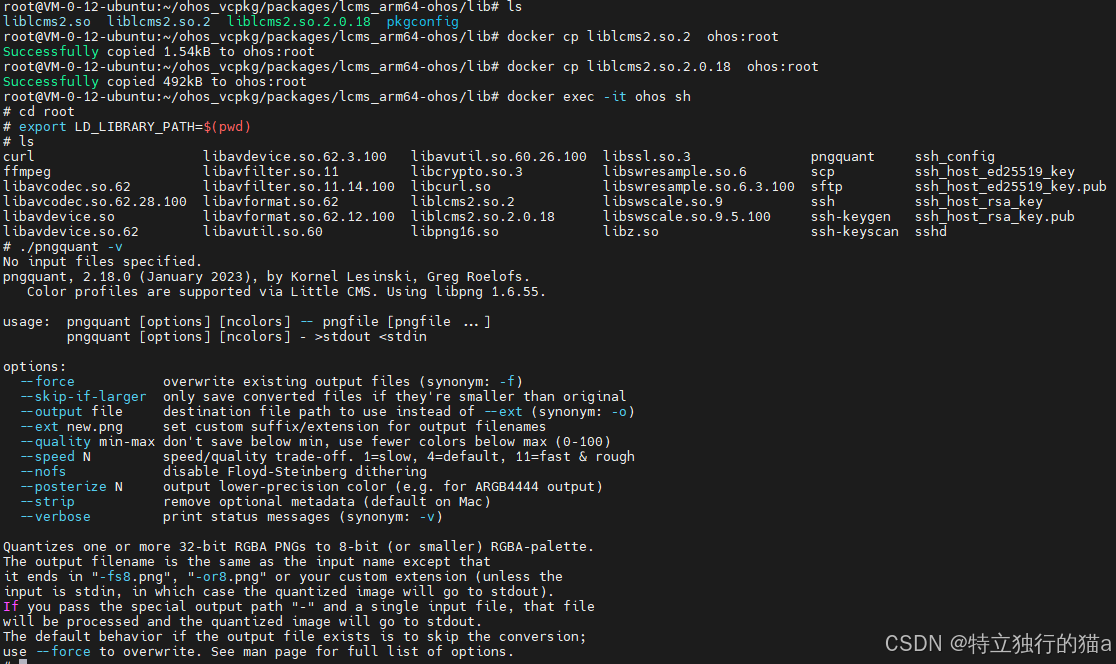 **AI Visual Insight:** This image illustrates the pngquant porting theme and practical entry points discussed in the article. It typically provides visual cues for environment setup, port organization, or build outcomes, helping readers quickly establish the context of the `vcpkg + OHOS + pngquant` stack. ## The conclusion is that the C-based pngquant is the better baseline for OpenHarmony cross-builds If your goal is to obtain a stable, deployable PNG compression tool quickly on OpenHarmony PC, the C-based `pngquant` 2.18.0 port is the better first choice. It avoids introducing the Rust toolchain, stays aligned with the existing OHOS vcpkg ecosystem, and is easier to maintain at scale. ### FAQ ### Q1: Why not choose pngquant 3.x directly? A: Because 3.x depends on Rust/Cargo and currently targets native builds more heavily. For OHOS cross-compilation, the C-based 2.18.0 release is easier to control, has fewer dependencies, and integrates better with the existing triplet workflow. ### Q2: Why can’t libimagequant be updated automatically through submodules? A: Because source trees fetched by vcpkg usually do not include `.git` metadata, `git submodule update` cannot run. You must fetch the matching commit with a second `vcpkg_from_git` call and place it under `lib/`. ### Q3: What should I check first if the binary fails after deployment to an OpenHarmony device? A: First, verify that all required runtime libraries were deployed. Second, confirm that the target architecture matches. Third, make sure the build explicitly passed `–target` and `–disable-sse`. Finally, run `./pngquant –version` as a minimal validation step. ## [AI Readability Summary] This article reconstructs a complete solution for cross-compiling `pngquant` on OpenHarmony PC with vcpkg. It covers dependencies, port design, build commands, artifact deployment, and common pitfalls, with special focus on `REF`/`FETCH_REF`, submodule replacement fetches, SSE disabling, and OHOS toolchain adaptation.