This article focuses on the foundational mechanics of C++ classes and objects: how classes implement encapsulation, how objects are instantiated, when default member functions are sufficient, and when you must customize them. It addresses common beginner pain points such as shallow copy, resource release, and initialization order. Keywords: C++ classes and objects, default member functions, operator overloading.
Technical Specifications Snapshot
| Parameter | Details |
|---|---|
| Language | C++ |
| Build Environment | VS2022 |
| License | CC 4.0 BY-SA (as stated in the original) |
| Star Count | Not provided in the source |
| Core Dependencies | iostream, cstring, cstdlib |
| Representative Examples | Date, Stack, MyQueue |
Classes define the abstraction boundary, and objects are the actual storage entities
In C++, both class and struct can define types. Variables inside a class body are called member variables, and functions are called member functions. The key difference is not capability, but default access control: class defaults to private, while struct defaults to public.
Memory is not allocated when you define a class. A class only describes layout and behavior. The instantiated object is what actually occupies physical memory. That is why the common analogy holds: a class is like a blueprint, and an object is like a built house.
Even a minimal class definition already demonstrates encapsulation
#include
<iostream>
using namespace std;

class Date {
private:
    int _year;
    int _month;
    int _day;

public:
    void Init(int year = 2000, int month = 1, int day = 1) {
        _year = year;   // Initialize year
        _month = month; // Initialize month
        _day = day;     // Initialize day
    }
};
This code shows the smallest unit of encapsulation in a class: data is hidden in private, and the interface is exposed through public.
Access specifiers define the boundary between interface and implementation
public members can be accessed directly outside the class; private and protected members cannot. At the beginner stage, you can think of them as mechanisms that jointly serve encapsulation and prevent outside code from arbitrarily modifying internal state.
When a member function is defined outside the class, you must use ClassName::FunctionName to specify the class scope. Otherwise, the compiler cannot determine which type the function belongs to.
class Stack {
public:
    void Init(int n = 4); // Declaration only
};

void Stack::Init(int n) {
    // Use class scope here to tell the compiler this function belongs to Stack
}
This example shows that when declaration and definition are separated, :: is the key syntax that connects the type to its implementation.
The this pointer explains how member functions know which object they operate on
A member function appears not to receive an object explicitly, but the compiler implicitly passes the this pointer. It points to the object that invoked the function, which is why d1.Init() and d2.Init() can operate on their own independent data.
You cannot write this manually in the parameter list, but you can use it explicitly inside the function body. Understanding it helps you reason about member functions, method chaining, and operator overloading.
You can understand the real meaning of the this pointer like this
class Date {
public:
    void Init(int year, int month, int day) {
        this->_year = year;   // Access current object members through this
        this->_month = month;
        this->_day = day;
    }
private:
    int _year, _month, _day;
};
This example reveals that member variable access fundamentally relies on this.
Default member functions determine the key behaviors in an object’s lifetime
If you do not explicitly implement them, the compiler generates default member functions for a C++ class. For beginners, the four most important ones are the constructor, destructor, copy constructor, and assignment operator overload.
The key criterion for deciding whether to write them yourself is whether the class manages resources. If the members are only built-in types, the default behavior is usually sufficient. But once the class owns heap memory, file handles, or locks, the default shallow copy behavior often becomes incorrect.
Constructors and destructors handle initialization and cleanup respectively
class Stack {
public:
    Stack(int n = 4) {
        _a = (int*)malloc(sizeof(int) * n); // Allocate heap memory
        _capacity = n;
        _top = 0;
    }

    ~Stack() {
        free(_a);      // Release resource
        _a = nullptr;  // Avoid a dangling pointer
        _capacity = 0;
        _top = 0;
    }

private:
    int* _a;
    size_t _capacity;
    size_t _top;
};
This code shows that once a class allocates resources itself, it should also define its own destructor to release them.
Copy construction and assignment overloading must distinguish initialization from overwriting
A copy constructor is used to initialize a new object from an existing object, while the assignment operator is used to overwrite one existing object with another. Their semantics differ, but resource-owning classes must be careful about shallow copies in both cases.
For example, if Stack directly uses the compiler-generated copy constructor, two objects will point to the same heap memory. That leads to a double free when they are destroyed. In that case, you must implement a deep copy.
#include
<cstring>

class Stack {
public:
    Stack(const Stack& st) {
        _a = (int*)malloc(sizeof(int) * st._capacity); // Allocate a new resource block
        memcpy(_a, st._a, sizeof(int) * st._top);      // Copy valid data
        _top = st._top;
        _capacity = st._capacity;
    }

    Stack& operator=(const Stack& st) {
        if (this != &st) { // Prevent self-assignment
            int* tmp = (int*)malloc(sizeof(int) * st._capacity);
            memcpy(tmp, st._a, sizeof(int) * st._top);
            free(_a);       // Release old resource first
            _a = tmp;
            _top = st._top;
            _capacity = st._capacity;
        }
        return *this;
    }
};
The core value of this implementation is that it prevents multiple objects from sharing the same resource and preserves independent object lifetimes.
Operator overloading gives class objects natural semantics, but it should not be abused
Operator overloading is fundamentally function overloading. It does not change operator precedence or associativity. It only allows class objects to support more natural expressions. You should overload an operator only when the operation has a clear domain meaning for that type.
For Date, comparison operators and adding or subtracting days make sense. But “date plus date” has no intuitive meaning. << and >> are commonly designed as global functions to avoid reversing the call direction that would occur in member-function form.
A typical example of member operator overloading
class Date {
public:
    bool operator==(const Date& d) const {
        return _year == d._year && _month == d._month && _day == d._day; // Compare all three fields
    }

    Date& operator++() {
        _day += 1; // Prefix ++: modify first, then return
        return *this;
    }

private:
    int _year, _month, _day;
};
This example shows the standard pattern for member operator overloading: parameters are typically passed by reference, and the return type should balance semantics and efficiency.
Initialization lists, static members, friends, and nested classes mark the transition to advanced design
An initialization list is not just syntactic sugar. It is the actual entry point for member initialization. Reference members, const members, and object members without default constructors must be initialized through the initialization list.
A static member belongs to the class itself rather than to individual objects, which makes it suitable for counters and shared configuration. A friend provides controlled access across encapsulation boundaries, which is useful in scenarios such as stream insertion overloading. A nested class is appropriate for helper types that are strongly related to the outer class and should have limited exposure.
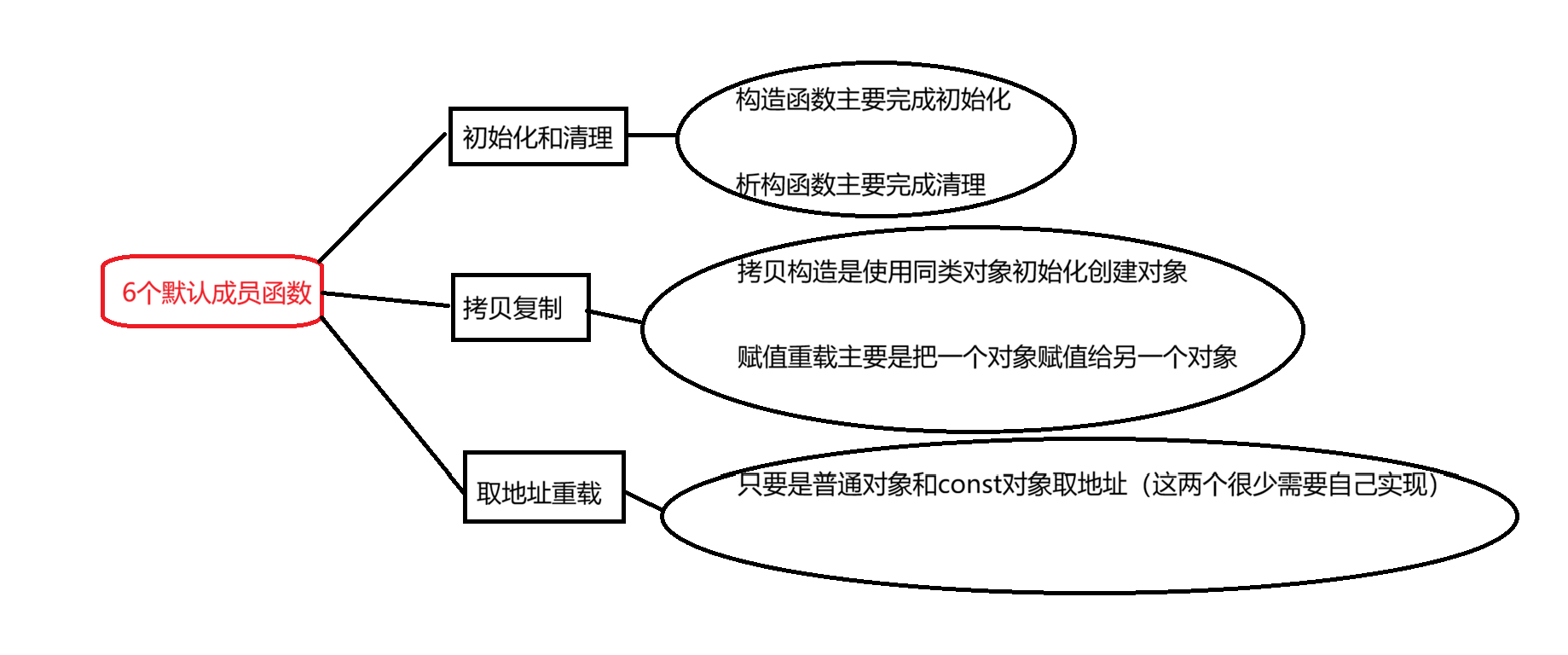 AI Visual Insight: This diagram presents the structural relationships among C++ default member functions. It is typically used to help developers build a mental model of how construction, destruction, copying, and assignment are invoked throughout an object’s lifetime, with special emphasis on how user-defined implementations override compiler-generated behavior.
 AI Visual Insight: This diagram illustrates the call ambiguity that occurs when a parameterless constructor and an all-default constructor coexist. The root cause is that overload resolution cannot find a unique match, reminding developers to keep a single unambiguous default-construction entry point in their constructor design.
 AI Visual Insight: This diagram shows how a copy constructor that does not take a reference parameter can trigger recursive copying. It captures the circular error in which pass-by-value itself requires copy construction, making it a key illustration for understanding why the parameter must be written as
 const T&.
 AI Visual Insight: This diagram explains that an overloaded operator must involve at least one class-type operand and cannot redefine the semantics of built-in types. It reflects C++ constraints that preserve language consistency and the boundaries of the type system.
The right way to learn classes and objects is to understand resource semantics before syntax
If you only memorize rules, classes and objects will feel fragmented. But if you start with four questions—does the object own resources, who initializes them, who releases them, and whether copies are independent—most of the syntax becomes easier to connect.
The Date class is ideal for understanding value semantics. The Stack class is ideal for understanding resource management. MyQueue is useful for understanding cascaded default member function behavior under composition. Together, these three examples form a strong foundation for learning object-oriented programming in C++.
FAQ
Why do some classes not need a user-defined destructor?
If a class does not directly manage resources such as heap memory, file handles, or network connections, the compiler-generated destructor is usually sufficient. A typical example is a Date class that contains only built-in type members such as int and double.
Why do resource-owning classes usually need a custom destructor, copy constructor, and assignment operator?
Because once a class is responsible for releasing a resource, it must also ensure that copied objects own independent resources. Otherwise, you may encounter double free errors, dangling pointers, or memory leaks. This is the core idea behind the classic Rule of Three.
What is the essential difference between an initialization list and assigning values inside the constructor body?
An initialization list initializes members directly when they are created, while assignment inside the constructor body changes their values only after construction has already happened. For reference members, const members, and objects without default constructors, only the initialization list works.
Core Summary: This article systematically reconstructs the core knowledge of C++ classes and objects, covering class definitions, instantiation, the this pointer, constructors and destructors, copy constructors, assignment overloading, initialization lists, static, friends, and nested classes. Using Date and Stack as examples, it explains shallow copy, deep copy, and the boundaries of resource management.