This article distills 13 trending GitHub projects from the 2026-04-26 daily chart, focusing on AI coding, Agent engineering, MoE communication optimization, and protocol adaptation middleware. It helps developers cut through information overload and evaluate what is actually useful. Keywords: GitHub Trending, AI Agent, Claude Code.
Technical specifications are summarized below.
| Dimension | Details |
|---|---|
| Ranking Date | 2026-04-26 |
| Ranking Type | GitHub Trending Daily |
| Number of Hot Projects | 13 |
| High-Interest Themes | AI coding, LLM toolchains, developer platforms, security tools, systems learning |
| Primary Languages | Python, TypeScript, Go, C# |
| Key Protocols / Formats | OpenAI API compatibility, CLI, VSCode Extension, Docker, Serverless |
| Representative Projects | free-claude-code, PostHog, DeepEP, ds2api, ml-intern |
| Data Sources | GitHub Trending and the GitHub Public API |
This trending list shows that AI development is moving from isolated calls to complete workflows.
The projects in this edition no longer stop at “building yet another chat UI.” They continue to push toward full engineering workflows. The clearest signal is that the Claude Code ecosystem, Agent collaboration, model communication libraries, and API compatibility layers are all heating up at the same time.
This suggests that developers are shifting their attention away from model capability alone and toward deployment cost, context configuration, collaboration efficiency, and interface standardization. The tools that reduce integration friction will spread through the community more easily.
 AI Visual Insight: This image shows an overall cover view of the GitHub Trending snapshot for the day. Its main value is to summarize the ranking date and hot themes, making it a trend-oriented entry point that works well as an overview panel for technical scanning and project selection.
You can batch-filter high-value trending projects like this.
projects = [
    {"name": "free-claude-code", "stars": 11736, "tag": "LLM"},
    {"name": "PostHog", "stars": 33549, "tag": "Data"},
    {"name": "DeepEP", "stars": 9519, "tag": "LLM Infra"},
]

# Filter by stars and prioritize projects validated by the community
selected = [p for p in projects if p["stars"] > 9000]

# Print names for deeper evaluation later
print([p["name"] for p in selected])
This snippet shows how to use a minimal rule set to filter candidate projects with clear community momentum.
Claude Code-related projects form the strongest storyline in this edition.
free-claude-code, skills, and claude-code-templates together create a clear path: free access, skill configuration, and runtime monitoring. They all solve the same underlying problem: how to evolve Claude from “a model that can write code” into “a sustainable development partner for ongoing collaboration.”
The value of free-claude-code lies in lowering the barrier to entry, with support for the terminal, a VSCode extension, and Discord. skills shows how a high-quality skill library can turn prompt engineering know-how into reusable assets. templates leans more toward operations, strengthening configuration and monitoring.
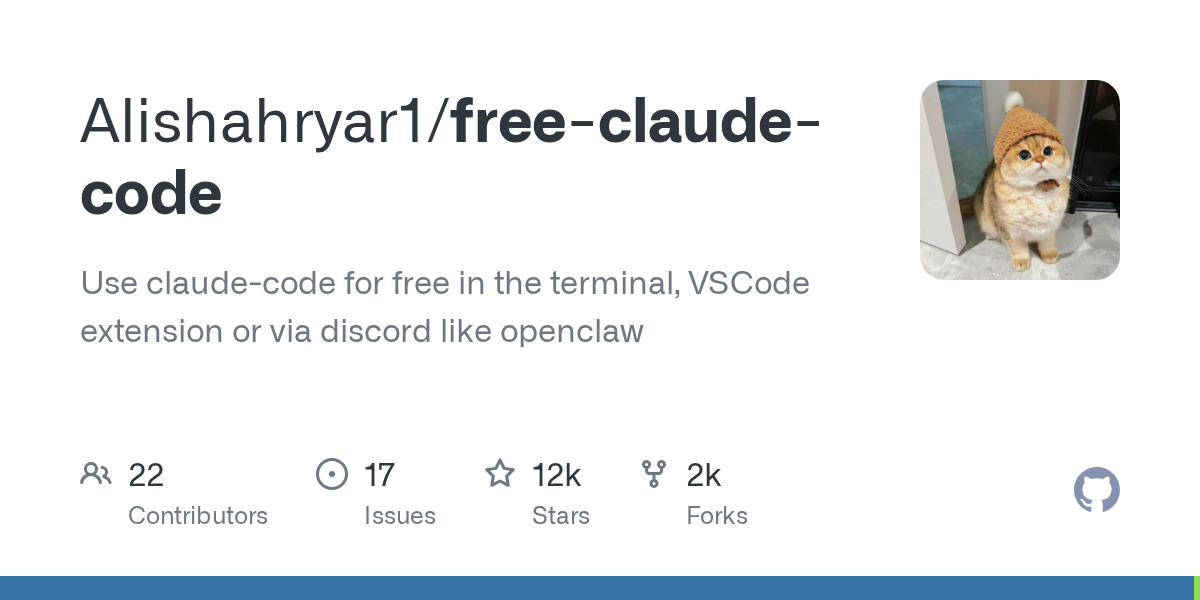 AI Visual Insight: This image presents a preview of the project repository, with emphasis on Claude Code usage in the terminal and editor. It shows that the project is not just a wrapped web interface, but a multi-entry integration tool designed for real developer workflows.
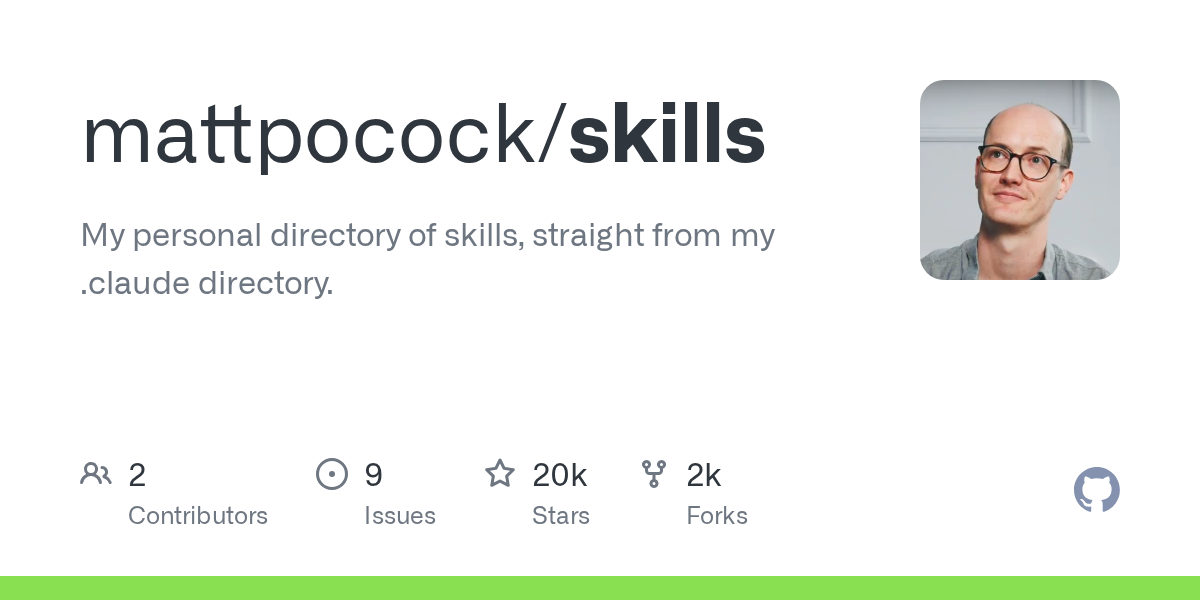 AI Visual Insight: This image reflects a repository organized around a skills catalog. It typically includes categorized command templates, role configurations, and task instructions, showing that its core value is to structure personal AI usage experience into reusable knowledge assets.
This directory layout works well for managing a Claude skill library.
skills/
├── code-review.md      # Code review rules
├── refactor.md         # Refactoring prompt template
├── test-generation.md  # Automatically generate test cases
└── docs.md             # Documentation writing guidelines
This kind of directory structure works well for turning AI collaboration experience into team-standard building blocks.
AI Agent and autonomous engineering projects are getting close to real production environments.
Roo-Code and ml-intern are two directions worth watching closely. The former brings multi-Agent team capabilities into the editor, while the latter attempts to let AI read papers, train models, and deliver outputs autonomously.
What these projects share is not better Q&A, but stronger task decomposition, execution orchestration, and result delivery. For engineering teams, the real value is upgrading an “assistant” into an “operational pipeline node.”
 AI Visual Insight: This image corresponds to a multi-agent collaboration interface inside an editor. It usually displays task panels, execution state, and context windows, showing that the project focuses on splitting complex engineering workflows across multiple role-based Agents for parallel execution.
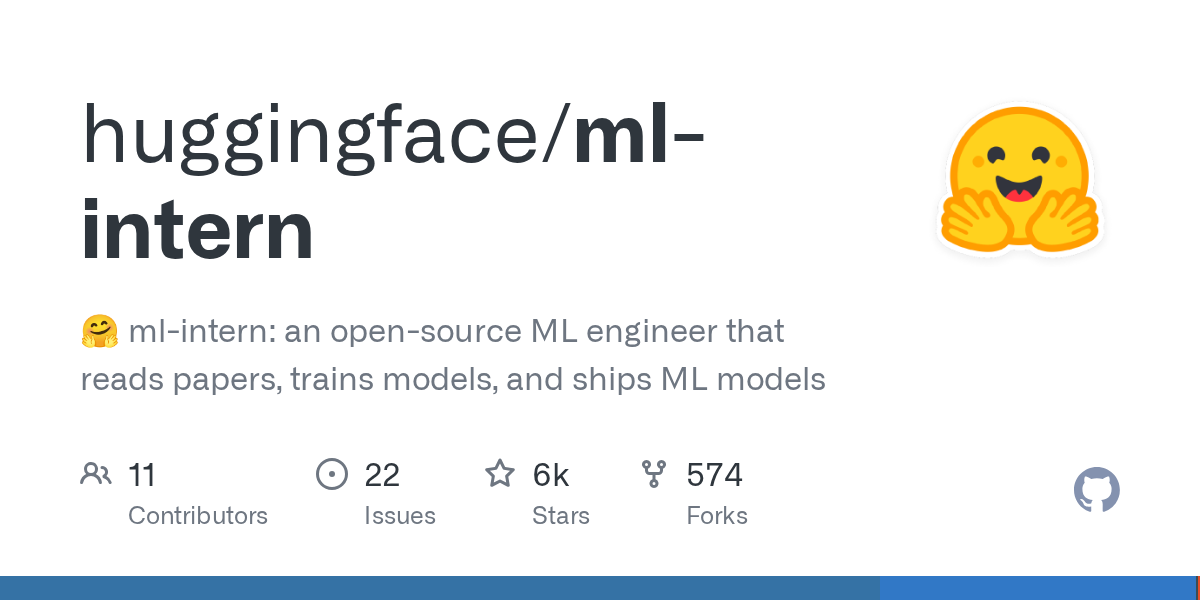 AI Visual Insight: This image highlights automated capabilities across paper understanding, training tasks, and model release pipelines, conveying that the project aims to cover the full machine learning engineering loop from research reading to experimental delivery.
Infrastructure projects are becoming a high-barrier category.
DeepEP and ds2api represent the training side and the integration side, respectively. DeepEP focuses on MoE expert-parallel communication, and its value lies in reducing communication bottlenecks in distributed large-model training. ds2api focuses on protocol conversion, mapping the Deepseek client protocol to common API formats such as OpenAI, Claude, and Google.
One improves lower-level throughput, while the other reduces upper-layer integration cost. Neither directly targets everyday end users, but both have strong engineering leverage. They are critical infrastructure projects built by a few people that benefit many.
 AI Visual Insight: This image most likely shows parallel computing or library-level architecture, with emphasis on inter-GPU communication, expert routing, and high-throughput execution paths, reflecting its low-level performance focus as an MoE communication library.
 AI Visual Insight: This image usually illustrates request flow relationships, where a client protocol enters middleware and is converted into standard API output. It emphasizes the project’s gateway role in multi-account rotation, protocol compatibility, and service deployment.
A typical gateway configuration pattern for unifying model interfaces.
server:
  port: 8080
providers:
  - name: deepseek
    protocol: native   # Original client protocol
  - name: openai
    protocol: openai   # Converted standard protocol
routing:
  strategy: round_robin  # Multi-account rotation
This configuration shows the core goal of a protocol adaptation layer: a unified entry point and controllable routing.
Non-AI projects still hold stable positions as high-value tools.
PostHog, PowerShell, build-your-own-x, and hackingtool cover product analytics, automation scripting, foundational learning, and security toolkits, respectively. They show that the trending list has not been completely monopolized by AI. Established categories that solve real, recurring needs still have strong staying power.
PostHog is especially notable. It combines analytics, session replay, experimentation, error tracking, and an AI assistant in a single platform, representing the “platform convergence” trend in the developer toolchain. build-your-own-x continues to serve as an entry point for technical education and is ideal for systematically strengthening foundational skills.
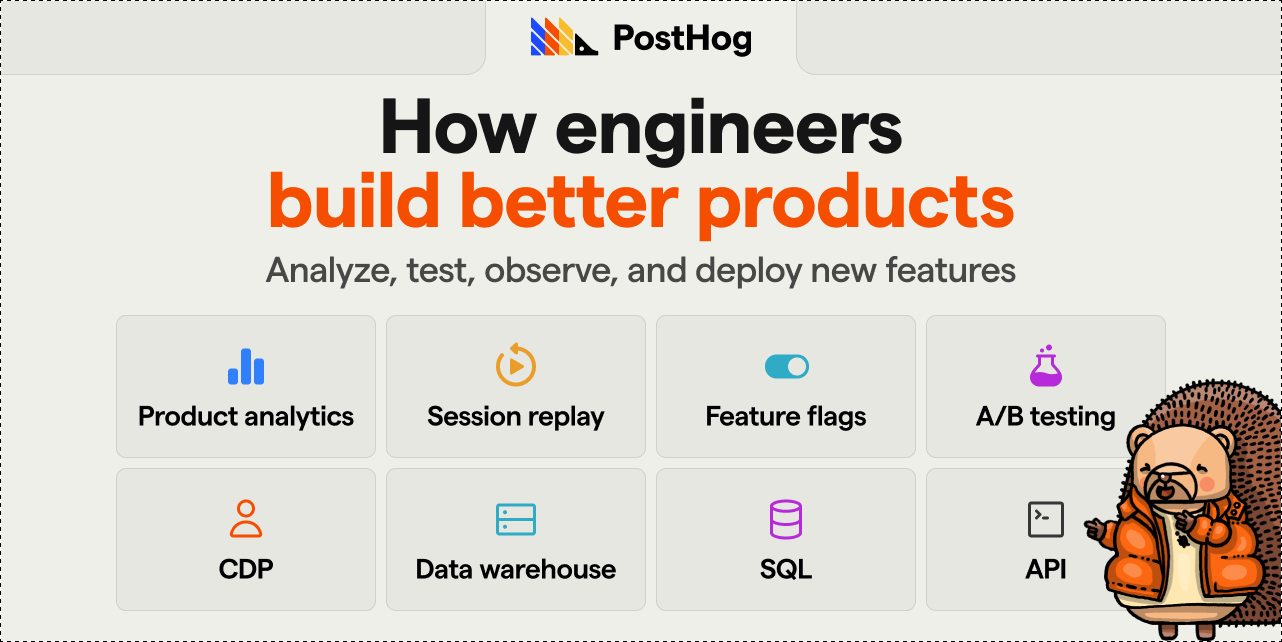 AI Visual Insight: This image shows a collection of capabilities within a developer platform, often including analytics dashboards, event streams, or product metric views. It reflects the platform’s identity as an integrated product analytics and debugging system.
 AI Visual Insight: This image reflects a knowledge navigation or project-list structure, emphasizing learning paths for building classic systems such as databases, compilers, and operating systems from scratch. It is well suited for constructing a foundational systems knowledge map.
If you only track five projects, this priority order makes sense.
The first tier should be free-claude-code, Roo-Code, DeepEP, ds2api, and PostHog. Together, they cover five critical nodes: AI coding entry points, multi-Agent collaboration, training infrastructure, protocol gateways, and data platforms.
If you are an application developer, start with free-claude-code, ds2api, and PostHog. If you are an AI engineer, prioritize Roo-Code, ml-intern, and DeepEP. If you want to strengthen your fundamentals, build-your-own-x has the highest long-term value.
Build a personal trending watchlist quickly.
1. Tool entry point: free-claude-code
2. Agent collaboration: Roo-Code
3. Model engineering: ml-intern
4. Training infrastructure: DeepEP
5. Protocol adaptation: ds2api
6. Full-stack analytics: PostHog
7. Foundational learning: build-your-own-x
This checklist works well when you split your tracking into two parallel buckets: “ready to try now” and “worth watching long term.”
FAQ
Q1: What is the strongest technical signal in this trending list?
A1: It is not a single-model capability jump. It is the full engineering of AI coding workflows, including skill accumulation, Agent collaboration, communication optimization, and API standardization.
Q2: Which projects are easiest for general developers to adopt right away?
A2: free-claude-code, PostHog, and ds2api have the lowest adoption barrier. They fit code assistance, product analytics, and unified model access, respectively.
Q3: Which projects are better for long-term learning investment?
A3: DeepEP, build-your-own-x, and ml-intern are better long-term bets. The first two help you understand foundational systems and training infrastructure, while the last represents the broader trend of automated ML engineering.
Core Summary: Based on the 2026-04-26 GitHub daily trending list, this article extracts 13 fast-growing open source projects and their key technical signals across Claude Code, AI Agents, MoE communication, full-stack analytics, and protocol middleware, helping developers quickly identify both practical tools and emerging trends.