GPT-5.5 is a next-generation flagship model built for real-world workflows. Its core improvements focus on Agent coding, computer control, and multi-tool orchestration. It addresses the limits of single-turn prompting, unreliable tool calls, and unstable long-running automation. Keywords: GPT-5.5, Agent architecture, API selection.
Technical specifications provide a quick snapshot
| Parameter | Details |
|---|---|
| Model family | GPT-5.5 Standard / Thinking / Pro |
| Core capabilities | Agent coding, computer control, deep research, omni-modal |
| Context window | 1M tokens (400K for Codex scenarios) |
| API pricing | Input $5.00 / Output $30.00 (per 1M tokens) |
| Protocols / interfaces | Chat Completions, Responses API, MCP-compatible integration |
| Reference benchmarks | Terminal-Bench 2.0, OSWorld-Verified, MCP Atlas, MMLU |
| Languages | Multilingual, including Chinese |
| GitHub stars | Not provided in the source, N/A |
| Core dependencies | OpenAI SDK, MCP orchestration platforms, Codex workflows |
GPT-5.5 represents a foundational rebuild for Agent workflows
GPT-5.5 was released on April 23, 2026, and was positioned as the first flagship foundation model retrained from scratch since GPT-4.5. That means it is not a routine fine-tuning upgrade. Instead, it rebuilds core capabilities at the model level for complex reasoning, tool loops, and computer interaction.
Its key value is not that it is simply “better at chatting,” but that it is “better at getting work done.” For developers, this changes how the model should be evaluated. Single-turn answer quality is no longer enough. What matters is the stability of multi-step planning, tool invocation, result verification, and error-recovery loops.
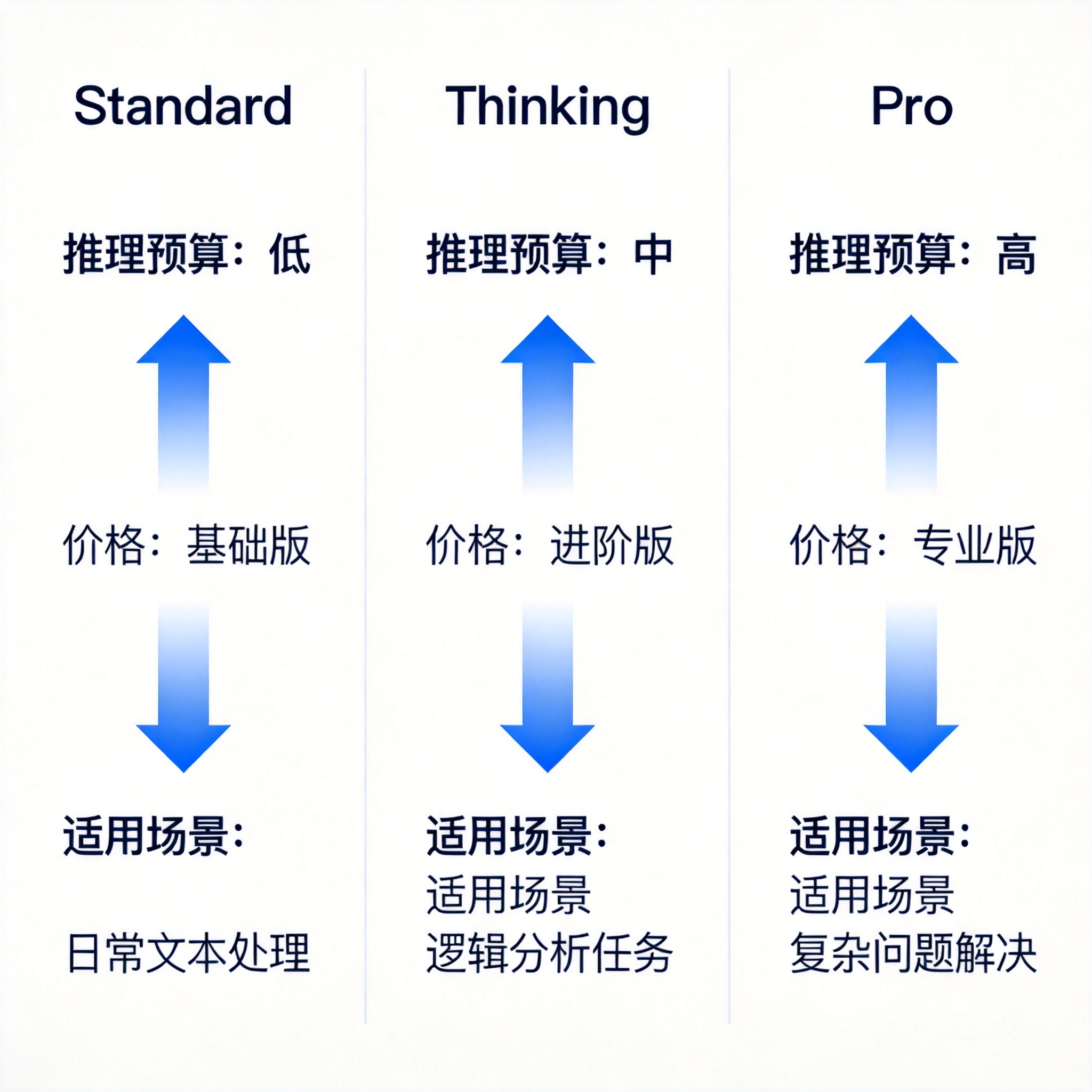 AI Visual Insight: The image outlines GPT-5.5 capabilities and version structure. It highlights the model’s shift from a retrained foundation toward three major capability tracks: Agents, deep research, and computer control. This reflects a positioning change from general conversation to real workflow execution.
Three versions span different accuracy and cost ranges
Standard targets general API use cases. Thinking offers a larger reasoning budget and fits complex decision-making. Pro targets high-accuracy tasks and is suitable for business processes with minimal tolerance for failure. In practice, this versioning strategy turns reasoning depth into an explicit commercial tier.
By reported metrics, GPT-5.5 reaches 92.4% on MMLU, while hallucination rates are down 60% relative to GPT-5.4. Although the exact evaluation methodology still needs independent reproduction, the direction is clear: reliability in complex work has become the optimization priority.
from openai import OpenAI

client = OpenAI()

response = client.chat.completions.create(
    model="gpt-5.5",  # Specify the flagship model
    messages=[
        {"role": "system", "content": "You are an enterprise technical architecture assistant."},
        {"role": "user", "content": "Break down the execution flow of a multi-tool Agent."}
    ],
    reasoning_effort="medium"  # Control the reasoning budget for complex tasks
)

print(response.choices[0].message.content)  # Output the model result
This example shows the basic GPT-5.5 invocation pattern in the standard SDK, along with a typical entry point for reasoning budget control.
Agent gains show up in autonomous multi-step execution loops rather than isolated benchmark scores
The biggest change in GPT-5.5 is the shift from “answering questions” to “executing workflows.” It can plan steps autonomously, call external tools, adapt its strategy based on intermediate results, and continue retrying after failure instead of producing a one-shot static answer.
That makes it much closer to an operational Agent core. In coding, terminal operations, browser tasks, and cross-application workflows, the model no longer depends on developers to manually chain every step together. It now has a meaningful degree of autonomous loop execution.
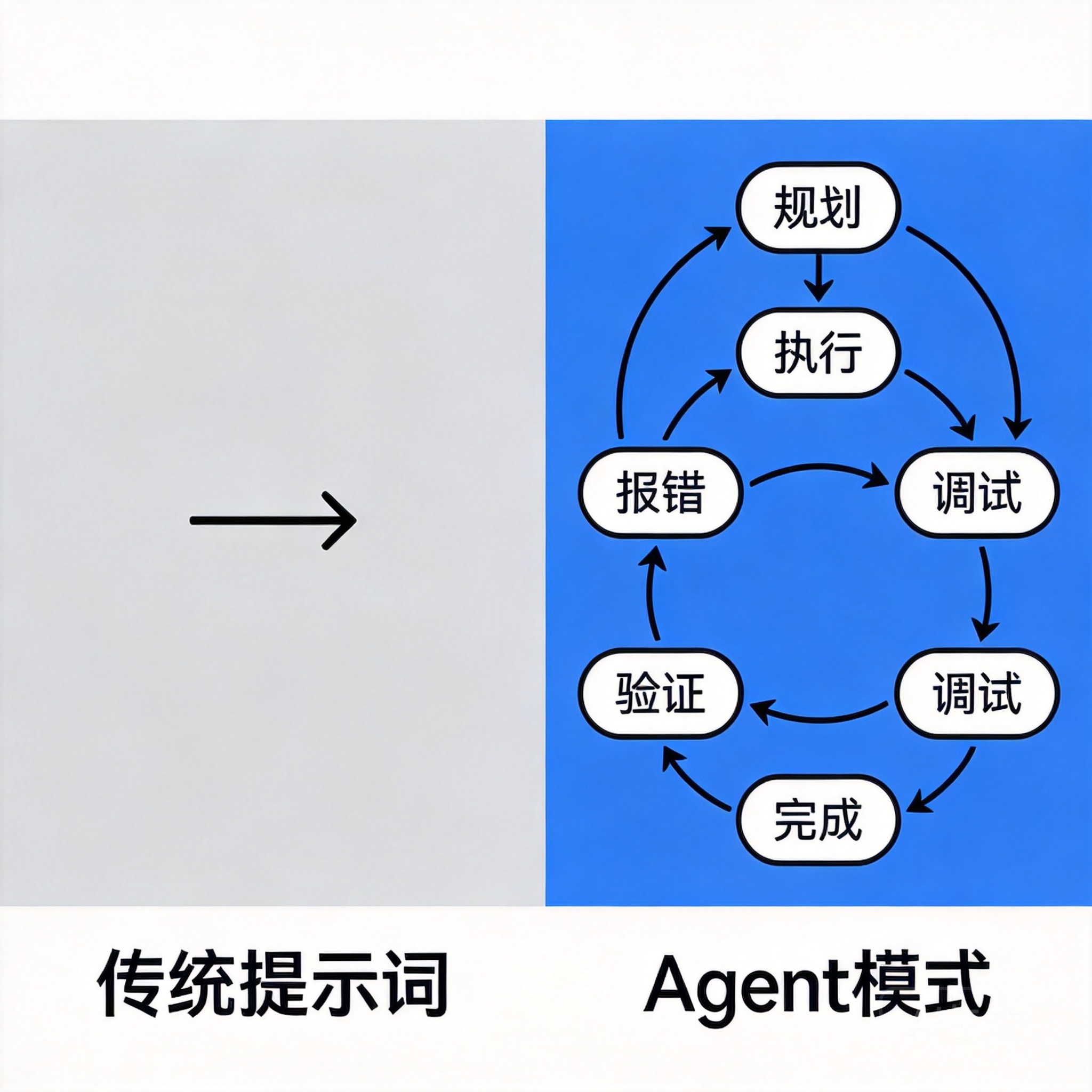 AI Visual Insight: The image focuses on Agent capability evaluation, emphasizing command-line workflows, desktop task completion, and tool orchestration accuracy. It shows that GPT-5.5’s advantage comes from stable execution across complex task chains, not just better single-problem accuracy.
Command-line and toolchain coordination is approaching production readiness
On Terminal-Bench 2.0, GPT-5.5 scores 82.7%, ahead of GPT-5.4 at 75.1%. This benchmark measures chained behaviors such as planning, execution, feedback reading, and iterative correction, which makes it much closer to real development environments than static code generation.
On MCP Atlas, GPT-5.5 reaches 75.3%, an 8.1-point improvement over the previous generation. For multi-tool orchestration systems built around MCP, this directly implies lower tool-call error rates, fewer recovery steps, and more stable automation pipelines.
workflow = [
    "Read the task instructions",      # Step 1: Understand the goal
    "Call the terminal to run the script",  # Step 2: Execute commands
    "Analyze the error logs",      # Step 3: Correct based on feedback
    "Search the documentation and modify the code",  # Step 4: Add external knowledge
    "Run validation again"       # Step 5: Close the loop
]

for step in workflow:
    print(f"Executing: {step}")  # Simulate an Agent multi-step loop
This pseudocode captures the core difference between Agents and traditional prompt engineering: the key is not longer prompts, but a more complete execution loop.
Computer control moves the model into RPA replacement territory
On OSWorld-Verified, GPT-5.5 scores 78.7%, slightly ahead of both GPT-5.4 and Claude Opus 4.7. The significance is not the absolute percentage difference. What matters is that the result validates the model’s continuity and stability in screen understanding, button clicking, and cross-application navigation.
Once a model can “see” interfaces and perform desktop actions, parts of traditional RPA that require heavy rule configuration begin to fall within the reach of natural-language-driven general Agents. This is especially important for office automation, support ticket routing, and internal operations systems.
GPT-5.5’s premium pricing only makes economic sense for complex tasks
GPT-5.5 API pricing is $5 per million input tokens and $30 per million output tokens, roughly double GPT-5.4. On the surface, that implies a significant cost increase. But real billing cannot be judged by unit price alone. You also need to measure how many tokens each task consumes and how many retries it requires.
A key takeaway from the source material is that GPT-5.5 used fewer tokens on some equivalent Codex tasks. If it reduces redundant output, lowers recovery loops, and shortens human intervention, the actual total cost may not exceed that of older models.
Three direct cost-reduction strategies are already clear
First, the Batch API can deliver a 50% discount, which fits bulk summarization, offline generation, and non-real-time pipelines. Second, cached input is priced at only 10% of standard input, which is ideal for system prompts and repeated context. Third, Flex processing fits latency-insensitive tasks and can reduce priority-related costs further.
def route_task(task_complexity: str) -> str:
    if task_complexity == "high":
        return "gpt-5.5"   # Use 5.5 for complex planning and reasoning tasks
    if task_complexity == "medium":
        return "gpt-5.4"   # Use 5.4 for medium-complexity tasks
    return "batch-mini"    # Send low-complexity batch tasks to a lower-cost path

print(route_task("high"))
This routing logic shows the most practical hybrid model strategy for enterprises: separate high-value reasoning from low-value execution.
Compared with competitors, GPT-5.5 is strongest in Agent workflows but still lags on some pure code completion benchmarks
Across tasks such as Terminal-Bench 2.0, OSWorld, and ARC-AGI-2, GPT-5.5 shows a clear advantage, especially in complex workflows that span tools, interfaces, and contexts. However, on SWE-Bench Pro, it trails Claude Opus 4.7 with 58.6% versus 64.3%.
This shows that GPT-5.5 is not “the best at everything.” Instead, it is most competitive in workflows that require autonomous execution. If your use case is closer to static code completion, Claude still deserves a place in hands-on evaluation.
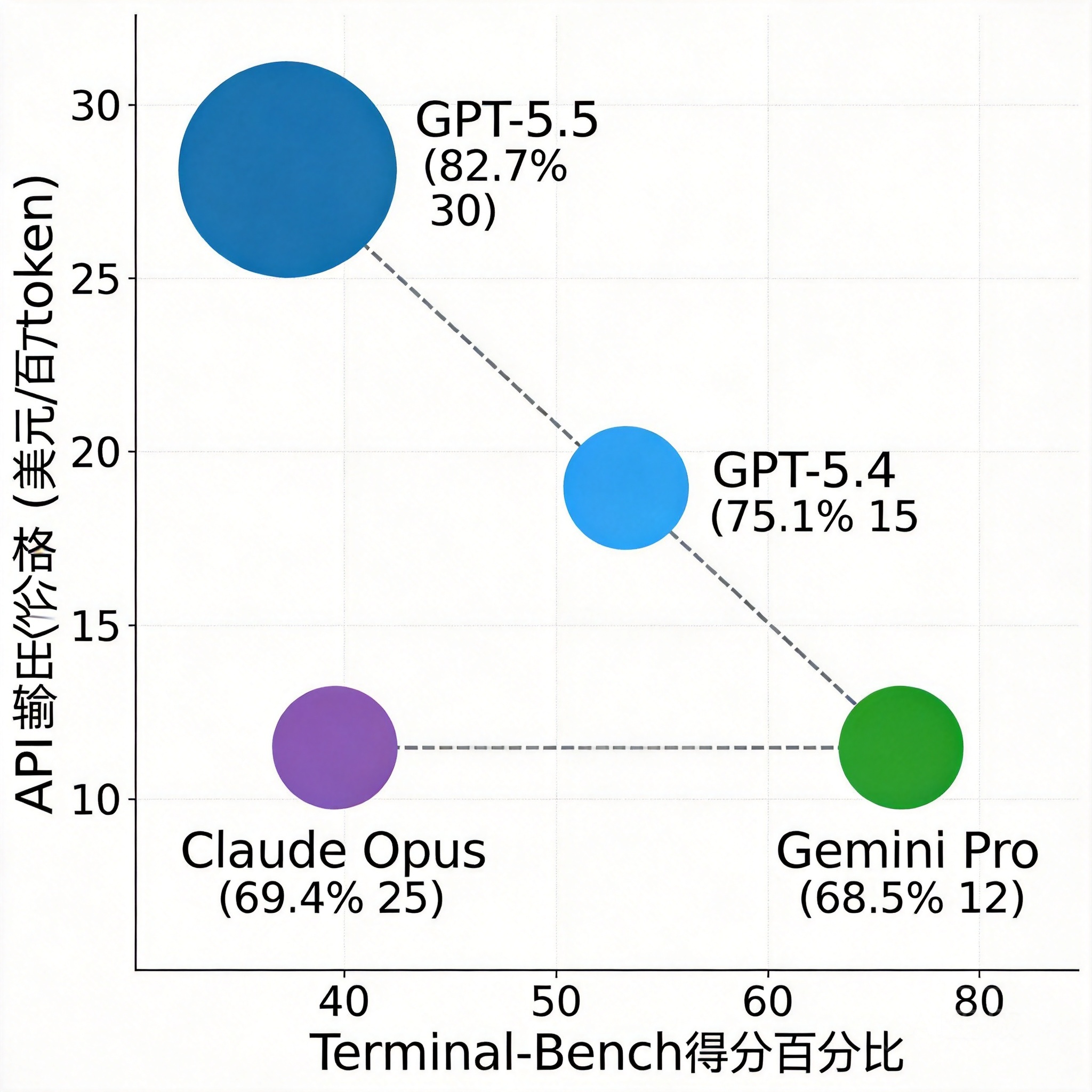 AI Visual Insight: The image compares GPT-5.5 with Claude and Gemini across multiple benchmarks. The technical takeaway is the capability split across Agent coding, computer control, and pure code completion. Model selection should not rely on a single leaderboard; it should align with the actual workflow type in your business.
Enterprise upgrade decisions should center on workflow automation density
If your team is building IDE assistants, DevOps automation, browser Agents, knowledge workflows, or ultra-long-context analysis systems, GPT-5.5’s strengths are more likely to translate into ROI. That is because it reduces not just answer-level errors, but human repair costs across the full task chain.
If your main workloads are summarization, classification, information extraction, and standard customer support, GPT-5.4 or lower-cost models will often remain the better choice. In other words, whether to upgrade depends less on whether the model is advanced and more on whether your workflow truly consumes reasoning capacity.
FAQ provides structured answers for evaluation and adoption
Q1: Which types of projects should prioritize GPT-5.5 integration first?
A: Prioritize Agent coding, terminal automation, browser operations, cross-application workflow orchestration, and ultra-long-context analysis. These tasks amplify GPT-5.5’s strengths in multi-step looping and tool scheduling.
Q2: How can enterprises control total API cost after pricing doubled?
A: A dual-model routing strategy is the most effective approach. Use GPT-5.5 for planning and complex reasoning, use GPT-5.4 or lower-cost models for high-frequency subtasks, and migrate non-real-time workloads to the Batch API.
Q3: If competitors score higher on some coding benchmarks, should teams still choose GPT-5.5?
A: It depends on task type. If pure code completion is the priority, run evaluations on your private repositories. If complete execution loops, desktop control, and multi-tool invocation matter more, GPT-5.5 usually delivers higher overall value.
Core summary: This article reconstructs the technical picture of GPT-5.5 from public information, focusing on Agent architecture, multi-step tool use, computer control, API pricing, and competitive comparisons. It helps developers and enterprises decide whether GPT-5.5 is worth the higher cost for stronger reasoning and automation.