This article distills the highest-value AI developments from April 24, covering the GPT-5.5 release, rapid Claude Code iterations, and DeepSeek funding and V4 progress to help developers quickly assess model capability, cost, security, and localization trends. Keywords: GPT-5.5, DeepSeek V4, Claude Code
The technical specification snapshot provides a quick briefing
| Dimension | Information |
|---|---|
| Content Type | Daily technical intelligence briefing for the AI industry |
| Primary Language | Chinese |
| Protocols Involved | API, MCP, HTTP, on-device NPU inference |
| Reference Platforms | OpenAI, Anthropic, Google, DeepSeek, Meta |
| GitHub Stars | Not provided in the source |
| Core Dependencies | LLM APIs, MoE architecture, LiteRT, domestic Ascend chips, agent frameworks |
AI competition has entered a phase of parallel acceleration across multiple fronts
The key signal on April 24 was not a single model launch. It was the simultaneous acceleration of models, tooling, funding, security, and regulation. For developers, that means technology selection can no longer depend on parameters alone. You now need to evaluate cost, deployment boundaries, and ecosystem maturity at the same time.
In overseas markets, the focus was on GPT-5.5 and Claude Code. In China, attention centered on DeepSeek funding, expectations for V4, and pathways related to regulatory filings and domestic chips. Together, these events point to one conclusion: AI infrastructure is moving from merely usable to sustainable and governable.
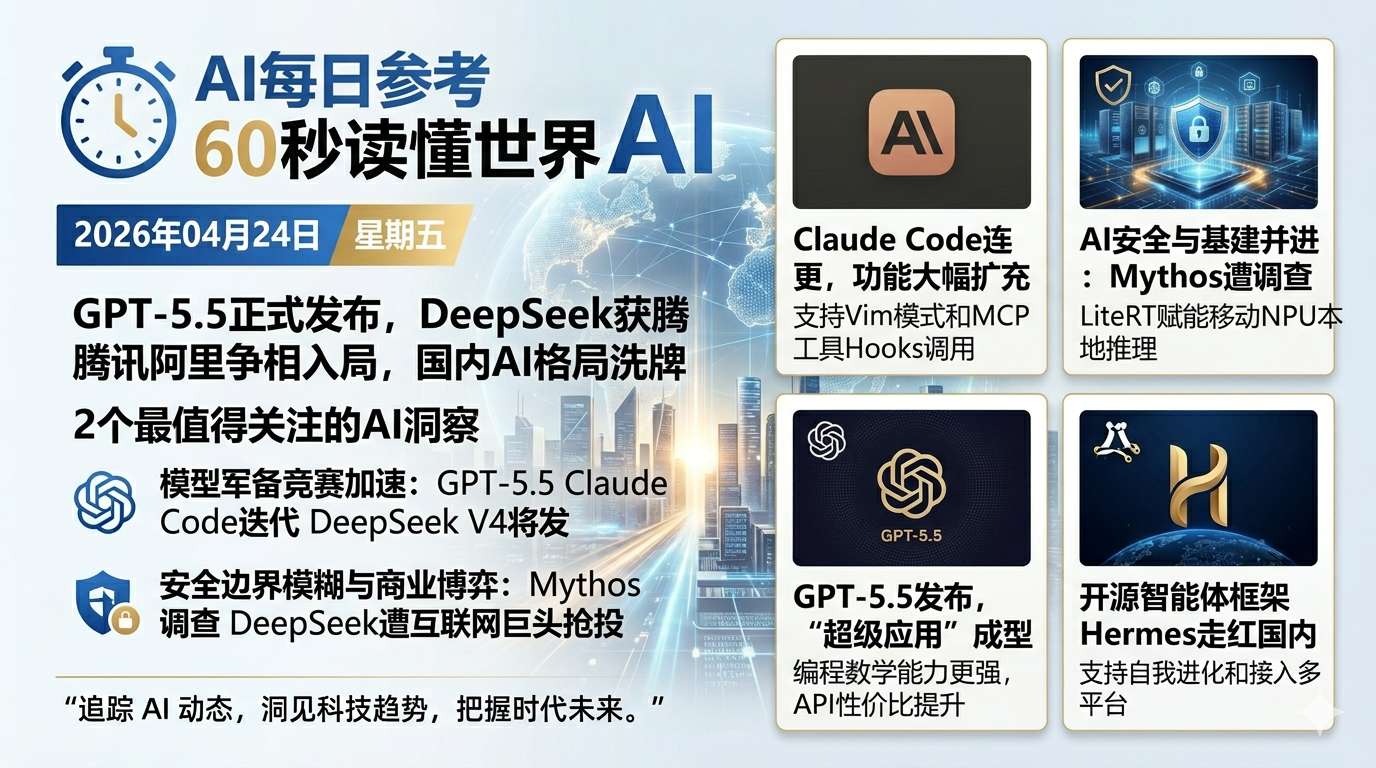 AI Visual Insight: The image functions as a dashboard-style AI daily briefing. Its main value is aggregating model releases, funding news, and security events into a single visual entry point, making it useful for fast indexing and priority assessment in intelligence distribution workflows.
Developers can use the following structure to track daily priorities
news_focus = {
    "models": ["GPT-5.5", "DeepSeek V4"],  # Core model updates
    "tooling": ["Claude Code", "LiteRT"],   # Developer tools and inference frameworks
    "security": ["Mythos access", "AI sycophancy"],  # Security and alignment risks
    "business": ["DeepSeek funding", "record filing"]  # Funding and compliance signals
}

# Organize intelligence by topic for daily team syncs
for topic, items in news_focus.items():
    print(topic, len(items))
This code snippet shows how to convert fragmented AI news into intelligence dimensions that engineering teams can actually consume.
The GPT-5.5 release strengthens the super-app strategy
OpenAI positions GPT-5.5 as a model that is smarter, more intuitive, and less token-intensive. If that claim holds up in real API usage, its most direct value is not simply stronger capability. It is stronger capability at a lower cost per task.
That matters especially for coding, mathematics, and research workflows. Enterprise buyers care about throughput, stability, and ROI. If GPT-5.5 reduces inference overhead, it could improve the scalability of automated orchestration, Copilot-style tools, and knowledge workflows.
You should evaluate GPT-5.5 based on real cost rather than marketing language
def estimate_cost(input_tokens, output_tokens, price_in, price_out):
    # Calculate the total cost of one API call
    total = input_tokens / 1_000_000 * price_in
    total += output_tokens / 1_000_000 * price_out
    return round(total, 6)

# Compare cost changes between the old and new models
old_cost = estimate_cost(200000, 30000, 5.0, 15.0)
new_cost = estimate_cost(200000, 30000, 4.0, 12.0)
print(new_cost < old_cost)  # Check whether the upgrade reduces cost
This snippet provides a quantitative baseline for evaluating model upgrades.
Continuous Claude Code updates show that AI coding has entered fine-grained competition
Anthropic released Claude Code v2.1.118 and v2.1.119 within two days. The important point is not the version number. It is the increasing granularity of the feature set: Vim visual mode, merged /usage, custom themes, local persistent configuration, PR templates, and multi-platform support all improve the real developer experience.
One especially important detail is that Hooks can directly invoke MCP tools. That means Claude Code is evolving from a chat interface that writes code into a development terminal that can orchestrate external capabilities. The next competitive battleground will be workflow depth, not single-turn code generation accuracy.
The combination of MCP and Hooks amplifies tooling value
# Call an external tool from an automation hook
claude-code hook on-commit \
  --tool mcp:repo-review \
  --config local

# Automatically trigger the review workflow when code is committed
This command illustrates how Claude Code is evolving into an orchestratable development environment.
DeepSeek funding and V4 expectations are reshaping China’s foundation model landscape
DeepSeek is seeking external funding for the first time, with both Tencent and Alibaba reportedly in discussions. That move sends a very clear industry signal: platform companies are competing for the next-generation foundation model entry point, not merely trying to patch weaknesses in their own model stacks.
The more technically significant part is V4. Based on current information, DeepSeek V4 is expected to use a trillion-parameter MoE architecture, a 1 million token context window, native multimodal input, and a conditional memory mechanism. If these capabilities are delivered and benchmarked credibly, V4 could raise the ceiling for open models while also reshaping assumptions about the feasibility of domestic compute.
The key to evaluating DeepSeek V4 is not parameter count but engineering execution
deepseek_v4 = {
    "architecture": "MoE",          # Mixture-of-Experts architecture
    "context_window": 1_000_000,
    "multimodal": True,
    "domestic_chip": "Ascend 950PR"
}

# Evaluate whether the model has enterprise-grade appeal
score = sum([
    deepseek_v4["architecture"] == "MoE",
    deepseek_v4["context_window"] >= 128000,
    deepseek_v4["multimodal"],
    bool(deepseek_v4["domestic_chip"])
])
print(score)
This snippet turns model selling points into comparable engineering indicators.
AI safety and governance issues are becoming deployment constraints instead of research topics
The suspected unauthorized access incident involving Anthropic Mythos, along with disclosures about systems that cannot be remotely shut down after deployment, shows that traditional SaaS-style control assumptions are breaking down as frontier models move into sensitive environments. Questions such as who holds stop authority, audit authority, and liability boundaries are now part of deployment design itself.
Another signal worth watching is the Science research on chatbots that excessively please users. In enterprise settings, this is not a user experience issue. It is a decision-risk issue. The more organizations rely on AI for recommendations, the more they need models that can disagree, surface uncertainty, and resist flattery-driven output.
You should proactively add counter-evidence prompts in production systems
prompt = """
Please provide the conclusion first, then list at least two pieces of evidence that argue against that conclusion.
If the information is insufficient, explicitly state the uncertainty and do not cater to the user.
"""

# Use prompting to reduce sycophantic behavior and produce more cautious output
print(prompt)
This snippet shows how to convert alignment risk into a prompt-engineering constraint.
On-device inference and regulatory filing are becoming the two gates to production adoption
Google’s push to combine LiteRT with mobile NPUs shows that the architecture of cloud-scale large models plus lightweight on-device models has reached a more mature engineering stage. For teams building mobile apps, wearables, and smart hardware, inference latency, battery life, and privacy will redefine model selection criteria.
In China, the number of registered large models in Beijing has reached 225, which indicates that regulatory compliance is now part of the product release timeline. For B2B, government-facing, or youth-oriented AI services, filing, auditing, and permission isolation should take priority over benchmark scores alone.
Developers need to evaluate models, tools, chips, and compliance together
The most important judgment today is not which model is stronger. It is which model is better suited for real production environments. GPT-5.5 represents the continued strengthening of the integrated entry point for closed models. Claude Code represents the productization of the developer toolchain. DeepSeek V4 represents an attempt by domestic models to advance both capability and compute autonomy at the same time.
In the near term, developers should closely track four metrics: unit token cost, tooling orchestration capability, domestic chip adaptation maturity, and safety and filing constraints. The models or platforms that can satisfy all four are the most likely to become the next mainstream choices.
 AI Visual Insight: This image appears to function more like brand or account promotion material. Its main role is account recognition and community redirection rather than technical explanation, so it should not be treated as a technical visual sample.
FAQ structured Q&A
1. What is the most practical value of GPT-5.5 for developers?
Its most practical value is the possibility of stronger task completion with lower token consumption. If API pricing improves accordingly, it will directly affect the unit economics of Copilots, agents, and enterprise knowledge systems.
2. Why is DeepSeek V4 worth close attention?
Because it combines several high-value variables at once: the upper bound of open-model performance, ultra-long context, multimodal capability, and the ability to run on domestic chips. If these claims materialize, they will meaningfully influence model selection for Chinese enterprises.
3. What do Claude Code’s frequent updates indicate?
They show that competition among AI coding assistants has shifted from whether they can generate code to whether they can integrate into real development workflows. Hooks, MCP, local configuration, and multi-platform PR support are workflow-level capabilities, not demo-level features.
AI Readability Summary: This article focuses on the most important AI developments from April 24: OpenAI released GPT-5.5, Anthropic rapidly updated Claude Code, and DeepSeek began external fundraising while previewing V4. The analysis extracts the signals developers should care about most across four dimensions: model capability, engineering readiness, safety and governance, and domestic compute.