This is a private online customer service and marketing system built on .NET 8. It covers the server, a desktop agent application, and a web-based admin console. The core challenge is addressing enterprise concerns about real-time communication stability, technology stack reliability, and delivery credibility. Keywords: .NET customer service system, private deployment, customer trust.
The system’s technical specifications are easy to identify
| Parameter | Details |
|---|---|
| Core languages | C#, JavaScript |
| Server | .NET 8 |
| Desktop agent application | WPF / .NET Framework 4.8 |
| Web admin console | Vue 3 |
| Visitor client | Native HTML/JS |
| Deployment models | Hosted online, private deployment |
| Concurrency performance | 4K+ simultaneous connections in the official environment |
| Typical customer scale | Nearly 40 agents online at the same time, about 5,000 daily sessions |
| Protocols / interactions | Real-time messaging, web-based admin access, desktop agent handling |
| Core dependencies | .NET, WPF, Vue 3, Visual Studio, .NET Standard |
| Open-source information | No GitHub or star count provided in the source; marked as unknown |
The core value of this system is not just that it can “chat.” It integrates enterprise customer service, marketing outreach, and private delivery into a software product that can evolve sustainably. As an independent developer, the author has continuously iterated on the product and gradually converted early trial users into stable customers.
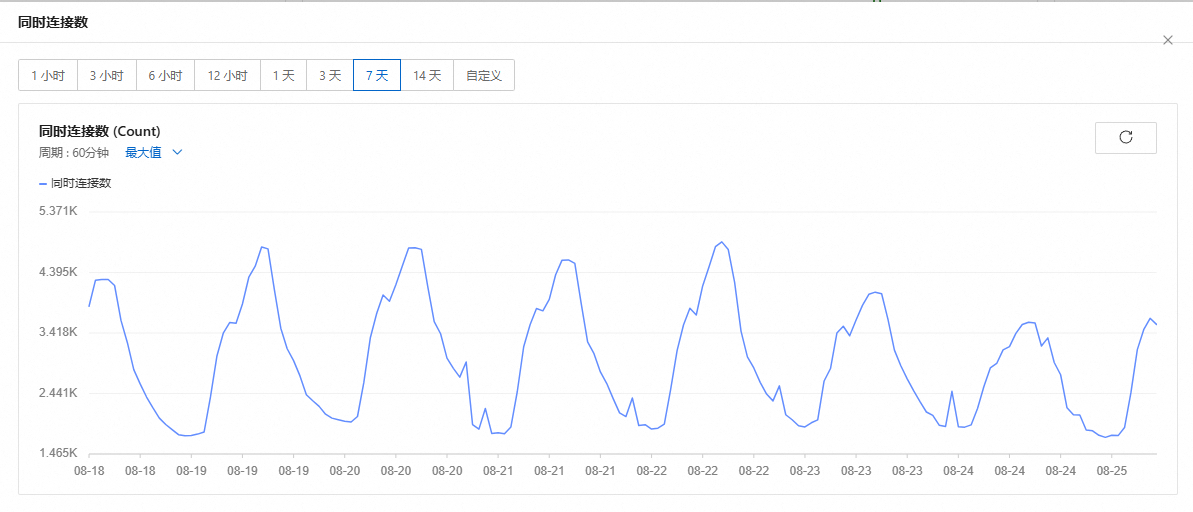 AI Visual Insight: This image shows connection monitoring results from the system’s official environment. The key signal is that simultaneous online connections have reached the 4K+ range, indicating strong engineering stability in long-lived connection management, session persistence, and resource scheduling on the server side.
The .NET stack gives independent developers practical advantages when building large customer service systems
The author’s point is not the abstract claim that “.NET is powerful,” but the concrete advantages it brings to an individual developer or a small team delivering a complex system. Both the server and the desktop agent application use C#, sharing a similar development model and significantly reducing context-switching costs.
With .NET Standard, a large amount of shared code can be reused between the server and client. In practice, this means protocol objects, foundational utility libraries, business models, and some common logic do not need to be maintained twice. Over time, that directly reduces iteration costs and the number of defects.
A unified language and toolchain act as an efficiency multiplier
public class ChatSessionService
{
    public SessionResult Create(string visitorId)
    {
        // A unified C# domain model lets the server and client share contracts
        var sessionId = Guid.NewGuid().ToString("N");

        // Record the session creation time for real-time session tracking
        return new SessionResult
        {
            SessionId = sessionId,
            VisitorId = visitorId,
            CreatedAt = DateTime.UtcNow
        };
    }
}
This code shows how a unified language and shared models make session logic easier to evolve collaboratively across multiple endpoints.
Visual Studio, the debugging toolchain, and Microsoft’s documentation ecosystem further lower the barrier to building large systems. For a product that must simultaneously maintain network communication, a desktop UI, backend administration, and deployment documentation, that level of tooling maturity is itself a productivity advantage.
The desktop agent application is chosen to support complex workflows, not personal technology preference
The author explicitly argues against making a complex customer service workstation fully web-based. The reason is not that the web cannot render interfaces, but that complex agent applications often require stronger local computation, richer state management, bulk data processing, and multi-task coordination.
The value of WPF is straightforward here: it is better suited to building highly interactive, long-running desktop workstations with complex state. For customer service scenarios involving session switching, message handling, shortcut actions, and multi-window collaboration, desktop software is often more stable than a browser container.
A typical multi-end architecture can be split like this
Visitor Client (HTML/JS)
    -> Connects to the real-time messaging service
Server (.NET 8)
    -> Session routing, message storage, business rules
Agent Client (WPF)
    -> Agent reception, state synchronization, shortcut actions
Admin Console (Vue 3)
    -> Configuration management, data viewing, system operations
This structural diagram summarizes the system’s separation of responsibilities: a lightweight front end, a centralized backend, a professional agent workstation, and an independent management layer.
Customer concerns about .NET are fundamentally concerns about deliverability
One of the most valuable observations in the source is that many customers are not truly questioning .NET itself. They are questioning whether the system can run reliably in their business environment. What must actually be proven is not language superiority, but architectural reliability, response speed when problems occur, and the ability to maintain the system over time.
In the first case, the customer initially hesitated because of Windows and .NET. But after a trial period, feedback cycles, and targeted adjustments, the customer gradually migrated the customer service systems of multiple apps into this platform. This shows that trust is usually built through a series of small successes, not through a single technical debate.
 AI Visual Insight: This image presents a live operational or collaboration scenario in a real business environment. Its main message is the migration process from trial use to multi-business integration, showing that the system already has the delivery capability required for interface integration, stable operational tuning, and large-scale replacement of legacy systems.
The second case is even more representative. A customer tried the system in 2021, gave up at the time, then redeployed it years later and switched multiple sites over within a short period, eventually becoming the largest customer. The key was not a single closed deal, but continuous updates that allowed a previously lost customer to see renewed usability and certainty.
Building customer trust depends on four repeatable actions
When facing challenges, answer architecture questions instead of joining technology tribalism
A customer’s technical team will often ask about reliability, deployment methods, platform compatibility, and performance boundaries. High-quality answers should focus on system design, fault handling, the evolution roadmap, and operations strategy, rather than getting trapped in debates about whether Java or .NET is better.
Patience lowers the customer’s understanding barrier
Repeating documentation, helping troubleshoot the environment, and answering questions that have already been answered may look inefficient, but they actually reduce the customer’s onboarding cost. For private software, the presales and implementation experience is itself part of the product.
def reply_customer(question, docs_ready=True):
    # Keep responses consistent and patient, even when the question is repeated
    if docs_ready:
        return "The relevant documentation and steps are prepared, with added environment check recommendations."
    # If documentation is incomplete, provide an actionable answer first and fill in the docs later
    return "Provide a temporary workaround first, then complete the documentation."
This pseudocode expresses a practical reality: patience is not just a slogan about attitude. It is an executable support process.
Real communication significantly increases certainty in technical purchasing
The author is willing to disclose technical details, participate in meetings, and continuously publish blog posts and update logs under a real identity. For technically sophisticated buyers, this transparency directly translates into credibility because they can continuously verify that the product is evolving.
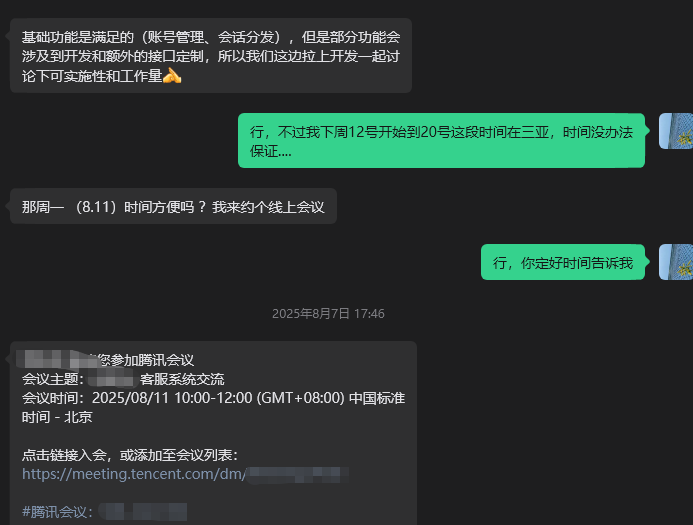 AI Visual Insight: This image is more like a product or operational results screenshot. The core technical message is not the interface style, but the signal that the product has entered a stage of sustained operation, with outward presentation, branding, and long-term maintenance maturity.
Long-term thinking is more persuasive to enterprise customers than short-term promotion
Traceable update logs, years of version evolution, bug-fix records, and public technical articles form a kind of time-based evidence chain. When enterprise customers buy a privately deployed system, they are essentially buying the ability to provide continuous service over the coming years.
The most valuable lesson in this practice is turning technical credibility into commercial credibility
This system builds trust not because it uses a trendy framework, but because its technology choices, product boundaries, delivery capability, and communication style form a closed loop: the architecture can be explained, the product can be trialed, issues are handled by a real person, and new versions continue to ship.
If you are also building real-time chat, IM, online customer service, or privately deployed SaaS, the most important takeaway is not to chase novelty blindly. It is to keep producing engineering evidence that is stable, transparent, and verifiable.
FAQ
Q: Why wasn’t the agent application built entirely as a web app?
A: Because an agent workstation is a high-interaction, long-connection, complex-state software scenario. WPF is better suited for handling multi-session switching, complex data state, and desktop-level operational density, while the web is better suited for presentation and lightweight administration.
Q: What are customers usually worried about when they hesitate over .NET?
A: Usually not the language itself, but whether the system is reliable, easy to deploy, and maintainable over the long term. The most effective way to remove that concern is to show concurrency data, case results, deployment experience, and a record of continuous updates.
Q: How can an independent developer increase enterprise customer trust in a product?
A: The core lies in four things: being able to explain the architecture, responding patiently to questions, openly sharing real technical details, and iterating consistently over the long term. In the end, enterprise customers trust stable delivery capability more than a one-time demo effect.
AI Readability Summary: This article reconstructs the practical experience behind the Shengxunwei online customer service system. It focuses on how the combination of .NET 8, WPF, and Vue 3 supports private deployment, real-time sessions, and high-concurrency connections, while summarizing four key ways to reduce customer technical concerns and build trust: architectural credibility, patient support, transparent communication, and long-term commitment.