QClaw is a local AI agent assistant built by Tencent on top of the OpenClaw ecosystem. Its core value lies in enabling users to handle files, orchestrate tasks, generate content, and assist development workflows through a desktop client and WeChat remote control, while keeping data on the local machine whenever possible. Keywords: local AI agent, WeChat remote control, task automation.
The technical specification snapshot outlines the product at a glance
| Parameter | Details |
|---|---|
| Product Name | QClaw |
| Product Positioning | Local AI agent assistant |
| Ecosystem Origin | Built on the OpenClaw open-source ecosystem |
| Primary Interaction Protocol | Local desktop interaction + WeChat messaging channel |
| Supported Form Factors | Windows and other desktop installers |
| Skill Ecosystem | 5,000+ Skills (as described in the source material) |
| Model Capability | Supports multi-model switching |
| Core Dependencies | OpenClaw ecosystem, Skill plugins, WeChat binding capability |
| Star Count | Not provided in the original source |
QClaw combines local execution with remote orchestration
QClaw is a localized AI agent within the Tencent PC Manager ecosystem. It is not positioned as a simple chat interface, but as an execution-oriented assistant that can actually do work on your computer. It emphasizes low-friction installation, local execution, security sandboxing, and direct WeChat connectivity.
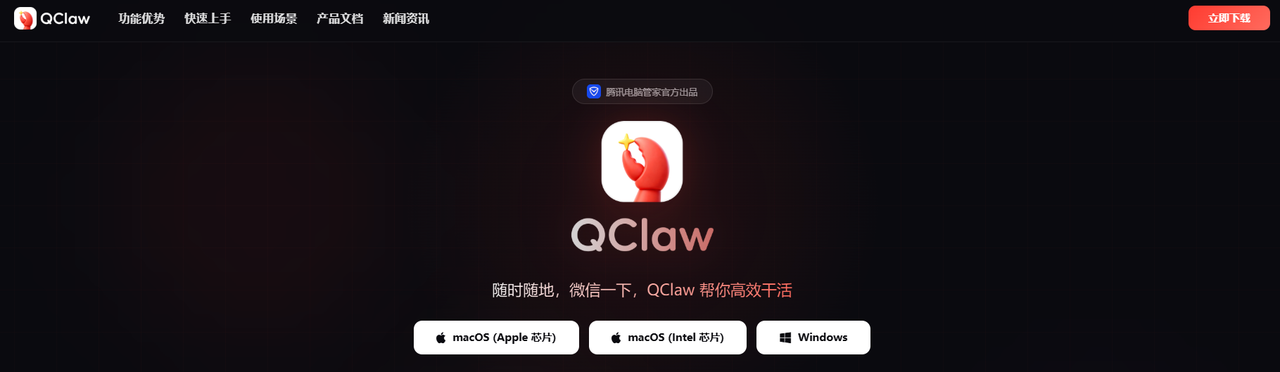 AI Visual Insight: This interface shows QClaw’s primary workspace. The center area serves as the entry point for conversation and task execution, indicating that the product uses a dual interaction model: natural language commands plus a graphical control console. This design makes it easy for non-developers to launch automation tasks quickly.
For developers, QClaw’s key value is not the model alone, but its ability to connect models, skills, tasks, and local machine resources. That is what allows it to process files, run scheduled tasks, generate documents, and even perform remote operations through WeChat.
Five capabilities define its practical boundaries
First, it supports local deployment, so task execution and file processing stay on the device whenever possible. Second, it works out of the box and does not require users to preinstall Node.js or Python. Third, it supports WeChat remote control, turning a mobile phone into a remote command interface.
Fourth, it offers a skill ecosystem that expands functionality through a marketplace and expert library. Fifth, it maintains persistent memory, emphasizing the ability to absorb historical context and user habits. Together, these characteristics make QClaw better suited to high-frequency, lightweight orchestration, and execution-heavy office and developer assistance scenarios.
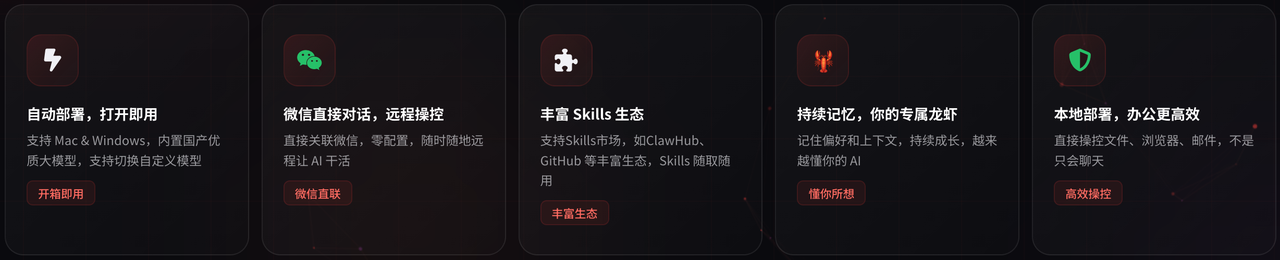 AI Visual Insight: This screenshot presents QClaw’s capability overview or promotional page. It highlights local security, WeChat collaboration, skill extensibility, and memory features, showing that the product is designed around a desktop agent execution layer rather than a single question-answering layer.
QClaw offers a short installation and onboarding path for fast evaluation
The official distribution provides a desktop installer, and users simply download the version that matches their operating system. After installation, the first console launch typically guides the user through WeChat login, which establishes both identity binding and the channel for future remote communication.
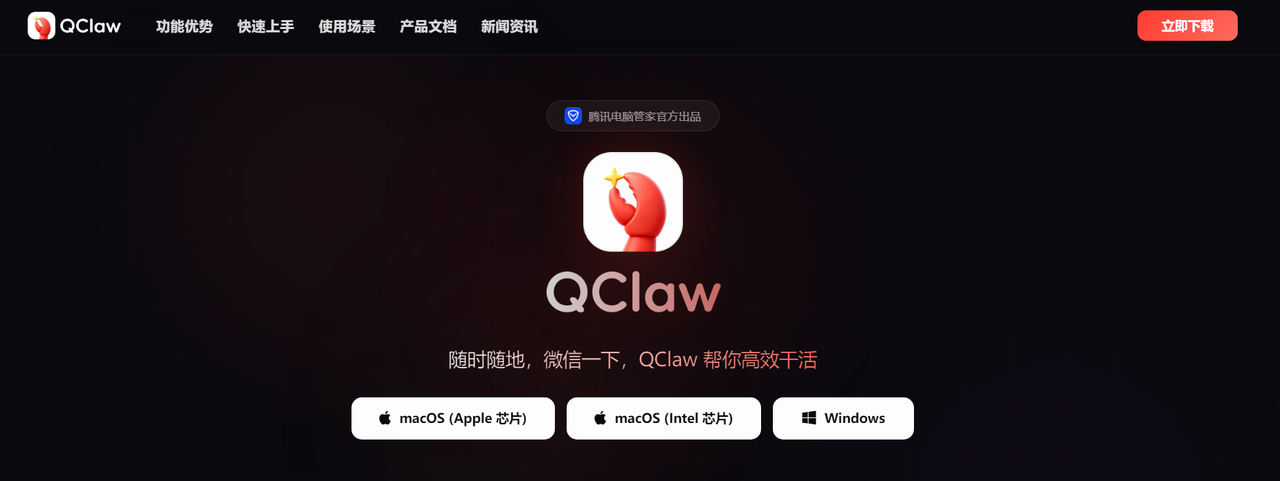 AI Visual Insight: This page shows the download entry point and distribution model, indicating that QClaw is delivered as standard desktop software rather than browser-based SaaS. That aligns with its positioning around local execution and local data processing.
The WeChat connection is the product’s most distinctive feature. After QR code binding is complete, users can send commands to ClawBot in WeChat. The local QClaw client receives and parses those commands, invokes local Skills, and returns the results.
# Basic QClaw onboarding flow
# 1. Download and install the client
# 2. Launch it and sign in by scanning with WeChat
# 3. Complete WeChat binding in the console
# 4. Send task commands to ClawBot in WeChat
# 5. QClaw invokes local Skills and returns the result
This flow shows the shortest path from installation to remote control in QClaw.
QClaw’s functional structure reflects a typical agent console design
The Connections module is essentially a Skill marketplace. Users can connect external capabilities as needed, such as note-taking, document handling, and automation interfaces. Its value is not simply the number of integrations, but the fact that it reduces the access barrier to a configuration-level task.
The Files module records artifacts generated during conversations and execution, making it suitable for tracing historical outputs. The Tasks module is the most engineering-relevant layer, because it transforms one-off prompts into reusable task instances.
Experts, model switching, and agent creation create a layered capability model
The Experts module can be understood as a set of prepackaged roles and skill combinations, such as an SQL assistant, product manager, or code analysis assistant. Model switching addresses trade-offs in cost, speed, and domain fit. Creating a new Agent means users can define a dedicated execution unit with personality, responsibilities, and long-term memory.
def select_qclaw_mode(scene: str) -> str:
    # Choose the most suitable QClaw capability entry point based on the scenario
    if scene == "sql生成":
        return "专家库 -> SQL助手"
    if scene == "远程拿文件":
        return "微信 ClawBot -> 文件检索 Skill"
    if scene == "定时提醒":
        return "任务 -> 定时自动化"
    # Fall back to standard chat, which is suitable for exploratory needs
    return "通用对话 + 模型切换"
This code snippet summarizes how different business scenarios map to QClaw’s feature entry points.
WeChat remote control makes QClaw more differentiated in office automation
In the original examples, users can ask ClawBot in WeChat to summarize documents, retrieve local files, and send them back. At its core, this is a separation between the message input layer and the desktop execution layer: commands are sent from the phone, while execution happens on the computer.
This is lighter than a traditional remote desktop because the user does not need full control of the machine interface. Instead, the user only sends goal-oriented commands. For looking up files while away from the desk, exporting materials on demand, or triggering fixed tasks, this model is highly efficient.
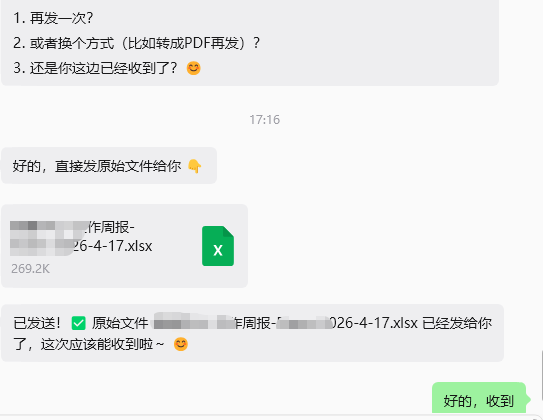 AI Visual Insight: This screenshot shows the delivery of files or task results on the WeChat side, demonstrating that QClaw has integrated local file retrieval, execution result packaging, and message return into one complete chain. It supports a full remote work loop.
Content creation and IT assistance are the easiest scenarios to adopt
In content creation workflows, QClaw can invoke expert roles such as a product manager or public account writing assistant to generate PRDs, marketing copy, outlines, and more. Because the system is skill-driven, the generation process can usually expose invocation logs, which provides a degree of explainability.
In IT scenarios, it can serve as an SQL assistant, code reading assistant, and documentation maintenance assistant. This is especially useful when taking over a legacy system: having QClaw analyze local code files and generate documentation can significantly reduce the cost of understanding the system.
-- Count new orders added each month
-- Core logic: group by year and month based on the order creation time
SELECT DATE_FORMAT(create_date, '%Y-%m') AS month,
       COUNT(*) AS new_order_count
FROM `order`
GROUP BY DATE_FORMAT(create_date, '%Y-%m')
ORDER BY month;
This SQL snippet reflects the most typical type of output produced by the SQL assistant-style experts described in the article.
Task automation determines whether QClaw can become a daily tool rather than a demo
The weather reminder example shows that QClaw is not only a reactive assistant, but also supports scheduled tasks. After the user describes a recurring objective in natural language, the system generates a task unit in the task list that can be toggled, executed immediately, or removed.
That means it already has the basic shape of a lightweight workflow system: define a goal, generate a task, bind a skill, execute on schedule, and return the result. This is especially valuable for repetitive work such as daily reports, reminders, and file archiving.
QClaw is better suited to users who want local agent capabilities at low cost
Based on the source material, QClaw is suitable for three groups: office users who want to operate their computers remotely, content workers who want fast AI automation, and developers who need assistance with code, SQL, and documentation.
Its strengths are fast deployment, simple interaction, and a rich skill ecosystem. Its boundaries are that deep customization, complex orchestration, and fully open ecosystem capabilities were not fully explored in the original material. As a result, it is best viewed as an entry point to local AI agents and a high-frequency task assistant, rather than a full enterprise orchestration platform.
FAQ
Q1: What is the core difference between QClaw and a standard chat-based AI tool?
QClaw focuses on execution rather than response generation. It not only produces text, but also uses local Skills to operate on files, create tasks, invoke experts, and trigger actions on the local machine through WeChat.
Q2: What is the most noteworthy capability in QClaw?
The most differentiated feature is WeChat ClawBot remote control. It connects the mobile messaging entry point with the local desktop execution chain, making it well suited to remote file retrieval, task triggering, and result delivery.
Q3: What is the best starting point for developers using QClaw?
A good starting point is four scenario types: SQL assistance, code analysis, document generation, and scheduled automation. These needs are structurally clear, inexpensive to validate, and make it easy to determine whether QClaw fits your workflow.
AI Readability Summary
This article reconstructs and analyzes the core capabilities, installation flow, and practical use cases of Tencent QClaw. It focuses on local deployment, WeChat remote control, the skill ecosystem, and development and office automation, helping developers quickly assess where QClaw fits and what value it can deliver.