Redisson provides reentrant distributed locks on top of Redis, addressing the deadlocks, accidental unlocks, lack of reentrancy, and renewal challenges of native
SETNX-style locks. This article focuses on Lua atomic scripts, WatchDog auto-renewal, Pub/Sub-based wake-up, and practical Spring Boot integration. Keywords: Redisson, Redis, distributed locking.
The technical specification snapshot provides a quick overview
| Parameter | Description |
|---|---|
| Primary Languages | Java, Lua |
| Communication Protocols | Redis RESP, Pub/Sub |
| Applicable Scenarios | Flash sales, inventory deduction, task mutual exclusion, cross-instance synchronization |
| Core Dependencies | redisson-spring-boot-starter 3.23.5, Redis |
| Lock Implementations | RLock, RFairLock, RReadWriteLock |
| Key Mechanisms | Lua atomicity, Hash-based reentrancy count, WatchDog, EVALSHA |
| Runtime Characteristics | Reentrant, safe unlock, automatic renewal, asynchronous non-blocking |
| Reference Popularity | Original article displayed 479 views |
Native Redis locks are not reliable in production
A common native Redis locking pattern is SETNX + EXPIRE, but it is not a complete production-grade solution by design. Even if you switch to SET key value NX PX, you only solve atomic lock creation and expiration setup. You still do not cover reentrancy, safe unlock, or lock renewal for long-running tasks.
In multi-instance deployments, locking is not just about “who gets the lock first.” You must also ensure that the owner is identifiable, unlock operations are validated, and abnormal exits do not create permanent deadlocks. This is where Redisson delivers real engineering value.
Native Redis locks have four core weaknesses
- Non-atomic window: separating lock creation from expiration can cause deadlocks.
- No reentrancy: nested calls in the same thread can lock themselves out.
- Accidental lock deletion: a timed-out thread may delete a lock that now belongs to another thread.
- No fairness or wake-up mechanism: high concurrency can lead to starvation and busy spinning.
-- This only illustrates the native approach and is not recommended for direct production use
if redis.call('setnx', KEYS[1], ARGV[1]) == 1 then
    redis.call('pexpire', KEYS[1], ARGV[2]) -- Set the expiration time
    return 1 -- Lock acquired successfully
end
return 0 -- Failed to acquire the lock
This snippet shows the basic idea behind the native approach, but it cannot express reentrancy, owner validation, or automatic renewal.
Redisson closes the distributed locking gap through combined mechanisms
Redisson is not just a wrapper around Redis commands. It builds a complete lock semantic model around RLock. It stores lock state in a Redis Hash, identifies the owner with UUID + threadId, and uses Lua scripts to merge validation, lock acquisition, reentrancy, and expiration refresh into a single atomic execution.
With this design, the lock works across JVM instances while still recognizing thread-level reentrancy relationships and preventing accidental unlocks.
Redisson’s lock data structure makes reentrancy possible
- Key: the business lock name, such as
lock:order:1001. - Field:
UUID:threadId, which identifies the current client thread. - Value: the reentrancy count.
When the same thread enters the critical section again, Redisson does not fail. Instead, it increments the counter. During unlock, it decrements the counter step by step and only deletes the lock when the count reaches zero.
Redisson lock acquisition is fundamentally Lua plus retry plus renewal
The lock entry point is typically lock() or tryLock(). The core logic first executes a Lua script: if the lock does not exist, create it; if the lock exists and the owner is the current thread, perform a reentrant acquire; otherwise, return the remaining TTL so the client knows how long to wait.
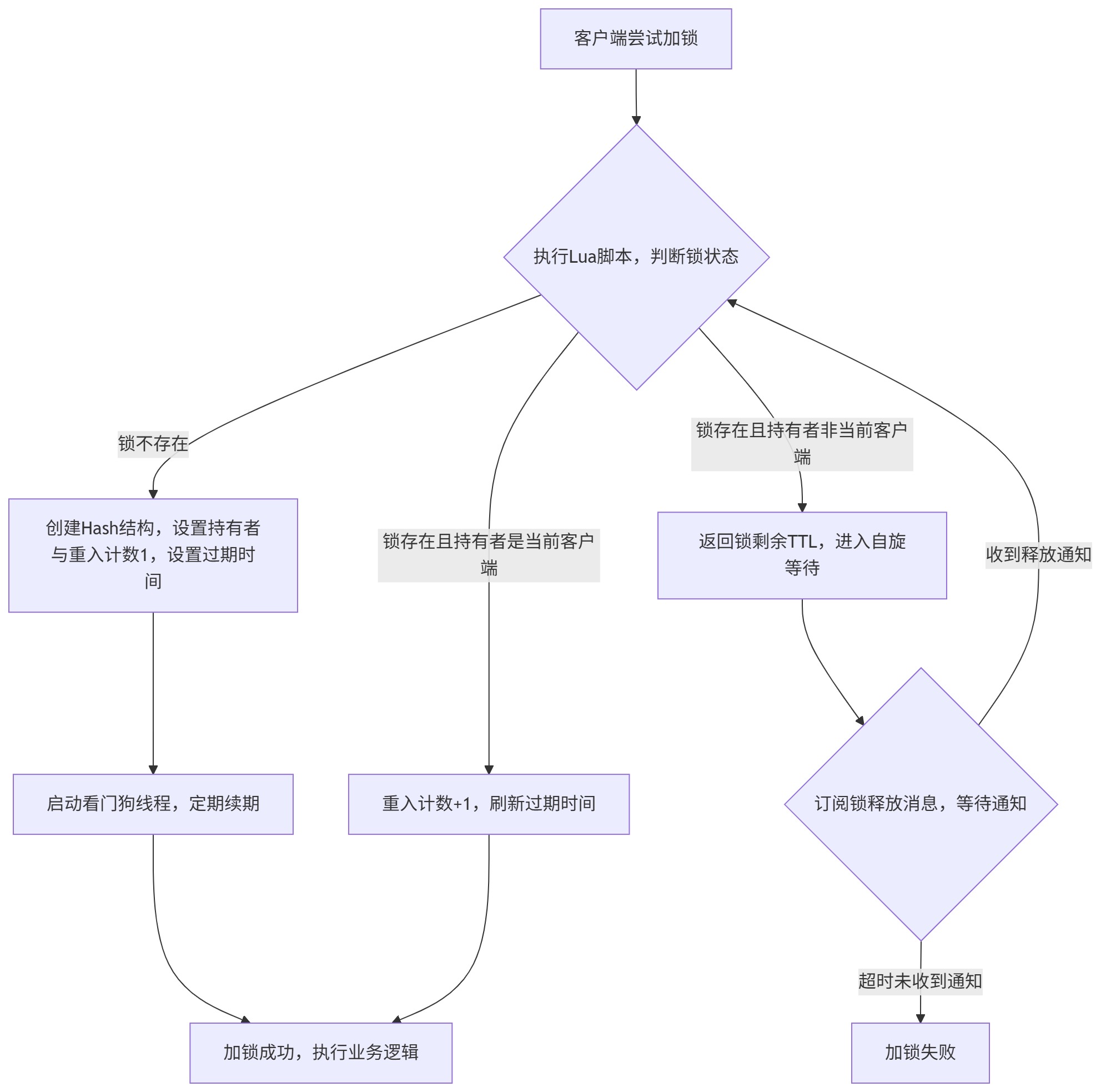 AI Visual Insight: This diagram shows the critical path in Redisson lock acquisition. The client first issues an atomic Lua lock request. If acquisition fails, it waits based on the returned TTL while subscribing to the lock-release channel. As soon as a published unlock notification arrives, it wakes up and retries immediately. The diagram also typically highlights the WatchDog renewal thread, showing that the lock lifetime is not fixed by a static timeout, but refreshed based on whether the owner is still alive.
The lock acquisition Lua script handles both first-time acquire and reentrancy
-- KEYS[1]: Lock name
-- ARGV[1]: Expiration time (ms)
-- ARGV[2]: Unique client identifier (UUID:threadId)
if (redis.call('exists', KEYS[1]) == 0) then
    redis.call('hset', KEYS[1], ARGV[2], 1) -- First-time acquire, initialize reentrancy count to 1
    redis.call('pexpire', KEYS[1], ARGV[1]) -- Set the lock expiration time
    return nil -- Return nil to indicate success
end
if (redis.call('hexists', KEYS[1], ARGV[2]) == 1) then
    redis.call('hincrby', KEYS[1], ARGV[2], 1) -- Reentrant acquire by the current thread
    redis.call('pexpire', KEYS[1], ARGV[1]) -- Refresh expiration after reentry
    return nil
end
return redis.call('pttl', KEYS[1]) -- Return the remaining TTL for retry strategy
This script collapses lock acquisition, reentrancy, and TTL refresh into one atomic operation.
The WatchDog mechanism solves lock expiration during long-running transactions
If you call lock() without explicitly setting leaseTime, Redisson enables the WatchDog. The default timeout is 30 seconds, and a background thread checks every 10 seconds. As long as the lock is still held by the current thread, Redisson keeps renewing it.
That means a business operation running for two minutes will not lose its lock automatically. But if the process crashes, the WatchDog stops, and the lock expires naturally after the timeout, which prevents permanent deadlocks.
Redisson unlock does not simply delete the key, but decrements the counter after safe validation
The unlock flow must first verify whether the current thread is the owner. If not, it returns immediately to avoid deleting another thread’s lock. If the current thread is the owner, Redisson first decrements the reentrancy count. Only when the count reaches zero does it delete the lock and publish a release message to wake waiting threads.
The unlock Lua script captures the essence of safe release
-- KEYS[1]: Lock name
-- KEYS[2]: Pub/Sub channel
-- ARGV[1]: Unlock message
-- ARGV[2]: Unique client identifier
-- ARGV[3]: Expiration time (ms)
if (redis.call('hexists', KEYS[1], ARGV[2]) == 0) then
    return nil -- Non-owners are not allowed to unlock
end
local counter = redis.call('hincrby', KEYS[1], ARGV[2], -1) -- Decrement reentrancy count by 1
if (counter > 0) then
    redis.call('pexpire', KEYS[1], ARGV[3]) -- Still reentered at deeper levels, refresh expiration
    return 1
else
    redis.call('del', KEYS[1]) -- Fully release the lock
    redis.call('publish', KEYS[2], ARGV[1]) -- Notify waiting threads to retry
    return 2
end
This script guarantees the production-grade requirement that only the lock owner can release the lock.
Spring Boot integration with Redisson has a low adoption cost
In most projects, you only need to add the starter dependency and configure the Redis address. Standalone, Sentinel, and Cluster modes are all supported. The main difference lies in the redisson.config section.
The Maven dependency should match your Spring Boot version
<dependency>

<groupId>org.redisson</groupId>

<artifactId>redisson-spring-boot-starter</artifactId>

<version>3.23.5</version>
</dependency>
This dependency enables Redisson quickly in a Spring Boot application.
Standalone configuration already covers most business workloads
spring:
  redis:
    host: 127.0.0.1
    port: 6379
    password: 123456
  redisson:
    config: |
      singleServerConfig:
        address: "redis://127.0.0.1:6379"
        password: 123456
        connectionPoolSize: 16 # Maximum connection pool size
        connectionMinimumIdleSize: 8 # Minimum idle connections
      lockWatchdogTimeout: 30000 # WatchDog timeout
This configuration defines standalone Redis connectivity and the WatchDog timeout.
Correct business encapsulation matters more than code that merely runs
In production, you should encapsulate locking into a shared utility or service layer. Hide details such as getLock, tryLock, and unlock, and enforce lock release in a finally block. Otherwise, business code can easily lose the unlock operation on exception paths.
In flash-sale scenarios, tryLock is recommended to cap wait time
public String seckill(Long productId) {
    String lockKey = "lock:seckill:product:" + productId;
    try {
        boolean locked = redissonClient.getLock(lockKey)
            .tryLock(1, 30, TimeUnit.SECONDS); // Wait for 1 second and hold for 30 seconds
        if (!locked) {
            return "Flash sale is too busy. Please try again.";
        }
        // Core business logic: validate inventory and deduct stock
        return "Flash sale succeeded";
    } catch (InterruptedException e) {
        Thread.currentThread().interrupt(); // Preserve the interrupt semantic
        return "The request was interrupted";
    } finally {
        RLock lock = redissonClient.getLock(lockKey);
        if (lock.isLocked() && lock.isHeldByCurrentThread()) {
            lock.unlock(); // Release only if held by the current thread
        }
    }
}
This code demonstrates the standard Redisson usage pattern for high-concurrency inventory deduction.
In production, knowing how to avoid pitfalls matters more than knowing how to call the API
Your lock key must reflect clear business granularity. A recommended format is lock:business:resourceId. A global lock amplifies contention, and a hot lock can directly collapse throughput.
If business execution time is unpredictable, prefer lock() without explicitly setting leaseTime, so the WatchDog can handle renewal. If you must set a fixed lease, leave enough buffer based on load-testing results.
Common optimization advice should be tied to the actual scenario
- General mutual exclusion: prefer
RLock. - Strong fairness requirement: use
RFairLock. - Read-heavy and write-light workloads: use
RReadWriteLock. - Consistent locking across multiple resources: consider
RMultiLock. - High-consistency cross-node locking: evaluate
RedissonRedLockcarefully.
FAQ
1. Why is Redisson safer than native Redis locks?
Because it uses Lua to guarantee atomicity, UUID + threadId to validate the owner, a Hash to track reentrancy count, and WatchDog to prevent lock expiration during long-running tasks.
2. Why can explicitly setting leaseTime cause problems?
After you set leaseTime, WatchDog is typically not enabled. If business execution exceeds that duration, the lock may expire early and allow another thread to enter the critical section.
3. Can Redisson completely solve distributed consistency problems?
No. It solves mutual exclusion, but it does not replace idempotency, transactional compensation, rate limiting, or eventual consistency design. High-risk workflows still require business-level fallback strategies.
Core summary
This article systematically reconstructs the core principles and production practices of Redisson distributed locks. It covers the pain points of native Redis locks, Lua-based atomic lock and unlock, reentrancy counting, WatchDog auto-renewal, the Pub/Sub wake-up mechanism, and Spring Boot integration, parameter tuning, and common failure handling. It is well suited for Java developers who need safe distributed mutual exclusion under high concurrency.