This article breaks down a self-healing architecture for embodied intelligent robots built around a seven-state connection state machine and a layered Agent cognitive pipeline. It addresses the common cloud-edge coordination problems where robots freeze on disconnect, lose control on reconnect, and struggle to resynchronize after recovery. The goal is to achieve seamless takeover within 300ms. Keywords: seven-state state machine, Agent self-healing, edge robotics.
Technical specifications provide a quick snapshot
| Parameter | Description |
|---|---|
| Primary languages | Python (pseudocode), C/C++ (embedded implementation) |
| Runtime environment | ESP32, STM32, edge controllers, cloud services |
| Communication protocols | MQTT, HTTP, heartbeat mechanism, custom bus |
| Outage recovery target | Seamless self-healing within 300ms |
| Detection latency | Less than 10ms |
| GitHub stars | Not provided in the original article |
| Core dependencies | TFLite Micro, lightweight on-device models, watchdog, sensor cache |
 AI Visual Insight: This animation highlights an end-to-end validation scenario for network resilience and the cognitive control loop. It is typically used to show that a robot can maintain continuous motion even when cloud connectivity fluctuates, emphasizing an unbroken perception-decision-execution chain.
A seven-state state machine is more effective than a simple online-offline split
Traditional robot network control often reduces connectivity to either online or offline. That simplification makes degradation strategies too coarse. A more robust approach introduces a seven-state state machine that explicitly models connection quality, execution phase, and recovery flow.
Recommended states include online ready, online executing, signal degraded, brief outage, persistent outage, recovery sync, and emergency stop. This allows the system to switch behaviors according to risk level instead of waiting for a full disconnect before passively stopping.
The seven-state connection model defines clear degradation boundaries
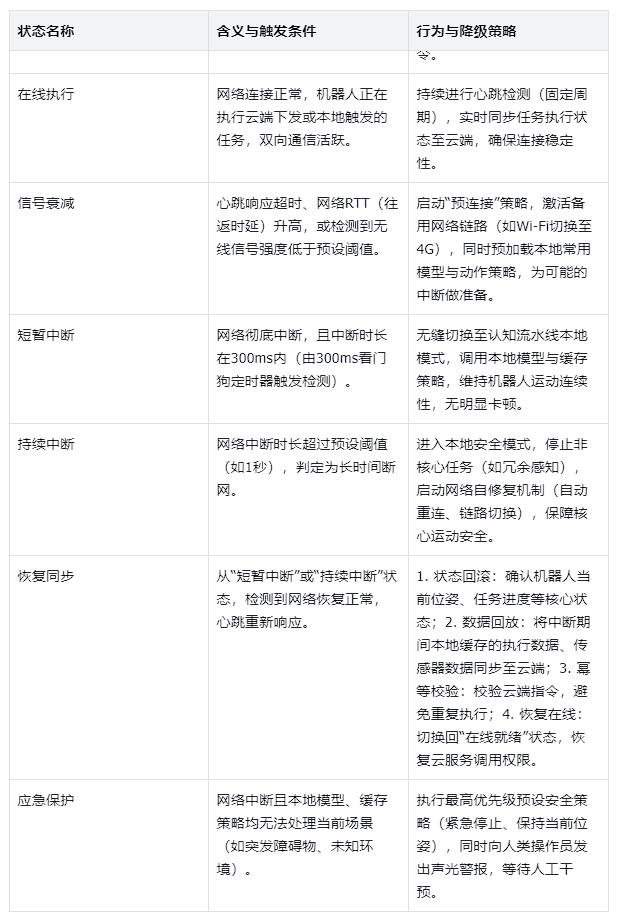 AI Visual Insight: The diagram should show the seven network connection states and their transition relationships. It should emphasize the closed-loop flow from normal execution to signal degradation, brief outage, persistent outage, recovery sync, and emergency shutdown, providing guidance for strategy switching and fault isolation.
from enum import Enum

class ConnectionState(Enum):
    ONLINE_READY = 1        # Online and ready, waiting for tasks
    ONLINE_EXECUTING = 2    # Online and executing, cloud-led control
    SIGNAL_DEGRADED = 3     # Signal degraded, early warning
    BRIEF_OUTAGE = 4        # Brief outage, trigger local takeover
    PERSISTENT_OUTAGE = 5   # Persistent outage, enter deep degradation
    RECOVERY_SYNC = 6       # Recovery sync, merge cloud-edge state
    EMERGENCY_STOP = 7      # Emergency protection, safety first
This code defines the minimum set of states required by the self-healing architecture and serves as the entry point for downstream strategy dispatch.
A layered Agent pipeline must treat connection state as a high-priority input
The connection state machine alone does not produce intelligent behavior. It must feed into the Agent pipeline. A reliable design splits the cognitive path into a reactive layer, a deliberative layer, and a metacognitive layer, with each layer handling different outage durations and risk levels.
The reactive layer handles millisecond-level takeover, the deliberative layer handles short-term strategy replanning, and the metacognitive layer handles long-term recovery and task reconstruction. In this model, 300ms self-healing does not depend on full large-model reasoning. It depends on fast local control near the robot.
Layered design balances real-time performance and robustness
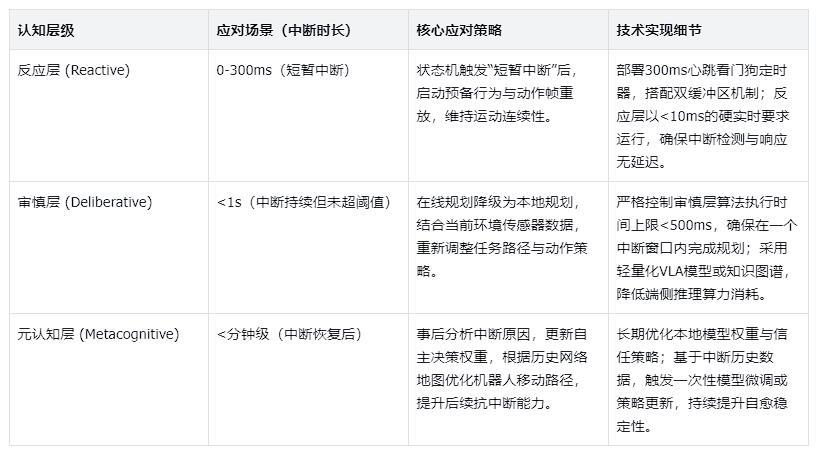 AI Visual Insight: The diagram should describe the three-layer structure of the reactive, deliberative, and metacognitive layers and their respective self-healing responsibilities. It should highlight how the reactive layer absorbs short outages, the deliberative layer adjusts local strategies, and the metacognitive layer restores task consistency and policy optimization after recovery.
def route_by_state(state):
    if state.name == "BRIEF_OUTAGE":
        return "reactive_layer"      # Prioritize the reactive layer within 300ms
    if state.name == "PERSISTENT_OUTAGE":
        return "deliberative_layer"  # Route long outages to the deliberative layer
    if state.name == "RECOVERY_SYNC":
        return "meta_layer"          # Let the metacognitive layer restore consistency after recovery
    return "cloud_first"
This code shows that the state machine does not directly control every behavior. Instead, it decides which cognitive layer should take over.
Seamless 300ms self-healing depends on four mechanisms working together
The first is low-latency detection. If the heartbeat interval is 100ms, the detection chain must confirm anomalies within a single cycle. In practice, this usually relies on watchdogs, interrupt-driven timers, and lightweight heartbeat packets.
The second is motion continuity. When the network drops, the system should not immediately issue a stop command. Instead, it should continue the last valid motion and use locally cached motion primitives to smooth the transition and prevent posture jitter.
The local offline brain determines the quality of short-term takeover
The third mechanism is on-device model takeover. You can use TFLite Micro or another lightweight model to generate conservative actions locally from IMU, encoder, and depth sensor data.
The fourth is recovery synchronization. When the network returns, the system must not switch directly back to the cloud. Otherwise, duplicate commands, state rollback, and reconnect storms can occur. You need idempotent commands and execution log replay.
def brief_outage_logic(sensor_data, local_model, actuator, cache):
    action = local_model.predict(sensor_data)   # Quickly predict a compensating action with the local model
    actuator.execute(action)                    # Execute the action to maintain continuous control
    cache.append({                              # Cache the execution trace for post-recovery synchronization
        "action": action,
        "sensor": sensor_data
    })
This code demonstrates the core takeover loop inside the 300ms window: read sensors, produce an action, and record the log.
A cloud-edge integrated architecture should place the state machine in the middle layer
An effective architecture does not bury the state machine inside the networking module. Instead, it places the state machine between cloud services and the edge cognitive pipeline. It receives heartbeat signals, link quality, and task status, then dispatches degradation strategies to downstream executors.
This middle-layer design brings two major benefits. First, it unifies fault semantics. Second, it isolates lower-level control from instability in upper-layer models. Even if cloud inference latency drifts, motion control can still run reliably through the state machine and the local reactive layer.
class RecoveryManager:
    def sync(self, local_logs, cloud_session):
        for item in local_logs:
            cloud_session.replay(item)   # Replay local execution records idempotently
        return "sync_done"
This code represents the core task of the recovery synchronization phase: replay local logs to restore cloud-edge state consistency.
Three engineering capabilities are required to move from demo to product
The first category is reliability engineering, including fault injection testing, network jitter replay, and watchdog false-positive calibration. The second is data engineering, including motion primitive cache strategy, recovery log compression, and on-device model version governance.
The third category is operational observability. You must track state transition frequency, average recovery duration, false trigger count, and the ratio of safety shutdowns. Without these metrics, 300ms self-healing remains a demo instead of a production capability.
Engineering challenges usually concentrate around recovery and safety boundaries
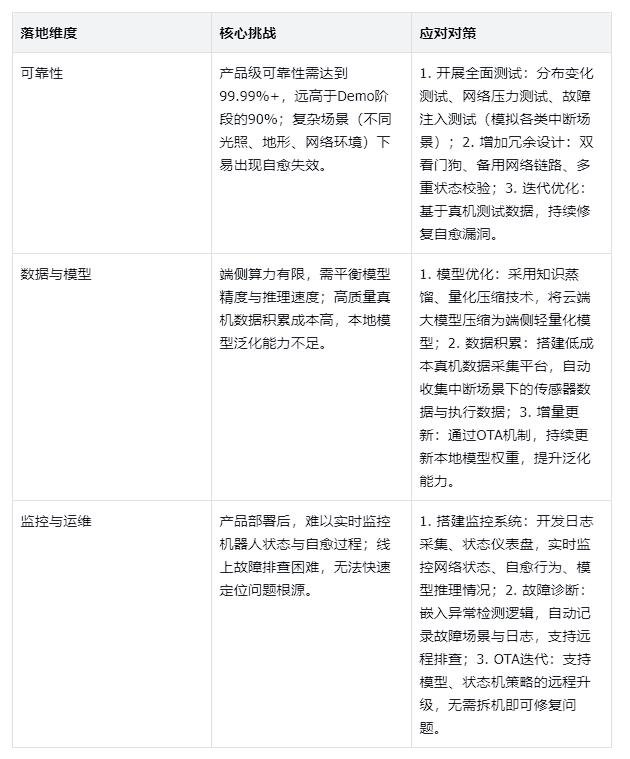 AI Visual Insight: The diagram should summarize the key productization challenges, such as false-positive rates, cache strategy, log synchronization, on-device takeover reliability, and safety shutdown boundaries. A countermeasure matrix can illustrate the path from a lab prototype to a mass-production architecture.
This architecture fundamentally redefines robot network resilience
The value of a seven-state state machine does not come from adding more labels. Its real value is turning the network outage problem into a control systems problem that is computable, observable, and degradable. It allows robots to evolve from cloud-dependent executors into autonomous systems with local survivability.
For embodied intelligence systems, the real goal is not permanent connectivity. The real goal is to preserve behavioral continuity, controllable decision-making, and verifiable recovery when the network becomes unstable.
FAQ
1. Why not use only online and offline states?
Because robot control requires fine-grained degradation. Signal degradation, short outages, persistent outages, and recovery sync all require different handling. A binary state model cannot support smooth switching.
2. What is the key bottleneck in achieving seamless 300ms self-healing?
The main bottleneck is the total latency across the detection path and the local takeover path, especially heartbeat evaluation, motion cache hit rate, and on-device model inference latency.
3. Which hardware platforms are best suited for this architecture?
It is well suited for ESP32-S3, STM32, hybrid edge MCU/MPU platforms, and robot control boards with local sensor caching and lightweight inference capabilities.
AI Readability Summary
This article reconstructs an integrated approach that combines a seven-state connection state machine with a layered Agent cognitive pipeline. It explains how to achieve seamless 300ms self-healing for robot-side network interruptions, covering state design, local takeover, recovery synchronization, on-device models, and production engineering considerations.