The Tomcat Container system hosts request routing, Web application isolation, and component lifecycle orchestration. At its core, it solves a fundamental problem: how requests are located and managed across multiple container layers. This article distills the key design of Engine, Host, Context, Wrapper, and ContainerBase. Keywords: Tomcat, Container, Lifecycle.
Technical Specification Snapshot
| Parameter | Description |
|---|---|
| Core Language | Java |
| Protocols | Servlet / HTTP |
| Project Origin | Apache Tomcat |
| GitHub Stars | Not provided in the source |
| Core Dependencies | Catalina, Lifecycle, JMX, Realm, Cluster, Pipeline |
| Focus Areas | Request processing, container hierarchy, lifecycle management |
Tomcat Container provides the structured backbone for request processing.
Tomcat does not pile all request-handling logic into a single Server object. Instead, it uses the Container abstraction to split request hosting, application isolation, Servlet mapping, and runtime extensibility into hierarchical components.
The value of this design is clear: it can represent both a complete Servlet engine and the wrapper object for a single Servlet. As a result, request processing naturally gains a tree structure and recursive lookup capability.
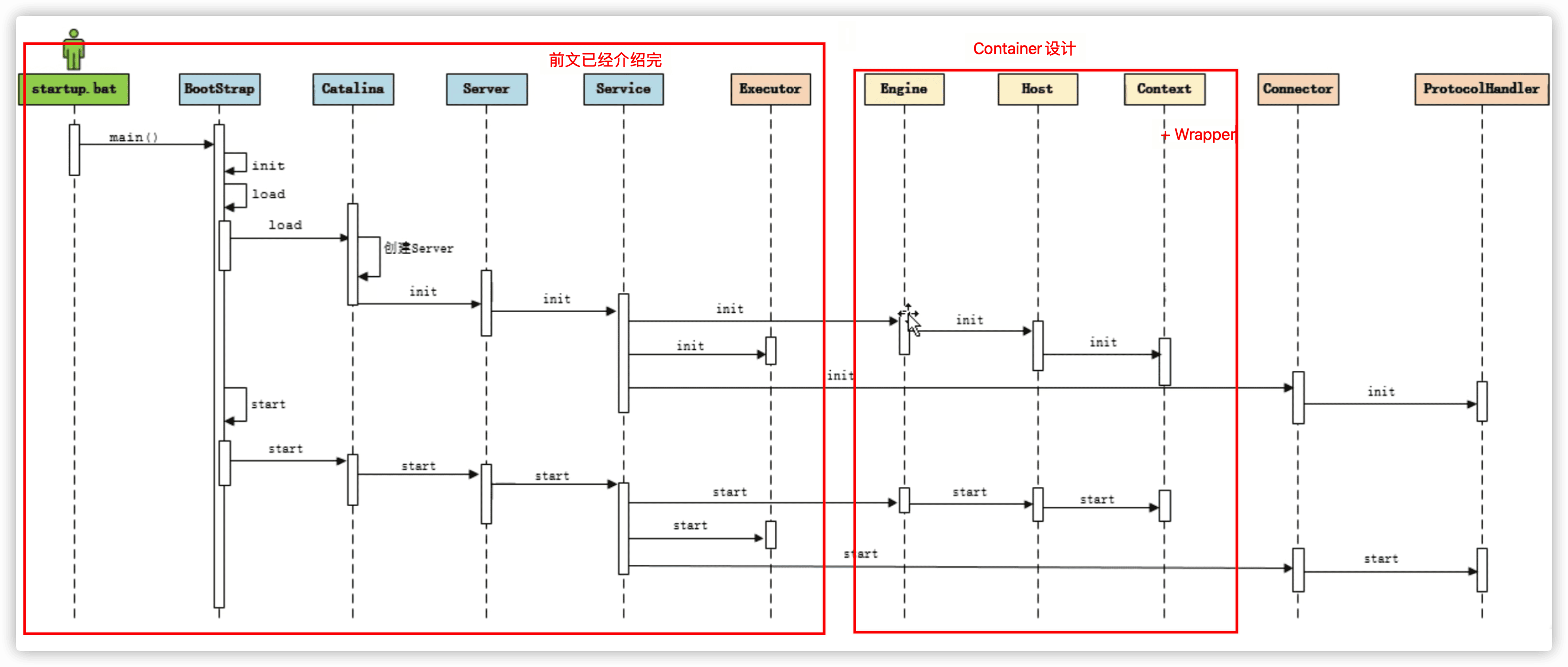 AI Visual Insight: The image shows the overall structure of Tomcat request-processing components. It emphasizes that Container is not an isolated object, but the hosting layer within the request flow, typically working together with connectors, adapters, and upper-level services.
The four container layers jointly define Catalina’s runtime model.
The comments in the Container interface explicitly identify four core implementations: Engine, Host, Context, and Wrapper. They are not peer-level components. Instead, they form a nested parent-child hierarchy.
// Abstract mapping of responsibilities across Tomcat's four container layers
Engine   // The entire Catalina Servlet engine
Host     // A virtual host that manages multiple Web applications
Context  // A Web application corresponding to a ServletContext
Wrapper  // The definition and wrapper for a specific Servlet
These four layers map to four levels of scope: global engine, site, application, and Servlet.
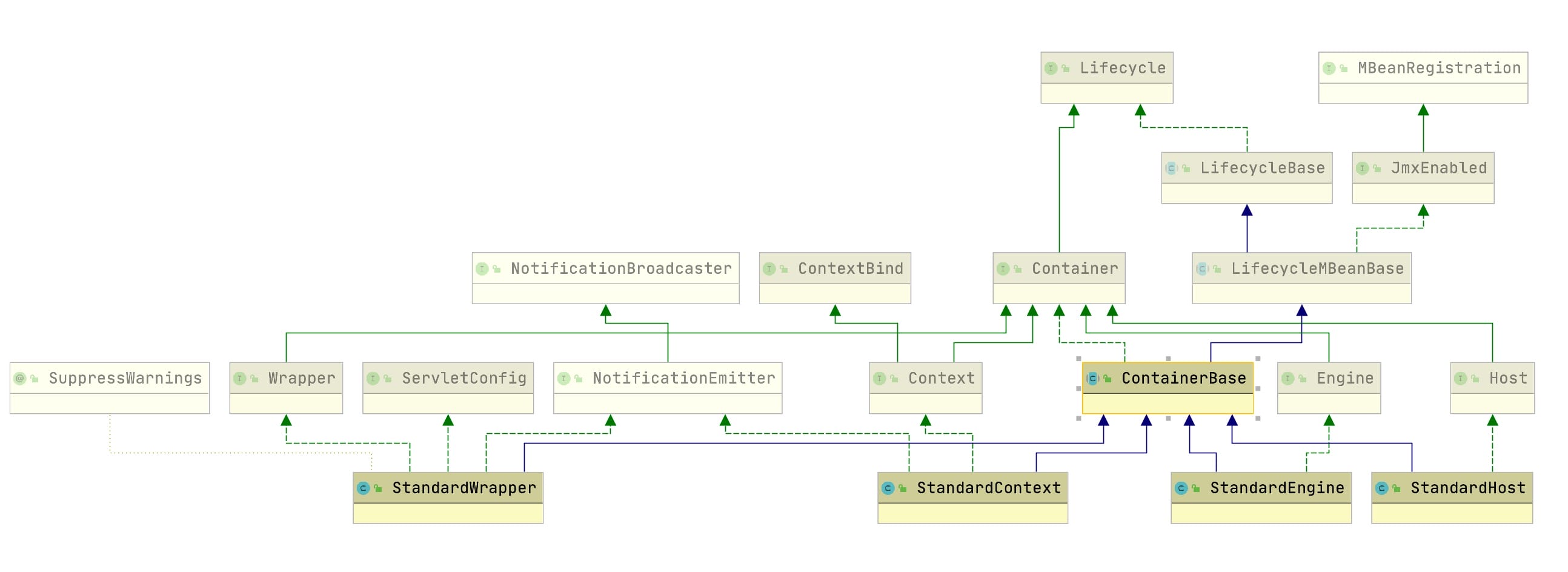 AI Visual Insight: The image shows the nested hierarchy of Engine, Host, Context, and Wrapper. It also highlights that the entire top-level structure is uniformly managed by Lifecycle, which means the container tree expresses not only structural relationships but also a unified start, stop, and destroy mechanism.
Container carries more than hierarchy because it also hosts runtime capabilities.
Container is not just a tree node. It also integrates supporting capabilities such as Loader, Logger, Manager, Realm, Resources, Cluster, Listeners, and Pipeline. This shows that it is a runtime unit, not a pure data model.
For example, Realm handles authentication and authorization domains, Cluster provides clustering capabilities, Pipeline implements valve-based chain-of-responsibility processing, and Listeners support event-driven extensions. Tomcat assembles these capabilities through interfaces instead of hardcoding them into a giant base class.
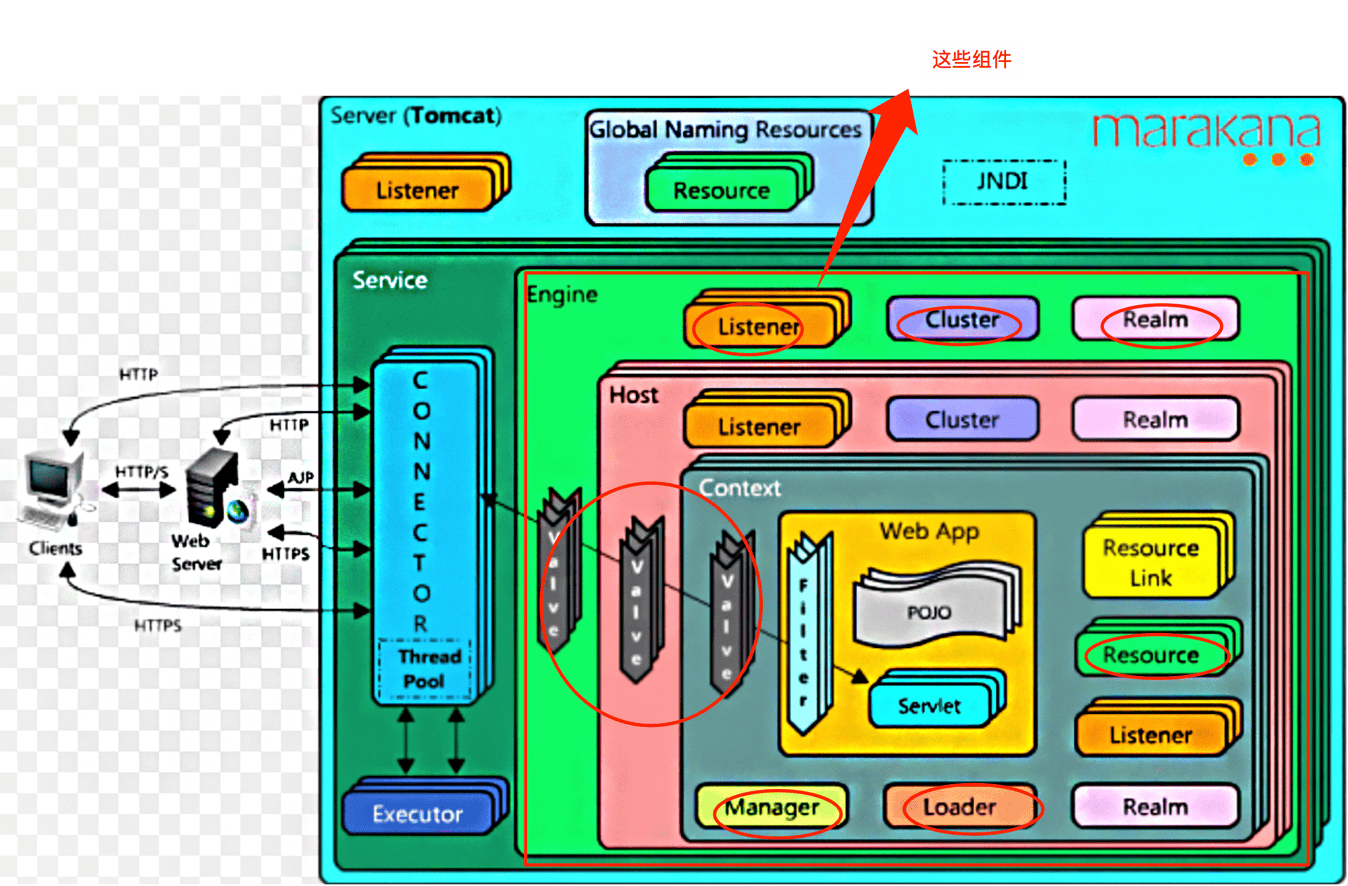 AI Visual Insight: The image shows the supporting components attached around Container, including Realm, Cluster, Listeners, and Pipeline. It illustrates how Tomcat builds an extensible Web container kernel through a “container core + supporting components” model.
The core container tree interface first solves parent-child navigation.
Container provides methods such as getParent(), setParent(), addChild(), findChildren(), and removeChild(). At its core, it defines a dynamically maintained component tree.
public interface Container {
    Container getParent();           // Get the parent container
    void setParent(Container c);     // Set the parent container
    void addChild(Container child);  // Add a child container
    Container[] findChildren();      // Get all child containers
    void removeChild(Container c);   // Remove a child container
}
This set of interfaces allows requests to drill down from Engine layer by layer, while also allowing configuration and lifecycle behavior to propagate along the tree.
The layered path from Engine to Wrapper gives request resolution a natural route.
At runtime, a request typically enters Engine first, then resolves the virtual host through Host, the Web application through Context, and finally the target Servlet through Wrapper. This model works well for both multi-tenant sites and multi-application deployment scenarios.
Notably, the layer above Engine is no longer a Container but a Service. For that reason, Tomcat provides utility logic to walk back from any container to its owning Service. This shows that the container tree is not the whole system, but one critical segment inside the Catalina core.
public static Service getService(Container container) {
    while (container != null && !(container instanceof Engine)) {
        container = container.getParent(); // Walk up the parent chain to Engine
    }
    return container == null ? null : ((Engine) container).getService();
}
This code lets Tomcat quickly return to the owning Service from any container node.
The event listener mechanism makes Container observable and extensible.
Container supports two types of listeners: ContainerListener and PropertyChangeListener. The former focuses on container-level events, such as adding a child container. The latter focuses on property changes, such as updates to name, realm, or cluster.
The key value of this design is decoupling. Tomcat can separate component changes from response logic instead of hardwiring chained behavior into the main execution path.
public void addContainerListener(ContainerListener listener);   // Register a container event listener
public void removeContainerListener(ContainerListener listener);
public void addPropertyChangeListener(PropertyChangeListener l); // Register a property change listener
public void fireContainerEvent(String type, Object data);       // Fire a container event
Together, these methods form the event infrastructure behind Tomcat’s container extension points.
ContainerBase is the most important foundational implementation of the Container interface.
If Container defines the contract, ContainerBase turns that contract into shared mechanisms. It centralizes logging, child-container management, Realm and Cluster injection, concurrent start-stop orchestration, and lifecycle template methods.
One especially important point stands out: ContainerBase does not optimize primarily for having fewer objects. Instead, it optimizes for clear component responsibilities, consistent lifecycle behavior, and controllable concurrency. That is a major reason Tomcat’s core remains maintainable over the long term.
Child container management reflects both structural and lifecycle consistency.
When adding a child container, Tomcat first validates name uniqueness, then sets the parent relationship, fires an event, and finally starts the child when the current state requires it. Importantly, the startup step is intentionally placed outside the synchronized block to avoid long lock hold times.
private void addChildInternal(Container child) {
    synchronized (children) {
        if (children.get(child.getName()) != null) {
            throw new IllegalArgumentException(); // Names must be unique
        }
        child.setParent(this);                    // Establish the parent-child relationship first
        children.put(child.getName(), child);    // Then write to the child container map
    }
    fireContainerEvent(ADD_CHILD_EVENT, child);  // Fire the add-child event
    child.start();                               // Start the child if the current state requires it
}
This logic keeps the container tree structure and runtime state as synchronized and convergent as possible.
Realm and Cluster assignment reflects a hot-swappable component model.
For both Realm and Cluster, ContainerBase uses a pattern that combines read-write locks, lifecycle coordination, and property change notifications. On reads, it prefers the local component and falls back to the parent container when none is configured locally. On updates, it stops the old component, attaches the new one, and starts it when needed.
public void setCluster(Cluster cluster) {
    // 1. Acquire the write lock and switch the reference
    // 2. Stop the old Cluster
    // 3. Bind the new Cluster to the current container
    // 4. Start the new Cluster
    // 5. Fire a property change event
}
This shows that Tomcat treats these capabilities as replaceable plug-in components rather than fixed fields.
Lifecycle template methods define the full operating loop of a container.
ContainerBase uses initInternal(), startInternal(), stopInternal(), and destroyInternal() to orchestrate a unified lifecycle. The sequence is very stable: initialize executors, start supporting components, start child containers, and then start the Pipeline. During shutdown, the order is reversed.
Inside startInternal(), Tomcat can start child containers in parallel and uses MultiThrowable to collect multiple exceptions. This is well suited to scenarios where multiple applications or Context instances must be brought up concurrently.
@Override
protected synchronized void startInternal() throws LifecycleException {
    getLogger(); // Initialize the logger
    if (getClusterInternal() instanceof Lifecycle lc1) lc1.start(); // Start Cluster
    if (getRealmInternal() instanceof Lifecycle lc2) lc2.start();   // Start Realm

    for (Container child : findChildren()) {
        startStopExecutor.submit(() -> { child.start(); return null; }); // Start child containers concurrently
    }

    if (pipeline instanceof Lifecycle lc3) lc3.start(); // Start Pipeline
    setState(LifecycleState.STARTING);                  // Update the lifecycle state
}
This template method uniformly drives the container and its supporting components into an available state.
Concurrent start and stop behavior is one of ContainerBase’s strongest engineering features.
The default value of startStopThreads is 1, in which case Tomcat uses InlineExecutorService. When the thread count is greater than 1, it delegates execution to the Server’s shared thread pool. This means Tomcat can switch strategies between lightweight deployments and highly concurrent environments.
The stop and destroy phases follow the same principle: children before parents, and stop before destroy. This helps prevent resource leaks and reduces illegal states under complex dependencies.
@Override
protected void destroyInternal() throws LifecycleException {
    // Destroy Realm, Cluster, and Pipeline first
    // Then remove and destroy all child containers
    // Finally shut down the start-stop executor
    super.destroyInternal(); // Clean up base resources such as MBeans
}
Its core significance is that it makes container shutdown deterministic and recoverable.
Understanding Container design helps you read Tomcat’s request entry points and extension model.
From an architectural perspective, Container solves the problem of how to break a Web container into a component tree that is composable, observable, manageable, and recursively navigable. From an implementation perspective, ContainerBase solves how that tree can be started, stopped, replaced, and observed safely.
If you are reading the Tomcat source code, it is usually more effective to first understand the relationships among Container, Lifecycle, Pipeline, Realm, and Cluster than to immediately trace the request call stack.
FAQ
Why does Tomcat need four container layers: Engine, Host, Context, and Wrapper?
These four layers correspond to the engine, virtual host, Web application, and Servlet. Together, they model isolation across multiple sites, multiple applications, and multiple Servlets, giving request resolution and configuration inheritance a clear hierarchy.
Why does ContainerBase start child containers outside the synchronized block?
Because start() can be slow. If Tomcat held the children lock during startup, it would amplify lock contention and block other threads from accessing the container tree, which would hurt both throughput and maintainability.
Why do Realm and Cluster support parent-container fallback?
This is a classic hierarchical inheritance design. Child containers can reuse the parent container’s security domain and clustering capability, which reduces duplicate configuration while preserving the flexibility to override locally when needed.
AI Readability Summary
This article systematically breaks down Tomcat’s Container architecture, focusing on the four-layer relationship among Engine, Host, Context, and Wrapper, as well as ContainerBase’s core implementation for child-container management, event listeners, Realm and Cluster injection, and lifecycle orchestration. It is especially useful for Java developers who want to understand Tomcat’s request-processing entry points and container abstractions.