[AI Readability Summary]
Tomcat implements component-level event listening through its Lifecycle system. When a component transitions through states such as start and stop, Tomcat broadcasts lifecycle events to registered listeners. This design decouples core state transitions from extension logic. The key concepts are Tomcat, the Observer Pattern, and Lifecycle.
Technical Specification Snapshot
| Parameter | Details |
|---|---|
| Core Topic | Tomcat event listener mechanism |
| Implementation Language | Java |
| Design Concepts | Observer Pattern, delegated event model |
| Key Interfaces | Lifecycle, LifecycleListener |
| Key Event Object | LifecycleEvent |
| Core Implementation Class | LifecycleBase |
| Concurrent Container | CopyOnWriteArrayList |
| Trigger Scenarios | Lifecycle state transitions such as start and stop |
| Star Count | Not provided in the source article |
| Core Dependencies | JDK EventObject, Tomcat LifecycleState |
Tomcat’s Listener Mechanism Is Essentially a Lifecycle Event Bus
Many internal Tomcat components implement the Lifecycle interface. That means they naturally support registering listeners, removing listeners, and broadcasting events. The real value of this mechanism is not the act of listening itself, but the complete decoupling of state changes from business-side responses.
When a component moves from NEW, STARTING, and STARTED to STOPPING and STOPPED, Tomcat wraps those transitions as events and hands them to external listeners for processing. As a result, the container’s core workflow does not need to know anything about extension logic.
The Lifecycle Interface Defines the Listener Entry Points
public interface Lifecycle {
    // Add a lifecycle listener
    void addLifecycleListener(LifecycleListener listener);

    // Get all current listeners
    LifecycleListener[] findLifecycleListeners();

    // Remove a specific listener
    void removeLifecycleListener(LifecycleListener listener);
}
This interface defines the three foundational capabilities of an event source: register, query, and remove.
You Need to Understand the Observer Pattern Before You Can Understand Tomcat Listeners
The Observer Pattern describes a one-to-many dependency. When the subject changes state, it proactively notifies all observers that depend on it. In Tomcat, Lifecycle is the subject, and LifecycleListener is the observer.
This design delivers two direct benefits. First, container state transitions remain stable. Second, extension logic becomes pluggable at the listener level without invading the main execution path.
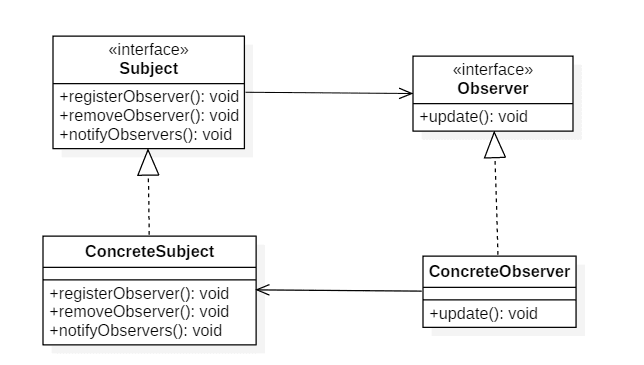 AI Visual Insight: This diagram shows the classic Observer Pattern structure. The central subject maintains a collection of observers and provides three key actions: register, remove, and notify. Multiple observers subscribe to a single subject, which directly maps to how Tomcat’s
 Lifecycle holds multiple LifecycleListener instances.
The Java Event Model Is More Engineering-Oriented Than the Classic Observer Pattern
The Java event model typically consists of three roles: event source, event object, and event listener. Tomcat directly adopts this abstraction, but narrows the event domain to component lifecycle transitions.
- Event Source: the component that implements
Lifecycle. - Event Object:
LifecycleEvent. - Event Listener:
LifecycleListener.
public interface EventListener extends java.util.EventListener {
    void handleEvent(EventObject event); // Handle the received event
}
This shows that a listener is fundamentally just a callback interface that consumes events.
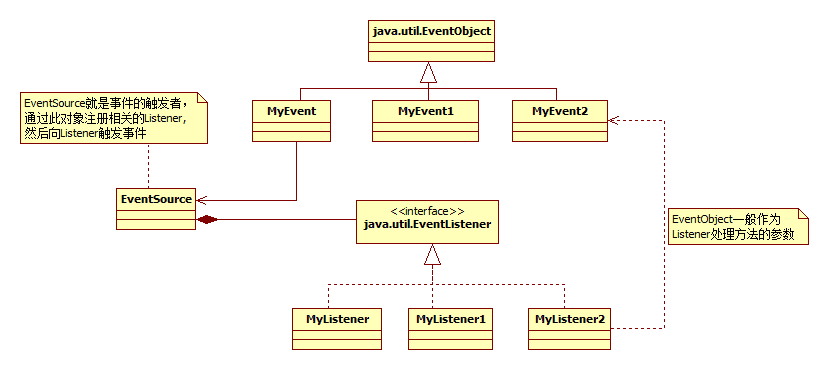 AI Visual Insight: This diagram illustrates the relationship between the event source, the event object, and listeners in an event-driven environment. The event source creates an event object and distributes it to multiple listeners. Each listener performs different logic based on the event payload, making the message carrier and delegation chain more explicit than in the pure Observer Pattern.
Tomcat Maps the Generic Event Model to the Lifecycle System
Tomcat starts by defining a listener interface. It exposes only one entry method for receiving lifecycle events, so implementers only need to focus on what event arrived and how to respond.
public interface LifecycleListener {
    // Receive a lifecycle event
    void lifecycleEvent(LifecycleEvent event);
}
This allows every lifecycle-related extension to attach uniformly to the lifecycleEvent callback.
LifecycleEvent Carries the Event Context
LifecycleEvent extends the JDK’s EventObject, so it naturally contains a reference to the event source. Tomcat also adds two fields, type and data, to express what happened and what additional data came with it.
public final class LifecycleEvent extends EventObject {
    private final Object data;   // Additional data
    private final String type;   // Event type

    public LifecycleEvent(Lifecycle lifecycle, String type, Object data) {
        super(lifecycle); // Record the event source
        this.type = type;
        this.data = data;
    }

    public Object getData() { return data; }
    public Lifecycle getLifecycle() { return (Lifecycle) getSource(); }
    public String getType() { return type; }
}
The key point in this code is that the event object does not just deliver a notification. It carries the source, the type, and the surrounding context.
LifecycleBase Is Where Event Broadcasting Actually Happens
Although Lifecycle only defines the capability, the actual listener storage and event dispatch logic live in LifecycleBase. It uses CopyOnWriteArrayList to store listeners, which makes traversal and notification safer in read-heavy, write-light scenarios.
private final List
<LifecycleListener> lifecycleListeners = new CopyOnWriteArrayList<>();

@Override
public void addLifecycleListener(LifecycleListener listener) {
    lifecycleListeners.add(listener); // Register the listener
}

@Override
public LifecycleListener[] findLifecycleListeners() {
    return lifecycleListeners.toArray(new LifecycleListener[0]); // Return a snapshot
}

@Override
public void removeLifecycleListener(LifecycleListener listener) {
    lifecycleListeners.remove(listener); // Remove the listener
}

protected void fireLifecycleEvent(String type, Object data) {
    LifecycleEvent event = new LifecycleEvent(this, type, data); // Create the event object
    for (LifecycleListener listener : lifecycleListeners) {
        listener.lifecycleEvent(event); // Broadcast the event one by one
    }
}
This implementation directly matches the Observer Pattern model of maintaining a subscriber list and notifying all subscribers in a unified way.
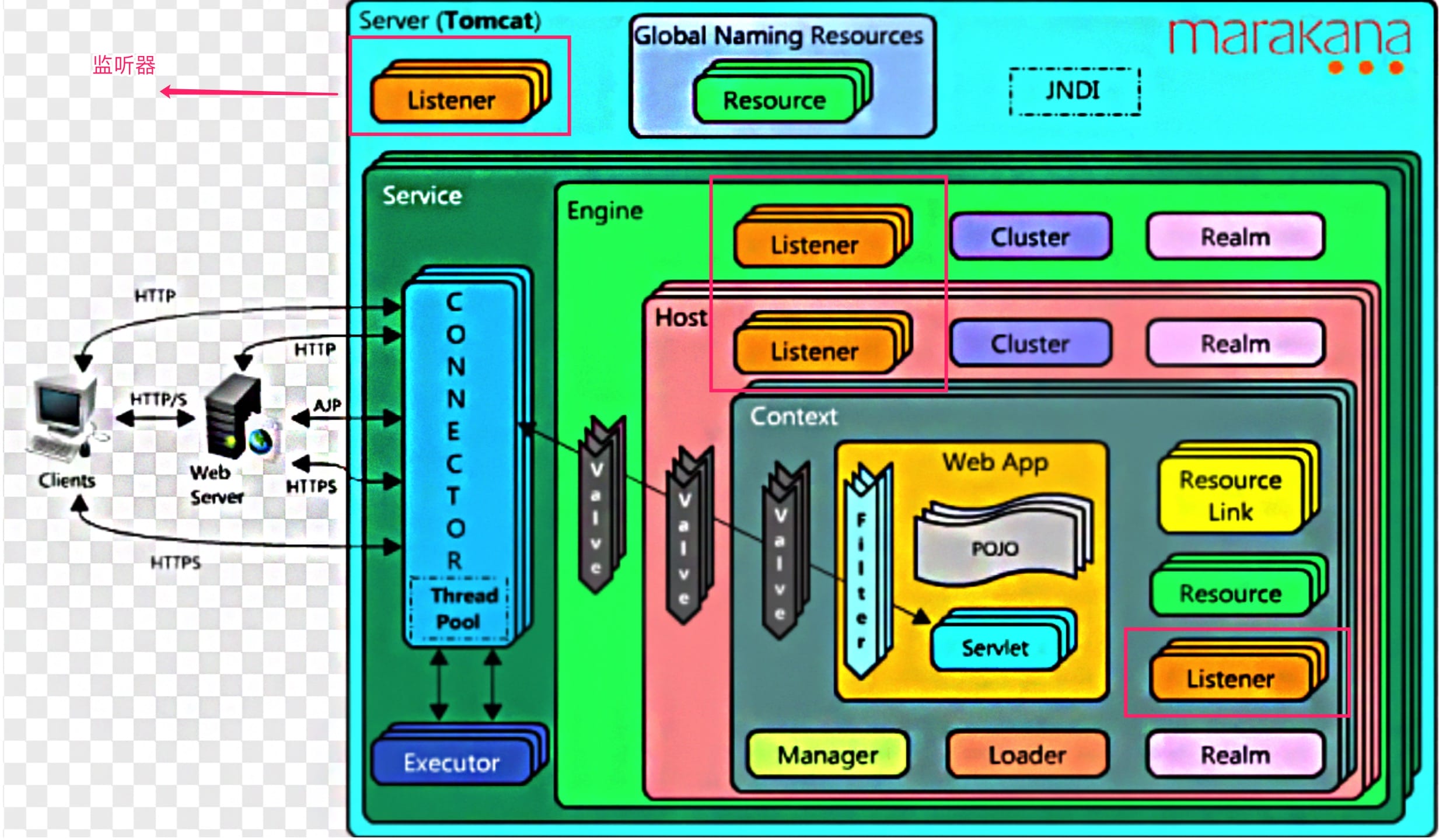 AI Visual Insight: This architecture diagram shows where lifecycle interfaces are distributed across Tomcat’s multi-layer container and component system. It highlights that the listener mechanism is not a one-off feature, but a shared abstraction across multiple core components, which allows event notifications to propagate through a unified lifecycle contract.
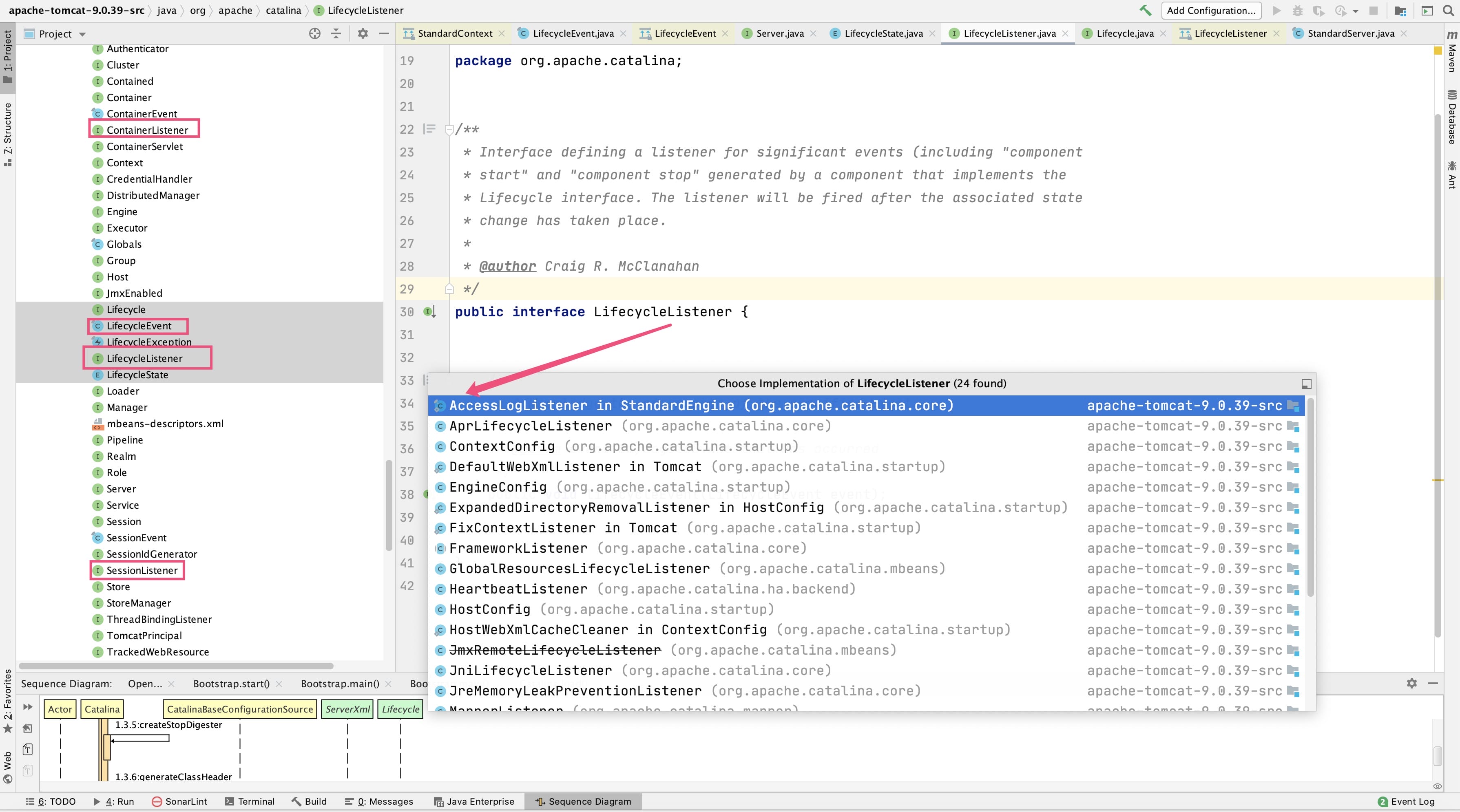 AI Visual Insight: This structural diagram presents the class hierarchy and invocation relationship among
 Lifecycle, the event object, the listener, and the base implementation class. It emphasizes LifecycleBase as the central hub for listener registration and event dispatch, responsible for both listener list management and event broadcasting.
The stop Method Shows How the State Machine Triggers Events
Tomcat does not fire events arbitrarily. It binds event emission to lifecycle state transition points. For example, during stop(), once the component enters a specific state, Tomcat calls fireLifecycleEvent().
@Override
public final synchronized void stop() throws LifecycleException {
    if (state.equals(LifecycleState.FAILED)) {
        fireLifecycleEvent(BEFORE_STOP_EVENT, null); // Broadcast the before-stop event first if the state is FAILED
    } else {
        setStateInternal(LifecycleState.STOPPING_PREP, null, false); // Move to the stopping-prep state
    }

    stopInternal(); // Execute the subclass-specific stop logic
    setStateInternal(LifecycleState.STOPPED, null, false); // Finally enter the stopped state
}
This shows that Tomcat’s listener mechanism is essentially a state-machine-driven event dispatch system.
This Mechanism Solves Three Core Problems in Tomcat Extensibility
First, it decouples components. Lifecycle control and additional processing logic stay separate, so core classes do not need to depend on specific extension implementations. Second, it standardizes extensibility. All components follow the same listener contract, which reduces the learning curve. Third, it improves observability. External logic can hook into points such as before startup, before shutdown, or after failure handling to implement auditing or operational behaviors.
From a source-code perspective, Tomcat did not invent a new model. Instead, it combines the Observer Pattern, the JDK event mechanism, and the container state machine into a highly extensible infrastructure.
A Minimal Mental Model Looks Like This
// 1. The component registers a listener
lifecycle.addLifecycleListener(listener);

// 2. The component state changes
setStateInternal(LifecycleState.STOPPING_PREP, null, false);

// 3. The framework creates and broadcasts an event internally
fireLifecycleEvent("before_stop", null);

// 4. The listener consumes the event
listener.lifecycleEvent(event);
These four steps form the shortest closed loop for understanding Tomcat lifecycle listening.
FAQ
1. What is the relationship between Tomcat’s Lifecycle listener mechanism and the Observer Pattern?
Lifecycle is the observed subject, LifecycleListener is the observer, and fireLifecycleEvent() is the notification action. Tomcat uses the Observer Pattern as the structural backbone and the JDK event object model to carry context.
2. Why does LifecycleBase use CopyOnWriteArrayList?
Because listeners are usually registered infrequently but triggered many times. CopyOnWriteArrayList allows notification traversal without additional locking, which makes it well suited for broadcast scenarios with many reads and few writes, while reducing concurrency complexity.
3. When are Tomcat events triggered?
They are primarily triggered by lifecycle state transitions, such as before startup, after startup, before shutdown, after shutdown, and during failure handling. Events are not a separate workflow. They are embedded directly into state machine transitions.
Core Summary: This article reconstructs Tomcat’s event listener mechanism by focusing on how Lifecycle, LifecycleListener, LifecycleEvent, and LifecycleBase work together. It explains how Tomcat uses the Observer Pattern to notify component state changes and walks through the full path of event registration, triggering, and consumption from the source code perspective.