VFNet is a dense object detection method from CVPR 2021. Its core idea is to use IACS to merge class confidence and localization quality, directly fixing NMS ranking distortion and replacing the loosely coupled classification-score-plus-centerness design. Keywords: VFNet, IACS, Varifocal Loss.
Technical Specification Snapshot
| Parameter | Details |
|---|---|
| Paper Title | VarifocalNet: An IoU-aware Dense Object Detector |
| Conference | CVPR 2021 |
| Task | Dense Object Detection / Anchor-free Detection |
| Core Idea | Use IACS to unify classification confidence and localization quality |
| Baseline Framework | FCOS + ATSS + FPN |
| Implementation Language | Python |
| Deep Learning Framework | PyTorch |
| Core Dependencies | FPN, ATSS, DCN, GIoU Loss |
| Ranking Mechanism | IACS directly serves as the detection score for NMS |
| Open Source Code | github.com/hyz-xmaster/VarifocalNet |
| GitHub Stars | Not provided in the original input |
VFNet Solves the Ranking Mismatch Problem in Dense Detection
One-stage detectors have long suffered from the same structural flaw: classification scores only answer “Does this look like the target class?” but not “How accurate is the box?” When NMS ranks boxes by classification score, boxes with high classification confidence but poor localization may be kept, while boxes with better localization but lower classification scores may be suppressed.
The traditional patch is to predict IoU or centerness in an extra branch and multiply it with the classification score. However, this approach still stacks errors from two separate branches. The ranking signal remains unstable, and both training and inference become more complex.
IACS Turns the Detection Score into a Single Variable
VFNet’s key change is to directly learn the IoU-aware Classification Score, or IACS. For the ground-truth class, the supervision target is no longer 1. Instead, it is the IoU between the predicted box and the ground-truth box. For all other classes, the target remains 0.
This means a high-scoring box must satisfy two conditions at the same time: it must belong to the target class, and it must also localize the object accurately. The meaning of the score is therefore upgraded from “classification confidence” to “detection quality that can be directly used for ranking.”
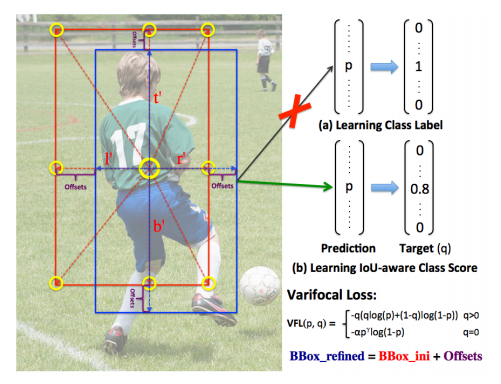 AI Visual Insight: This figure compares traditional classification supervision with IACS supervision. On the left, the model only learns class presence. On the right, the ground-truth class label is replaced with a continuous IoU value. The yellow sampled points also show the later star-shaped feature extraction locations. The red box indicates the initial regression box, and the blue box indicates the refined box, illustrating a design where score prediction and box refinement share the same geometric prior.
The oracle experiment in the paper is especially convincing: if ground-truth IoU is directly used as the classification score, the AP upper bound is substantially higher than that of traditional classification scores. This shows that the problem is not NMS itself, but the ranking signal fed into NMS.
Varifocal Loss Provides a Matched Training Objective for IACS
IACS is not a binary label. It is a continuous label that carries quality information, so standard Focal Loss is not a good fit. VFNet therefore introduces Varifocal Loss, whose core idea is to handle positive and negative samples asymmetrically.
import torch

def varifocal_loss(pred, target, alpha=0.75, gamma=2.0):
    # pred: predicted IACS, usually in the range [0, 1]
    # target: IACS label, IoU for positive samples and 0 for negative samples
    pos_mask = target > 0  # positions of positive samples

    # Down-weight negative samples in a focal-style manner to suppress many easy negatives
    neg_weight = alpha * pred.pow(gamma)
    neg_loss = -(~pos_mask).float() * neg_weight * torch.log(1 - pred + 1e-6)

    # Weight positive samples by IoU strength so higher-quality boxes incur larger loss
    pos_loss = -pos_mask.float() * target * (
        target * torch.log(pred + 1e-6) +
        (1 - target) * torch.log(1 - pred + 1e-6)
    )

    # Normalize to avoid instability caused by fluctuations in the number of positives
    loss = (pos_loss + neg_loss).sum() / (pos_mask.sum().clamp(min=1))
    return loss
This code implements the core logic of VFL: it focuses learning on high-IoU positive samples while automatically down-weighting easy negative samples.
Varifocal Loss Is Ranking-Oriented Rather Than Purely Classification-Oriented
Its biggest difference from standard Focal Loss is that positive samples are not uniformly treated as 1. Instead, they participate in optimization according to IoU magnitude. As a result, the high-scoring boxes learned during training are statistically closer to the ranking criterion that NMS actually needs at inference time.
Experiments also show that VFL is not only effective for VFNet. It also delivers consistent gains on dense detectors such as RetinaNet, RepPoints, and ATSS, which suggests strong transferability.
Star-Shaped Feature Representation Makes Score Prediction Aware of Box Geometry
If IACS is expected to reflect localization quality, single-point features are clearly not enough. VFNet introduces a Star-shaped Box Feature Representation that derives 9 key sampling points from the initial box: the center, the midpoints of the top, bottom, left, and right edges, and the four corner points. It then uses deformable convolution to aggregate features from these locations.
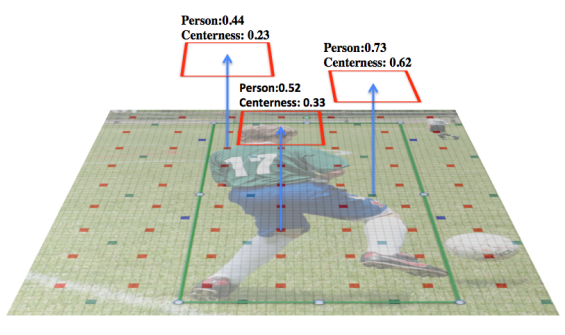 AI Visual Insight: This figure shows the three standard output branches of the FCOS detection head: the classification branch, the box regression branch, and the centerness branch. It makes it clear why the older paradigm needs an extra quality branch to compensate for ranking errors, and it provides a structural contrast for VFNet, which removes centerness and directly predicts IACS instead.
import torch

def star_sample_offsets(ltrb):
    # ltrb: [..., 4], representing left, top, right, bottom
    l, t, r, b = ltrb.unbind(dim=-1)
    zero = torch.zeros_like(l)

    # Build star-shaped sampling offsets from 9 points to explicitly encode box geometry
    points = [
        (zero, zero),      # center point
        (-l, zero),        # left midpoint
        (r, zero),         # right midpoint
        (zero, -t),        # top midpoint
        (zero, b),         # bottom midpoint
        (-l, -t),          # top-left corner
        (r, -t),           # top-right corner
        (-l, b),           # bottom-left corner
        (r, b)             # bottom-right corner
    ]

    offsets = torch.stack([torch.stack([px, py], dim=-1) for px, py in points], dim=-2)
    return offsets.flatten(-2)
This code shows how the star-shaped sampling points are constructed. In essence, it extracts richer structure-aware features in the box coordinate system.
AI Visual Insight: This image highlights how the 9 yellow sampling points generated from the initial box cover the center, boundaries, and corner regions. Compared with single-center sampling, this design is better at capturing aspect ratio, edge texture, and local context, making it more suitable for both IACS prediction and box refinement with geometrically consistent feature inputs.
The Box Refinement Module Further Raises the Localization Ceiling
VFNet does not only change the scoring mechanism. It also adds Bounding Box Refinement on the regression side. The process first predicts an initial box, then uses star-shaped features to predict scale factors that adjust the four box sides a second time, producing a more accurate final box.
This design balances two goals. First, the initial box provides coarse localization. Second, star-shaped features supply box-level geometric context for refinement. During training, both the initial box and the refined box are supervised, usually with a GIoU-style loss.
VFNet Makes Small Architectural Changes but Delivers Strong Gains
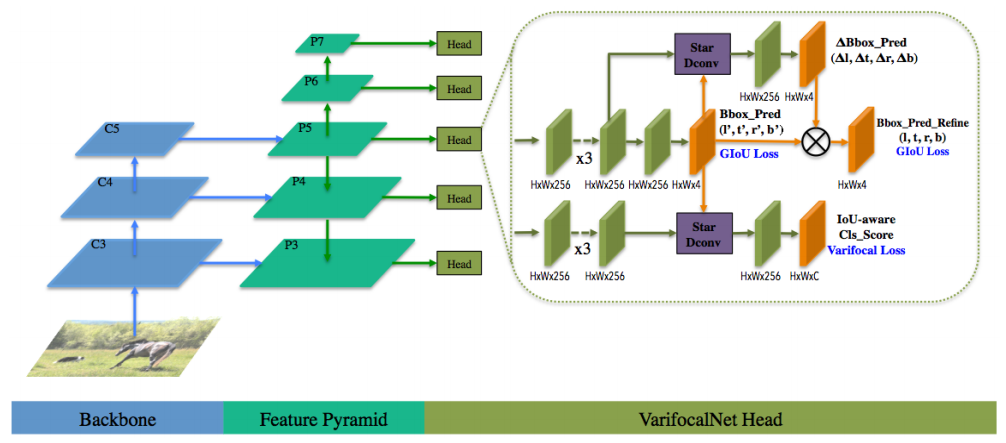 AI Visual Insight: This figure presents the full VFNet pipeline. The backbone outputs multi-scale features, FPN builds P3-P7, and the features then flow into two head subnets. The regression head first predicts the initial box and then refines it further. The classification head uses Star DConv to aggregate box-level features before predicting IACS. Structurally, VFNet keeps the FCOS/ATSS backbone intact and only strengthens scoring and regression details locally, which makes reproduction relatively low-cost.
From an engineering perspective, VFNet’s biggest advantage is its low replacement cost. It evolves from FCOS + ATSS, does not introduce heavy RoI operations, and does not rewrite the dense detection paradigm. That makes it a practical enhancement for existing one-stage detectors.
Experimental Results Show That VFNet Gains Come from Three Synergistic Components
First, oracle results show that IACS is the ranking signal closest to the theoretical optimum. Second, VFL makes continuous quality labels learnable in a stable way. Third, star-shaped features and box refinement improve consistency between scoring and localization.
On COCO test-dev, VFNet typically gains about +2 AP over ATSS with the same backbone. With a stronger backbone and DCN, the single-model single-scale result reaches 55.1 AP, validating that this is not a local trick but a complete and effective scoring paradigm for object detection.
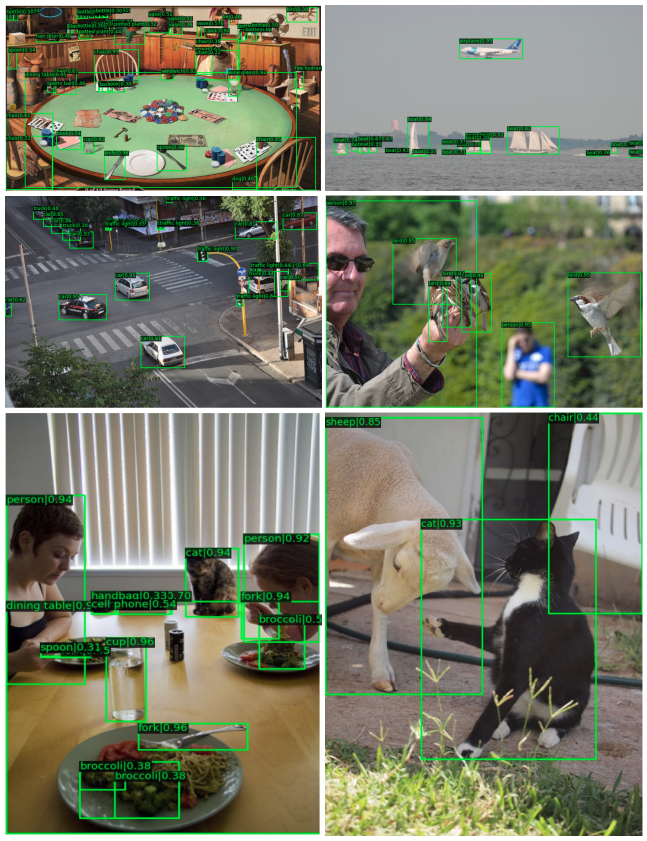 AI Visual Insight: This figure shows VFNet’s final detection outputs in multi-class COCO scenes. The model produces more stable high-quality boxes for occlusions, small objects, and crowded instances, which indicates that IACS does not merely improve the numeric value of classification confidence. It fundamentally improves proposal ranking and retention during post-processing.
VFNet’s Main Contribution Is an Upgrade to the Detection Scoring Paradigm
VFNet’s most important contribution is not just a new loss function. It upgrades the detection score from a plain class probability to a joint variable that combines class probability and localization quality. This directly targets the most critical ranking requirement in detection post-processing.
For researchers, it offers a new path for aligning classification and regression. For production use, it reduces dependence on extra quality branches and keeps the detection head simpler. Many later IoU-aware and quality-aware detectors continue along the path opened by VFNet.
FAQ
Q1: What is the biggest difference between VFNet and FCOS?
A: FCOS still models classification score and localization quality separately, usually relying on centerness to assist ranking. VFNet directly predicts IACS, merging “is this an object of the class” and “how accurate is the box” into a single score.
Q2: Why is Varifocal Loss more suitable than Focal Loss for VFNet?
A: Because VFNet does not use a fixed positive label of 1. Instead, positive labels are continuous IoU values. VFL assigns higher weight to high-quality positive samples while suppressing a large number of easy negatives, which better matches the ranking-oriented optimization goal.
Q3: What makes star-shaped feature representation stronger than single-point features?
A: It explicitly samples the center, boundaries, and corners of the box, so it can encode shape, scale, and local context at the same time. This gives IACS prediction a better understanding of box quality and also makes subsequent box refinement more stable.
Core Summary: VarifocalNet (VFNet) combines classification confidence and localization quality into a single score through the IoU-aware Classification Score, solving the NMS ranking distortion problem. This article breaks down IACS, Varifocal Loss, star-shaped features, and box refinement, and summarizes the key gains over ATSS on COCO.