Technical Specification Snapshot
| Parameter | Description |
|---|---|
| Development Language | LabVIEW graphical programming |
| Communication Protocols | LXI, VISA, SCPI, Ethernet |
| Article Popularity | 290 views, 5 likes, 3 bookmarks |
| Typical Scale | 500–600 test points, hundreds of thousands of combination tasks |
| Core Hardware | Matrix switch, measurement instruments, industrial PC/chassis |
| Core Dependencies | LabVIEW array processing, Parallel For Loop, file I/O |
[AI Readability Summary] For LabVIEW multi-channel test and measurement systems with more than 600 test points, the core challenge is to generate arbitrary two-point test sequences with a combinatorial algorithm, then reduce total test time through matrix-based grouping, parallel preprocessing, and single-threaded hardware scheduling. This approach addresses massive pairing counts, communication latency, and data persistence bottlenecks. Keywords: LabVIEW, multi-channel test and measurement, matrix switch
The system’s core objective is to complete full traversal data acquisition across large-scale test points
In impedance and voltage testing scenarios, the number of test points can scale beyond 600. The system must acquire electrical parameters between any two points. In essence, this means generating all unique pairwise combinations from the test-point set rather than performing a simple sequential scan.
As the number of test points increases, the task volume expands rapidly. With 600 points, the total number of combinations exceeds one hundred thousand. If the system still follows a fully serial process of “generate one pair, switch once, measure once, write once,” it becomes extremely difficult to reduce total test time enough to meet acceptance requirements.
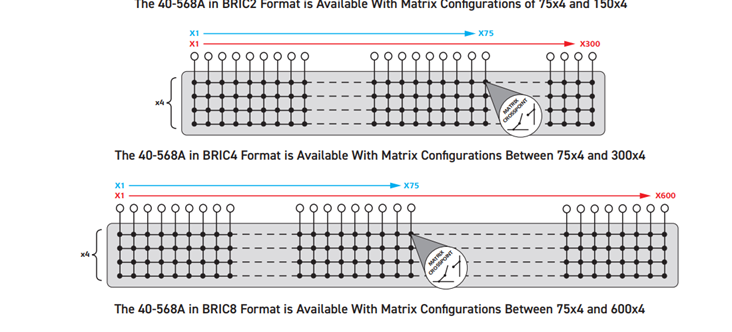 AI Visual Insight: The figure illustrates the pairing relationships among multi-channel test points, highlighting how pairwise connections across a large number of nodes create a dense test-task graph. The technical implication is that the bottleneck does not lie in a single sample, but in task orchestration after combinatorial explosion, matrix mapping, and channel switching overhead.
from math import comb

def pair_count(points: int) -> int:
    # Calculate the number of pairwise test-point combinations: C(n, 2)
    return comb(points, 2)

for n in [500, 600]:
    # Output the theoretical task count for different test-point scales
    print(n, pair_count(n))
This code quickly estimates the theoretical total number of test tasks as the number of test points grows.
Test-point combinations should be planned offline rather than calculated on demand
A more effective engineering approach is to use LabVIEW array operations to generate pairing sequences in batches first, and then split tasks according to matrix hardware limits. This shifts computational pressure forward and reduces repeated branching and temporary allocation inside the acquisition loop.
Pre-grouping also provides a direct benefit: it allows you to build a more stable scheduling queue based on matrix units, instrument count, and channel mutual exclusion constraints. That queue becomes the foundation for parallel acquisition preparation and time-sliced execution.
End-to-end test time requirements make layered optimization mandatory
The original scenario imposes a clear constraint: the full test workflow must finish within 10 minutes. The voltage threshold for each measurement group is below 50 V, and the operating current does not exceed 100 mA. That means range configuration is relatively fixed, and the real challenge is throughput rather than adaptive range handling.
The execution time of a single test step usually comes from four components: software scheduling, matrix switching, instrument response, and communication transfer. Even if each component only adds a few milliseconds, the accumulated total across hundreds of thousands of tasks can still exceed the time budget by a wide margin.
def total_time(task_count, sched_ms, switch_ms, measure_ms, comm_ms):
    # Sum the per-step latency and estimate total test duration in milliseconds
    per_step = sched_ms + switch_ms + measure_ms + comm_ms
    return task_count * per_step

# Example: estimate the total time for hundreds of thousands of tasks
print(total_time(150000, 1.2, 3.5, 4.0, 2.3) / 1000, "seconds")
This code turns the intuition that “each step is short” into the engineering reality that “the total workflow is long.”
Different bus architectures can amplify or reduce timing overhead
LXI devices rely on Ethernet. Their advantages include flexible wiring and strong modularity, but network jitter can introduce random latency. PXI uses a local bus, which provides more stable transfer characteristics and is better suited for continuous acquisition workloads that require high frequency and low jitter.
The value of LabVIEW lies in its ability to support both architectures while separating optimization across layers: reduce loop overhead in the compute layer, reduce interaction count in the communication layer, and minimize channel-switching waste in the control layer.
The hardware architecture must be designed around matrix partitioning and exclusive resource ownership
The system’s core hardware is a modular matrix switch. It maps a large number of test points onto a finite set of controllable switching channels and supports coordinated operation across multiple matrix units, enabling larger row-and-column expansion.
Because chassis slots and modules can continue to scale, this design naturally supports future upgrades to systems with thousands of test points. When multiple measuring instruments are connected at the same time, they can also form independent sampling paths and provide the hardware foundation for multi-task parallelism.
Parallel optimization fits the data flow, not the hardware flow
LabVIEW Parallel For Loops are well suited for pure computation tasks such as pairing generation, result conversion, and task decomposition, because these steps do not involve exclusive resource ownership and can directly leverage multi-core CPUs.
However, matrix switches, serial devices, and LXI instruments are all shared hardware resources by nature. If multiple threads write to them at the same time, SCPI command interference, incorrect channel switching, and data mismatches can occur. Therefore, the correct strategy is “parallel data processing, serial hardware execution.”
from queue import Queue

task_queue = Queue()

def enqueue_tasks(tasks):
    for task in tasks:
        # Tasks can be generated in parallel during preprocessing
        task_queue.put(task)

def hardware_worker():
    while not task_queue.empty():
        task = task_queue.get()
        # Send hardware commands in a single thread to avoid resource contention
        print(f"Execute task: {task}")
        task_queue.task_done()
This code captures the core scheduling idea: generate tasks in parallel, execute hardware actions serially.
Field performance bottlenecks usually come from the UI, communication, and exception recovery
In large-scale loops, frequent UI refreshes can consume foreground thread resources and introduce jitter into the acquisition loop. In practice, you should replace real-time display with timed batch refresh and decouple UI updates from background test-and-measurement control.
A typical communication-layer issue is fragmented SCPI traffic. If the system sends only one command at a time, it introduces extra handshake and response wait time. A better approach is to batch similar configuration commands and cache matrix state to avoid repeated transmission.
Long-run stability determines whether the system is deliverable in production
Testing hundreds of thousands of combinations means the application must support self-recovery. Timeouts, disconnections, instrument no-response events, and channel anomalies should not terminate the entire job immediately. Instead, the system should log the issue, reconnect automatically, and skip a single failed item when necessary.
At the data persistence layer, the system should not write to disk point by point. Instead, it should buffer a fixed batch and then flush in bulk. This reduces disk I/O frequency and creates structured records based on test-point ID, switching sequence, voltage value, and acquisition timestamp.
buffer = []
BATCH_SIZE = 1000

def save_result(result):
    # Write to the in-memory buffer first to reduce frequent disk operations
    buffer.append(result)
    if len(buffer) >= BATCH_SIZE:
        flush_to_disk()

def flush_to_disk():
    global buffer
    # Flush to disk in batches to improve overall throughput
    print(f"Write {len(buffer)} records in batch")
    buffer = []
This code shows how segmented buffered writes reduce the drag that I/O places on the main acquisition loop.
The essence of this solution is to split massive testing into a schedulable data flow and a controllable hardware flow
In summary, this kind of LabVIEW multi-channel test and measurement system does not simply aim for “faster sampling.” Instead, it systematically compresses end-to-end test time through combination preprocessing, matrix partitioning, parallel computation, serial hardware control, and batch storage.
When the number of test points grows from dozens to hundreds, the factor that truly determines success is task orchestration capability, not whether a single VI is sufficiently complex. As long as you optimize compute, communication, switching, and storage as separate cost domains, completing full-scale acquisition within 10 minutes becomes an achievable engineering target.
FAQ
1. Why does testing 600 test points run much slower than expected?
Because complexity does not grow linearly. It grows with pairwise combinations. Once the task count reaches the hundred-thousand scale, even millisecond-level delays accumulate and eventually exceed the total time budget.
2. Can LabVIEW parallel loops directly control a matrix switch?
That is not recommended. Parallel loops are suitable for pure data processing, but not for shared hardware control. Matrix switches, serial devices, and LXI instruments should use single-threaded queue-based scheduling to avoid resource conflicts.
3. How can I improve test efficiency without replacing the hardware?
Prioritize three actions: pre-generate test-point combinations, batch SCPI commands, and use staged buffered disk writes. These changes are usually more effective than simply increasing CPU performance or refreshing the UI more aggressively.
Core Summary: This article reconstructs a LabVIEW-based multi-channel test and measurement solution focused on pairwise combinations for 600-class test points, matrix switch scheduling, LXI/PXI communication, and batch data storage, explaining how to complete hundreds of thousands of test tasks within a 10-minute acceptance window.