Linux anonymous pipes are one of the most classic IPC mechanisms. Their core capability is to let a parent and child process share a kernel-managed memory buffer and perform unidirectional byte-stream communication through
pipe()andfork(). They solve the problem of data transfer across isolated process address spaces. Keywords: Linux IPC, anonymous pipe, fork.
Technical specifications provide a quick snapshot
| Parameter | Details |
|---|---|
| Topic | Linux anonymous pipe (pipe) |
| Supported systems | Unix / Linux |
| Programming languages | C / C++ |
| Core system calls | pipe(), fork(), read(), write(), close() |
| Communication model | Half-duplex, byte-stream oriented |
| Process relationship requirement | Commonly used between parent and child processes |
| Kernel objects | struct file, inode, ring buffer |
| Default buffer characteristics | Memory-level buffering, commonly around 64 KB |
| Star count | Not provided in the source material |
| Core dependencies | glibc, Linux VFS, pipefs |
Inter-process communication fundamentally means sharing accessible resources
Processes are isolated from one another. Each process has its own address space and kernel-managed structures, so it cannot directly read another process’s memory. The essence of IPC is to let multiple processes indirectly access the same controlled resource through operating system mechanisms.
From an evolutionary perspective, Linux IPC broadly progressed through three stages: pipes, System V IPC, and POSIX IPC. Anonymous pipes are the earliest and easiest to understand, especially for parent-child process scenarios.
Pipes solve the fundamental problem of how isolated processes exchange data
You can think of a pipe as a special file fabricated by the kernel. It has no on-disk backing store, but it exposes file-like access interfaces, inode attributes, and a buffer, so processes can communicate by reading and writing it just like a file.
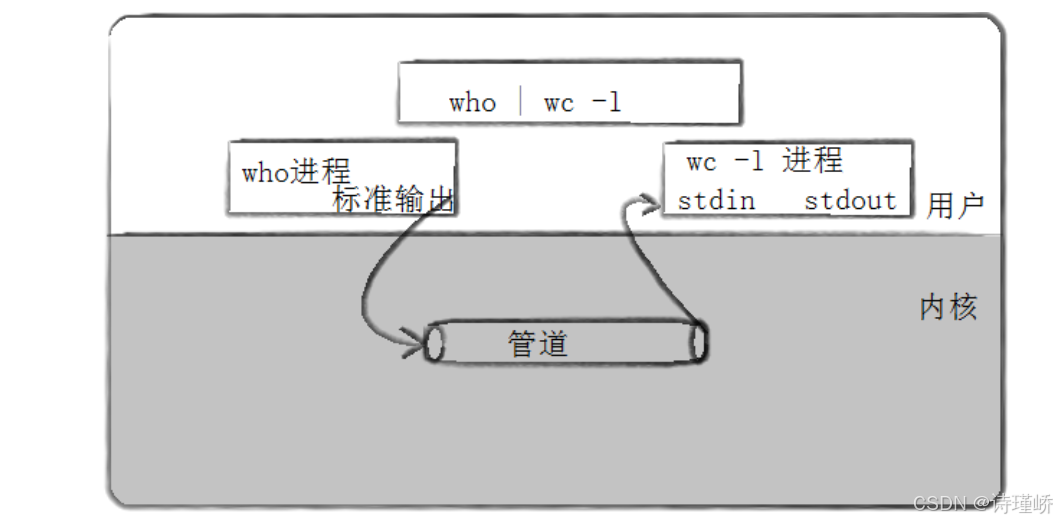 AI Visual Insight: This diagram shows the high-level topology of a pipe as a data channel between two processes: the process on the left writes a byte stream into a kernel buffer, and the process on the right reads from that same buffer. It emphasizes that the communication medium is not shared user-space memory, but a kernel-hosted data stream channel.
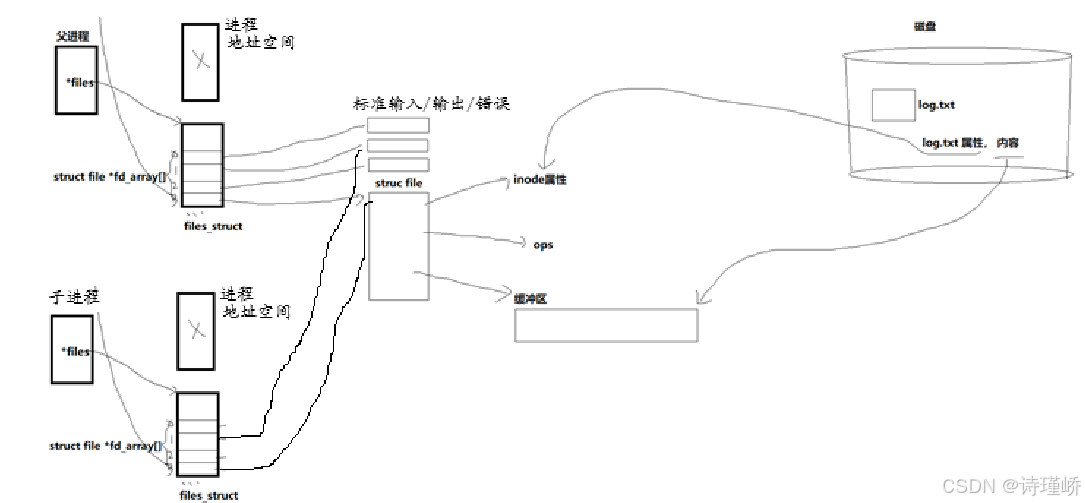 AI Visual Insight: This diagram further illustrates how a parent and child process connect to the same pipe object. The key idea is a single underlying resource referenced by multiple file descriptors, which sets up the conceptual foundation for understanding file descriptor inheritance after
 fork().
Anonymous pipes establish a communication path through an unnamed in-memory file
An anonymous pipe is called anonymous because it exists only in memory. It has no filesystem path and is never persisted to disk. Its lifetime typically depends on the processes that keep it open and the file descriptor references that remain active.
Its API is extremely simple: int pipe(int pipefd[2]);. Here, pipefd[0] is the read end, and pipefd[1] is the write end. These two file descriptors are the only entry points you need to understand the rest of the behavior.
int pipefd[2];
if (pipe(pipefd) < 0) {
    // Exit immediately if creation fails
    return 1;
}
// pipefd[0]: read end
// pipefd[1]: write end
This code requests a pair of related read/write file descriptors from the kernel.
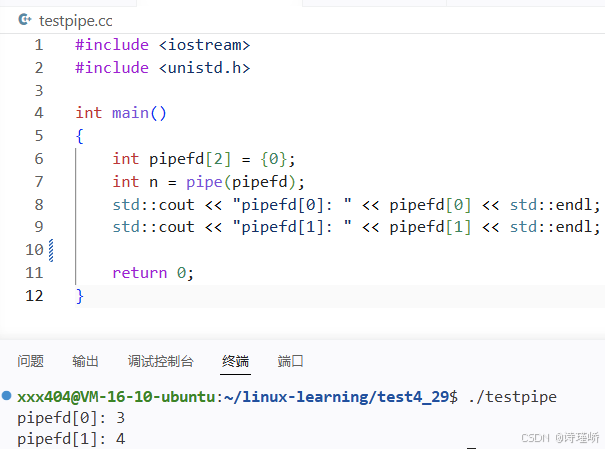 AI Visual Insight: This diagram clearly marks the read end and write end of an anonymous pipe. It shows that
 pipe() returns not a single handle, but a pair of file descriptors with directional semantics, which directly reflects the pipe’s unidirectional communication model.
The fork inheritance mechanism determines why parent and child processes can communicate
When you create a pipe alone, only the current process holds the two file descriptors. What actually lets another process see the same resource is not data copying, but fork() inheritance of the file descriptor table.
After the parent process calls fork(), the child process inherits the parent’s file descriptor table. At that point, fd[0] and fd[1] in both the parent and child point to the same set of kernel pipe objects, so the precondition for communication exists naturally.
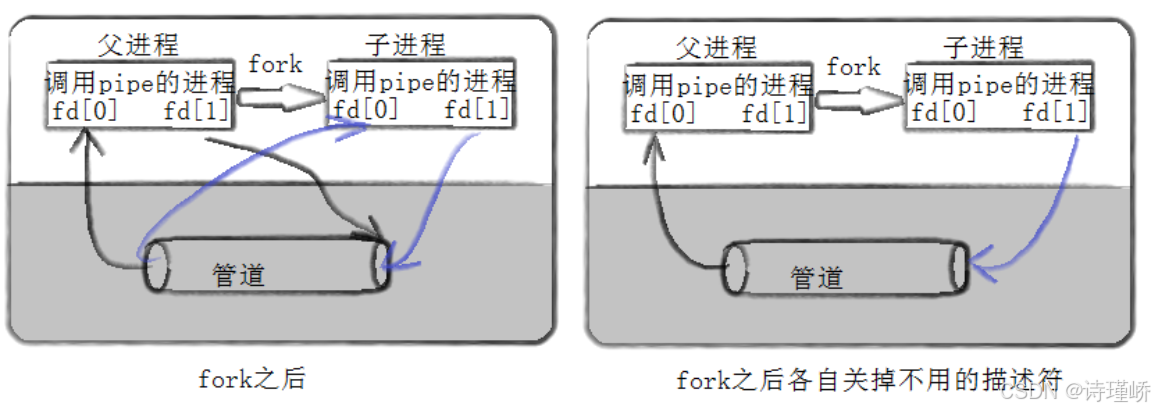 AI Visual Insight: This diagram depicts the resource state after
 pipe() but before fork(). The focus is that a single process already holds both the read-end and write-end descriptors, each mapped to pipe-related file objects in the kernel.
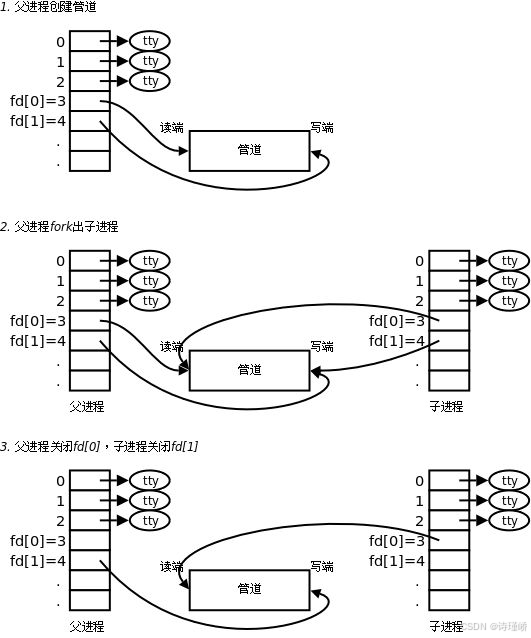 AI Visual Insight: This diagram shows the shallow-copy effect on the parent and child file descriptor tables after
 fork(): the fd slots in both processes point to the same underlying pipe resources. This is the core mechanism that enables anonymous pipes to support communication between related processes.
Unidirectional data flow requires explicitly closing unused ends
Although both parent and child inherit both ends, the anonymous pipe itself is designed as half-duplex. The best practice is to keep only one side for reading and the other for writing, and close the unused ends to avoid semantic confusion and resource leaks.
pid_t id = fork();
if (id == 0) {
    close(pipefd[0]);          // The child closes the read end and only writes
    write(pipefd[1], msg, len);
} else {
    close(pipefd[1]);          // The parent closes the write end and only reads
    read(pipefd[0], buf, size);
}
This code shapes the shared resource into a clear, one-way data stream.
Anonymous pipes have well-defined runtime boundary semantics
An anonymous pipe is not just a simple buffer. It also embeds synchronization and blocking behavior. If reads are faster than writes, the reader blocks and waits. If writes are faster than reads, data accumulates in the buffer, and once the buffer is full, the writer blocks.
Even more important are the two terminal states: when all write ends are closed, the read end returns from read() after consuming the remaining data, indicating EOF. When all read ends are closed but a writer continues writing, the writing process receives SIGPIPE and is usually terminated by the system.
ssize_t n = read(rfd, buf, sizeof(buf) - 1);
if (n > 0) {
    buf[n] = '\0';            // Append a string terminator after reading data
} else if (n == 0) {
    // All write ends are closed, so the reader has reached end-of-file
} else {
    // Read failed; inspect errno for the cause
}
This code distinguishes among three critical states: data read successfully, EOF reached, and read failure.
 AI Visual Insight: This diagram shows the runtime output of a basic demo program. The child process periodically writes string messages, and the parent process continuously reads and prints them, validating the one-way streaming behavior of an anonymous pipe.
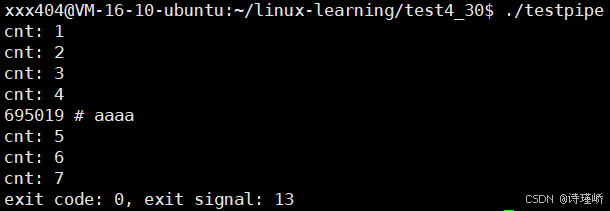 AI Visual Insight: This diagram corresponds to a boundary-condition experiment. It highlights the behavior where the write side exits abnormally or is terminated by a signal after the read side is closed, showing that pipes do more than transfer data: the kernel also uses signals to preserve communication consistency.
From the kernel’s perspective, a pipe combines VFS objects with an in-memory buffer
From user space, a pipe is just two integer file descriptors. From the kernel’s perspective, it is a carefully organized set of data structures. The most important conceptual upgrade is this: one pipe does not correspond to just one struct file. Instead, the read end and write end each have their own independent struct file.
The value of this design is state isolation. The read end and write end maintain independent f_mode, f_flags, and offset-related control state, so they do not interfere with each other by sharing a single file object.
Two struct file objects can point to the same pipe only by sharing one inode
Although the read-side file and write-side file are independent, their f_inode pointers ultimately converge on the same pipe inode. That inode does not manage disk blocks. Instead, it manages the pipe’s in-memory data resources.
At the same time, VFS assigns different operation handlers to the read and write ends through f_op. read() ultimately dispatches to pipe_read, and write() ultimately dispatches to pipe_write. Blocking, wake-up, synchronization, and mutual exclusion are all encapsulated inside these implementations.
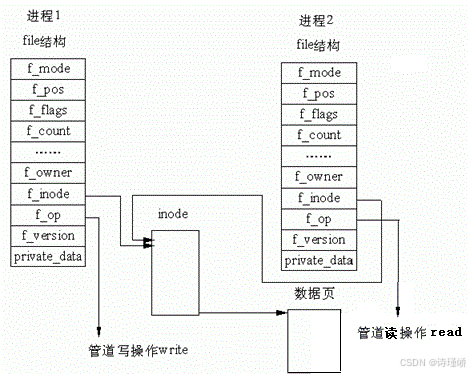 AI Visual Insight: This diagram shows the kernel object relationships behind an anonymous pipe: each process holds its own file descriptors, the file descriptors map to independent
 struct file objects, and those objects connect through a shared inode to the same set of in-memory pages. It fully reveals how the VFS abstraction, permission isolation, and shared buffer cooperate.
// User space calls write(fd, buf, len)
// VFS locates struct file based on fd
// struct file->f_op->write dispatches to pipe_write
// pipe_write copies data into the pipe's ring buffer
This pseudocode summarizes the call path from a user-space write() call to the kernel’s pipe write path.
The core characteristics of pipes can be reduced to five conclusions
First, anonymous pipes are unidirectional by default. Second, they are best suited to processes with a parent-child relationship. Third, they are still fundamentally a file abstraction, but the data flows only in memory.
Fourth, pipes come with built-in synchronization and blocking semantics, so developers get basic ordering control without manually implementing locks. Fifth, pipes are byte-stream oriented rather than message-oriented, so the number of reads and writes may not align with application-level message boundaries.
FAQ: The three questions developers care about most
Q1: Why can anonymous pipes usually be used only between parent and child processes?
A: Because they have no filename, external processes cannot reopen them through a path. In practice, processes usually have to rely on fork() inheriting existing file descriptors in order to share the same pipe resource.
Q2: Does read() returning 0 always mean an error?
A: No. For a pipe, it usually means all write ends have been closed and the buffered data has been fully consumed, which is the standard EOF semantic.
Q3: Why is the writer killed after the read end closes?
A: Because continuing to write to a pipe that no process reads is meaningless. The kernel sends the writing process a SIGPIPE signal, whose default action is to terminate the process.
Core summary consolidates the full mechanism
This article systematically reconstructs the anonymous pipe mechanism in Linux inter-process communication. It covers IPC evolution, how pipe() and fork() work together, how to shape unidirectional data flow, blocking and EOF boundary behavior, and kernel implementation details from struct file and inode to the ring buffer. It is well suited for quickly building a complete mental model from the API layer down to kernel objects.