The core tension in AI Agent design is not whether to automate, but which actions should run automatically and which must be intercepted. This article distills a dual-lane security model, explains the engineering value of risk classification, allowlists, risk labels, and secondary confirmation, and helps you establish enforceable boundaries between efficiency and safety. Keywords: AI Agent, security mechanisms, risk classification.
Technical Specification Snapshot
| Parameter | Details |
|---|---|
| Domain | AI Agent security design |
| Core concepts | Dual-lane model, Allowlist, risk labels, secondary confirmation |
| Target audience | Developers, product managers, enterprise automation teams |
| Representative products | AutoGPT, Cursor, Claude Code, Warp |
| Core dependencies | Tool calling framework, permission controls, audit logs, confirmation mechanisms |
| Protocols / interfaces | Tool Calling, wrapped Shell/File/API operations |
| Source article type | General architectural analysis with practical implementation insights |
| GitHub stars | Not provided in the original article |
| Primary languages | Python, YAML, pseudocode |
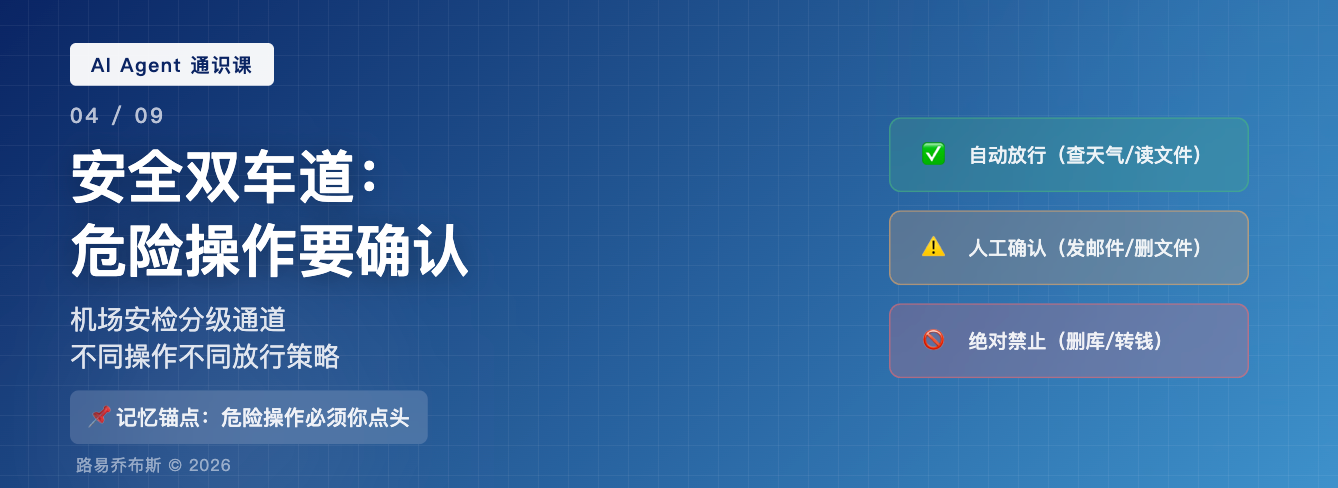 AI Visual Insight: This image looks more like a course cover or section banner than a system architecture diagram. It identifies the content series rather than exposing specific data flows, permission models, or execution-path details.
AI Agent security design must be built on risk classification
Once an AI Agent can call tools, it is no longer just a “model that can talk.” It becomes an executor that may read files, send emails, run commands, or delete data. The real risk comes from side effects, not reasoning itself.
The core problem is simple: if you grant full autonomy, the probability of incidents rises; if you require confirmation for every step, the experience becomes painful. The key to security design is not choosing between automation and manual control, but splitting execution paths based on operational risk.
Airport security is the best analogy for understanding the Agent security model
Airports do not apply the same standard to every item. Ordinary luggage goes through automated screening, suspicious items receive manual inspection, and clearly prohibited items are blocked immediately. AI Agent security should work the same way: low-risk actions run automatically, medium-risk actions request confirmation, and high-risk actions are denied by default.
This design is more efficient than “ask about everything” and more trustworthy than “allow everything.” Its value does not come from theoretical elegance, but from the fact that it maps directly to tool permissions, execution flows, and user interaction.
from enum import Enum

class RiskLevel(Enum):
    SAFE = "safe"          # Read-only operations with low side effects
    CONFIRM = "confirm"    # Has side effects and requires user confirmation
    BLOCK = "block"        # High-risk or unacceptable; reject immediately

def decide_action(tool_name: str, is_read_only: bool, is_risky: bool) -> RiskLevel:
    if is_risky and tool_name in ["delete_db", "wire_transfer"]:
        return RiskLevel.BLOCK  # Explicitly block clearly high-risk operations
    if is_risky:
        return RiskLevel.CONFIRM  # Route general risky operations to confirmation
    return RiskLevel.SAFE  # Auto-execute safe operations
This code demonstrates a minimal viable risk decision engine: classify first, then choose the execution path.
The four mainstream security strategies each have boundary conditions
A fully automated strategy feels smooth, but it is hard to control. That is why early systems such as AutoGPT often triggered accidental file deletion, repeated API calls, or runaway budgets. This model works for sandboxes, experiments, and demos, but not for real production environments.
A step-by-step confirmation strategy keeps full control in the user’s hands and provides the strongest compliance posture, but prompts on every tool call interrupt the task chain. It fits high-accountability scenarios such as finance, production changes, and enterprise workflows.
Allowlists work well for developers who are willing to define boundaries
The core idea behind an allowlist is the principle of least privilege. Instead of guessing the user’s tolerance for risk, the system requires the user to explicitly declare which directories, commands, or tools may run automatically. Products such as Claude Code follow this path.
Its advantage is clear boundaries, and once configuration is complete, the experience remains strong. Its downside is a higher learning curve. If the allowlist becomes too broad, the security benefit quickly collapses.
auto_approve:
  read_file: always
  write_file:
    allowed_paths:
      - "src/"      # Only allow changes in the application code directory
      - "tests/"    # Allow generating or fixing tests
  shell:
    allowed_commands:
      - "git status"  # Read-only status check
      - "npm test"    # Run tests with controlled side effects
      - "ls"          # List directory contents
This configuration shows the practical focus of allowlist design: permissions must be granular down to paths and commands.
Risk label models are a better fit for mass-market Agent products
The risk label strategy, represented by products such as Warp, abstracts tool capabilities into two key dimensions: is_read_only and is_risky. This is easier to implement than asking ordinary users to write allowlists by hand, and it is better suited to out-of-the-box consumer products.
It delivers two core benefits. First, read-only tasks can run in parallel, which improves overall response speed. Second, every action with side effects goes through a confirmation gate, which reduces irreversible damage caused by mistakes.
The combination of two labels should determine execution strategy, not the tool name itself
The same shell does not make all commands equivalent, and even a read operation may involve privacy concerns. A truly sound design does not classify tools crudely by name. It classifies behavior by operational properties.
def execute_tool(tool):
    if tool.is_read_only and not tool.is_risky:
        return "auto_parallel"   # Safe read operations can run in parallel
    if not tool.is_read_only and not tool.is_risky:
        return "auto_serial"     # Writes with low risk can run automatically in sequence
    if tool.is_risky:
        return "need_confirm"    # Risky operations must require user confirmation
This logic captures the dual-lane model: the fast lane runs automatically, and the dangerous lane stops for approval.
The correct orchestration pattern for mixed tasks is parallel reads first, then serialized confirmation
Take the workflow “organize meetings, delete expired items, and send reminders” as an example. Querying calendars, reading contacts, and identifying status are all low-risk read operations, so they can run concurrently. Deleting meetings and sending emails are high-risk side-effect operations, so they must be confirmed one by one or in batches.
This workflow design has strong engineering value. On one hand, it shortens total execution time. On the other, it concentrates user attention on the actions that actually require accountability, instead of wasting it on harmless steps.
Irreversible operations must include secondary confirmation and audit logs
Actions such as deletion, wire transfers, and sending external messages should not only require confirmation, but also support secondary confirmation. Many incidents do not happen because the model is “malicious.” They happen because a tired user clicks through approval by mistake.
At the same time, every dangerous operation should leave an audit trail, including invocation time, parameters, execution result, and initiating context. Without logs, you cannot perform post-incident review, and you cannot achieve enterprise-grade governance.
def confirm_delete(resource_id: str, user_input: str) -> bool:
    expected = "DELETE"
    if user_input != expected:
        return False  # Secondary confirmation failed; reject the deletion
    log = {
        "action": "delete",
        "target": resource_id,
        "approved": True  # Record the audit event
    }
    print(log)
    return True
This code shows that secondary confirmation is not bureaucracy. It is the final gate that prevents irreversible incidents.
Different scenarios should use different combinations of security strategies
For developer-facing coding Agents, a hybrid model of “risk labels + allowlist” is the best starting point. Risk labels provide out-of-the-box usability, while allowlists give advanced users finer control. This preserves efficiency while supporting customization in complex environments.
For consumer-facing daily assistants, a default risk label strategy is usually better, because most users will not maintain permission configurations. Enterprise internal automation should strengthen step-by-step confirmation, operational auditing, rollback mechanisms, and cost limits.
When designing Agent security mechanisms, prioritize these five checks
- Do you have explicit risk classification instead of a one-size-fits-all allow policy?
- Do deletion, messaging, and payment operations require confirmation?
- Do irreversible operations require secondary confirmation?
- Do you have complete logging and audit capabilities?
- Do you enforce limits on cost, frequency, timeouts, and emergency human stop mechanisms?
FAQ
Q1: What is the most important principle in AI Agent security design?
A: It is not “fully automatic” or “fully manual.” It is risk-based classification. Low-risk actions should be automated, high-risk actions should require confirmation, and unacceptable actions should be prohibited.
Q2: How should I choose between an allowlist and risk labels?
A: Developer products should combine both. Consumer products should prioritize risk labels. Enterprise environments with strict compliance should add auditing, approvals, and rollback mechanisms on top.
Q3: Why is secondary confirmation essential?
A: Because operations such as deletion, money transfer, and message sending are often irreversible. A single mistaken click can cause real loss, and secondary confirmation significantly reduces accidental approval risk.
AI Readability Summary: This article systematically reconstructs AI Agent security design around a dual-lane model: automatically allow read-only, low-risk actions; route writing, deletion, and messaging into confirmation and audit flows; and compare four mainstream strategies—full automation, step-by-step confirmation, allowlists, and risk labels.