This launch event centered on the Pura 90 series and Pura X Max, showcasing Huawei’s latest progress in intelligent imaging, wide foldable form factors, and HarmonyOS 6.1 cross-device collaboration. It addresses a common reader pain point: fragmented specs, complex product lines, and unclear ecosystem value. Keywords: Pura 90, Pura X Max, HarmonyOS 6.1.
Technical specifications are easy to scan at a glance
| Dimension | Details |
|---|---|
| Language | Chinese |
| License | CC 4.0 BY-SA |
| Stars | Not provided in the original |
| Core Dependencies | Kirin 9030S, Kirin 9030 Pro, HarmonyOS 6.1, XMAGE, Xiaoyi Intelligent Brain |
The core takeaway from this event is that Huawei is rebuilding the premium device experience through imaging, AI, and the HarmonyOS ecosystem
On April 20, 2026, Huawei unveiled the Pura 90 series, Pura X Max, and several wearables, productivity devices, and audio-video products. The product logic was highly coherent: smartphones serve as the entry point for imaging and AI, foldables introduce new interaction models, and HarmonyOS 6.1 connects the experience across devices.
Compared with isolated hardware upgrades, the more important story this time is Huawei’s coordinated “software-hardware-chip-cloud” strategy. Whether it is the intelligent imaging on the Pura 90 or the ambient AI on the Pura X Max, the message is fundamentally about system-level capability rather than component stacking.
 AI Visual Insight: The image highlights the event’s hero visual and the core new-product lineup, emphasizing that smartphones, foldables, and IoT devices all sit inside one HarmonyOS ecosystem. The key message is full-scenario integration, not isolated device specifications.
Developers can extract new-product information quickly with a structured representation
products = {
    "Pura90": ["标准版", "Pro", "Pro Max"],  # Three-tier imaging flagship positioning
    "Foldable": ["Pura X", "Pura X Max"],     # Expansion of the wide foldable product line
    "Ecosystem": ["WATCH", "AI眼镜", "MateBook", "智慧屏", "Sound X5"]
}

for category, items in products.items():
    print(category, len(items))  # Count the coverage of each product line
This code abstracts the launch-event product tree, making it easier to build content indexes, ingest data into a knowledge base, or enhance search.
The Pura 90 series focuses on tighter integration between computational photography and performance scheduling
The Pura 90 series continues Huawei’s flat-screen flagship direction, with clear segmentation across the standard, Pro, and Pro Max models. Visually, it emphasizes expressive color aesthetics. Technically, it focuses on XMAGE intelligent photography, the Red Maple color camera, and the image-understanding capability of the Kirin 9030S.
Official information indicates that the Kirin 9030S delivers meaningful gains in image understanding, the AI color engine, telephoto video clarity, and stabilization precision. This suggests Huawei is deeply integrating the ISP, NPU, and imaging algorithms into a unified system designed to deliver polished results straight out of the camera.
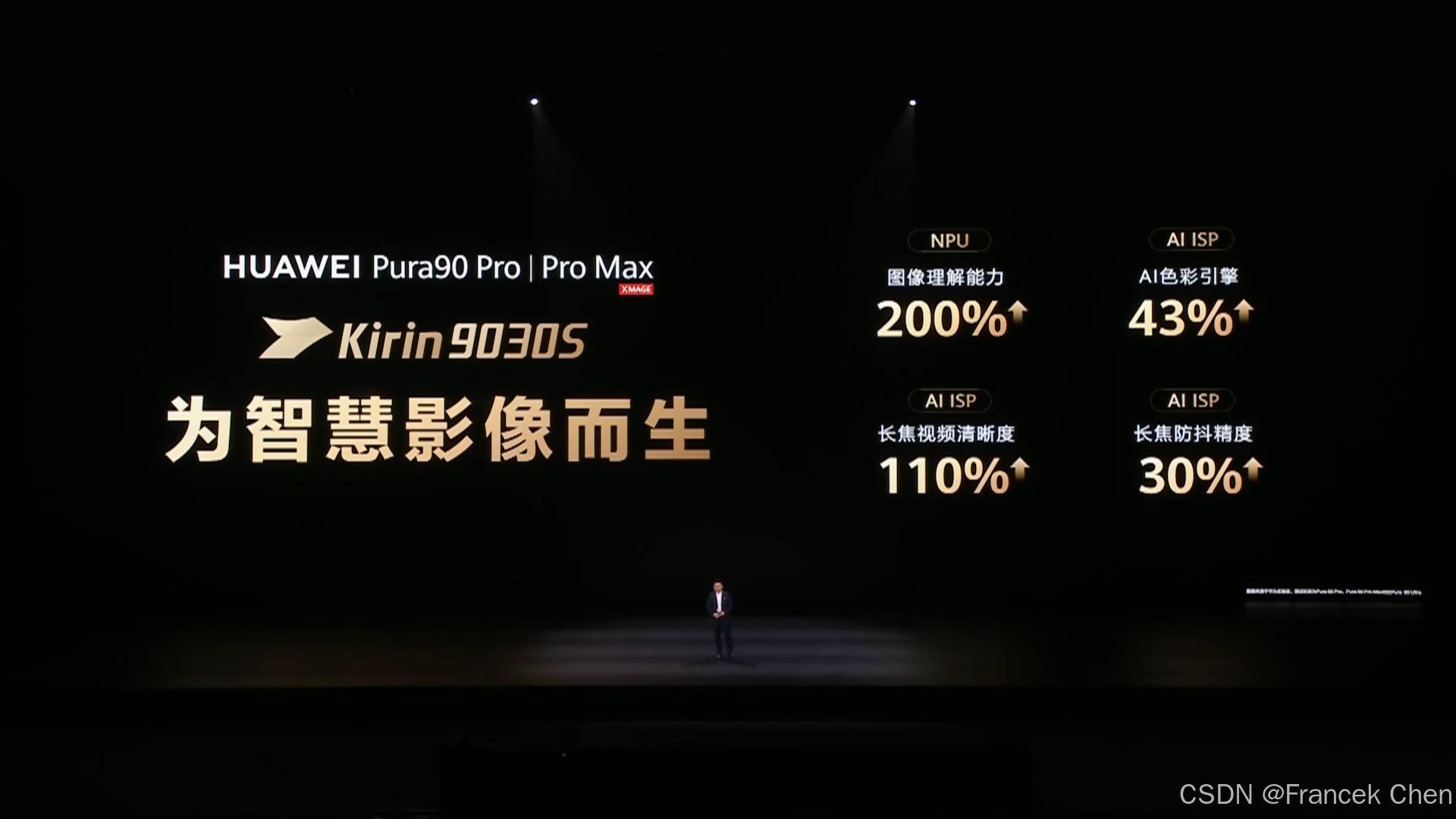 AI Visual Insight: This image emphasizes the imaging-compute improvements of the Kirin 9030S, showing that chip upgrades are no longer judged only by CPU and GPU metrics, but increasingly by specialized capabilities such as image understanding, color processing, and telephoto video handling.
The key differences between Pro and Pro Max appear in telephoto and primary camera specifications
The Pura 90 Pro features a 50 MP ultra-light primary camera, a 50 MP macro telephoto camera, and a 12.5 MP ultra-wide camera, positioning it as a balanced high-end model. The Pura 90 Pro Max goes further with an ultra-high dynamic range primary camera that supports LOFIC, along with a 200 MP large-sensor telephoto configuration.
The strongest signal here is that the Pro Max combines a high-resolution telephoto lens, real-time RAW-domain processing, and RYYB into a new premium imaging moat. This is a classic computational photography strategy rather than a traditional approach centered only on stacking larger CMOS components.
camera_stack = {
    "main": "50MP/LOFIC",         # The primary camera emphasizes high dynamic range
    "tele": "200MP/RYYB",         # The telephoto camera emphasizes high resolution and light intake
    "engine": "XMAGE + RAW实时处理"  # The algorithm layer closes the imaging loop
}

print(" + ".join(camera_stack.values()))
This code abstracts the Pro Max imaging architecture into three layers: primary camera, telephoto camera, and algorithm engine. It works well as a concise technical overview.
The value of the Pura X Max lies not only in being a large foldable, but in establishing a wide-screen interaction paradigm
The Pura X Max is the product with the strongest form-factor innovation at this event. Its inner and outer display proportions are close to the logic of A4 paper, with a 5.4-inch outer screen and a 7.7-inch inner screen. This points to information-dense scenarios such as reading, office work, and creative tasks, rather than simply enlarging the display.
The core competitiveness of this wide foldable approach depends on whether apps can truly benefit from adaptive layouts, column-based reading, and multitasking. For developers, responsive UI adaptation, split-screen state management, and high-frequency task flows on the outer screen will become key priorities.
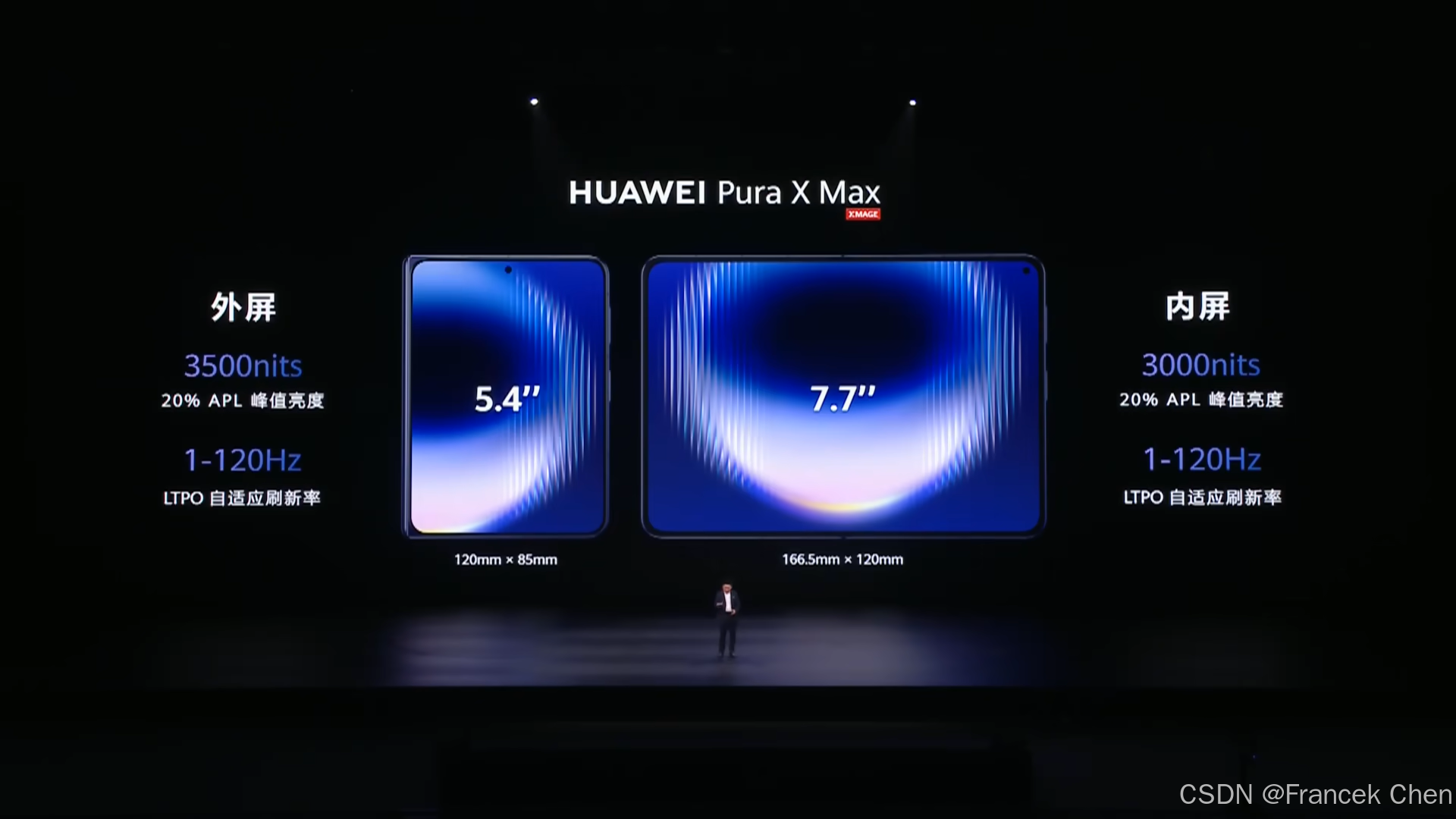 AI Visual Insight: The image shows the Pura X Max inner-to-outer screen proportions and unfolded form. The technical focus is not the size itself, but its tablet-like horizontal information density, which better suits documents, multi-window workflows, and creative scenarios.
The Pura X Max pushes ambient AI down into the foldable system layer
Xiaoyi Intelligent Brain is positioned as an ambient AI solution covering note capture, brief generation, photo editing, world exploration, and A2A agent collaboration. Its significance is that it upgrades AI from a passively invoked tool into a continuously present task-layer assistant.
Together with the Kirin 9030 Pro, HarmonyOS 6.1, and Xinghe Interconnect, the Pura X Max forms a closed loop from local compute and system scheduling to cross-device document transfer. It supports 20 file formats including Sketch, Key, PSD, and AI, reinforcing its role as a lightweight productivity device.
def ai_assistant(task):
    abilities = {
        "记录": "小艺帮记",      # Meeting and idea capture
        "整理": "小艺简报",      # Automatic summarization and structured output
        "协作": "A2A智能体协作"  # Cross-task scheduling and execution
    }
    return abilities.get(task, "通用问答")

print(ai_assistant("整理"))
This code uses a simple mapping to express the task-routing logic of ambient AI.
The broader product lineup further strengthens the HarmonyOS ecosystem as a mesh of connected devices
In addition to the smartphones, Huawei also launched the WATCH Ultimate Design Brilliant Stars Edition, WATCH FIT 5, WATCH Buds 2, AI Glasses, MateBook 14, Vision Smart Screen S7 Pro, and Sound X5. Together, these products form a complete chain from wearables to desktop computing to the living room.
From a technical perspective, these are not isolated updates. The AI Glasses emphasize Huawei-designed chips, first-person capture, and voice interaction. The MateBook 14 highlights HarmonyOS 6.1 and Wi-Fi 7+. The smart screen and speaker continue to serve as home control hubs and content distribution nodes.
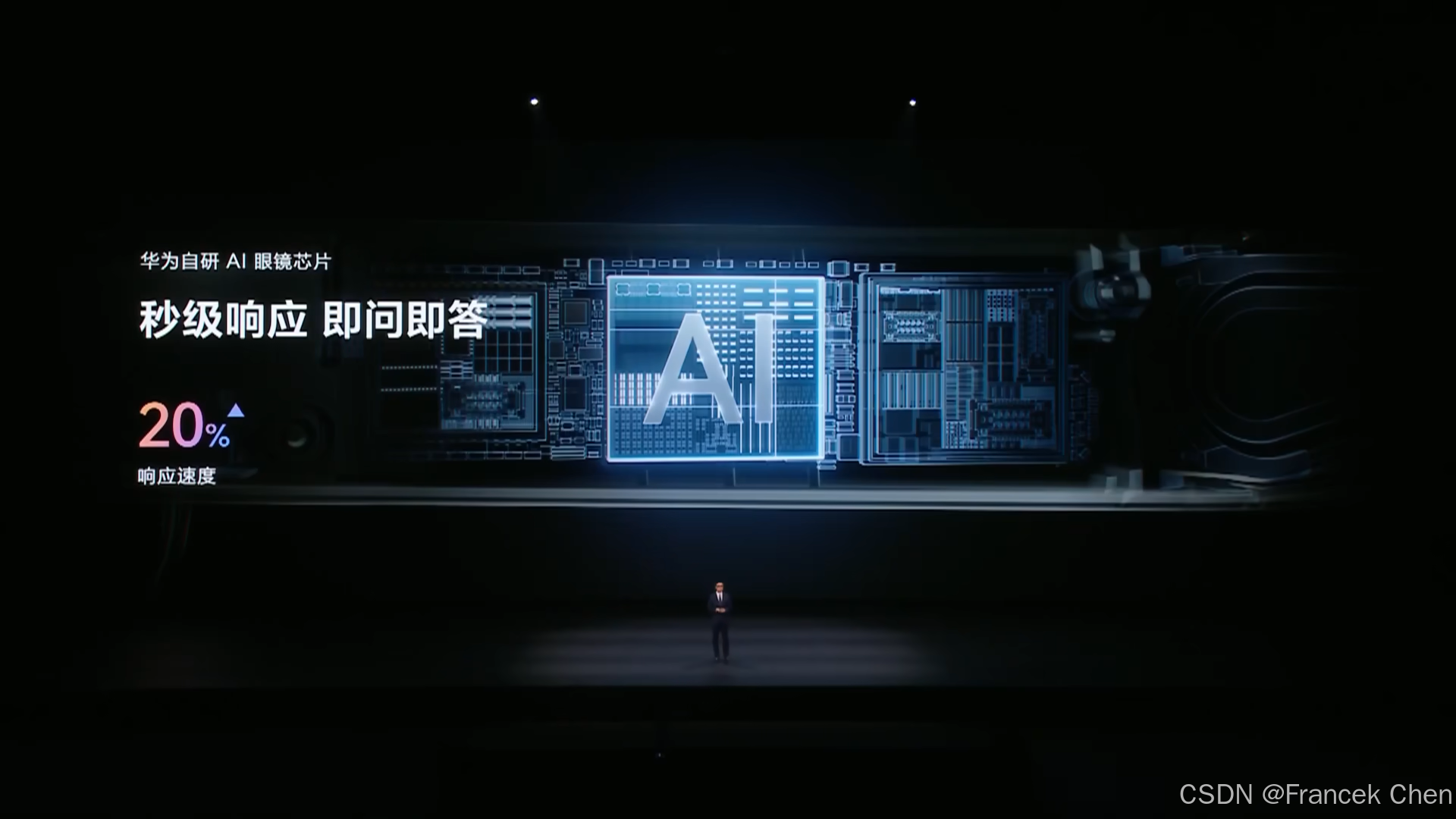 AI Visual Insight: The image presents the lightweight structure and wearing design of the AI Glasses. The technical focus is on head-shape-data-driven ergonomics, hinge stability, and an embedded AI interaction entry point rather than pure accessory styling.
HarmonyOS 6.1 turns standalone product strengths into cross-device experience advantages
Based on the event information, HarmonyOS 6.1 is no longer just a mobile OS update. It is the collaborative foundation across multiple terminal categories. Its value lies in unified scheduling for fast app launch, task switching, direct asset transfer, device interconnection, and security protection.
For content platforms, productivity apps, and creative tools, this means development priorities will shift from single-device optimization to continuous multi-device experiences, including file handoff, state synchronization, window adaptation, and embedded AI services.
This launch event shows that Huawei’s device strategy is shifting from flagship hardware competition to system capability competition
The Pura 90 series addresses the ceiling for imaging and performance in flagship slab phones. The Pura X Max addresses efficient interaction in a new form factor. The broader all-scenario product lineup fills out device entry points across everyday life, office workflows, and the home. Together, they point to one conclusion: the HarmonyOS ecosystem is now the core product.
From a technical communication perspective, the most important takeaway from this event is not the retail price of any individual device. It is that Huawei has integrated imaging, AI, foldable form factors, and multi-device collaboration into a reusable system narrative.
FAQ
1. What are the key technical highlights of the Pura 90 Pro Max?
Answer: The core highlights are the LOFIC primary camera, 200 MP RYYB telephoto lens, real-time RAW-domain processing, and XMAGE intelligent photography. Together, they represent a systematic upgrade in computational photography.
2. Why does the Pura X Max matter to developers?
Answer: It validates the application-adaptation value of the wide foldable form factor. Developers should focus on horizontal layouts, multi-window collaboration, high-frequency outer-screen tasks, and AI assistant integration.
3. What role does HarmonyOS 6.1 play in this launch event?
Answer: It serves as the unified collaboration foundation across phones, wearables, PCs, smart screens, and speakers, handling performance scheduling, cross-device connectivity, file transfer, and system-level AI capabilities.
Core Summary: This article focuses on the Huawei Pura 90 series and Pura X Max launch event, systematically breaking down the Kirin 9030S/9030 Pro, XMAGE intelligent photography, wide foldable design, HarmonyOS 6.1, and new multi-device products to help developers quickly understand the evolution of imaging, AI interaction, and the HarmonyOS ecosystem.