IP Data Cloud provides enterprises with high-accuracy IP lookup, proxy detection, and risk profiling capabilities. It addresses the common limitations of traditional IP databases, including low accuracy, slow updates, and weak concurrency support. Its core value lies in street-level geolocation, multidimensional risk tags, and real-time APIs. Keywords: IP lookup, risk control, proxy detection.
Technical specifications provide a quick snapshot
| Parameter | Description |
|---|---|
| Primary language | Python (examples), with SDK support for Java, Go, and more |
| Access protocol | HTTP/HTTPS API |
| Data coverage | Global IPv4/IPv6 |
| Location accuracy | City-level to street-level |
| Update frequency | Daily updates with 24/7 monitoring |
| Response capability | Millisecond-level response with high concurrency support |
| Core dependencies | requests, multidimensional IP intelligence database |
| Star count | Not provided in the source material |
Enterprise risk systems require IP intelligence with higher factual density
In finance, e-commerce, social platforms, gaming, and advertising systems, an IP address is no longer just a network identifier. It has become a foundational signal for risk control, compliance, and geographic decision-making.
Common issues with traditional solutions include geolocation that only reaches the city level, incomplete proxy detection, stale data updates, and insufficient API throughput. The result is higher false-positive rates, lower evasion costs for malicious actors, and less accurate marketing targeting.
 AI Visual Insight: This diagram shows the central role of IP data services across enterprise security and business systems. It is typically presented as a four-layer structure covering data ingestion, tag identification, risk assessment, and business decision-making, highlighting how IP intelligence flows through login, transaction, content moderation, and ad delivery pipelines.
Street-level geolocation improves the granularity of geographic decisions
One of the core strengths of this solution is its upgrade from city-level geolocation to street-level geolocation. For use cases such as anomalous login detection in finance, regional compliance auditing, and local ad targeting, every increase in granularity improves rule precision and stabilizes decision quality.
The source material states that its technical approach uses a hybrid architecture combining dynamic density clustering algorithms with a multilayer neural network geolocation model. It covers more than 20 dimensions, including country, province, city, district, street, latitude, longitude, postal code, and time zone.
location_fields = [
    "country", "province", "city", "district",  # Basic administrative divisions
    "street", "longitude", "latitude",            # Finer-grained geographic coordinates
    "zipcode", "timezone"                          # Auxiliary fields for compliance and time zone decisions
]

# Core logic: improve business decision accuracy through finer-grained fields
if "street" in location_fields:
    print("Street-level geolocation is supported for refined risk control and targeting")
This code illustrates why street-level fields matter for refined risk control and location-based strategy execution.
A multidimensional tag system fits risk engines better than a single geolocation field
Knowing only where an IP is located is far from enough. Enterprises care more about whether the IP looks like a real user, whether it is anonymized, whether it carries historical risk, and what kind of network environment it comes from.
That is why multidimensional risk profiling is essential. Key dimensions include network type, proxy type, risk history, behavioral traits, usage scenario, and geographic coordinates. This transforms an IP from a static address into a computable business signal.
Risk profile fields can map directly to business rules
| Tag dimension | Typical content | Business value |
|---|---|---|
| Network type | Residential broadband, mobile network, data center, enterprise dedicated line | Distinguishes real users from machine-generated traffic |
| Proxy detection | HTTP, SOCKS, VPN, residential proxy | Identifies anonymous access and evasion behavior |
| Risk history | Bulk registrations, credential stuffing, anomalous logins | Intercepts high-risk sources earlier |
| Usage scenario | Personal browsing, enterprise office use, cloud service, crawler | Helps identify access intent |
| Geographic fields | Latitude/longitude, time zone, postal code | Supports compliance audits and regional strategies |
# Core logic: map IP tags to a risk control conclusion
risk_score = 0
if info.get("is_proxy"):
    risk_score += 40  # Proxy access usually requires closer scrutiny
if info.get("network_type") == "datacenter":
    risk_score += 30  # Data center IPs are common in scripted or relay traffic
if info.get("risk_level") == "high":
    risk_score += 50  # High-risk tags directly raise the score

decision = "reject" if risk_score >= 60 else "review" if risk_score >= 30 else "pass"
This code shows how to turn tags into executable risk scoring rules.
High-frequency updates and high-concurrency response determine whether the solution is production-ready
IP ownership and proxy networks are not static data. Cloud provider expansion, proxy pool rotation, and ISP allocation changes can all make intelligence stale very quickly.
This solution emphasizes 24/7 distributed monitoring, daily updates, average daily processing of more than 1,000 GB of data, and more than 1,000 monitoring points worldwide. For real-time risk control, this means query results stay much closer to the current network state.
Millisecond-level APIs fit online decision paths better
Login verification, payment risk checks, flash-sale events, and live-stream interactions all require extremely low latency. If IP lookup becomes a bottleneck, even a strong upstream system will slow down.
import requests

API_KEY = "YOUR_API_KEY"
url = "https://api.ipdatacloud.com/v2/query"
params = {
    "key": API_KEY,
    "ip": "8.8.8.8",
    "fields": "country,province,city,district,isp,network_type,is_proxy,risk_level,longitude,latitude,usage_type"
}

try:
    resp = requests.get(url, params=params, timeout=3)  # Core logic: enforce a timeout to avoid blocking business threads
    data = resp.json()
    if data.get("code") == 200:
        info = data["data"]  # Core logic: extract the IP profile result
        print(info)
except requests.RequestException as e:
    print(f"Request failed: {e}")
This code demonstrates the minimum closed loop for real-time API integration: request, parse, and timeout control.
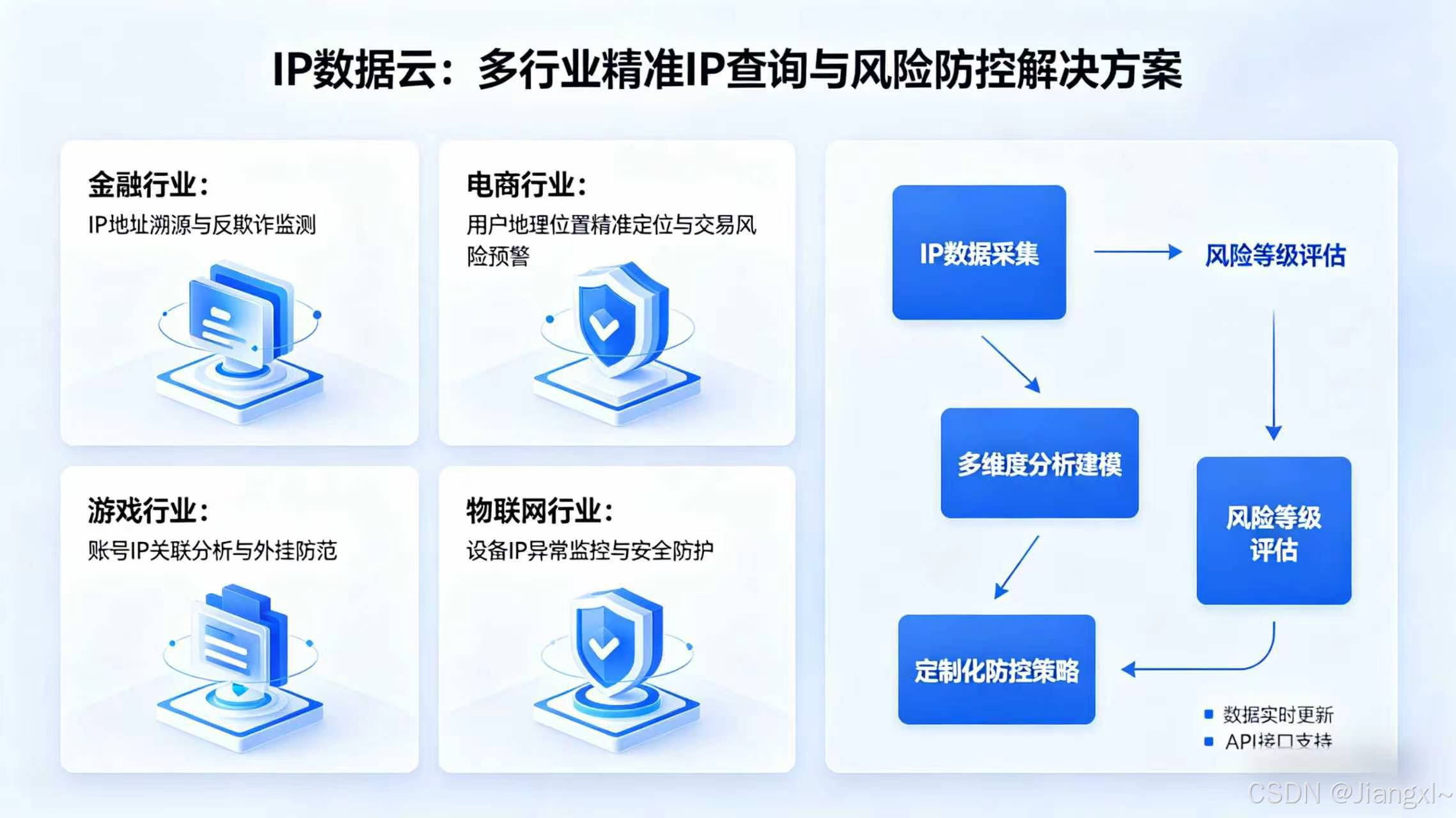 AI Visual Insight: This image appears to illustrate industry deployment scenarios. It typically presents finance, e-commerce, social, gaming, and security use cases side by side to show how the same IP intelligence foundation can be reused across industries, with different tag combinations supporting differentiated strategies.
Industry value has shifted from generic lookup to precise decision-making
The financial sector focuses on remote login anomalies, abnormal account opening, and card fraud interception. These scenarios rely heavily on the combined strength of proxy detection, historical risk, and precise geolocation.
E-commerce platforms mainly combat bulk account registration, fake orders, and promotion abuse. Here, network type and usage scenario fields are especially important, because data center IPs, cloud service IPs, and normal residential networks exhibit clearly different behavioral patterns.
Social, gaming, and security scenarios depend more on profile completeness
Social platforms need to identify bot accounts and spam content sources, with particular attention to cloud service, proxy, and crawler characteristics. Gaming scenarios care more about account farming, multi-instance abuse, and cross-region cheating, making overseas proxies and abnormal geographic jumps especially sensitive signals.
Security teams can use high-accuracy geographic data and network type information to support source tracing in DDoS, credential stuffing, or scanning incidents. Advertising teams can use district- or street-level location data to improve return on ad spend for local services, retail foot traffic, and nearby conversion campaigns.
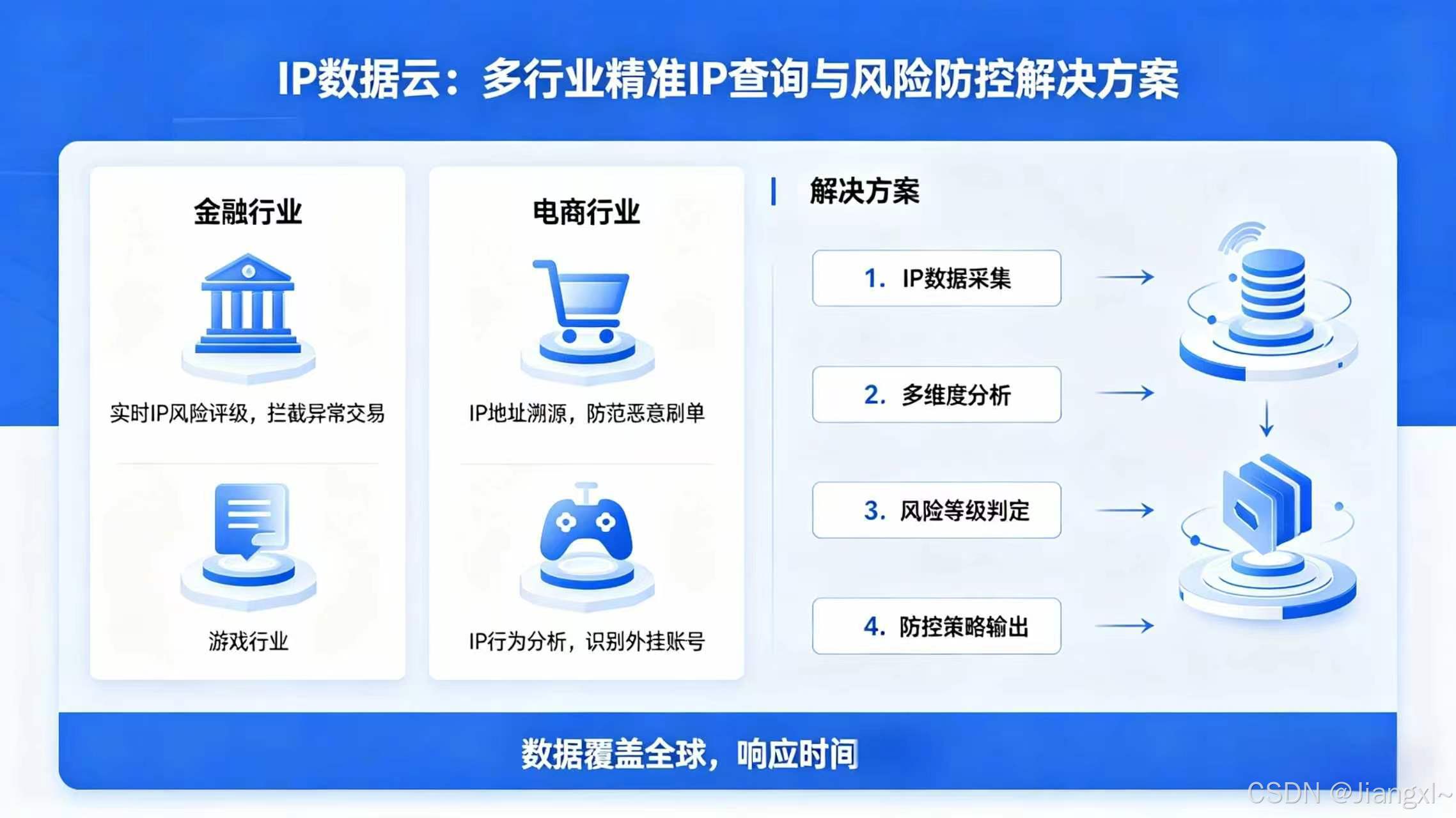 AI Visual Insight: This diagram is typically used to show API integration, offline database deployment, or overall product architecture. Its visual focus often includes data sources, query interfaces, enterprise intranet deployment, and result feedback loops, reflecting that the solution supports both online API calls and private deployment for high-compliance environments.
Real-time API queries and offline database deployment support different compliance models
For small and midsize teams, real-time APIs are faster to adopt and easier to maintain, making them well suited for direct integration into online services. For financial institutions, government organizations, or isolated internal network environments, private deployment of an offline database is often better aligned with data boundary and compliance requirements.
When evaluating a solution, focus on four metrics: field completeness, proxy detection accuracy, update frequency, and concurrency SLA. Do not compare only the per-query price. You should also evaluate the cost of false positives and the business return from improved risk control.
FAQ
Q1: Which business scenarios are the best fit for IP Data Cloud?
A1: It is best suited for scenarios that require real-time evaluation of client source quality, such as login risk control, transaction review, anti-fraud, geographic ad targeting, content security, and attack attribution.
Q2: Why is multidimensional profiling more important than simple geolocation?
A2: Geolocation can only answer where a request comes from. Multidimensional profiling can also tell you whether the source uses a proxy, whether it behaves like a machine, whether it has historical risk, and what type of network environment it belongs to, making it much more useful for risk decisions.
Q3: Should enterprises prioritize APIs or offline databases?
A3: Use APIs first for low-friction validation. If you need high concurrency, low latency, intranet compliance, or strict data residency, an offline database or private deployment is usually the better choice.
Core Summary: This article reconstructs and explains the core capabilities of IP Data Cloud, including street-level geolocation, multidimensional risk profiling, daily updates, and millisecond-level response. It also shows how these capabilities create practical value for risk control and precise decision-making across finance, e-commerce, social media, gaming, security, and advertising.