This technical retrospective examines the Shengxunwei live chat system. Its core goal is to show how the .NET stack supports real-time chat, private deployment, and high-concurrency access, and how those capabilities translate into customer trust. The article addresses three common concerns: technology selection, proof of product stability, and the long-term sustainability of an independently built product. Keywords: .NET, live chat system, private deployment.
The technical specification snapshot shows a delivery-oriented architecture
| Parameter | Details |
|---|---|
| Project Name | Shengxunwei Live Chat and Marketing System |
| Core Languages | C#, JavaScript, HTML |
| Server Framework | .NET 8 |
| Agent Console Technology | WPF, .NET Framework 4.8 |
| Admin Console Technology | Vue 3 |
| Visitor Client Technology | Native HTML/JS |
| Communication Scenarios | Real-time messaging, session intake, agent workspace |
| Deployment Models | Official hosted edition, private deployment, self-hosted |
| Concurrency Performance | 4K+ simultaneous connections in the official environment |
| Typical Customer Scale | Nearly 40 agents online, about 5,000 daily sessions |
| Protocol Model | Web real-time communication, application API integration |
| Core Dependencies | .NET 8, .NET Standard, WPF, Vue 3, Visual Studio |
| GitHub Stars | Not provided in the original text |
The strength of this .NET stack lies in delivery efficiency, not abstraction
The most valuable point in the article is not a generic argument about whether .NET is powerful. It is the emphasis on what .NET gives an independent developer. For an independent product, the primary metric for a technology stack is not popularity. It is whether the stack can support the stable, continuous, and low-overhead delivery of a complex system.
The server and the agent console share C# and a large portion of the same development libraries. That allows the developer to advance server capabilities, desktop interactions, and business logic reuse within one mental model. This kind of consistency directly reduces the cost of switching across languages.
.NET Standard makes cross-client reuse practical
// Shared business contract: reusable across the server and desktop agent console
public interface IMessageService
{
    Task SendAsync(ChatMessage message); // Send a message
    Task<IReadOnlyList<ChatMessage>> GetHistoryAsync(string sessionId); // Get message history
}

public class ChatMessage
{
    public string SessionId { get; set; } = string.Empty; // Session ID
    public string Content { get; set; } = string.Empty;   // Message content
}
This code shows how .NET Standard-style shared contracts reduce duplicate development and improve consistency across clients.
Another key advantage is the toolchain. Visual Studio, the debugger, performance profilers, and the official documentation ecosystem together form the productivity foundation for a solo developer building enterprise-grade software. For products that require long-term maintenance, this tooling advantage compounds over time.
The agent workspace must be treated as software engineering, not just web engineering
The original article makes a clear point: a complex customer service client should not be reduced to a purely web-based implementation. This is not a rejection of the web. It is an argument that the agent workspace is a software system with high state density, frequent interaction, and heavy parallel task handling.
In real customer service scenarios, agents often need to handle multiple sessions at the same time, monitor message alerts, use canned replies, search a knowledge base, switch statuses, and work with large amounts of in-memory state. If you rely only on the browser environment, your development boundaries, resource scheduling options, and support for complex interactions become more constrained.
A typical concurrent processing model for an agent console
// A background thread processes messages from multiple sessions
public async Task ProcessSessionsAsync(IEnumerable
<string> sessionIds)
{
    foreach (var sessionId in sessionIds)
    {
        var history = await _messageService.GetHistoryAsync(sessionId); // Fetch session history
        UpdateUi(sessionId, history); // Refresh the agent workspace UI
    }
}
This pattern shows why a desktop client is better suited for complex workspace tasks, while the web is better suited for display-oriented and lightweight interaction entry points.
Customer trust starts with observable runtime facts
The article provides two very strong signals. First, the official environment has already exceeded 4K simultaneous connections. Second, in the largest customer scenario, nearly 40 agents are online, with about 5,000 sessions per day and roughly 40,000 to 60,000 messages sent and received.
The significance of these numbers is not that they represent an absolute top-tier benchmark. Their value lies in the fact that they are real examples of a system that has been delivered, operated, and maintained over time. For enterprise buyers, real operational data builds trust more effectively than technical slogans.
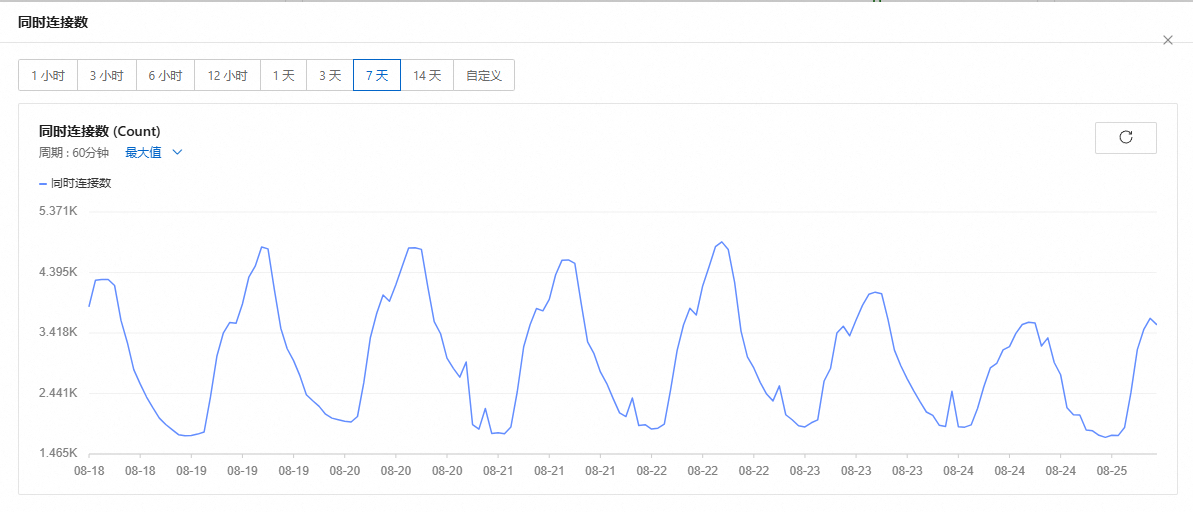
AI Visual Insight: This image provides production evidence of the connection scale handled by the live chat system. Its core value is that it demonstrates the real-time communication service already has meaningful high-concurrency capacity. The number shown can be treated as a direct external signal of system capacity, connection management quality, and long-lived connection stability.

AI Visual Insight: This image reflects the customer journey from trial to requirements feedback to the large-scale replacement of a legacy system. It shows that product maturity is not achieved in a single step. It is built gradually through API alignment, version iteration, and corrections to business-level details.
Technical concerns do not disappear on their own and must be resolved through communication and results
The author notes that many customer concerns about Windows and .NET do not necessarily come from deep technical evaluation. They often come from market narratives and default assumptions. The solution is not to argue about whether Java or .NET is stronger. The discussion should shift toward architecture, deployment, reliability, and problem-resolution capability.
This is a very mature way to communicate technology in B2B settings. It avoids abstract ideological debates and answers only the question that matters: can this system be deployed reliably in my business environment? Once customers see deployment support, integration adaptability, incident response, and a record of long-term maintenance, trust can turn into a purchasing decision.
A sample configuration for private deployment
server:
  runtime: dotnet8        # Server runtime
  mode: self-hosted       # Private deployment mode
client:
  desktop: wpf-net48      # Agent console compatible with Win7
web_admin:
  framework: vue3         # Admin console technology stack
capacity:
  concurrent_connections: 4000+  # Verified concurrency scale
This configuration sample summarizes the system’s core technical profile across multiple clients and private deployment scenarios.
Trust ultimately comes from four long-term variables
The first is how you face challenges. Questions from a customer’s technical team are, in essence, an evaluation of architectural credibility and delivery credibility. The ability to answer patiently matters more than the ability to repeat technical slogans.
The second is patience. Continuous responses to documentation, deployment support, and repeated questions are an underrated competitive advantage in B2B products. Many systems do not fail because of missing features. They fail because of a poor communication experience.
The third is authenticity. Publishing technical details, acknowledging edge-case issues, and fixing defects continuously can significantly reduce the perceived risk of working with a one-person team.
The core of long-termism is not fast updates but traceability
The original article notes that the changelog can be traced back to 2021, and that blogs and technical notes have continued to be published over time. This means customers do not see a tool that appeared overnight. They see a product with a continuous evolution path.

AI Visual Insight: This image focuses more on product identity and operational presence, but it still conveys a key signal: the developer operates the product under a real name and publishes consistently in public. That lowers enterprise concerns that a personal project may be unstable.
This case study reveals the core methodology for independent developers building enterprise software
The Shengxunwei live chat system shows that .NET is not the trust barrier. The absence of an evidence chain is. A unified language stack, strong desktop support for complex interactions, private deployment capability, real concurrency data, and a long-term maintenance record together form a credible delivery system.
For teams building real-time chat, agent workspaces, or private SaaS offerings, the most valuable lesson here is not a specific framework choice. It is a principle: technology decisions must ultimately serve explainable stability, verifiable performance, and sustainable customer relationships.
FAQ
1. Why is the agent console not implemented entirely as a web application?
Because agent workspaces usually involve multi-session handling, complex state management, and high-frequency interaction. A desktop client is generally more stable for resource usage, interaction organization, and complex task handling. The web works well for visitor entry points and administrative display, but it is not always the best fit for heavy-duty agent scenarios.
2. Why do customers sometimes have concerns about a .NET-based stack?
Those concerns often come from industry narratives rather than actual load-testing results. In practice, the factors that influence purchasing decisions are usually deployment flexibility, stability data, issue response speed, and whether the product has a long-term maintenance record.
3. How can an independent developer build trust with enterprise customers?
The key is not branding alone. It is the evidence chain: reproducible deployment plans, real runtime data, a continuous changelog, transparent technical communication, and consistent response and remediation when issues occur.
[AI Readability Summary]
Based on real-world engineering practice, this article reconstructs the .NET technology stack and customer-trust building path behind the Shengxunwei live chat system. It focuses on full-stack development, private deployment, stability validation, and technical communication, explaining how an independent product can move from technology choices to commercial credibility.