This project is a WeChat Mini Program service system for the pet industry, built with UniApp, Spring Boot, Vue, and MySQL. It covers core workflows such as user booking, pet records, merchant processing, and back-office administration, solving the inefficiency, fragmented information, and collaboration challenges of traditional offline pet service scheduling. Keywords: WeChat Mini Program, pet service system, Spring Boot.
The technical specification snapshot outlines the core stack
| Parameter | Description |
|---|---|
| Programming Languages | Java, JavaScript |
| Frontend Applications | UniApp WeChat Mini Program, Vue admin dashboard |
| Backend Protocol | RESTful HTTP API |
| Database | MySQL |
| Build Tool | Maven |
| Core Dependencies | Spring Boot, Spring Data JPA, Vue, Element UI, UniApp |
| Runtime Tools | IDEA/Eclipse, Navicat, HBuilderX |
| GitHub Stars | Original data not provided |
The system establishes a complete digital business loop for pet service scenarios
The core goal of this project is not just a standalone booking page. It connects the full pet service lifecycle—from consultation and order placement to fulfillment, review, and administration—into a traceable workflow. Users submit service requests through the WeChat Mini Program, merchants process orders in the backend, and administrators handle platform governance and data maintenance.
This design fits scenarios such as pet grooming, boarding, medical appointment scheduling, and health record management. Compared with traditional phone-based or in-store registration, it reduces communication costs and allows service status, user records, and order data to accumulate in a structured way.
 AI Visual Insight: The image shows the project cover and system positioning. It highlights a three-end collaborative architecture that uses the WeChat Mini Program as the user entry point, with a Java backend and a Vue admin panel, making it suitable as a prototype for a digital pet service platform.
The system capabilities can be abstracted into collaboration among three roles
Regular users focus on pet information management, service booking, and review feedback. Merchants focus on order processing, service scheduling, and resource allocation. Administrators focus on accounts, permissions, content, and platform data security.
This layering means the database design must support relationships across multiple entities, including users, pets, orders, service items, and review records. The backend API must also define clear authorization boundaries.
@Entity
public class User {
    @Id
    @GeneratedValue(strategy = GenerationType.IDENTITY)
    private Long id;

    private String username;
    private String password;

    @OneToMany(mappedBy = "user")
    private List
<Pet> pets; // Associated list of pets owned by the current user
}
This code defines the one-to-many relationship between a user and pets, which serves as the foundation for modeling pet record ownership.
The frontend-backend separation architecture gives the Mini Program and admin panel clear responsibilities
The backend uses Spring Boot to provide a unified API and handles authentication, order flow, data persistence, and business validation. The admin panel is built with Vue and is suitable for operators who need tabular management and visual interactions. The Mini Program frontend uses UniApp to integrate with the WeChat ecosystem while reducing multi-platform development cost.
The value of this combination is that business rules stay centralized on the server side, while the frontend focuses only on interaction and presentation. This makes future expansion to H5, native apps, or new operations dashboards much easier.
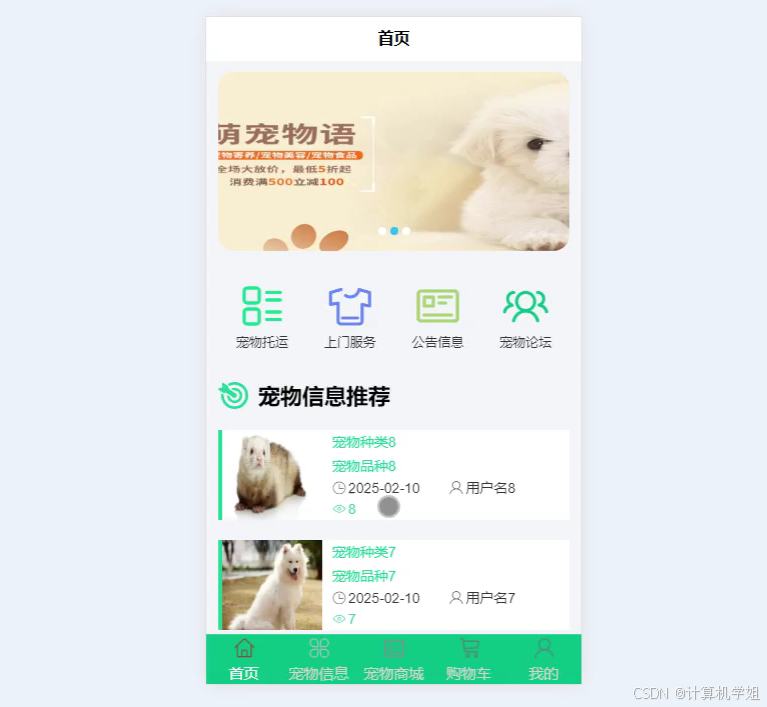 AI Visual Insight: The image shows the Mini Program homepage or service entry interface. It typically includes service categories, banners, or shortcut navigation, and helps validate whether the mobile information layout works for high-frequency booking scenarios.
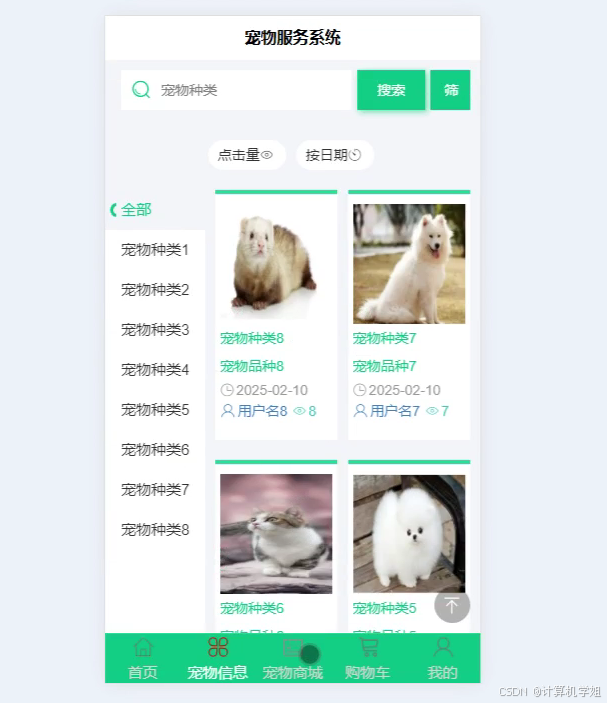 AI Visual Insight: The image shows page transitions inside the Mini Program. It may involve pet information, booking lists, or the personal center, reflecting how UniApp organizes native-style interactions in the WeChat environment.
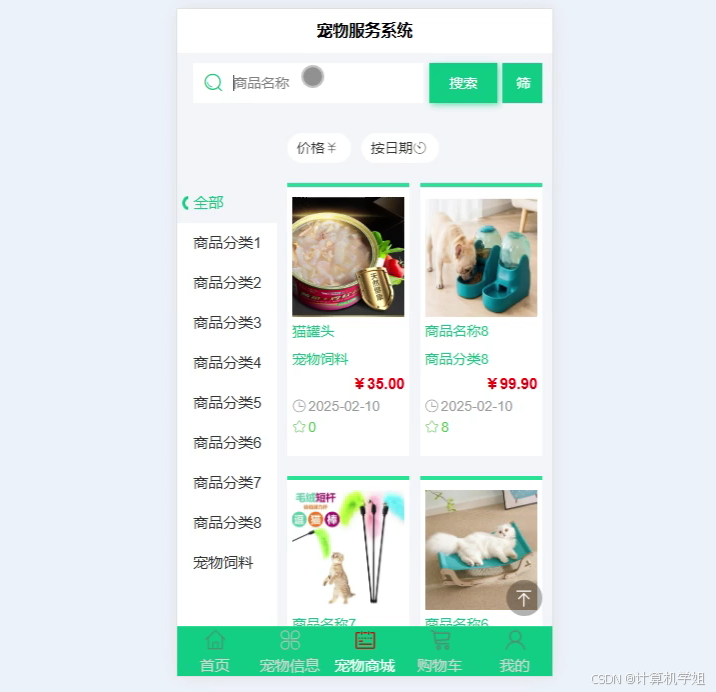 AI Visual Insight: The image shows a service detail or form entry interface. The focus is how users select service items, fill in booking information, and submit requests, reflecting a form-driven frontend workflow.
The API layer should be designed around booking and record management
The original example already provides the outline of a booking controller, but the business logic is still minimal. In a real project, the booking API should at least validate user identity, service availability, time conflicts, and initial order status.
@RestController
@RequestMapping("/api/pet-service")
public class PetServiceController {

    @Autowired
    private PetService petService;

    @PostMapping("/book")
    public ResponseEntity
<String> bookService(@RequestBody BookingRequest request) {
        petService.createBooking(request); // Execute booking creation logic
        return ResponseEntity.ok("Booking successful");
    }
}
This code demonstrates the minimum closed loop for a service booking API: receive the request, call the service layer, and return a standardized result.
The Mini Program frontend is responsible for reducing booking friction and shortening the user path
The key to a pet service Mini Program is not having many pages, but keeping the path short. Users should complete service selection, pet binding, time confirmation, and submission in as few steps as possible. UniApp makes it possible to support both WeChat Mini Program and H5 extensions within a single codebase.
During frontend implementation, it is best to separate service categories, available time slots, pet records, and historical orders into independent modules. This avoids overly heavy page state and improves maintainability.
Page({
  data: {
    services: ['洗澡', '美容', '寄养']
  },
  onLoad() {
    console.log('首页加载完成'); // Page initialization log
  },
  handleServiceTap(e) {
    const serviceType = e.currentTarget.dataset.type;
    uni.navigateTo({
      url: `/pages/service-detail?type=${serviceType}` // Navigate to the service detail page
    });
  }
})
This code implements service category display on the homepage and navigation to the detail page, which is a typical entry-point interaction on the Mini Program side.
The admin dashboard is ideal for high-frequency data maintenance tasks
The backend interface typically includes modules such as user management, pet records, service items, booking orders, and review feedback. Vue combined with Element UI can quickly build capabilities such as lists, forms, pagination, and status filtering.
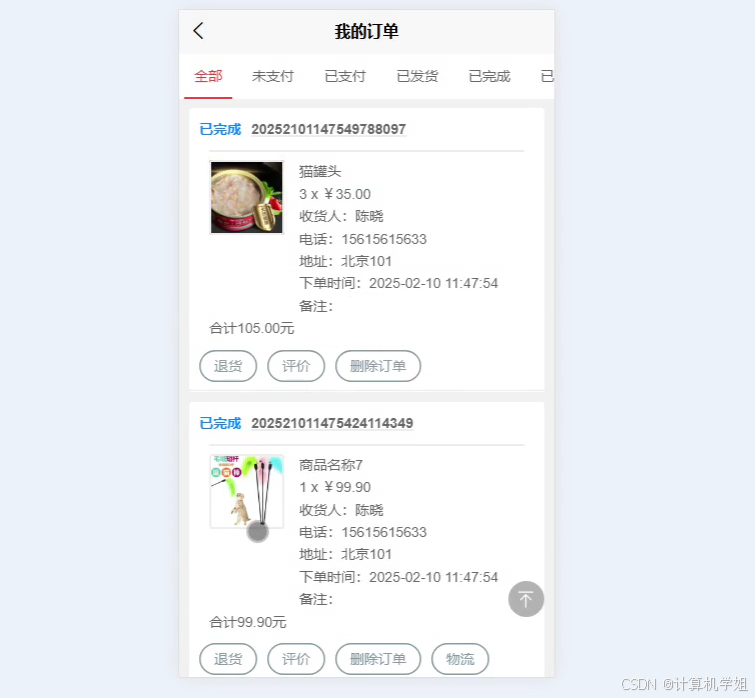
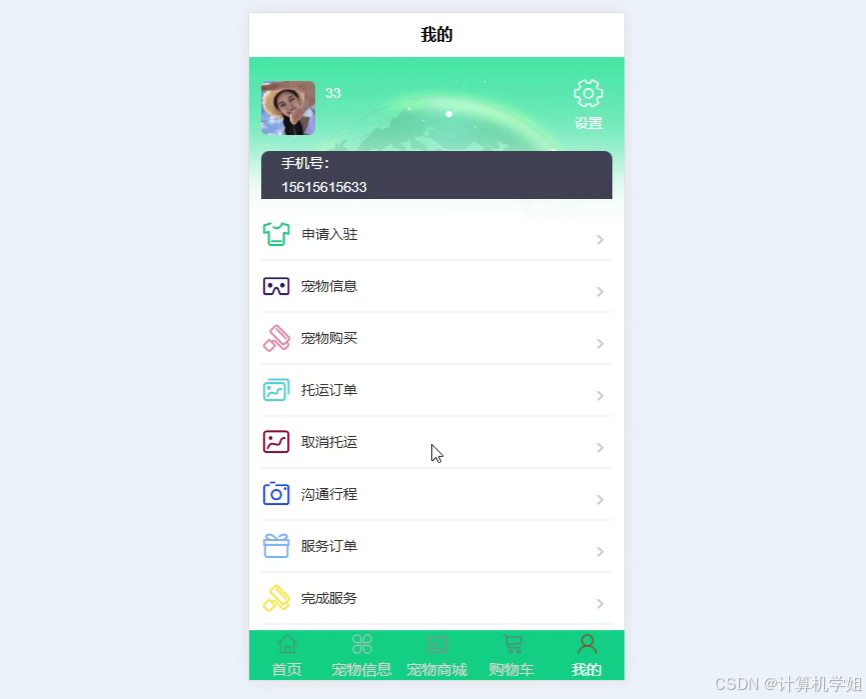 AI Visual Insight: The image shows a functional page or order page inside the Mini Program, reflecting how the system integrates service status, user action entry points, and information cards into a mobile interface.
 AI Visual Insight: The image shows the personal center or record management page, typically used to centrally display personal data such as pet records, booking history, and review entry points.
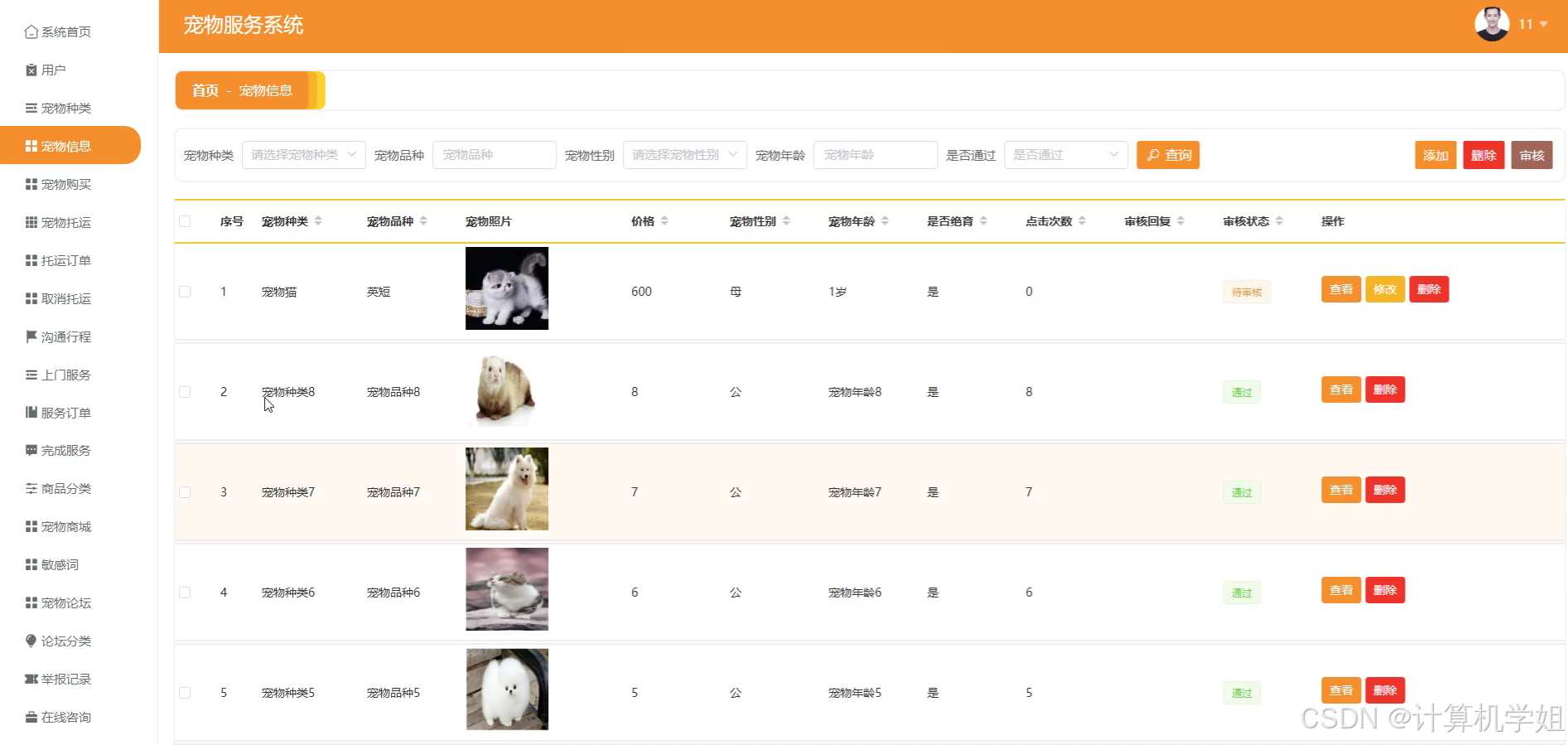 AI Visual Insight: The image shows the list-based management interface of the web admin dashboard, including menu navigation, data tables, and action buttons, making it suitable for frequent processing of orders, users, and service resources.
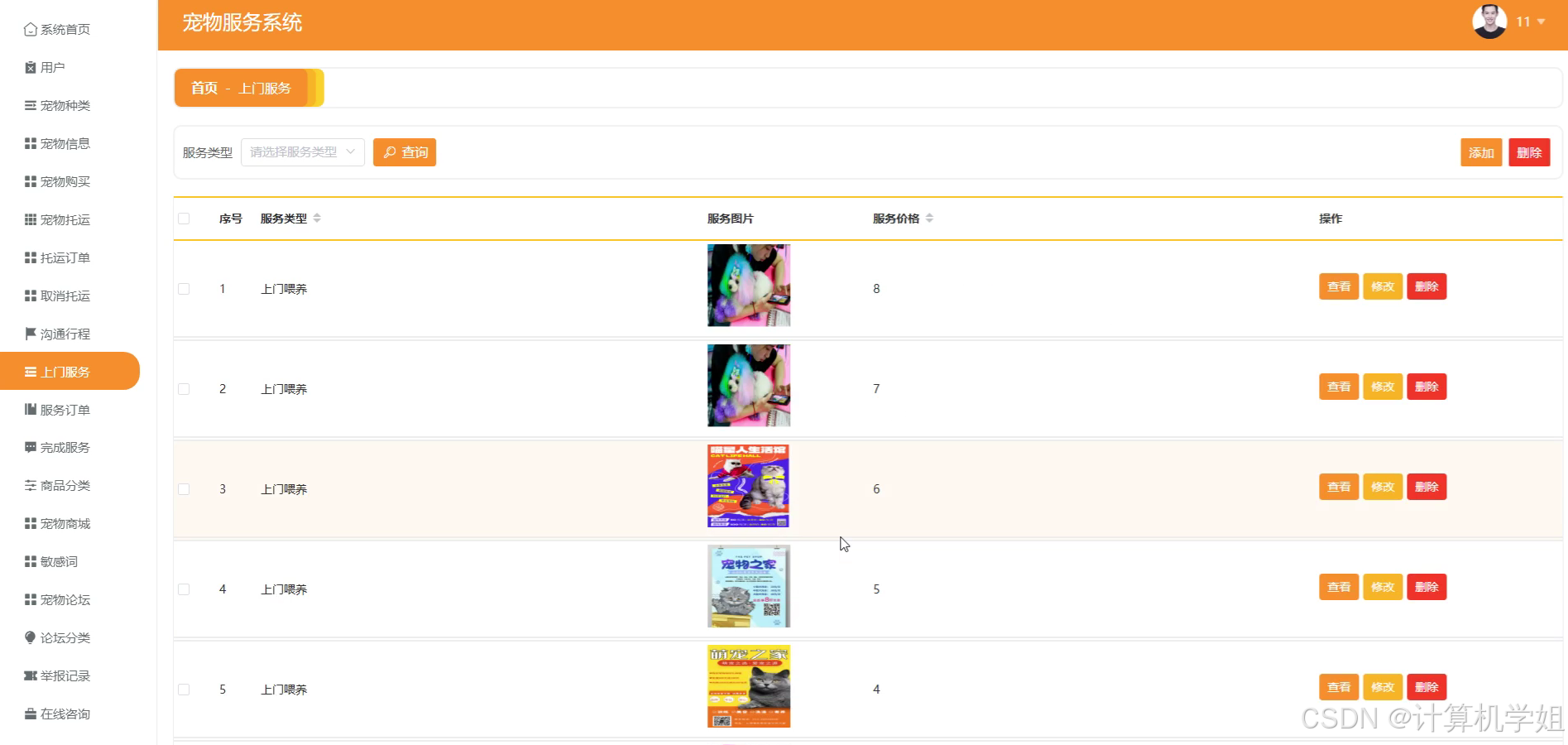 AI Visual Insight: The image shows an edit or detail page in the backend, highlighting the admin side’s ability to enter, review, and maintain business data and status, which is an essential part of the operational closed loop.
<template>
  <div class="pet-booking">

<h2>宠物服务预约</h2>
    <el-select v-model="selectedService" placeholder="选择服务类型">
      <el-option label="洗澡" value="bath"></el-option>
      <el-option label="美容" value="grooming"></el-option>
    </el-select>
    <el-button @click="submitBooking">提交预约</el-button>
  </div>
</template>

<script>
export default {
  data() {
    return {
      selectedService: ''
    }
  },
  methods: {
    submitBooking() {
      this.$message.success('预约请求已发送'); // Notify the user that submission succeeded
    }
  }
}
</script>
This code shows the basic implementation pattern for a backend booking interaction form, which can be extended into a complete order processing component.
The data model and system scalability determine whether the project can move beyond a graduation project
Based on the original material, the system already has the typical characteristics of an academic course project. However, if it is going to enter real deployment, it still needs authentication and authorization, payment integration, message notifications, log auditing, and exception tracing.
At a minimum, the database should include tables for users, pets, services, bookings, reviews, and merchants. If the system needs to support high-concurrency booking, it should also add time-slot inventory or service resource locking mechanisms.
The practical value of this solution is that it can be reused across many local service Mini Programs
Pet services are only the surface scenario. At its core, this is a general-purpose architecture built around multiple roles, booking, orders, records, and backend governance. With minor adaptation, it can be migrated to housekeeping, beauty services, health management, on-demand repair, and similar businesses.
Its reference value therefore goes beyond the source-code stack itself. It validates the collaboration boundary between UniApp and Spring Boot, as well as the operational stability of a Vue admin dashboard in business scenarios.
FAQ structured Q&A
1. Why is UniApp a better fit for this project than a native WeChat Mini Program?
UniApp is suitable for scenarios where the WeChat Mini Program and H5 need to share the same codebase, which reduces duplicated frontend development effort. For course projects and small to mid-sized service platforms, it improves delivery speed and maintenance efficiency.
2. What core responsibilities does Spring Boot handle in this system?
Spring Boot provides the unified API, business rules, access control, and database access layer. It acts as the business hub of the entire system. Without a stable backend, both the Mini Program and the admin panel remain only presentation layers.
3. If the system continues to evolve, which capabilities should be added first?
The highest-priority additions are login authentication, payment APIs, booking conflict validation, message notifications, and operation logs. These capabilities directly affect system usability, security, and real-world business readiness.
AI Readability Summary: This article reconstructs a pet service WeChat Mini Program project and explains its frontend-backend separation architecture based on UniApp, Spring Boot, Vue, and MySQL. It analyzes the multi-role business loop, core modules, API design, and implementation examples, making it a practical reference for pet booking and service management systems.