This is a late-April 2026 snapshot of frontier model capabilities for developers, focused on the key updates, cost shifts, and best-fit scenarios for GPT-5.5, Claude Opus 4.7, Gemini 3.1 Pro, and Grok 4.3. The core challenge is simple: there is no universal model, so how do you choose the right one for each task? Keywords: AI coding, model selection, Agent.
The technical specification snapshot highlights each model’s role
| Parameter | GPT-5.5 | Claude Opus 4.7 | Gemini 3.1 Pro | Grok 4.3 |
|---|---|---|---|---|
| Primary Positioning | Terminal automation and code generation | Creative software connectivity and engineering collaboration | Deep research and document generation | Reasoning, voice, and real-time information |
| Language Support | Multilingual | Multilingual | Multilingual | Multilingual |
| Protocols / Interfaces | Tool calling, terminal workflows | MCP, connectors, GitLab integration | Conversational file export, Research workflows | Reasoning model APIs, voice interaction |
| Representative Data | Terminal-Bench 82.7%, OSWorld 78.7% | New tokenizer + Connectors | Deep Research upgrade | GPQA 85.9, AIME 89.4 |
| GitHub Stars | Not disclosed | Not disclosed | Not disclosed | Not disclosed |
| Core Dependencies | Codex / terminal agent capabilities | Blender Python API, Adobe ecosystem, MCP | Google ecosystem, document export pipeline | xAI reasoning stack, Colossus training cluster |
Competition among these four models has shifted from “who is strongest” to “who fits best”
The late-April 2026 updates make one thing clear: flagship model competition is no longer about a single benchmark score. It is now about owning the workflow. What developers actually care about is which model can complete the current task more reliably at a controllable cost.
The most valuable signal in the source material is not the marketing language. It is the set of four actionable capability signals: terminal operations, cross-software connectivity, research and document generation, and high-intensity reasoning.
models = {
    "GPT-5.5": "terminal automation / complex coding",
    "Claude Opus 4.7": "creative software / engineering collaboration",
    "Gemini 3.1 Pro": "deep research / document generation",
    "Grok 4.3": "reasoning-intensive / real-time retrieval"
}

for name, scene in models.items():
    print(f"{name} -> {scene}")  # Output the mapping between models and use cases
This snippet maps model strengths directly to selection scenarios, which makes it useful when designing routing strategies.
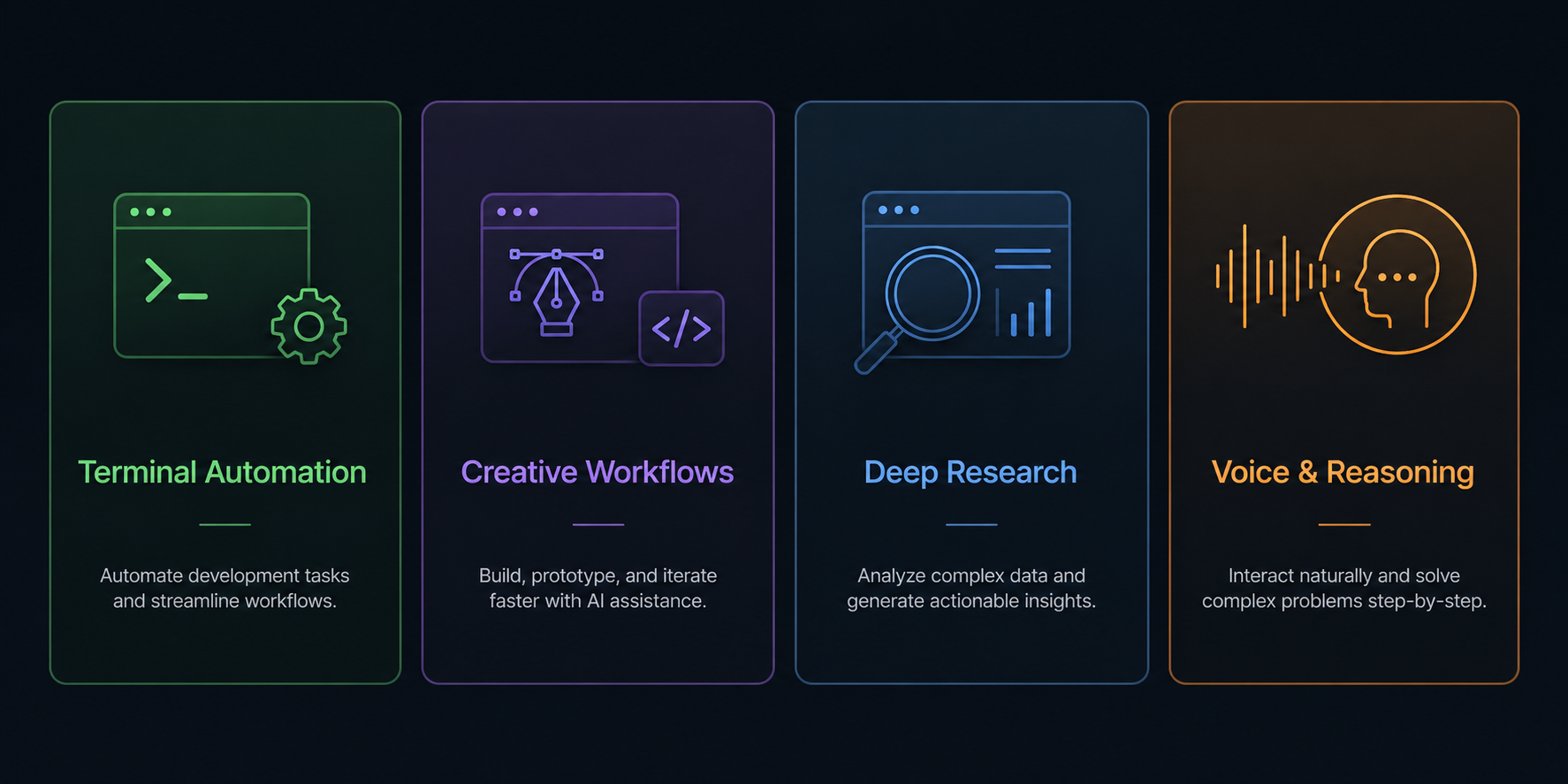 AI Visual Insight: This image works more like a banner illustration than a detailed technical graphic. It emphasizes the article’s theme rather than exposing fine-grained engineering structure. Its main message is the comparison framework of four parallel models, which makes it a useful entry point for capability comparison, but it does not carry verifiable engineering details such as benchmark charts, architecture diagrams, or interface flows.
GPT-5.5 has established a lead in terminal control and code generation
The source material shows that GPT-5.5 reached 82.7% on Terminal-Bench 2.0, a 7.6-point gain over GPT-5.4. It also achieved a 78.7% success rate on OSWorld-Verified. That suggests it does not just write code well. It is also better at executing code in real environments.
More importantly, it appears to sustain long-running tasks. The original text notes that it can operate autonomously for nearly 10 hours with stability. That matters for long-chain Agents, automated repair, and batch script execution. Its advantage is not just single-turn intelligence. It is sustained usability.
# A typical task chain that fits terminal-agent execution

git clone repo-url
cd project
pytest
npm run build
python scripts/fix_lint.py
git diff
This command sequence represents the closed loop GPT-5.5 handles well: fetch code, test, build, repair, and compare.
Claude Opus 4.7 acts more like an intelligent control plane for cross-software workflows
The core update in Claude Opus 4.7 is not benchmark performance. It is connectors. Once ecosystems such as Adobe Creative Cloud, Autodesk Fusion, Blender, Ableton, and Splice are integrated, Claude’s value shifts from “can answer questions” to “can orchestrate professional software.”
The Blender connector is especially important. Built on MCP, it can use natural language to drive the Blender Python API for scene analysis, batch object operations, and tool extensions. That gives Claude a differentiated edge in 3D, digital content production, and visualization workflows.
import bpy

# Batch-modify object name prefixes in a Blender scene
for obj in bpy.data.objects:
    if obj.type == 'MESH':
        obj.name = f"asset_{obj.name}"
This kind of script is exactly the sort of productivity scenario where Claude plus the Blender connector can deliver outsized value.
However, cost requires attention. The original text notes that after enabling the new tokenizer, Claude Opus 4.7 may consume up to 35% more tokens for the same text. In code-heavy scenarios, measured usage can reach 1.32x to 1.47x of the previous generation. Teams that use Claude Code frequently should revisit their budgets.
Gemini 3.1 Pro is the most practical choice for deep research and deliverable generation
The upgrade path for Gemini 3.1 Pro is very clear: turn research output into deliverables faster. Deep Research improves online analysis and report generation, while direct in-conversation export to Docs, Sheets, PDF, CSV, Markdown, and LaTeX significantly shortens the manual handoff process.
That makes it particularly well suited to development scenarios that follow a “research first, output second” pattern, such as evaluating technology stacks, scanning large codebases, organizing API differences, and producing review materials. It may not be the strongest coding Agent, but it is extremely strong in the knowledge synthesis pipeline.
report_targets = ["PDF", "Markdown", "CSV", "LaTeX"]

# Simulate exporting research output into different document formats
for target in report_targets:
    print(f"Export research report -> {target}")
This snippet captures Gemini’s core value: converting research conclusions into structured files quickly.
Grok 4.3 currently fits best as a supplemental model for reasoning and real-time intelligence
Grok 4.20 Reasoning performs competitively on GPQA Diamond, AIME 2025, and LiveCodeBench, which suggests it has solid capability in academic reasoning, mathematics, and competition-style programming. Its main limitation is not intelligence. It is that the engineering ecosystem is still catching up.
But Grok’s potential comes from its roadmap. The 1T and 1.5T parameter versions are scheduled for release in May, with Grok 5 as the eventual target. For teams that need real-time information, voice interaction, and strong reasoning support, it is worth keeping Grok under active evaluation.
Developers should adopt a task-based multi-model routing strategy
If your core tasks involve terminal automation, complex code generation, and long-running autonomous execution, prioritize GPT-5.5. If your business depends on 3D, design, creative toolchains, or deep GitLab collaboration, Claude Opus 4.7 is the better fit.
If you frequently do technical research, competitor analysis, document organization, codebase understanding, and need direct document export, Gemini 3.1 Pro is the most efficient choice. If your tasks emphasize mathematical reasoning, voice interfaces, or real-time information enrichment, use Grok as a complementary engine.
A minimum viable model routing rule looks like this
def route_model(task: str) -> str:
    if "终端" in task or "自动修复" in task:
        return "GPT-5.5"  # Prioritize terminal and long-chain tasks
    if "Blender" in task or "Adobe" in task:
        return "Claude Opus 4.7"  # Prioritize creative software workflows
    if "研究" in task or "报告" in task:
        return "Gemini 3.1 Pro"  # Prioritize deep analysis and document export
    return "Grok 4.3"  # Use for reasoning support and real-time retrieval tasks
This routing logic works well as a baseline for an enterprise AI gateway or local Agent orchestration.
The safest conclusion today is that no single model is universally optimal
GPT-5.5 is strongest in execution loops. Claude Opus 4.7 is strongest in cross-software connectivity. Gemini 3.1 Pro is strongest in research delivery. Grok 4.3 is strongest in reasoning and future potential. High-performing teams do not bet on one model alone. They decompose capabilities by task.
From an engineering perspective, the 2026 model selection standard is already clear: start with task type, then evaluate integration ecosystem, and finally calculate token and execution cost. Benchmarks are only the starting point. Workflow fit is the real destination.
FAQ
Q1: If a developer can subscribe to only one model first, which one should they choose?
A1: If your work centers on code generation, terminal automation, and Agent execution, start with GPT-5.5. If your daily work leans more toward research, reporting, and document export, start with Gemini 3.1 Pro.
Q2: Is Claude Opus 4.7 still a good fit for pure software engineering teams?
A2: Yes, but it is a stronger fit for teams that already use GitLab Duo, MCP, or creative software workflows. If you care mostly about unit cost and terminal execution efficiency, GPT-5.5 usually has the advantage.
Q3: Is Grok 4.3 worth bringing into production right now?
A3: It works well as a supplemental model, especially for reasoning-intensive tasks, real-time retrieval, and voice interaction. If you need a mature engineering ecosystem, it is reasonable to wait and evaluate stability after its May release cadence progresses.
AI Readability Summary: Based on public updates available in late April 2026, this guide compares GPT-5.5, Claude Opus 4.7, Gemini 3.1 Pro, and Grok 4.3 across coding, terminal control, deep research, creative connectors, and reasoning tasks, then translates those differences into practical model selection guidance for developers.