ESP32-S3 makes it possible to build a low-cost embodied AI agent that can see, hear, speak, and move. The core challenge is balancing compute, cost, and real-time performance. This article distills a practical path across cloud-edge-device collaboration, open-source frameworks, hardware adaptation, and offline AI. Keywords: ESP32-S3, embodied AI, edge AI.
Technical Specifications Snapshot
| Parameter | Details |
|---|---|
| Primary Languages | C / C++ / Python (in parts of the ecosystem) |
| Development Frameworks | ESP-IDF, Arduino, TensorFlow Lite Micro |
| Communication Protocols | Wi-Fi 802.11 b/g/n, BLE 5.0, I2S, I2C, PWM, MCP |
| Recommended Storage | 16MB Flash + 8MB PSRAM |
| Typical Power Consumption | Can run below 0.5W in some scenarios |
| GitHub Stars | Not provided in the source; depends on the specific open-source project |
| Core Dependencies | ESP-IDF, TFLM, Edge Impulse, I2S drivers, servo drivers |
ESP32-S3 Has Become a Preferred Core for Low-Cost Embodied AI Agents
The value of ESP32-S3 is not that it replaces high-compute platforms. Its value lies in completing the full loop of perception, connectivity, execution, and basic inference with an extremely low BOM cost. It fits resource-constrained scenarios such as desktop companions, robot dogs, wheeled robots, and voice terminals.
Its key advantages include integrated Wi-Fi and BLE, vector instructions for lightweight inference, expandable PSRAM, and a mature ESP-IDF ecosystem. That makes it a natural fit for the role of an “edge cerebellum.”
 AI Visual Insight: This animated image highlights the interaction pattern of an embodied AI agent. In practice, it typically corresponds to the coordinated loop of voice input, state feedback, and action execution. It works best as a visual illustration of the “perception-decision-execution” loop rather than a static hardware showcase.
Cloud, Edge, and Device Role Separation Defines the System Ceiling
The core of a low-cost design is not pushing all intelligence into the MCU. It is about dividing responsibilities. The cloud handles the LLM, multi-turn dialogue, and intent parsing. The ESP32-S3 handles sensor acquisition, motion control, local caching, and offline fallback.
This architecture solves three problems at the same time: it reduces compute pressure on the device, minimizes jitter for latency-sensitive tasks, and preserves minimum viable functionality during network loss.
// Pseudocode: cloud-edge collaborative execution flow
void handle_user_event() {
    capture_audio();              // Capture microphone audio
    if (local_wakeup_detected()) {// Local wake word detected
        send_to_cloud_llm();      // Upload to the cloud for intent parsing
        Intent cmd = get_intent();// Get the structured command
        execute_motion(cmd);      // Execute motion or play voice output
    } else {
        run_idle_tasks();         // Enter low-power tasks when not awakened
    }
}
This code shows the minimum closed loop of local wake-up, cloud understanding, and on-device execution.
Mainstream Open-Source Paths Have Evolved into a Clear Layered Stack
The first path is MimiClaw. This type of solution emphasizes pure C, low overhead, and strong control. It fits embedded developers who want to understand the underlying architecture. Its focus is not flashy UI. Its focus is splitting sensors, memory, control, and fault tolerance into clear modules.
The second path is the XiaoZhi AI ecosystem. It is more oriented toward rapid reproduction. It offers richer documentation, tutorials, and derivative hardware, making it a strong choice for building a working prototype first and optimizing it later.
MimiClaw Is Better for Learning a Minimal Yet Complete System Design
The engineering value of MimiClaw is that it implements a runnable agent skeleton with a very small software footprint. Developers can directly observe how sensor input, network calls, motion mapping, and exception fallback relate to each other.
If your goal is a maintainable long-term project, this modular approach matters even more. As hardware evolves, you can decouple the driver layer from the behavior layer instead of rewriting the control logic every time.
The XiaoZhi AI Ecosystem Is Better for Quickly Building Voice Robots and Robot Dogs
A basic desktop companion typically consists of an ESP32-S3, INMP441, MAX98357, a 3W speaker, and an optional OLED. It can quickly connect to models such as ChatGPT, Doubao, and DeepSeek to support voice Q&A and device control.
A more advanced robot dog adds four or more servos, a lithium battery, and a chassis structure so that natural language can map directly to physical movement.
# Pseudocode: map an LLM instruction to servo actions
def dispatch_intent(intent):
    if intent == "forward":
        move_servo_group("walk_forward")  # Control quadruped gait for forward walking
    elif intent == "sit":
        move_servo_group("sit_down")      # Switch to a sitting posture
    else:
        speak("Unrecognized motion command")  # Voice feedback for an exception
This code demonstrates the shortest mapping path from natural language intent to an action template.
The MCP Protocol Gives Large Models the Ability to Control Physical Devices
You can think of MCP as a standard translation layer between the large model and the hardware execution layer. The LLM outputs a high-level intent, and MCP compresses that into a structured command the device can execute.
Without this protocol layer, systems often couple natural language directly to GPIO, PWM, and I2S control, which makes future extension expensive. Once MCP is introduced, the semantic layer and control layer gain a much clearer boundary.
Offline TinyML Fills the Gap for Network Outages and Low-Power Scenarios
If the robot depends entirely on the cloud, it loses its “intelligence” as soon as the network drops. A more robust approach is to keep wake word detection, simple visual recognition, and sound classification on the device.
With TensorFlow Lite Micro and Edge Impulse, the ESP32-S3 is capable of handling small-model inference tasks, especially low-frame-rate vision detection and offline wake-up detection.
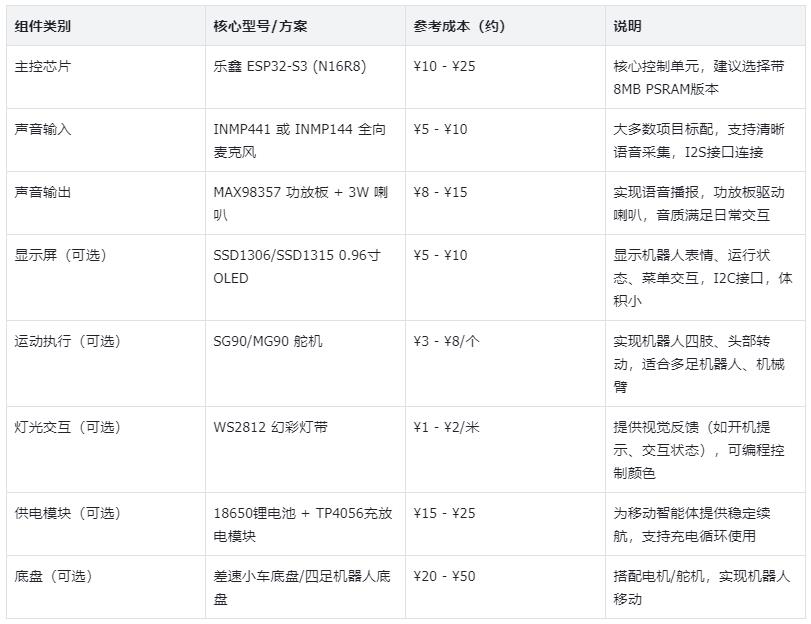 AI Visual Insight: This image corresponds more closely to a BOM or hardware cost breakdown. The focus is typically the price split across the main controller, audio, display, servos, and power modules. For developers, the key insight is not any single component specification but the overall cost-control strategy and solution layering.
Hardware Adaptation Should Prioritize Audio Reliability and Power Stability
For audio input, INMP441 is a strong recommendation. For output, MAX98357 plus a 3W speaker is a practical choice. Both use I2S, which provides mature driver support at low cost. For display, prioritize SSD1306, which can deliver status and expression feedback through I2C.
On the power side, mobile devices should use an 18650 lithium battery with a TP4056 charging module, followed by 3.3V regulation for the main controller. Servos and motors should not share a fragile power path directly with the MCU, or you will likely see resets and noise issues.
// Pseudocode: initialize audio and display peripherals
void board_init() {
    i2s_mic_init();       // Initialize the I2S microphone input
    i2s_speaker_init();   // Initialize the I2S amplifier output
    oled_i2c_init();      // Initialize the OLED display
    pwm_servo_init();     // Initialize PWM channels for servos
}
This code summarizes the most common board-level initialization flow for an embodied AI agent.
Upgrading from a Wheeled Robot to a Robot Dog Is the Most Natural Motion-Control Path
Beginners can start with a differential-drive wheeled robot to practice motor control, voice commands, and obstacle avoidance logic. A driver module such as the L9110S is sufficient for entry-level validation, and the control model is simpler.
Once you move into quadrupeds or robotic arms, the main question shifts from “can it move?” to “how can it move reliably in coordination?” At that stage, you should prioritize multi-channel PWM, posture sequences, center-of-gravity shifting, and independent power design.
 AI Visual Insight: This image looks more like a complete hardware prototype or structural assembly showcase. It typically reveals the development board position, sensor layout, actuator placement, and wiring approach. Its value for builders lies in observing module stacking, space usage, and motion-mechanism integration.
The Best Learning Path Moves from Reproduction to Independent Customization
In the first stage, directly reproduce a XiaoZhi AI desktop companion or robot dog and focus on getting voice input, online dialogue, and motion control working end to end. In the second stage, study a MimiClaw-style architecture to understand modular decomposition. In the third stage, add local TinyML and custom hardware.
The real barrier is not building a talking box. It is making the system work reliably under low cost, low power, and unstable network conditions. That is exactly where the ESP32-S3 approach has the most engineering value.
FAQ
1. Can ESP32-S3 really run embodied intelligence?
Yes, but more precisely, it is well suited for edge control, lightweight inference, and device coordination. It is not suitable for running the core of a large language model locally. The best practice is to let the cloud handle cognition while the device handles execution.
2. For beginners, should I start with a voice robot or a wheeled robot?
Start with a voice robot. The audio pipeline, network calls, and state feedback are easier to debug, and the success rate is higher. After that works, add a chassis and servos to upgrade it into a mobile agent.
3. If the network is unstable, how can the system remain usable?
Keep the wake word, local action tables, basic dialogue responses, and exception handling on the device. That way, even if the cloud is unavailable, the device can still respond to simple commands and maintain minimum functionality.
AI Readability Summary
This article reconstructs a complete technical path for building a low-cost embodied AI agent with ESP32-S3. It covers cloud-edge-device architecture, MimiClaw and the XiaoZhi AI ecosystem, offline TinyML capabilities, audio/display/power adaptation, and motion-control strategies. The goal is to help developers use a roughly $3-class microcontroller to quickly build a practical “see, hear, speak, and move” closed loop.