This article focuses on Gymnasium’s extensibility through Wrappers, environment rendering, and video recording. These capabilities solve common reinforcement learning engineering problems such as poor environment reuse, difficult debugging, and limited visualization. Keywords: Gymnasium, Wrapper, CartPole.
Technical Specification Snapshot
| Parameter | Description |
|---|---|
| Primary Language | Python |
| Core Frameworks | Gymnasium, PyTorch |
| Typical Environment | CartPole-v1 |
| API Types | Env / Wrapper / Rendering |
| Rendering Protocol | render_mode="rgb_array" |
| Core Dependencies | gymnasium, random |
| Applicable Scenarios | Reinforcement learning training, debugging, visualization |
| GitHub Stars | Not provided in the source |
Gymnasium’s Extension APIs Improve the Engineering Usability of Reinforcement Learning Environments
In reinforcement learning projects, the training loop is usually not the bottleneck. The environment interface is. Developers often need to modify observations, clip actions, scale rewards, or record agent behavior. If you change the environment source code directly, both reusability and maintainability decline.
Gymnasium solves this problem through its extension APIs and Wrapper mechanism. It allows developers to add capabilities by wrapping an existing environment externally, without breaking the original implementation. That makes it especially well suited for rapid experimentation and production-style integration.
Wrapper Is the Most Important Extensibility Abstraction in Gymnasium
A Wrapper essentially inherits from Env and accepts an existing environment instance. It preserves the original interface while allowing you to override step(), reset(), or more granular processing methods. This lets you intercept the input and output flow of the environment.
There are three common subclasses: ObservationWrapper for observation processing, RewardWrapper for reward processing, and ActionWrapper for action processing. These correspond to state preprocessing, reward shaping, and policy perturbation, which are three of the most common intervention points in reinforcement learning engineering.
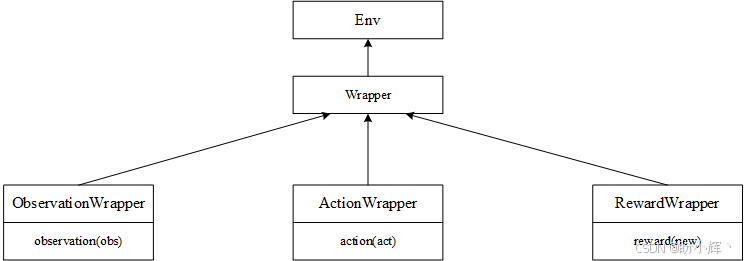 AI Visual Insight: This diagram shows the inheritance structure of Gymnasium’s environment abstractions.
 Wrapper sits on top of Env and further branches into ObservationWrapper, RewardWrapper, and ActionWrapper. This design demonstrates Gymnasium’s layered object-oriented extension model, which allows developers to modify only the observation, reward, or action pathway without rewriting the full environment lifecycle.
ActionWrapper Works Well for Injecting Exploration Noise
A common requirement is this: even if the agent outputs a fixed action, you may want to replace it with a random action at a small probability to force exploration. This can reduce premature policy convergence and is especially useful in early experiments and baseline validation.
import gymnasium as gym
import random

class RandomActionWrapper(gym.ActionWrapper):
    def __init__(self, env: gym.Env, epsilon: float = 0.1):
        super().__init__(env)  # Initialize the parent class and store the wrapped environment
        self.epsilon = epsilon  # Store the probability of triggering a random action

    def action(self, action):
        if random.random() < self.epsilon:
            action = self.env.action_space.sample()  # Sample a random action from the action space
            print(f"Random action: {action}")  # Print the replacement result for debugging
        return action
This code intercepts the original action with probability epsilon and replaces it with a random sample from the action space.
The Wrapped Environment Still Preserves the Original Env Interface
This is the most valuable property of Wrappers. From the perspective of the training loop, the wrapped object is still a standard environment, so you do not need to rewrite the main flow. You can apply a single wrapper or stack multiple wrappers to build a composable environment processing pipeline.
import gymnasium as gym

env = RandomActionWrapper(gym.make("CartPole-v1"), epsilon=0.1)
obs, info = env.reset()  # In newer Gymnasium versions, reset returns observation and info
This code creates a CartPole environment instance with random action injection.
You Can Verify the Wrapper Even with a Fixed Action Policy
Even if the agent always outputs action , the wrapper will still inject random actions periodically. That makes it a clear and intuitive way to demonstrate that the action flow has been modified, compared with only inspecting the class definition.
obs, info = env.reset()
total_reward = 0.0
terminated = False
truncated = False

while not (terminated or truncated):
    obs, reward, terminated, truncated, info = env.step(0)  # Always execute action 0
    total_reward += reward  # Accumulate the episode reward

print(f"Reward got: {total_reward:.2f}")
env.close()
This code runs a fixed-action policy and uses the total reward and console output to observe whether the wrapper intervenes in action execution.
Rendering Wrappers Make Reinforcement Learning Debugging Visual
In many experiments, a reward curve alone is not enough to explain policy behavior. Rendering directly shows how the agent interacts with the environment, making it an efficient tool for diagnosing abnormal policies, reward design issues, and action-space mapping problems.
Gymnasium splits the legacy Monitor into two wrappers with clearer responsibilities: HumanRendering for real-time display and RecordVideo for video capture. Both require the environment to be initialized with render_mode="rgb_array".
HumanRendering Is Best for Local Interactive Observation
import gymnasium as gym

env = gym.make("CartPole-v1", render_mode="rgb_array")
env = gym.wrappers.HumanRendering(env)  # Render pixel frames to a separate window
This code displays the environment’s pixel frames in a graphical window in real time, which is useful for local policy debugging.
RecordVideo Is Better for Remote Training and Experiment Review
On headless servers, a real-time window is not practical. In that case, video recording is more valuable. It saves each rollout to disk for offline analysis, experiment archiving, and result presentation.
import gymnasium as gym

env = gym.make("CartPole-v1", render_mode="rgb_array")
env = gym.wrappers.RecordVideo(env, video_folder="video")  # Automatically write video files
This code records the interaction between the agent and the environment and saves the output to the video directory.
Additional Gymnasium Wrappers Support Standardized Training Pipelines
Beyond action, reward, and observation processing, Gymnasium also provides capabilities such as time limits, frame stacking, reward normalization, image preprocessing, and vectorized environments. These features cover most environment-side requirements, from classic control tasks to Atari workloads.
In PyTorch reinforcement learning projects, it is best to treat environment creation as a separate module: first create the base environment, then apply wrappers layer by layer. This keeps the training script focused on the interaction interface while the environment customization logic remains testable, replaceable, and reusable.
The Wrapper Mechanism Defines Gymnasium’s Engineering Ceiling
The core value of Gymnasium is not just a unified environment interface. Its real strength is a highly modular framework for environment enhancement. Wrappers turn exploration injection, observation transformation, reward shaping, rendering, and recording into composable capabilities.
If you are building reinforcement learning experiments with PyTorch, prioritize ActionWrapper, HumanRendering, and RecordVideo. They will significantly improve debugging efficiency, experiment reproducibility, and code cleanliness.
FAQ
1. Why use a Wrapper instead of modifying the environment source code directly?
Because a Wrapper preserves the original environment interface while adding new functionality non-invasively. This makes the environment easier to reuse, test, and compose, and it is better suited for team collaboration and iterative experimentation.
2. What should I watch for in the return values of reset() and step() in Gymnasium?
In newer versions of Gymnasium, reset() usually returns (obs, info), while step() returns (obs, reward, terminated, truncated, info). During development, you should distinguish between natural termination and time truncation instead of reusing older Gym conventions.
3. How should I choose between HumanRendering and RecordVideo?
Use HumanRendering first for local debugging because it lets you observe policy behavior in real time. Use RecordVideo first for server-side training or experiment archiving because it does not depend on a graphical interface and is better suited for batch workloads and post-run review.
Core Summary: This article systematically reconstructs Gymnasium’s API extensibility, with a focus on the Wrapper mechanism, real-time rendering with HumanRendering, and video capture with RecordVideo. Using CartPole as an example, it shows how to inject random exploration with ActionWrapper while improving environment reusability and debugging efficiency.