This is a booking management platform for the home services industry. It connects three coordinated endpoints—customer ordering, service provider acceptance, and back-office operations management—to solve fragmented bookings, poor progress visibility, and inefficient staff scheduling. Keywords: home services booking mini program, Vue 3, multi-end management.
The technical specification snapshot defines the project baseline
| Parameter | Details |
|---|---|
| Project Type | Home services booking mini program / multi-end management platform |
| Frontend Language | JavaScript |
| Core Framework | Vue 3 + Composition API |
| Routing | Vue Router 4 |
| State Management | Pinia |
| Build Tool | Vite |
| Target Platforms | WeChat Mini Program / H5 / App (UniApp-expandable) |
| Permission Model | RBAC |
| Protocol / Interaction | HTTP API, frontend-backend separation, mobile-first |
| Star Count | Not provided in the source material |
| Core Dependencies | Vue 3, Vue Router 4, Pinia, Vite |
The project creates a complete closed-loop workflow for home services operations
This project is not a single booking page. It connects service discovery, order submission, payment, dispatching, service delivery, reviews, refunds, and financial reporting into one operational workflow. For home service businesses, this closed-loop design delivers much more practical value than a display-only mini program.
The customer app, provider app, and admin dashboard map to three roles: consumers, executors, and managers. This design keeps responsibilities clear, supports day-to-day booking operations, and leaves enough room to integrate real backend APIs later.
The customer app enables low-friction ordering and tracking
The mobile side uses a bottom tab bar as the primary navigation pattern, covering login, homepage, service details, booking confirmation, orders, messages, and account center. Users enter from categorized homepage sections and can quickly browse services such as home cleaning, maternity care, appliance repair, and pipe unclogging.
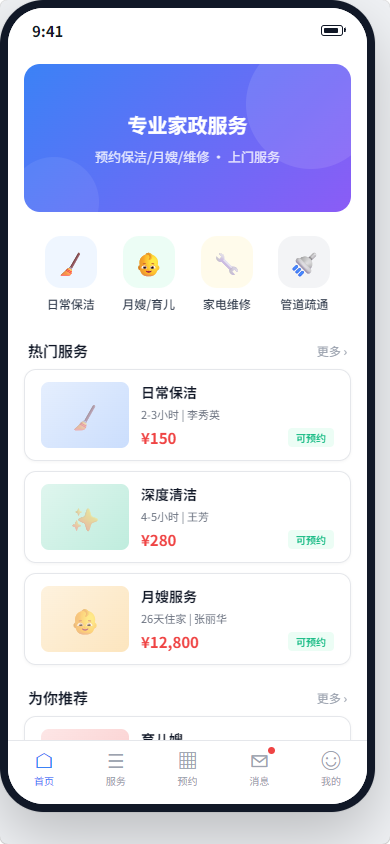 AI Visual Insight: This interface shows the information hierarchy of the mobile homepage: search and campaign entry points at the top, a service-category grid in the middle, and a recommended content feed at the bottom. The card-based layout and high-frequency service prioritization indicate that the product focuses on fast service discovery and high-conversion entry point exposure.
The service details page consolidates pricing, service scope, staff introduction, and review information, with a direct booking trigger at the bottom. The booking confirmation page continues by collecting key fields such as address, time, and assigned service provider, which matches a typical O2O service ordering flow.
// Core submission logic for the booking confirmation page
const submitBooking = async () => {
  // Validate that a service address has been selected
  if (!form.addressId) throw new Error('请选择服务地址')
  // Validate that the booking time is complete
  if (!form.serviceTime) throw new Error('请选择服务时间')
  // Submit booking data to the backend API
  await api.createOrder(form)
  // Redirect to the payment result page
  router.push('/pay-result')
}
This code demonstrates the minimum closed loop for a booking scenario: validation, order creation, and redirection to the payment result page.
Service progress tracking improves user trust
The project breaks service status into six stages: paid, accepted, en route, arrived, in service, and completed. Users can view these updates in real time from the order details page or a dedicated progress page. This timeline-style feedback directly addresses one of the most common pain points in traditional home services: lack of transparency.
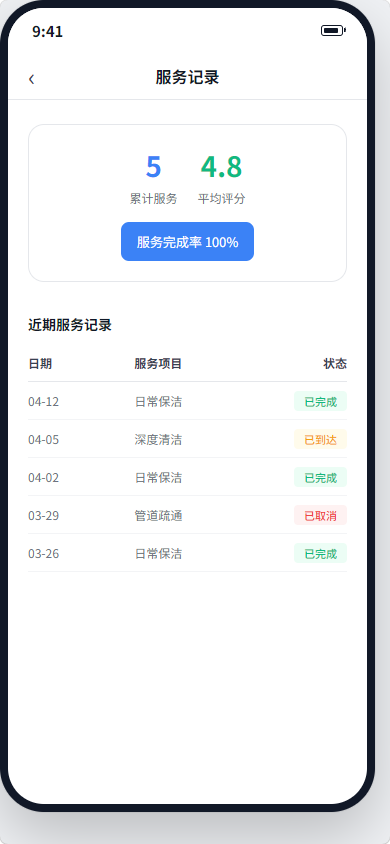 AI Visual Insight: This image highlights a timeline-based service fulfillment design. It uses staged nodes and ordered progress states to visualize order execution. This kind of status flow maps well to real dispatch scenarios and also provides a clean structural foundation for future integration of location tracking, photo uploads, and exception reporting.
Modules such as the message center, address management, coupons, favorites, feedback, and settings complete the user operations layer. These are not just add-on pages—they are important levers for improving repeat purchases and building long-term user assets.
The provider app digitizes service fulfillment
The provider side stays lightweight and keeps only high-frequency functions such as today’s orders, pending orders, order details, and progress updates. This focused design helps reduce training costs and allows frontline staff to accept orders and update statuses quickly on mobile devices.
Photo upload during service execution is especially important. It does more than record proof of service—it also provides an evidence chain for dispute handling, quality review, and refund approval. In the home services industry, features like this often carry more business value than flashy UI work.
// Example logic for a provider updating service progress
async function updateProgress(orderId, status, photos) {
  // Build the progress update payload
  const payload = { orderId, status, photos }
  // Call the API to write fulfillment status
  await api.updateOrderProgress(payload)
  // Return the latest order details
  return api.getOrderDetail(orderId)
}
This code maps directly to the core provider action: update status and sync the latest order data.
The admin dashboard handles dispatching, finance, and access control
The backend includes eight major modules: analytics dashboard, service management, provider management, order management, refund approval, financial reporting, company management, and permission management. It is not just a collection of CRUD pages. It organizes capabilities around operational efficiency.
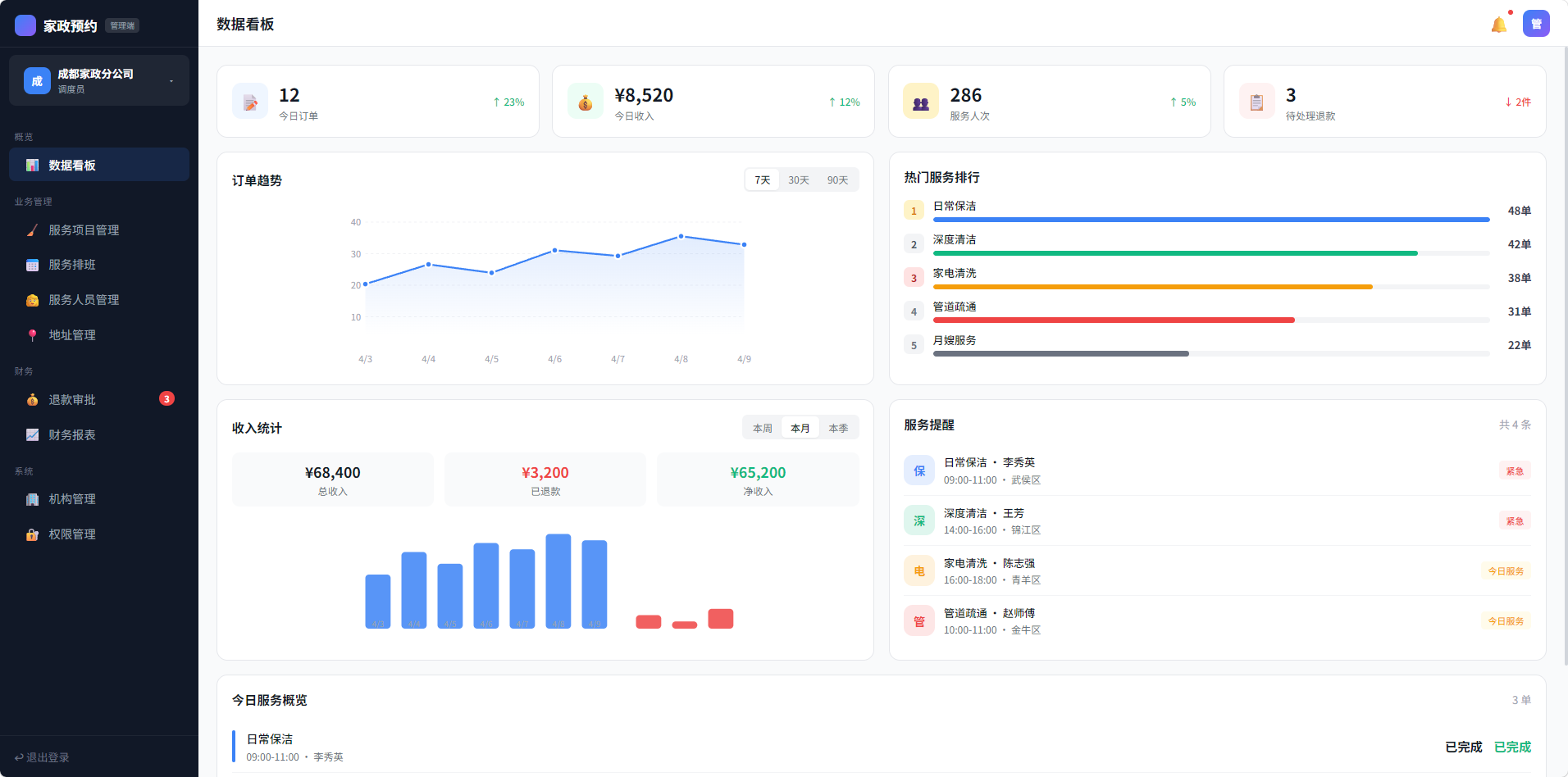 AI Visual Insight: This image shows the typical structure of an admin analytics dashboard: KPI cards at the top, trend charts in the middle, and detail or summary sections at the bottom. It indicates that the system already considers how operations teams consume data and can support monitoring of key metrics such as order volume, revenue, and pending refunds.
Order management handles dispatching and fulfillment confirmation, refund approval supports after-sales workflows, and financial reports cover revenue, refunds, and net income statistics. Multi-company management suggests SaaS or chain-operation scalability, while the RBAC permission matrix ensures clear access boundaries across roles.
The frontend structure is clean and suitable for secondary development and academic projects
The original structure is divided by page domains, with the main app, provider app, and admin dashboard separated from one another. This makes parallel team development easier. Reusable components such as ServiceCard.vue also show that the interface follows a component-based design approach.
// Example of global state in Pinia
import { defineStore } from 'pinia'

export const useAppStore = defineStore('app', {
  state: () => ({
    // Current logged-in role: user/provider/admin
    role: 'user',
    // Current company context for multi-organization switching
    currentOrgId: null
  })
})
This code reflects the project’s basic modeling approach for role switching and multi-company context management.
The design strengths center on cross-end consistency and a replaceable architecture
The project clearly adopts frontend-backend separation. It currently drives pages with frontend mock data, but it can later switch smoothly to real APIs. For teaching, prototyping, and capstone projects, this approach is highly practical: first validate the interaction flow, then incrementally complete backend services.
The mobile UI is designed around a 375px viewport and uses rounded cards, gradients, and bottom sheets that align with common WeChat Mini Program interaction patterns. Global CSS variables further reduce the cost of brand skinning and theme customization.
This type of project is best suited to three development scenarios
The first is a graduation project or capstone, because the business flow is complete, the roles are clear, and the documentation and page count are rich enough to expand requirement analysis, high-level design, database design, and testing sections. The second is source-code customization, where developers can quickly replace the industry model with beauty services, nail care, maintenance, repair, or on-demand washing and care. The third is enterprise prototype validation, where teams can test the booking workflow and back-office process before a full build.
Deployment and evaluation should prioritize real backend integration readiness
If you plan to move toward production, you should verify four things first: payment integration, address and map services, order status transitions, and permission plus company-level isolation. Payment and refunds are especially critical because they often determine whether a system can move from demo mode to real commercial use.
The original material includes an online demo link and source code download link, which suggests that the project is positioned as a deliverable that is demonstrable, customizable, and reusable for teaching. If you want to use it in production, you should add backend capabilities such as API authentication, audit logging, exception compensation, and object storage.
FAQ
1. Is this project better suited for prototyping, a capstone project, or commercial use?
It can serve all three, but the positioning differs. For prototyping and capstone work, you can use the existing frontend structure directly. For commercial use, you must add payment, API authentication, order consistency guarantees, file storage, and operations monitoring.
2. Why is the three-end split so important in this project?
Because the home services business naturally includes three roles: customers placing orders, providers fulfilling services, and administrators managing dispatch and operations. Once these three ends are separated, process boundaries become clearer, permission control becomes easier, and future extension becomes more manageable.
3. Which modules should be prioritized during secondary development?
Prioritize the service categories, booking fields, order state machine, payment flow, and admin reporting. These five areas directly determine how well the system fits a target industry and are the key steps in upgrading a demo project into an operational platform.
[AI Readability Summary]
This article reconstructs the core design of a home services booking mini program, covering the customer app, provider app, and admin dashboard. It explains the Vue 3, Pinia, and Vite architecture, the end-to-end business workflow, page modules, RBAC permissions, and multi-company management. It is well suited for product prototype analysis, secondary development evaluation, and capstone project research.