This article focuses on how C++ exception handling works in real engineering environments: it explains throw/catch, stack unwinding, exception rethrowing, and exception hierarchy design to address resource leaks, error propagation, and program crashes. Keywords: C++ exception safety, RAII, noexcept.
Technical Specification Snapshot
| Parameter | Description |
|---|---|
| Language | C++ |
| License | CC 4.0 BY-SA (as declared by the source article) |
| Stars | Not provided in the source article |
| Core Dependencies | ` |
,,,,` |

AI Visual Insight: This image serves as the article header and emphasizes the theme of industrial-grade C++ programming and exception safety. It is content-oriented rather than code-specific, but it clearly communicates the technical focus on robust system design.
Exception handling is a core mechanism for industrial-grade C++ robustness
Exceptions are not syntactic sugar. They are a runtime error propagation mechanism. They decouple error detection from error handling, allowing lower-level modules to report problems while upper-level modules decide whether to recover, degrade gracefully, or terminate.
Unlike the error codes commonly used in C, C++ exceptions can throw objects directly and carry richer context, such as error messages, error codes, module names, and business data. That expressive power is better suited to complex systems.
The minimum working model of exceptions consists of throw, try, and catch
#include
<iostream>
#include
<string>
using namespace std;

int Divide(int x, int y) {
    if (y == 0) {
        throw string("Divisor cannot be zero"); // Throw an exception object when the divisor is 0
    }
    return x / y; // Return the result on the normal path
}

int main() {
    try {
        cout << Divide(10, 0) << endl; // Call a function that may throw
    } catch (const string& err) {
        cout << err << endl; // Catch the exception by matching type
    }
    return 0;
}
This code demonstrates the basic exception propagation path: a function throws an object, and the caller catches and handles it through a type-matching catch block.
Exception catching follows type matching and nearest-handler rules
A catch block does not simply intercept any exception it sees. It matches by type precisely. If the thrown object is a string, then catch(int) or catch(const char*) will not work. In practice, capture by reference is recommended to avoid unnecessary copies.
In addition, an exception is handled first by the nearest matching catch. In other words, if an inner function already catches it, the outer layer usually never sees that exception. This behavior is the foundation for local repair and layered error handling.
Ordinary code after a throw does not continue executing before a catch is reached
#include
<iostream>
#include
<string>
using namespace std;

void Run() {
    string* ptr = new string("tmp"); // Simulate manually allocated resources
    if (true) {
        throw string("error"); // Statements after the throw will not execute
    }
    delete ptr; // This line will never run, creating a resource leak risk
}
This code reveals the essential risk behind exception safety: if resource release is written after the throw point, the exception path will skip the cleanup logic entirely.
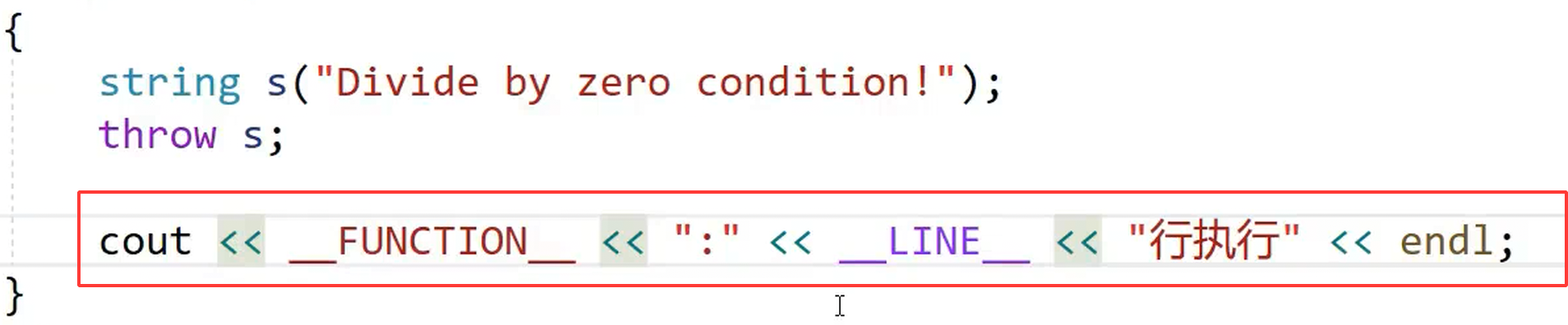
AI Visual Insight: This image shows how control flow is transferred immediately after an exception is thrown, emphasizing that statements after throw are unreachable. Its technical value lies in clarifying the direct relationship between control-flow interruption and skipped cleanup logic.
Stack unwinding determines how exceptions propagate across functions
When the current scope has no matching catch, the program does not pause in place. Instead, it walks outward through the call stack and searches for a handler function by function. This process is called stack unwinding.
During stack unwinding, already-constructed stack objects are destroyed in reverse order, so stack-based resources are usually safe. However, unmanaged resources such as raw pointers, file handles, and locks can still leak if they are not properly wrapped.
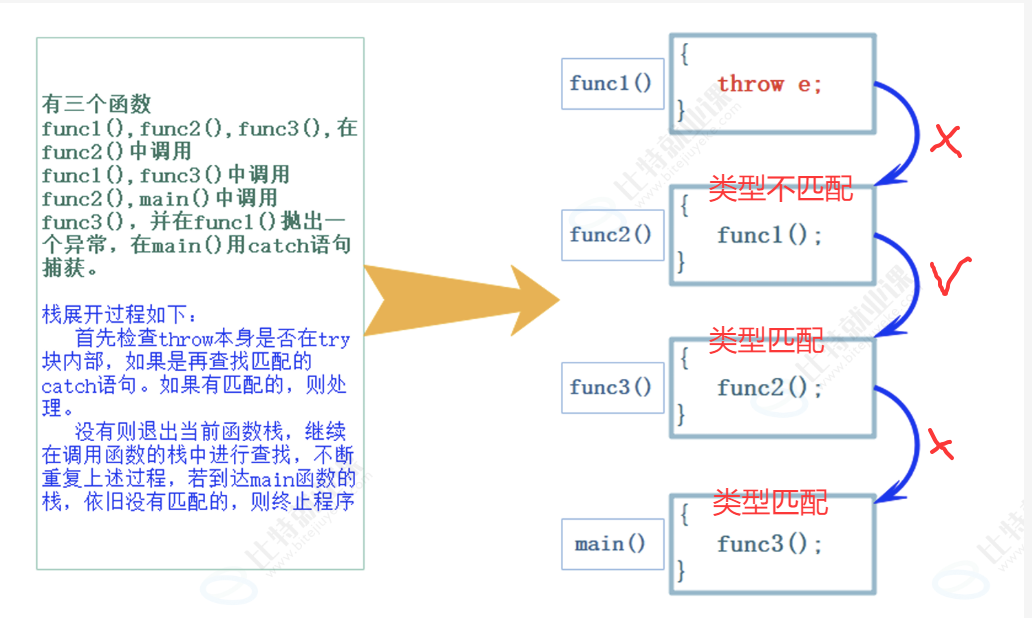
AI Visual Insight: The diagram illustrates how an exception travels outward through the call chain, highlighting two critical mechanisms: searching for a matching catch one frame at a time, and destroying local objects in reverse order. It is a key supporting visual for understanding why RAII works.
Uncaught exceptions eventually trigger terminate
int main() {
    try {
        // Application entry point
    } catch (...) {
        // Fallback catch to prevent exceptions from escaping runtime boundaries
    }
    return 0;
}
In server-side, desktop, or embedded applications, placing a fallback catch(...) at the main entry point is a basic defensive measure that can prevent unhandled exceptions from terminating the process directly.
An inheritance-based exception hierarchy is easier to maintain in large projects
In engineering practice, one of the worst patterns is scattering throw int and throw char* throughout the codebase. A better approach is to define a unified base exception type, then let database, cache, network, and other modules derive their own exception classes from it. The base class can then support consistent catching and logging.
This design preserves module-specific details while keeping upper-layer interfaces stable, which is a critical constraint for exception governance in multi-team environments.
A custom exception hierarchy can unify error models across modules
#include
<iostream>
#include
<string>
using namespace std;

class Exception {
public:
    Exception(const string& msg, int id) : _msg(msg), _id(id) {}
    virtual string what() const { return _msg; } // Return the error message
    int id() const { return _id; }
    virtual ~Exception() = default;
protected:
    string _msg;
    int _id;
};

class HttpException : public Exception {
public:
    HttpException(const string& msg, int id, const string& method)
        : Exception(msg, id), _method(method) {}
    string what() const override {
        return "HttpException:" + _method + ":" + _msg; // Build module-specific context
    }
private:
    string _method;
};
The value of this code is straightforward: upper layers only need to catch const Exception& to remain compatible with exception objects from different subsystems.
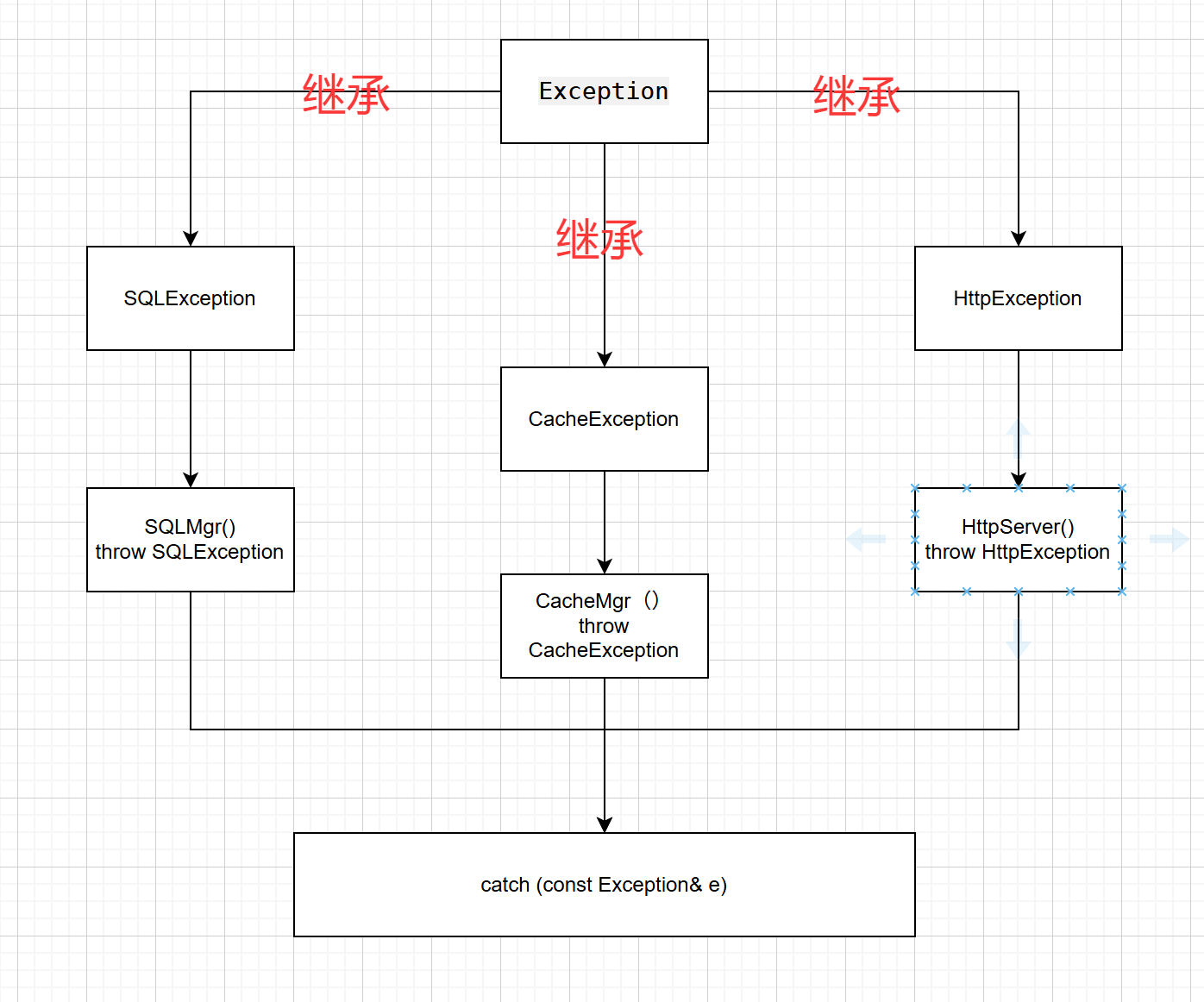
AI Visual Insight: The image shows multiple business-module exceptions converging into a unified base class. It highlights the architectural principle that derived classes express detail while the base class enables consistent handling. This model works well for servers, middleware, and foundational libraries.
Exception rethrowing is useful for retries, degradation, and layered handling
Catching an exception does not mean you must swallow it locally. If the current layer can identify the error category but cannot fully resolve it, it should add logs, release resources, or perform a retry locally, and then rethrow the same exception with throw;.
A typical example is a network send failure. Temporary network jitter may be retryable, while permission errors are not. In this case, the current layer should classify by error code and allow only transient failures to enter retry logic.
Resource cleanup should rely on RAII before handwritten catch logic
#include
<memory>
#include
<stdexcept>
using namespace std;

double SafeDivide(int a, int b) {
    unique_ptr<int[]> buf(new int[10]); // Manage dynamic resources with RAII
    if (b == 0) {
        throw runtime_error("Division by zero"); // Resources are released automatically when an exception is thrown
    }
    return static_cast
<double>(a) / b;
}
This code shows why RAII is the primary strategy for exception safety: when an object leaves scope, its destructor runs automatically, so you do not need to manually release resources at every exception exit point.
noexcept is the exception contract mechanism in modern C++
Since C++11, exception specifications have primarily relied on noexcept. Declaring a function as noexcept means it promises not to throw exceptions. The standard library depends heavily on this property for optimizations, especially in move constructors and container operations.
However, noexcept is better understood as a contract than a static firewall. If a noexcept function actually throws, the program will usually call terminate immediately, which is often more severe than ordinary exception propagation.
noexcept is appropriate for destructors, move operations, and low-level foundational interfaces
class Buffer {
public:
    ~Buffer() noexcept {
        // Destructors should not allow exceptions to escape
    }

    Buffer(Buffer&& other) noexcept {
        // Declaring move construction noexcept helps containers optimize relocation
    }
};
This code captures the typical boundaries for noexcept: destructors and move operations must remain stable and predictable so exceptions do not break container behavior or object lifetime semantics.
The standard library exception system provides general but incomplete infrastructure
The C++ standard library uses std::exception as the root and provides common exception types such as runtime_error and bad_alloc. General-purpose applications can use them directly, but enterprise systems often still need a custom business exception tree.
A recommended strategy is to let your internal exception hierarchy inherit from std::exception, expose a consistent what() interface externally, and retain engineering fields such as error codes, trace IDs, and request context.
FAQ
1. Why is RAII, rather than try/catch, the real core of exception safety?
Because try/catch can only repair some execution paths, while RAII covers every scope-exit path, including normal returns, thrown exceptions, and early exits. That makes it far more reliable.
2. Should catch(...) be used extensively?
No. Do not overuse it. It is appropriate as a last line of defense at application entry points, thread boundaries, and framework boundaries, but business logic should prefer catching explicit types so error semantics are not lost.
3. When is a custom exception hierarchy required?
When a project contains multiple modules, involves collaboration across multiple engineers or teams, and requires unified logging and error codes, you should establish an inheritance-based exception hierarchy. Otherwise, error handling becomes fragmented and difficult to troubleshoot or maintain.
Core Summary: This article systematically reconstructs the core mechanisms of C++ exception handling, covering exception throwing and catching, stack unwinding, rethrowing, inheritance-based exception hierarchies, exception safety, and noexcept conventions. It also uses engineering-focused examples to show how to build more robust industrial-grade systems.