[AI Readability Summary] The React ecosystem has evolved from a single UI library into a platform spanning web, mobile, component engineering, and AI applications. This article distills six trending GitHub projects and explains how they address long-standing challenges in performance, cross-platform development, collaboration, and developer productivity. Keywords: React ecosystem, Next.js, frontend engineering.
The technical snapshot highlights the ecosystem at a glance
| Project / Dimension | Language | License | Stars | Core Dependencies |
|---|---|---|---|---|
| facebook/react | JavaScript / TypeScript | MIT | 238k+ | React Compiler, Fiber, Server Components |
| facebook/react-native | JavaScript / TypeScript / C++ | MIT | 112k+ | JSI, TurboModules, Fabric |
| freeCodeCamp/freeCodeCamp | TypeScript / JavaScript | BSD-3-Clause | 442k+ | React, Node.js, MongoDB, Express |
| facebook/create-react-app | JavaScript | MIT | 104k+ | Webpack, Babel, Jest, ESLint |
| storybookjs/storybook | TypeScript | MIT | 89k+ | CSF, Vite/Webpack, Testing Library |
| ChatGPTNextWeb/NextChat | TypeScript | MIT | 87.7k+ | Next.js, Tailwind CSS, Zustand |
The React ecosystem has completed its platform upgrade
By 2026, React is no longer just a view library. It has become the core interface of a complete application development platform. Upward, it connects to Next.js, Storybook, and AI applications. Downward, it spans rendering orchestration, Server Components, and cross-platform runtimes.
This mature evolution addresses long-standing frontend pain points: poor first-load performance, difficult component reuse, high cross-platform maintenance costs, and the challenge of integrating AI capabilities into real engineering workflows. The projects trending on GitHub together form a representative sample of this evolutionary path.
A typical React technology stack now looks like this
# Initialize a modern React application
pnpm create next-app@latest my-app
cd my-app
pnpm add tailwindcss zustand
pnpm dlx storybook@latest init
This command sequence shows the shortest path to a modern React setup built on Next.js, Tailwind CSS, and Storybook.
The React core library defines the ceiling of the rendering and component model
facebook/react is the foundation of the entire ecosystem. The most important changes in React 19 are not about adding more syntax. They are about making Server Components, compiler optimization, and concurrent scheduling increasingly default capabilities.
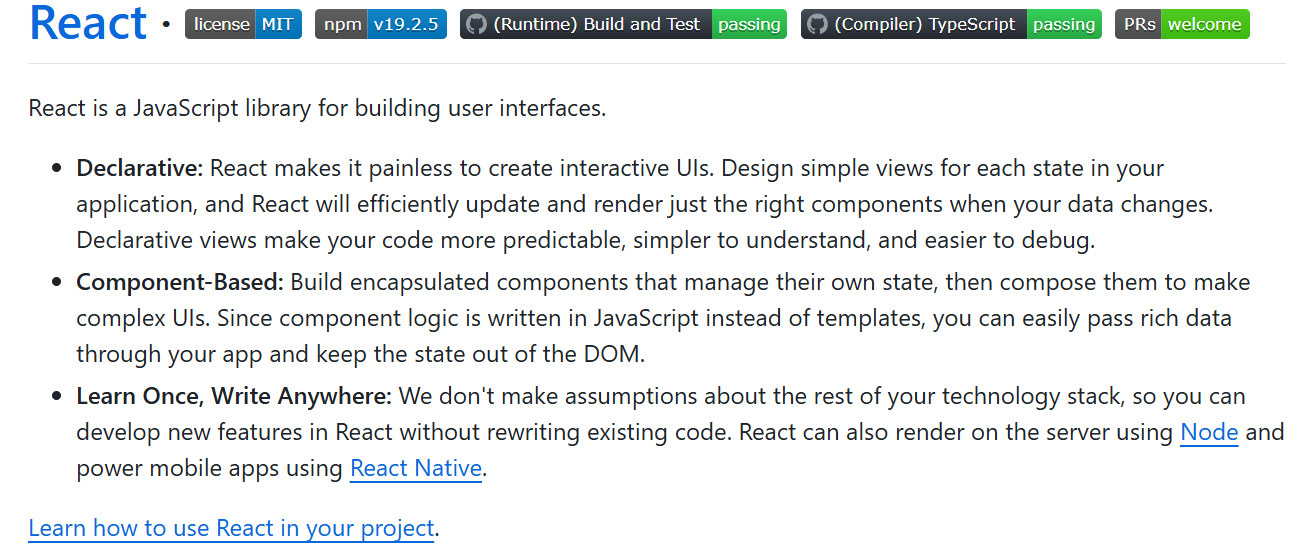 AI Visual Insight: This image shows the React repository interface and core brand identity, emphasizing its role as the root node of the ecosystem. Screenshots like this typically highlight the repository name, star count, code entry points, and social signals, reflecting community scale, maintenance activity, and the density of onboarding information.
Fiber enables React to handle interruption, resumption, and priority scheduling with finer granularity. Server Components move part of the rendering work back to the server, reducing the client-side JavaScript burden and significantly improving first-load speed and time-to-interactive.
The React component model is better suited to declarative complex interfaces
export default async function Page() {
  const data = await fetch("https://api.example.com/posts").then(r => r.json()) // Fetch data directly on the server
  return <PostList posts={data} /> // Pass the result into the component
}
This example shows how Server Components combine data fetching and UI output on the server.
React Native extends the same component mindset to mobile
facebook/react-native matters not only because it is cross-platform, but because it uses a unified component abstraction to reduce the cost of maintaining both iOS and Android apps.
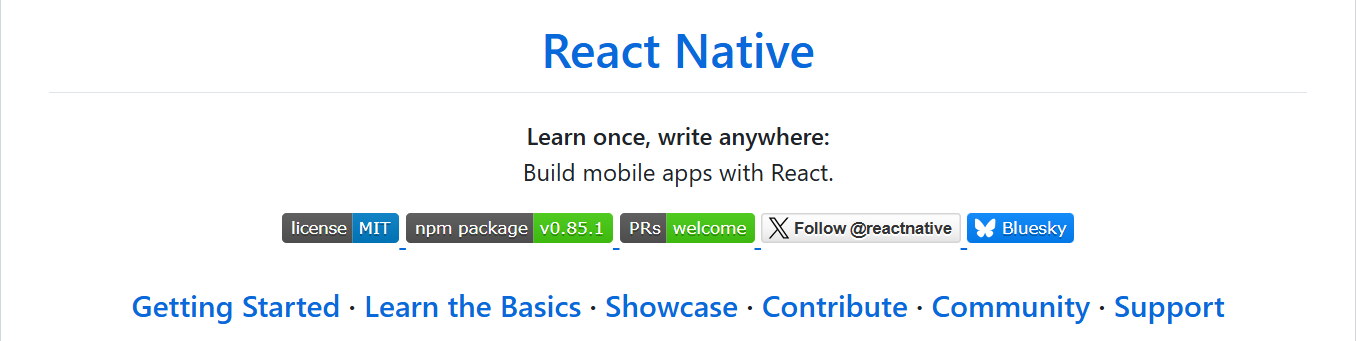 AI Visual Insight: This image shows the React Native repository or a related technical interface, typically including project identity, version information, and module entry points. Its visual emphasis usually centers on cross-platform mobile capabilities, suggesting the coordination between the JavaScript layer, the native bridge layer, and the rendering layer.
TurboModules and Fabric are the key drivers of performance gains in the new architecture. The former reduces communication overhead between JavaScript and native code. The latter provides a more modern rendering mechanism, making frequent scrolling, animation, and complex gesture scenarios more stable.
The React Native invocation path has become much more streamlined
import { Text, View } from "react-native"

export default function App() {
  return (

<View>

<Text>{"Hello React Native"}</Text> {/* Unified component semantics mapped to native controls */}
    </View>
  )
}
This snippet reflects the stable mapping between the React semantic layer and the native rendering layer.
Education platforms and scaffolding tools have amplified React adoption
freeCodeCamp represents React at scale in education platforms, while create-react-app represents React’s standardized contribution to learning and prototype development.
 AI Visual Insight: This image corresponds to the freeCodeCamp project and typically highlights the course platform repository, contribution entry points, and project overview. It conveys a product structure that tightly couples educational content, an interactive practice system, and an open-source collaboration model.
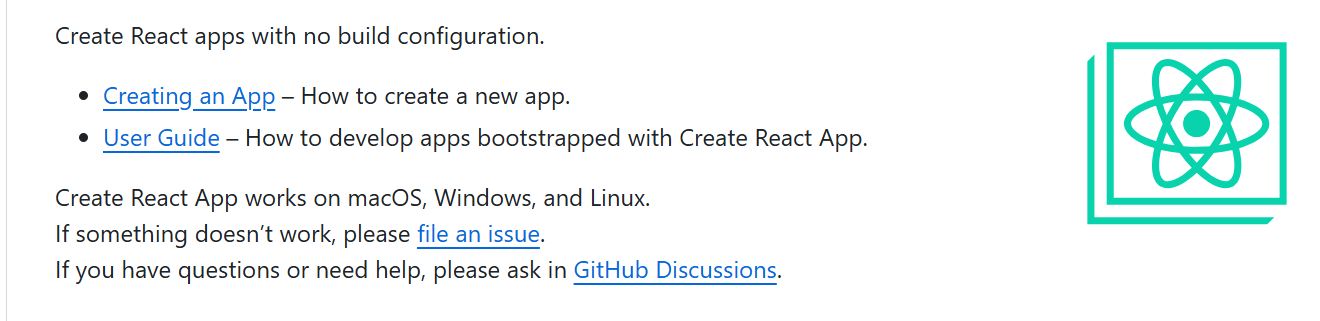 AI Visual Insight: This image corresponds to the Create React App repository or introduction page. Technically, it emphasizes its position as a zero-configuration scaffolding tool. The visual structure usually centers on quick startup, the default toolchain, and developer experience, reflecting its low-barrier value in education and prototyping scenarios.
freeCodeCamp uses React to build interactive learning flows, proving that componentization works not only for business systems but also for large-scale education products. Although CRA no longer represents the most advanced path, it remains a classic example for understanding how Webpack-based engineering abstraction works.
Component engineering has become infrastructure for large teams
storybookjs/storybook matters because it allows teams to develop, test, and document components outside business context, turning them into reusable design system assets.
 AI Visual Insight: This image corresponds to the Storybook project page. Common elements include a list of component examples, a documentation panel, and testing plugin entry points. It reveals engineering capabilities such as isolated component rendering, state enumeration, and automated documentation generation.
Storybook does not primarily solve the question of how to write a component. It solves how to make components verifiable, communicable, and evolvable in multi-person collaboration. That is especially critical for design systems, enterprise platforms, and internal-facing products.
Storybook configuration can quickly establish a component asset hub
import type { Meta, StoryObj } from "@storybook/react"
import { Button } from "./Button"

const meta: Meta<typeof Button> = {
  title: "Design/Button",
  component: Button,
}

export default meta
export const Primary: StoryObj<typeof Button> = {
  args: { children: "提交" }, // Drive component states with args
}
This example shows how Storybook uses stories to unify component display, testing, and documentation.
NextChat shows how React integrates with AI applications
ChatGPTNextWeb/NextChat represents the stage where the React ecosystem has entered AI-native applications. It is not just a chat interface. It is also a modern frontend architecture blueprint that integrates model access, streaming responses, internationalization, and PWA capabilities.
 AI Visual Insight: This image corresponds to the NextChat repository or product interface and often includes the conversation UI, a side configuration panel, or repository information. Technically, it reflects the integrated state of multi-model access, streaming message rendering, responsive layout, and product-grade interaction design.
It shows that the React ecosystem has expanded its boundary into the AI product layer. The frontend no longer handles only presentation. It also takes responsibility for state orchestration, model switching, token-stream rendering, and user workflow continuity.
The core of AI chat applications is streaming state management
import { create } from "zustand"

export const useChatStore = create(set => ({
  messages: [],
  append: (msg) => set(state => ({ messages: [...state.messages, msg] })), // Append the message stream
}))
This code shows how an AI chat interface can use a lightweight state library to manage a continuously growing message stream.
The mainstream conclusions for the React ecosystem are now clear
For new projects, Next.js + TypeScript + Tailwind CSS is the highest-probability choice. For cross-platform scenarios, React Native remains the most reliable engineering option. For component teams, Storybook is the organizational tool for accumulating reusable assets.
React itself continues to play the role of a unified component mental model. Whether in web, mobile, education platforms, or AI applications, developers are reusing the same declarative mindset and engineering methodology.
FAQ answers the most common architecture questions
1. What is the most important capability to watch in React 19?
Answer: Server Components, concurrent scheduling, and more mature server-rendering coordination. These directly improve first-load performance, data-fetching paths, and component boundary design.
2. Should you still use Create React App today?
Answer: It is still acceptable for teaching, demos, and lightweight prototypes, but production projects should prefer Next.js or Vite. The reason is that both offer more advanced build speed, server capabilities, and modern routing systems.
3. Why is the React ecosystem especially well suited to AI application frontends?
Answer: Because it handles complex state, streaming UI, component reuse, and cross-platform consistency particularly well. Projects like NextChat have already shown that React is highly suitable for the model interaction layer.
Core Summary: Based on trending GitHub projects, this article systematically breaks down the React ecosystem’s maturity path in 2026, covering React, React Native, freeCodeCamp, CRA, Storybook, and NextChat, with a focus on Server Components, cross-platform development, engineering workflows, and AI integration trends.