A production-focused guide to long-running AI agent reliability, covering checkpoint recovery, intelligent retries, idempotency controls, context compression, budget governance, and safety guardrails. It addresses three common failure modes: fragile demos, broken long execution chains, and uncontrolled side effects. Keywords: AI Agent, LangGraph, Checkpointing.
The Technical Specification Snapshot
| Parameter | Details |
|---|---|
| Core Topic | Reliable operation for long-running AI agents |
| Primary Language | Python |
| Typical Protocols | HTTP, PostgreSQL connections, asynchronous task invocation |
| Reference Frameworks | LangGraph, Temporal |
| Core Dependencies | tenacity, pybreaker, langsmith, guardrails |
| Applicable Scenarios | PR review, automated operations, workflow orchestration, HITL approvals |
| Stars | Not provided in the source |
Long-Running AI Agents Are Inherently Unstable in Production
A demo that works does not mean the system is production-ready. Long-running agents often span multiple reasoning rounds, repeated tool calls, and external approvals. As the execution chain grows longer, the probability of failure rises quickly.
A typical example is a code review agent: it fetches a PR, analyzes changes, runs tests, checks for vulnerabilities, generates a report, and sends notifications. If any step times out, runs twice, or loses state, the entire task can fail.
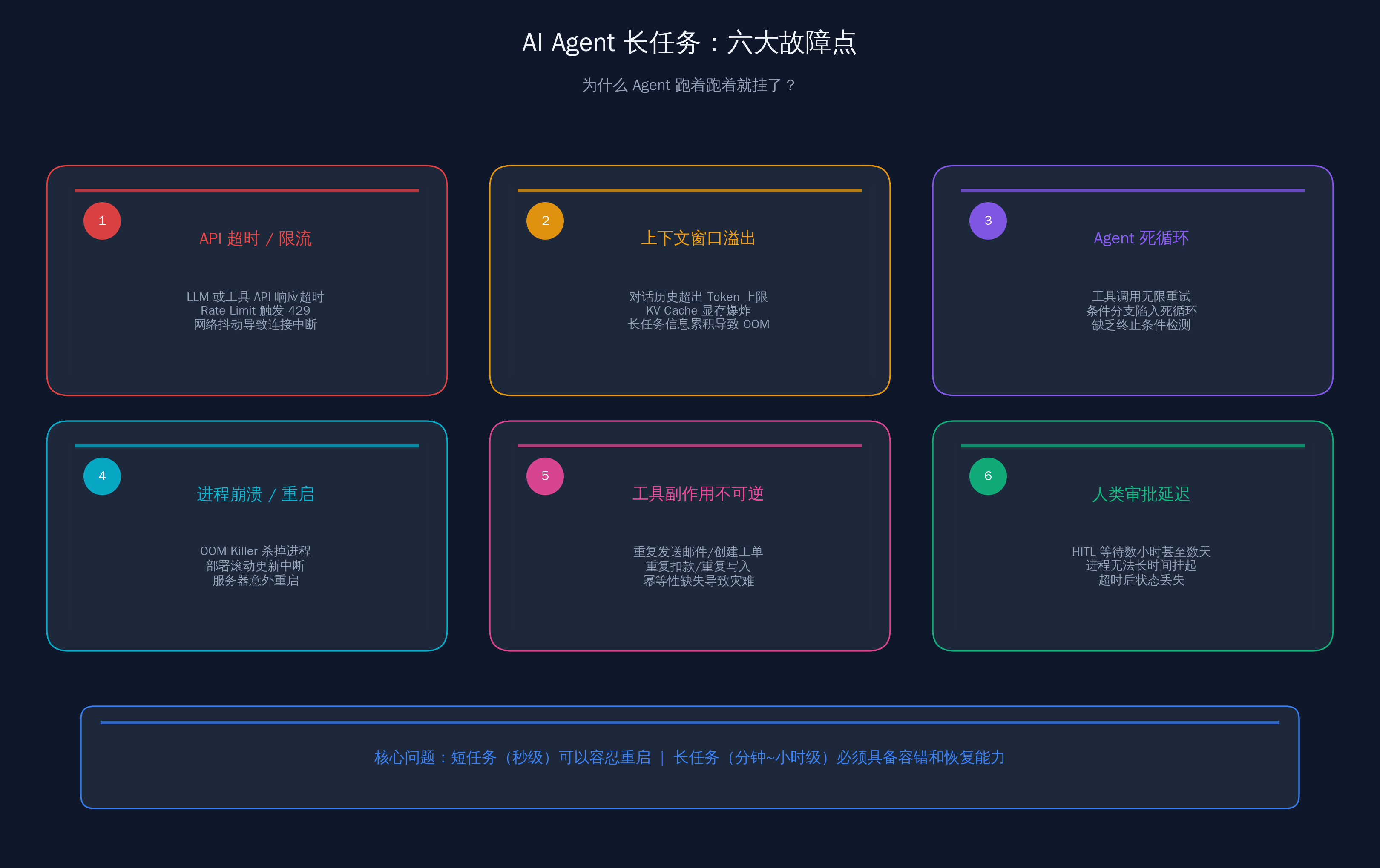 AI Visual Insight: This image highlights the many failure entry points in a long-running agent execution chain, typically including external APIs, accumulated context, process lifecycle events, and waits for human approval. It shows that reliability issues are not isolated point failures, but systemic risks across the entire workflow.
Six Common Failure Classes Determine Success or Failure
API timeouts and rate limits are the most common problems. If a single task needs 20 tool calls, even a 5% failure rate per call can significantly reduce end-to-end success. Without retries, long-running tasks are nearly impossible to operate reliably.
Context window overflow is more subtle. As message history, tool outputs, and retrieved documents continue to accumulate, the model may forget important facts, make poor judgments, or fail outright around the context limit.
Process crashes, infinite loops, repeated tool side effects, and delayed human approvals expose separate gaps in recovery, termination controls, idempotent design, and suspension handling.
Production-Grade Agents Must Use Persistent State
The core value of checkpointing is not just data backup. It is preserving execution position. If every step persists its state, the task can resume from the latest point instead of restarting from scratch.
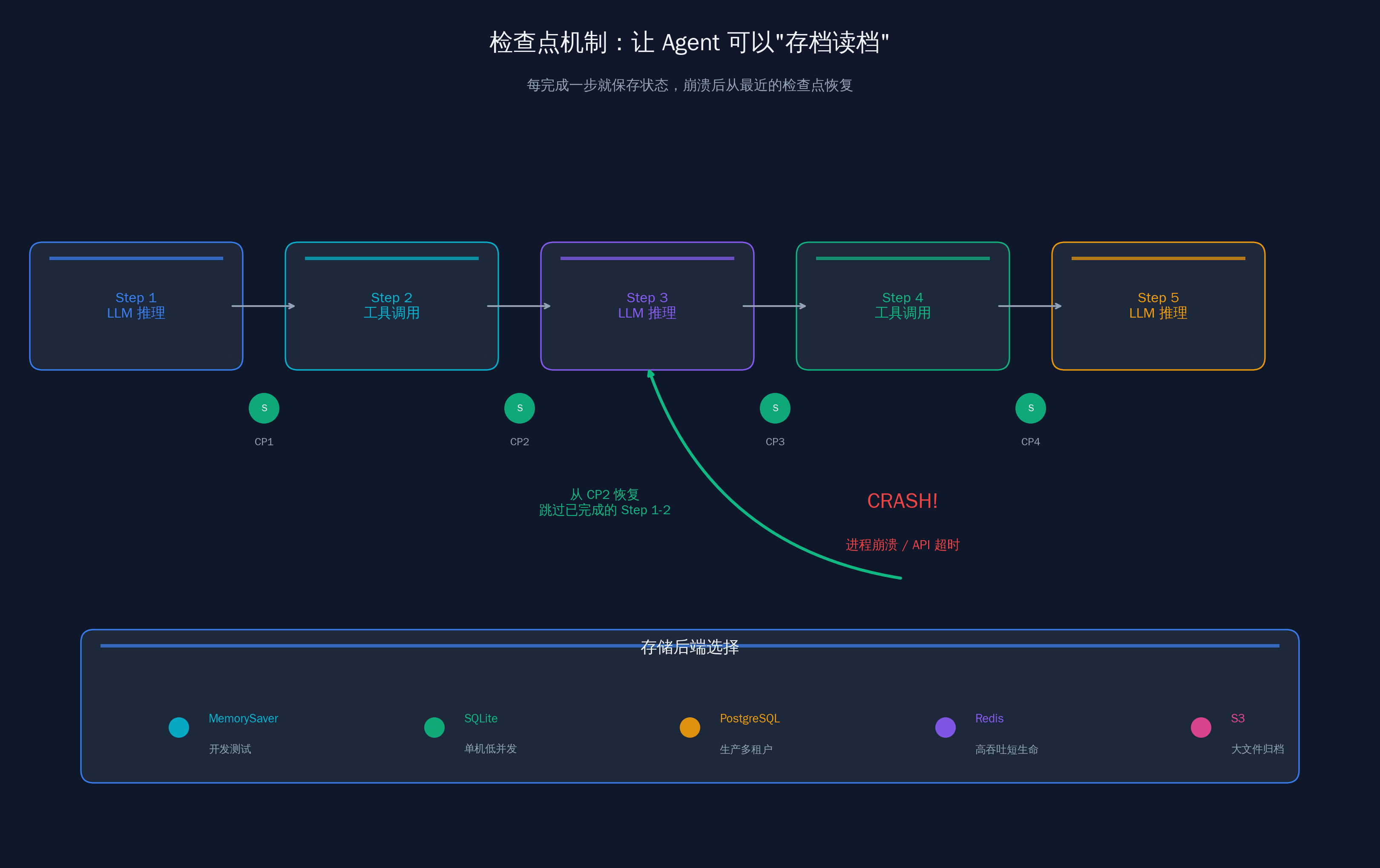 AI Visual Insight: This image emphasizes the three-stage flow of task execution, state persistence, and crash recovery. It shows that checkpointing must preserve not only messages, but also step position, configuration, and intermediate artifacts to enable true resumable execution.
LangGraph Works Well for Quickly Building Recoverable Workflows
from langgraph.checkpoint.postgres import PostgresSaver
from langgraph.checkpoint.memory import MemorySaver

# Use in-memory storage first in development
checkpointer = MemorySaver()

# Switch to PostgreSQL persistence in production
checkpointer = PostgresSaver.from_conn_string(
    "postgresql://user:pass@localhost:5432/agent_db"
)

# Compile the workflow and inject checkpointing
graph = workflow.compile(checkpointer=checkpointer)
config = {"configurable": {"thread_id": "task-001"}}  # Unique ID for each task

# Progress is saved automatically during the first execution
result = graph.invoke({"messages": [("user", "Review this PR")]}, config)

# Pass None after a crash to resume from the latest checkpoint
result = graph.invoke(None, config)
This code automatically saves and restores agent execution state, which is a foundational capability for long-running fault tolerance.
Temporal is a better fit for more complex orchestration. It uses event sourcing to preserve execution history and natively supports activity retries, timeouts, and cross-language workflows.
Intelligent Retries Must Distinguish Transient Errors from Permanent Errors
Retries are not just about trying again a few more times. Errors such as 401, 400, and 404 are usually not recoverable. By contrast, 429, 500, gateway timeouts, and short-lived network glitches are appropriate retry candidates.
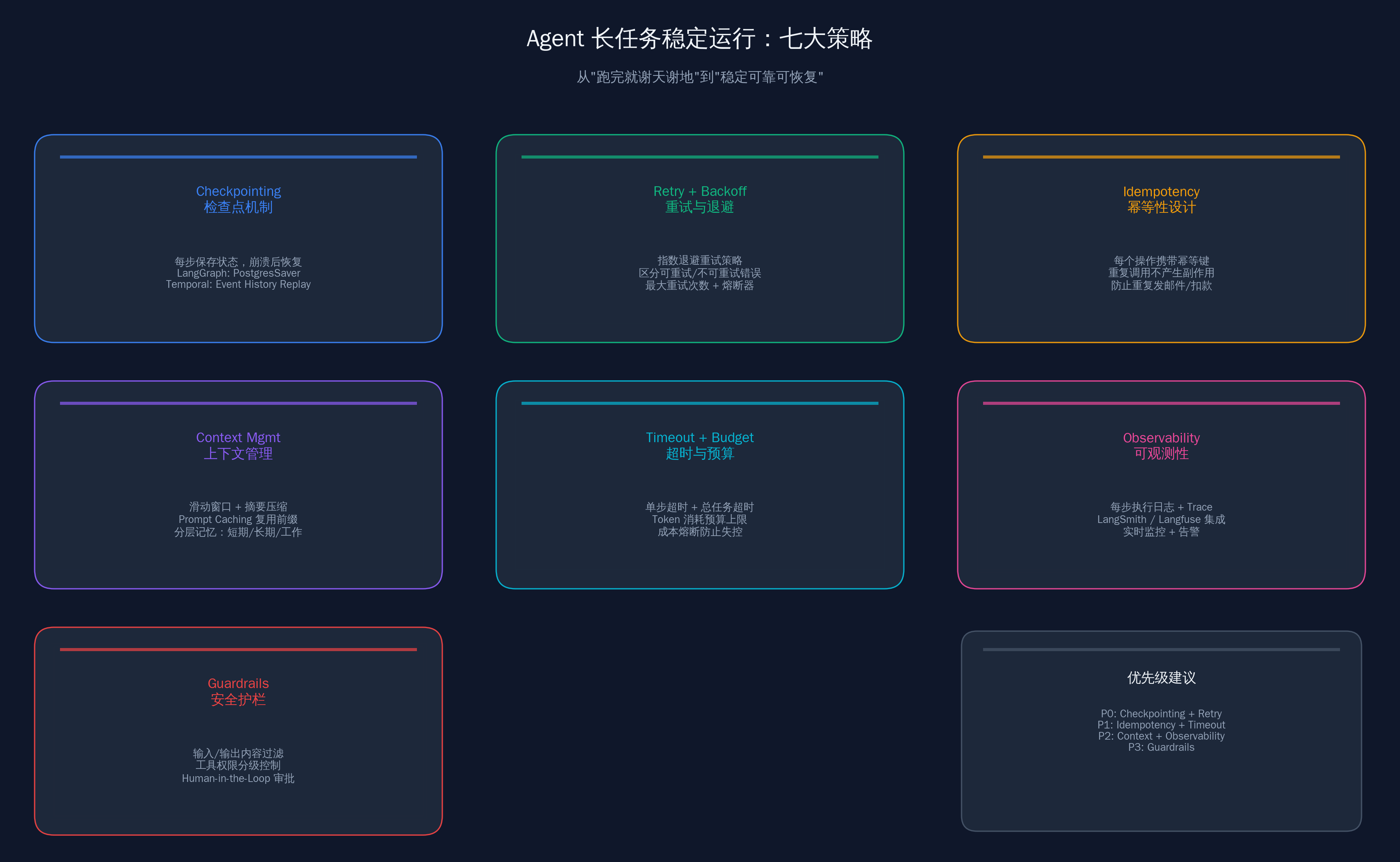 AI Visual Insight: This image compares fixed intervals, linear backoff, exponential backoff, and jitter-based strategies. It emphasizes that exponential backoff with random jitter helps reduce retry storms and hotspot pressure, making it well suited for high-concurrency agent call chains.
Exponential Backoff with Jitter Is the Recommended Default
from tenacity import retry, stop_after_attempt
from tenacity import wait_exponential_jitter, retry_if_exception_type

class TransientError(Exception):
    pass

@retry(
    stop=stop_after_attempt(3),
    wait=wait_exponential_jitter(initial=1, max=30, jitter=3),
    retry=retry_if_exception_type(TransientError),
)
async def call_tool(tool_name: str, params: dict):
    try:
        return await tool_executor.execute(tool_name, params)
    except RateLimitError:
        raise TransientError("Rate limit triggered; retryable")  # Recoverable error
    except TimeoutError:
        raise TransientError("Call timed out; retryable")  # Transient failure
This code moves the retry decision up to the exception classification layer, preventing useless errors from being amplified through repeated retries.
If a downstream service keeps failing, you should also add a circuit breaker. That allows the system to fail fast during sustained incidents instead of exhausting threads, tokens, and API quotas.
Idempotency Is the Core Defense Against Side-Effect Disasters
After checkpoint-based recovery, a step may run again. If that step sends email, charges money, writes to a database, or deploys a service, duplicate execution can directly cause production incidents.
 AI Visual Insight: This image shows the control pattern where the same request may arrive multiple times but only takes effect once. In practice, this usually combines idempotency keys, deduplication storage, locks, and result caching, and it applies to any agent tool call with external side effects.
Idempotency Keys Should Bind the Task, Step, and Parameter Hash
import hashlib
import json

def generate_idempotency_key(task_id: str, step_name: str, params: dict) -> str:
    payload = f"{task_id}:{step_name}:{json.dumps(params, sort_keys=True)}"
    return hashlib.sha256(payload.encode()).hexdigest()[:16]  # Generate a short idempotency key
This code generates a stable idempotency key so the server can recognize and deduplicate repeated submissions for the same task step.
In practice, combine this with unique constraints, distributed locks, and result caching to build a closed-loop pattern of deduplicate, lock, execute, and cache.
Context Management Determines Whether an Agent Forgets Midway
The core tension in long-running tasks is simple: the agent needs to remember more information, but the context window is always limited. If you keep feeding the model every historical message, tool result, and RAG document, overflow becomes inevitable.
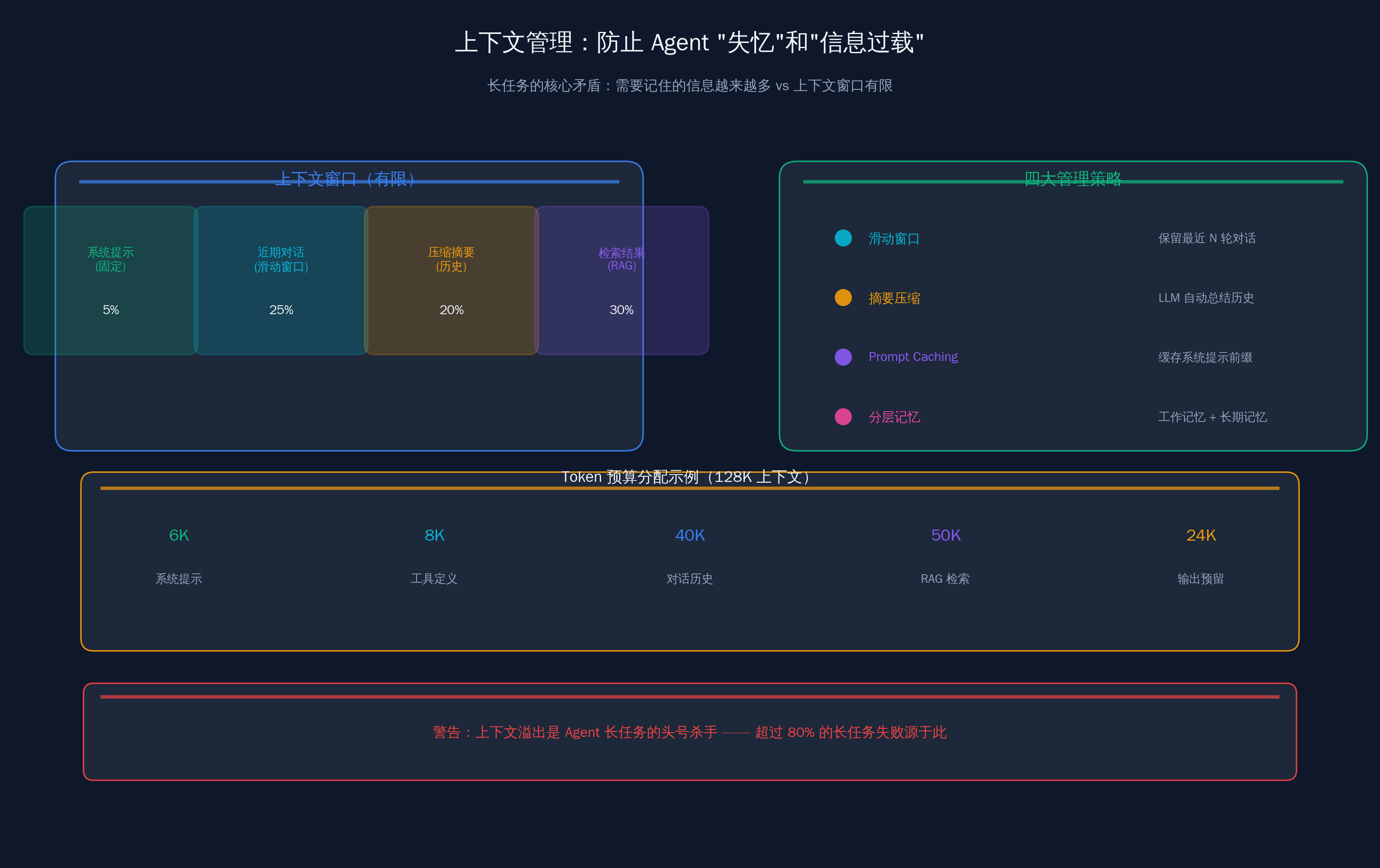 AI Visual Insight: This image illustrates a layered model of working memory, compressed summaries, and external memory. It shows that effective context is not the same as preserving the full original text. You need to filter, summarize, and retrieve high-value information before reassembling it for the model.
Four Practical Context Governance Strategies Work Well
First, use a sliding window to retain only recent conversation. Second, compress older history through summarization. Third, use prompt caching for system prompts and tool definitions. Fourth, separate working memory, short-term memory, and long-term memory into different storage layers.
def sliding_window(messages: list, max_turns: int = 10) -> list:
    system_msgs = [m for m in messages if m["role"] == "system"]
    conv_msgs = [m for m in messages if m["role"] != "system"]
    recent = conv_msgs[-max_turns * 2:]  # Keep only the most recent turns
    return system_msgs + recent
This code trims historical messages with a sliding window and prioritizes the context closest to the current decision.
Timeout and Budget Governance Are Required to Prevent Runaway Behavior
Production agents do not only fail. They can also run out of control. A single tool may hang, one step may retry forever, a full task may still be running after 40 minutes, or token usage may exceed budget.
A practical approach is to use three timeout layers: 30 to 60 seconds for each tool, 2 to 5 minutes for each step, and 30 to 60 minutes for each task. You should also implement token and dollar cost budgets and stop execution automatically when a threshold is exceeded.
import asyncio

async def run_with_timeout(coro, timeout_seconds: int, error_msg: str):
    try:
        return await asyncio.wait_for(coro, timeout=timeout_seconds)
    except asyncio.TimeoutError:
        raise RuntimeError(f"{error_msg}, timed out after {timeout_seconds}s")  # Raise an explicit timeout exception
This code provides a unified timeout control entry point that can be reused at the tool, step, and task levels.
Observability Makes Every Decision Traceable
Without logs, traces, and metrics, you may know that a task failed, but not which step failed, how many tokens it consumed, or whether the system entered a retry storm.
At minimum, build observability at three layers: structured logs for inputs and outputs, traces for parent-child execution steps, and metrics for success rate, P99 latency, budget utilization, and idempotency hit rate.
With LangSmith, Langfuse, Prometheus, and Grafana, you can turn an agent from a black box into a diagnosable system.
Safety Guardrails Should Be the Final Runtime Defense
Input and output filtering can reduce prompt injection and harmful generation. Tool-tiering can prevent the model from directly triggering high-risk actions. For operations such as deleting data, executing SQL, sending email, or deploying services, it is best to require Human-in-the-Loop approval by default.
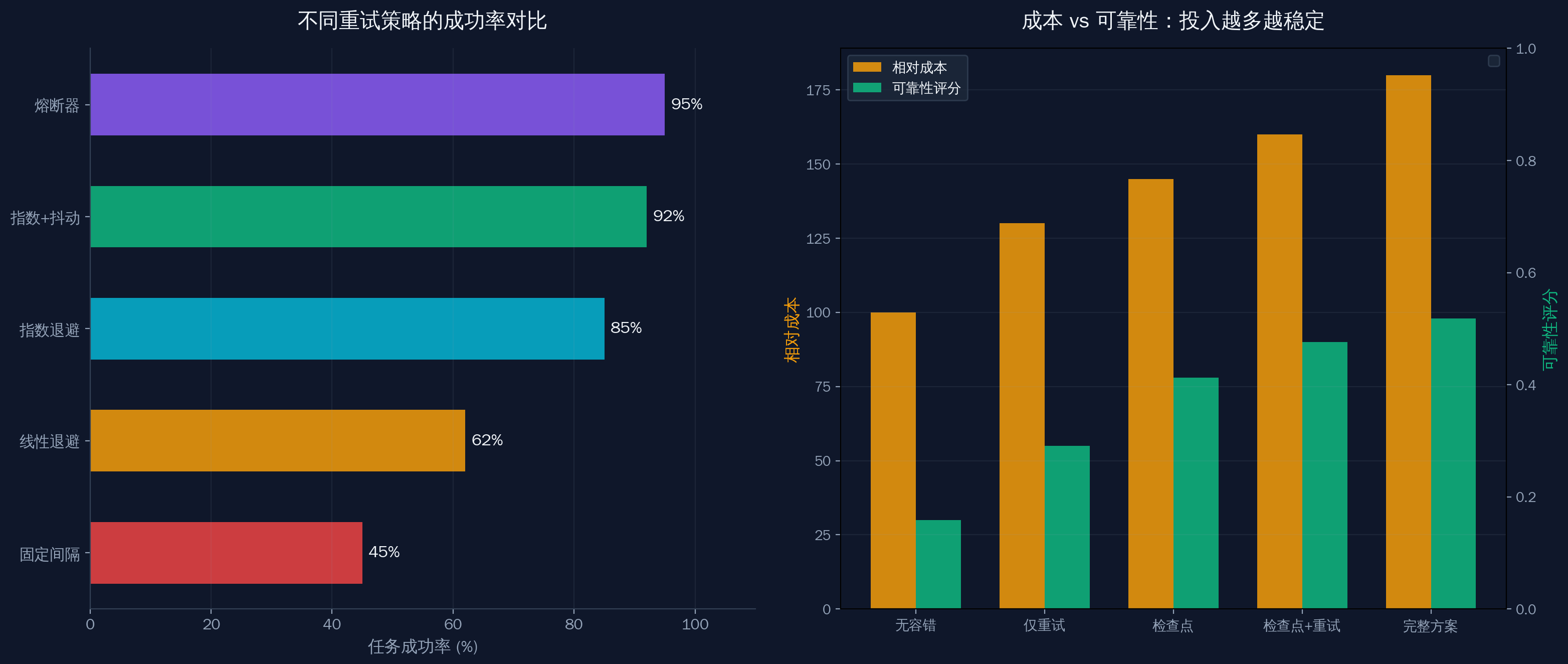
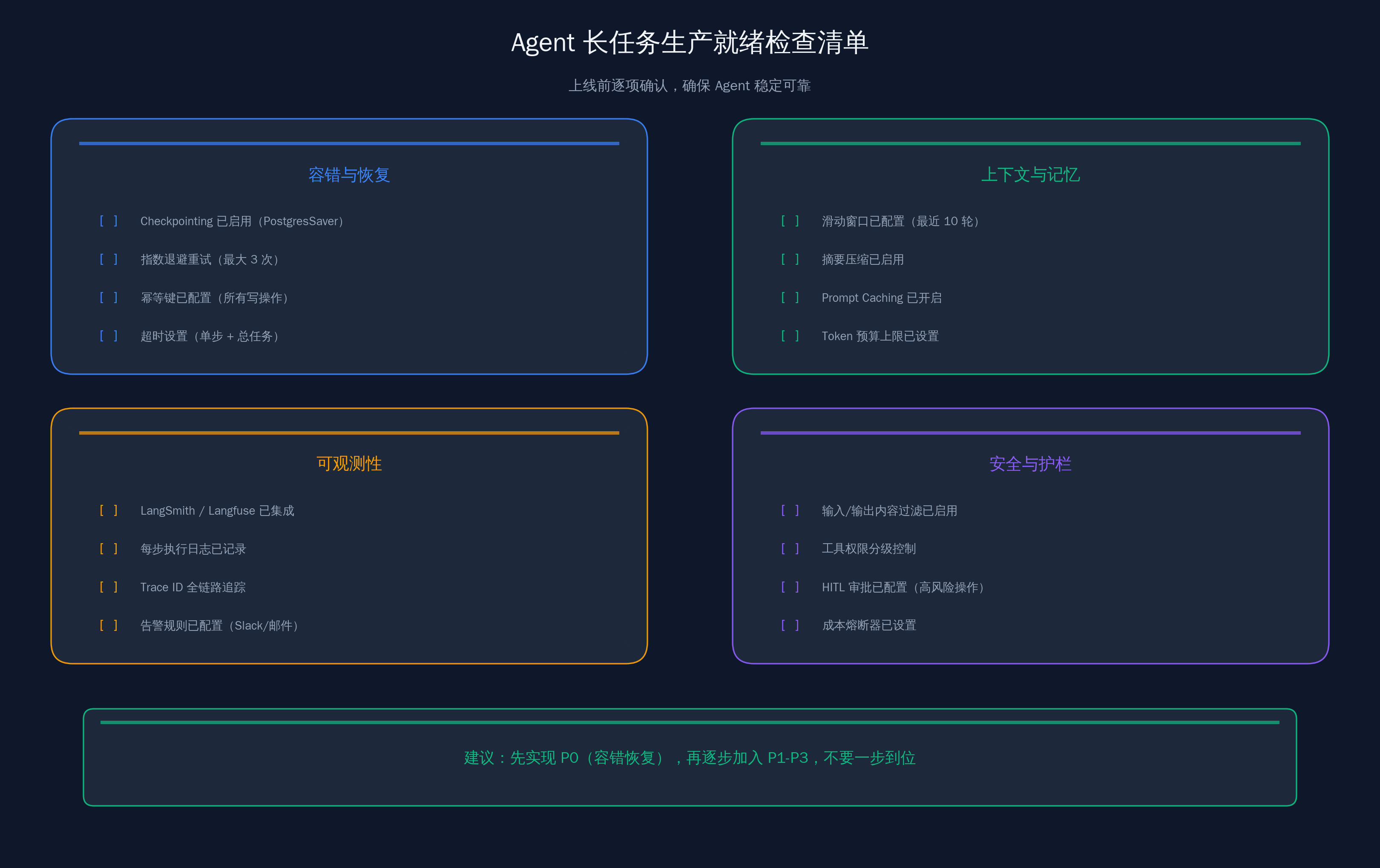 AI Visual Insight: This image functions like a pre-launch readiness checklist. It emphasizes that reliability work has a clear priority order, usually starting with P0 controls such as recovery, retries, and idempotency, then expanding to budgets, observability, and security governance.
Production Rollout Priorities Should Be Clear
P0: checkpointing, exponential backoff retries, idempotency keys.
P1: timeout policies, token budgets, context compression.
P2: observability, alerting, and structured logging.
P3: guardrails, HITL approvals, cost circuit breakers, and A/B testing.
FAQ
FAQ 1: Why does the demo seem stable while production fails frequently?
Because demos usually have short execution paths, smaller datasets, no external side effects, and no real traffic or long-duration runtime pressure. Production environments expose rate limiting, context overflow, retry storms, process restarts, and delays from human approvals all at once.
FAQ 2: How should I choose between LangGraph and Temporal?
If you are primarily building LLM-native workflows and want state graphs, checkpointing, and HITL capabilities quickly, choose LangGraph first. If you care more about strongly consistent orchestration, event sourcing, and enterprise-grade durable execution, Temporal is the better fit.
FAQ 3: What is the minimum viable production stability setup for an AI agent?
At minimum, include three things: persistent checkpointing, classified exponential backoff retries, and idempotency keys for all side-effecting operations. Without these three controls, long-running tasks are difficult to keep stable in production and even harder to recover safely.
Core Summary
This article presents a systematic reliability architecture for long-running AI agents in production. It covers checkpointing, retry backoff, idempotency, context management, timeout and budget controls, observability, and safety guardrails to help developers upgrade demo-grade agents into production systems that are recoverable, monitorable, and auditable.