Tomcat uses Lifecycle to uniformly manage component initialization, startup, shutdown, and destruction, and uses JMX/MBeans to expose runtime management capabilities. Together, they solve three classes of problems: uncontrolled container state, scattered extension points, and complex monitoring integration. Keywords: Tomcat, Lifecycle, JMX.
The technical specification snapshot provides a quick overview
| Parameter | Content |
|---|---|
| Topic | Tomcat component management source code |
| Core language | Java |
| Key protocols/specifications | JMX, MBean, Lifecycle conventions |
| Focus components | Server, Service, Connector, Container |
| Star count | Not provided in the original article |
| Core dependencies | CopyOnWriteArrayList, MBeanServer, ObjectName, Registry |
Lifecycle is the unified control plane for Tomcat component coordination
Core Tomcat objects such as Server, Service, Engine, Host, Context, and Wrapper do not run independently. Tomcat brings them all under the Lifecycle system, which defines the standard behavioral boundary for a component from creation to destruction.
Its value goes far beyond simply exposing start() and stop() methods. Lifecycle consolidates state transitions, exception handling, event notification, and extension hooks into a single protocol. As the container hierarchy grows deeper, behavior becomes more predictable.
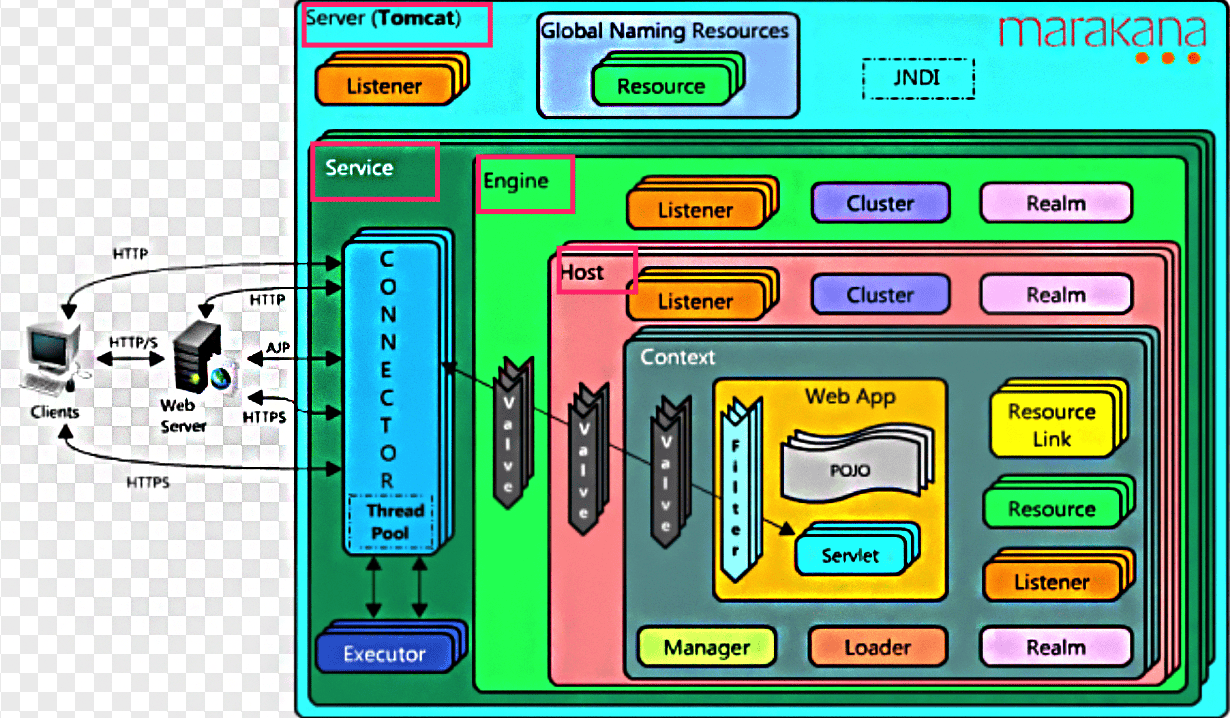 AI Visual Insight: This diagram shows the organizational relationship between Tomcat’s top-level Server and its downstream components. It highlights that lifecycle management is not a point solution, but a unified dispatch model propagated from the top-level container downward.
The Lifecycle interface defines three categories of capabilities
The first category is listener management, which registers, retrieves, and removes LifecycleListener instances. The second is flow control through init, start, stop, and destroy. The third is state inspection, which reads the current lifecycle state.
public interface Lifecycle {
    // Listener management
    void addLifecycleListener(LifecycleListener listener);
    LifecycleListener[] findLifecycleListeners();
    void removeLifecycleListener(LifecycleListener listener);

    // Lifecycle control
    void init() throws LifecycleException;
    void start() throws LifecycleException;
    void stop() throws LifecycleException;
    void destroy() throws LifecycleException;

    // State inspection
    LifecycleState getState();
    String getStateName();
}
This interface defines the minimum abstraction surface of Tomcat lifecycle management.
LifecycleState constrains legal transitions through a state machine
Tomcat does not treat lifecycle as a simple boolean. Instead, it defines states such as NEW, INITIALIZING, INITIALIZED, STARTING_PREP, STARTING, STARTED, STOPPING, STOPPED, DESTROYED, and FAILED.
This means component management follows a strongly state-constrained model. For example, an uninitialized component cannot start directly, and a startup failure moves the component into FAILED instead of leaving it in an ambiguous intermediate state.
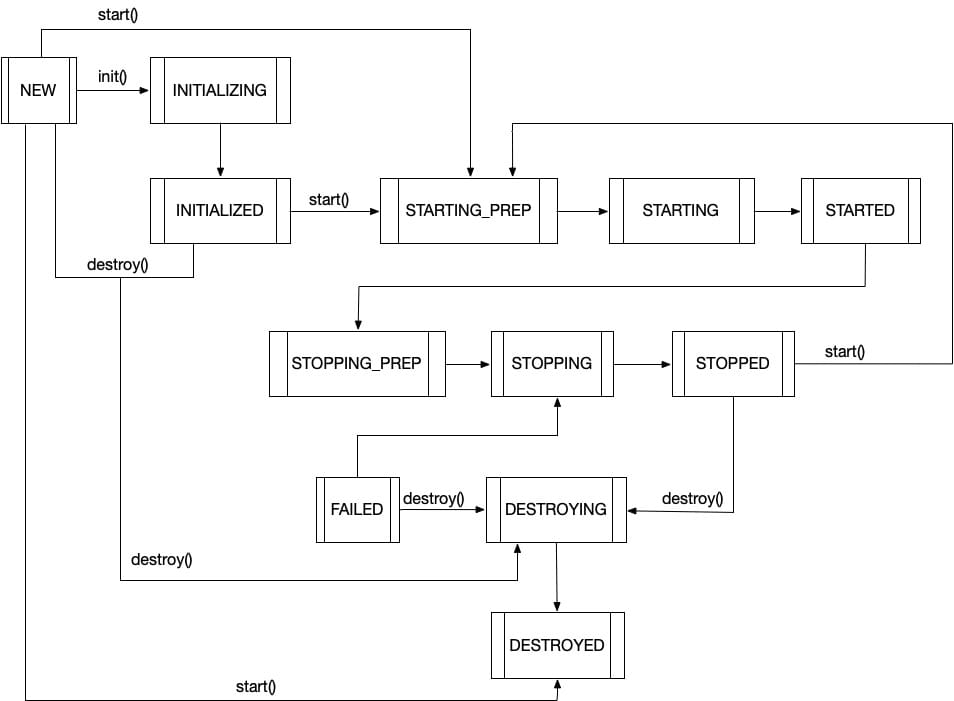 AI Visual Insight: This diagram presents the complete Lifecycle state transition graph, emphasizing the main path
 NEW → INITIALIZED → STARTED → STOPPED → DESTROYED and the exceptional FAILED branch. It is a key reference for understanding illegal transition validation.
LifecycleBase solidifies the main flow with the template method pattern
LifecycleBase is the foundational implementation of Lifecycle. It hardcodes the common logic in the parent class and pushes the variable behavior down into four abstract methods: initInternal, startInternal, stopInternal, and destroyInternal.
This is a classic template method pattern: the parent class defines the skeleton, and subclasses fill in the details. At the same time, the transitions themselves follow state machine constraints, so Tomcat combines the template method pattern with a state machine here.
public abstract class LifecycleBase implements Lifecycle {
    // Use volatile to guarantee state visibility
    private volatile LifecycleState state = LifecycleState.NEW;

    @Override
    public final synchronized void init() throws LifecycleException {
        // Only allow initialization from the NEW state
        if (!state.equals(LifecycleState.NEW)) {
            throw new LifecycleException("invalid init transition");
        }
        // Enter the initializing state
        state = LifecycleState.INITIALIZING;
        initInternal(); // Subclass implements the actual initialization logic
        // Initialization completed
        state = LifecycleState.INITIALIZED;
    }

    protected abstract void initInternal() throws LifecycleException;
}
This code reflects the core design principle: the parent class controls the process, and subclasses supply the implementation.
The listener mechanism makes state changes externally subscribable
Inside LifecycleBase, Tomcat uses CopyOnWriteArrayList to store listeners. That choice shows a preference for read concurrency and safe iteration over high-frequency write performance. For a container lifecycle scenario with infrequent registration and frequent notification, this is a reasonable trade-off.
After each state update, Tomcat uses the event name mapped from LifecycleState to call fireLifecycleEvent, then notifies listeners one by one. This allows listeners mounted during server.xml parsing to execute extension logic at critical points.
private final List
<LifecycleListener> lifecycleListeners = new CopyOnWriteArrayList<>();

protected void fireLifecycleEvent(String type, Object data) {
    LifecycleEvent event = new LifecycleEvent(this, type, data);
    for (LifecycleListener listener : lifecycleListeners) {
        listener.lifecycleEvent(event); // Invoke each listener callback
    }
}
This logic converts a state change into a consumable event.
The start and stop flows demonstrate strict fault-tolerant control
start() does not start blindly. If the state is NEW, Tomcat triggers init() first. If the state is FAILED, it executes stop() for cleanup first. If the state is illegal, it throws an exception immediately. Tomcat corrects the context before entering the startup logic.
stop() also enforces clear boundaries. A component in the NEW state can transition directly to STOPPED, while only STARTED and FAILED allow a real shutdown. This prevents repeated shutdowns, out-of-order shutdowns, and lingering dirty state.
@Override
public final synchronized void start() throws LifecycleException {
    if (state.equals(LifecycleState.NEW)) {
        init(); // Initialize a new object first
    }
    if (!state.equals(LifecycleState.INITIALIZED)
            && !state.equals(LifecycleState.STOPPED)) {
        throw new LifecycleException("invalid start transition");
    }
    state = LifecycleState.STARTING_PREP;
    startInternal(); // Subclass executes startup details
    state = LifecycleState.STARTED;
}
This code shows that Tomcat treats startup as a constrained state transition rather than an ordinary method call.
JMX gives the Tomcat lifecycle observability and manageability
Lifecycle answers the question, “How does a component live?” JMX answers, “How can a component be observed, managed, and controlled?” Tomcat exposes internal components through JMX to external management tools such as JConsole or custom administration endpoints.
JMX centers on a three-layer structure: MBeans expose resource capabilities, the MBeanServer handles registration and routing, and Remote Management provides remote access. Tomcat builds its management model on top of these three layers.
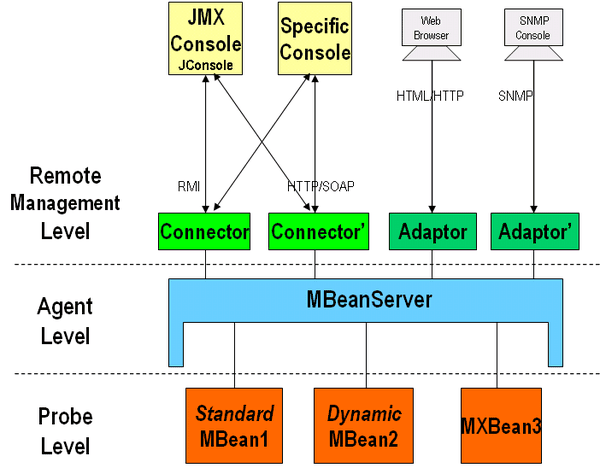 AI Visual Insight: This diagram shows the three-layer JMX architecture: MBeans at the bottom act as resource probes, the MBean Server in the middle provides unified registration and dispatch, and Remote Management at the top provides remote connectivity. It reflects the layered design of the monitoring and management path.
A minimal JMX example explains how an MBean works
A standard MBean requires a convention-based interface such as ServerMonitorMBean, and an implementation class then exposes the concrete attributes. After registration with the MBeanServer, external tools can fetch attribute values through an ObjectName.
public interface ServerMonitorMBean {
    long getUpTime();
}

public class ServerMonitor implements ServerMonitorMBean {
    private final ServerImpl target;

    public ServerMonitor(ServerImpl target) {
        this.target = target;
    }

    @Override
    public long getUpTime() {
        return System.currentTimeMillis() - target.startTime; // Return uptime
    }
}
This code demonstrates how to wrap a regular object as a management object readable through JMX.
MBeanServer mBeanServer = MBeanServerFactory.createMBeanServer();
ObjectName objectName = new ObjectName("objectName:id=ServerMonitor1");
mBeanServer.registerMBean(serverMonitor, objectName); // Register the MBean
Long upTime = (Long) mBeanServer.getAttribute(objectName, "UpTime"); // Read the attribute
This code shows that JMX is essentially about registering an object and then reading management attributes by name.
LifecycleMBeanBase connects lifecycle management with JMX management
Tomcat does not require every component to implement the full JMX registration flow on its own. Instead, it provides LifecycleMBeanBase, which extends LifecycleBase and implements JmxEnabled, merging both capabilities into a unified base class.
As a result, many core containers have both a standard lifecycle and built-in MBean registration and deregistration. That is why Tomcat management behavior stays highly consistent across components.
public abstract class LifecycleMBeanBase extends LifecycleBase implements JmxEnabled {
    @Override
    protected void initInternal() throws LifecycleException {
        // Register with the MBeanServer during initialization
        oname = register(this, getObjectNameKeyProperties());
    }

    @Override
    protected void destroyInternal() throws LifecycleException {
        // Unregister from the MBeanServer during destruction
        unregister(oname);
    }
}
This code shows that Tomcat embeds MBean registration directly into lifecycle hooks.
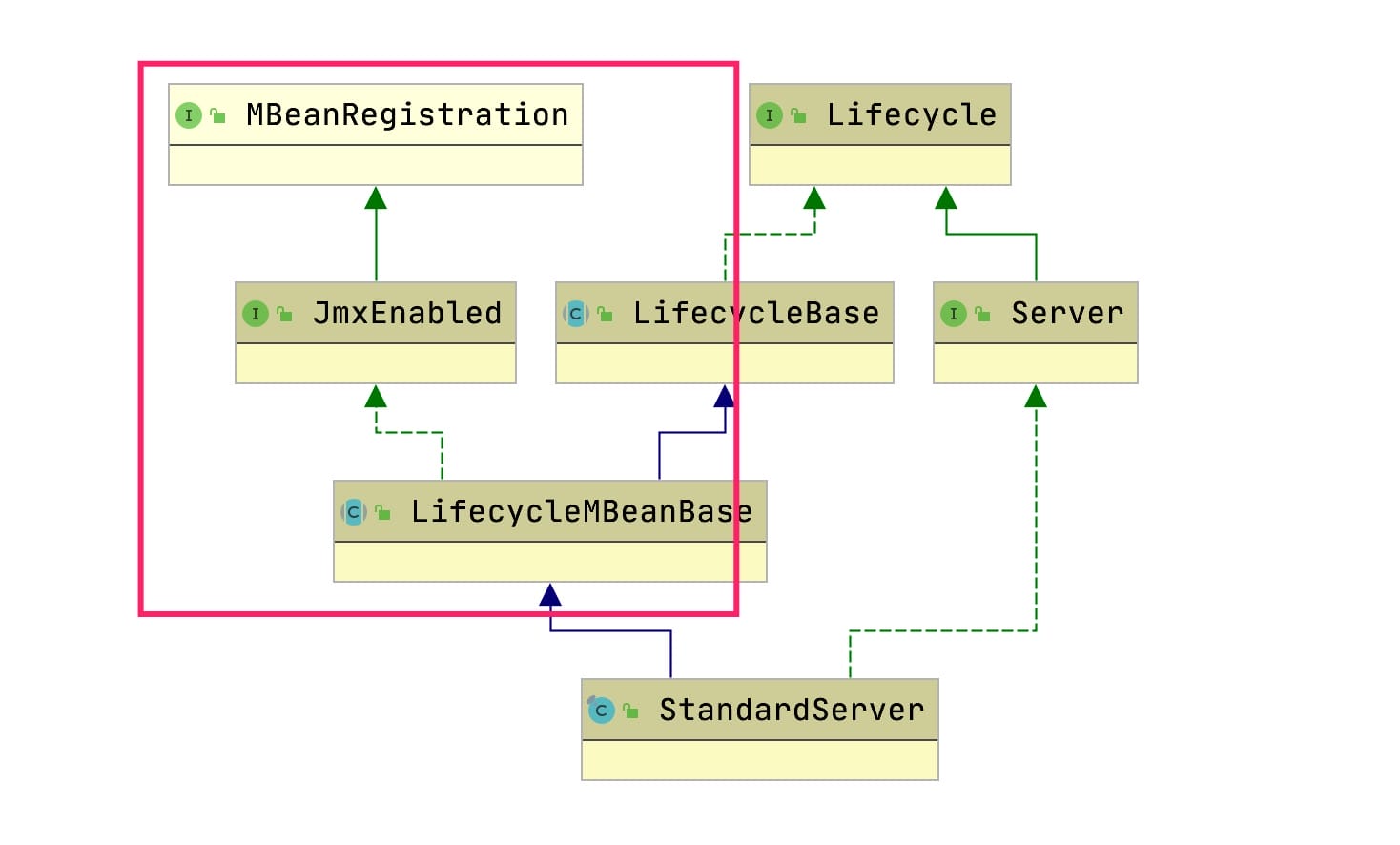 AI Visual Insight: This diagram shows the inheritance and implementation relationships among
 LifecycleMBeanBase, JmxEnabled, MBeanRegistration, and concrete container classes. It highlights how Tomcat reuses lifecycle and JMX management logic through an abstract base class.
The design conclusion is a combination of state machine, template method, and management abstraction
From the source code perspective, Tomcat component management is not a pile of scattered APIs. It is a highly cohesive architecture: Lifecycle defines the protocol, LifecycleState constrains state transitions, LifecycleBase solidifies the process, and LifecycleMBeanBase integrates JMX.
This design delivers three practical benefits: unified component behavior, fewer illegal states, and stronger runtime observability. The same methodology is valuable when reading Tomcat, the Spring container, or middleware source code in general.
FAQ provides structured answers to common questions
Why does Tomcat model lifecycle as a state machine instead of a few ordinary methods?
Because component management has strict ordering requirements and exceptional branches. A state machine prevents illegal calls such as starting before initialization or stopping repeatedly after destruction, and it provides clear semantics for failure recovery.
Why is the template method pattern a good fit for LifecycleBase?
Because all components follow the same lifecycle skeleton, but their initialization and startup details differ. The template method pattern reuses the shared process while letting subclasses focus only on concrete implementation, which reduces duplicate code and behavioral drift.
What problem does LifecycleMBeanBase solve in Tomcat?
It pulls JMX registration and deregistration into lifecycle hooks, so container components become manageable by default. Developers no longer need to write repetitive MBean integration logic for every component.
AI Readability Summary: This article reconstructs Tomcat component management internals from the source code perspective, focusing on the Lifecycle state machine, the template method implementation, and the JMX/MBean registration and management path. It helps developers quickly build a complete mental model of the relationships among Server, containers, and management interfaces.