[AI Readability Summary] Apache IoTDB is an open source time series database built for Industrial IoT. Its core strengths include native hierarchical modeling, highly compressed TsFile storage, and coordinated edge-cloud architecture that address large-scale time series ingestion, querying, and cost control. Keywords: IoTDB, time series database, Industrial IoT.
Technical Specifications Snapshot
| Parameter | Details |
|---|---|
| Project Name | Apache IoTDB |
| Primary Language | Java |
| Network Protocols | JDBC, Thrift, SQL interfaces |
| Open Source License | Apache License 2.0 |
| GitHub Stars | Not provided in the source |
| Core Dependencies / Capabilities | TsFile, Gorilla encoding, edge-cloud architecture, hierarchical schema |
| Typical Use Cases | Industrial IoT, edge computing, energy monitoring, device time series analytics |
Apache IoTDB Was Designed for Industrial Time Series Data Management
The Internet of Things and the Industrial Internet continue to drive rapid growth in time series data volumes. Traditional relational databases struggle to balance high-frequency ingestion, low-cost storage, and real-time querying at the same time. Apache IoTDB has a clear positioning: it provides native data management capabilities for the hierarchical structures of devices, sensors, production lines, and factories.
Unlike general-purpose databases that add time series support as an afterthought, IoTDB optimizes its data model, file format, and deployment model specifically for industrial scenarios. That makes it more than a database that can store time series data. It is a data foundation designed for industrial operations.
 AI Visual Insight: This image presents an architectural view centered on industrial time series data. Its main purpose is to highlight the mapping between devices, measurement points, data flows, and the database, showing that IoTDB is not a standalone storage component but an integrated data foundation for industrial data collection, storage, and analysis.
Market Changes Are Forcing Time Series Databases to Redefine Their Capability Boundaries
Industrial environments generate data with high concurrency, continuous writes, and rapidly declining time value. A single factory can produce millions of data points within seconds. If a database lacks native compression, hierarchical organization, and fast aggregation, both cost and performance can quickly become unmanageable.
As a result, enterprises no longer evaluate databases only by whether they can store time series data. They also ask whether the system can store data reliably, cost-effectively, and with real-time query support across coordinated edge-cloud deployments. This is where IoTDB diverges from traditional database approaches.
Time Series Database Selection Should Focus on Ingestion, Query Performance, Compression, and Scalability
When evaluating a time series database, ingestion throughput is the first critical metric. Industrial data collection pipelines usually cannot tolerate obvious delays, and they certainly cannot tolerate data loss. The system must remain stable under sustained high-frequency writes.
The second key metric is query efficiency. Time series analysis is not limited to simple point lookups. More commonly, it involves time-range filtering, window aggregation, state statistics, and cross-device comparisons. If the database does not optimize for these query patterns, application responsiveness will slow down noticeably.
-- Define measurement points by device hierarchy to match industrial organization
CREATE TIMESERIES root.factory.line1.robot1.temp WITH DATATYPE=FLOAT;

-- Insert timestamped data points for continuous collection scenarios
INSERT INTO root.factory.line1.robot1(timestamp, temp, status)
VALUES (1700000000000, 25.5, 'running');

-- Aggregate by time window to support monitoring and trend analysis
SELECT AVG(temp)
FROM root.factory.line1.*
GROUP BY ([2024-01-01T00:00:00, 2024-01-01T12:00:00), 1h);
This SQL example demonstrates IoTDB’s hierarchical modeling, ingestion, and time-window aggregation capabilities.
Storage Optimization Determines Long-Term TCO
At industrial scale, petabyte-level time series data is not unusual. IoTDB reduces storage overhead through its columnar TsFile format and time series compression algorithms. The source states that its compression ratio typically ranges from 3x to 8x and can reach 20:1 in specific scenarios. That directly affects long-term total cost of ownership.
Ecosystem Compatibility Determines Implementation Speed
IoTDB is not just a storage engine. It also needs to integrate with surrounding systems such as Spark, Flink, and Grafana. Strong ecosystem compatibility means less data movement and shorter system integration cycles, which is especially important for enterprise adoption.
Apache IoTDB’s Core Advantages Come From Its Native Hierarchical Model and TsFile
IoTDB’s most distinctive capability is its hierarchical tree model. It uses a path-based “device-measurement” organization that naturally matches the real structures of factories, workshops, production lines, devices, and sensors. This significantly reduces metadata management complexity.
Compared with approaches that rely on tags or wide tables to map device relationships, this modeling approach is better suited to industrial domains. The source notes that in complex query scenarios, a tree-based schema design can reduce query code volume by about 70%.
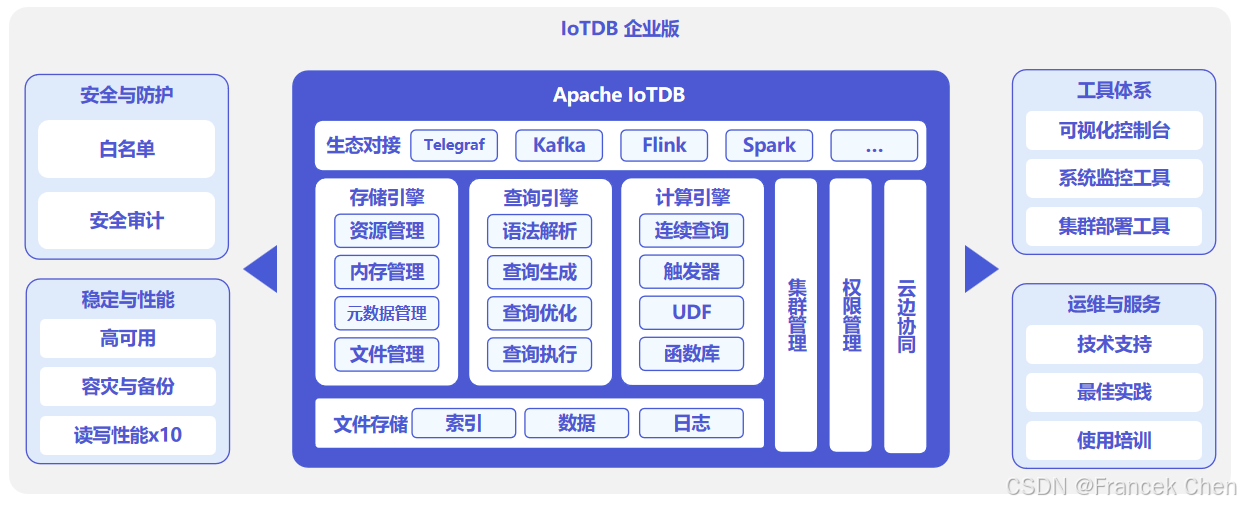 AI Visual Insight: This image compares the architectural approaches of mainstream time series databases, with emphasis on IoTDB’s hierarchical tree model, file format, and device-oriented industrial organization. It helps readers understand how IoTDB differs from InfluxDB and TimescaleDB in both modeling and storage design.
TsFile Makes Edge-to-Cloud Data Pipelines More Reliable
TsFile is IoTDB’s core storage format and a major reason it performs well in edge scenarios. It supports resumable transfer, unreliable network transmission, and highly compressed storage, making it well suited for power grids, mines, remote stations, and other environments with unstable connectivity.
# Download the package and replace it with your target version
wget https://archive.apache.org/dist/iotdb/1.4.0/apache-iotdb-1.4.0-bin.zip
unzip apache-iotdb-1.4.0-bin.zip
cd apache-iotdb-1.4.0/sbin

# Start a standalone service for local validation and development testing
./start-standalone.sh

# Connect to the database with the CLI on the default port 6667
./start-cli.sh -h 127.0.0.1 -p 6667 -u root -pw root
These commands download the standalone edition of IoTDB, start it, and connect through the CLI.
IoTDB Fits Industrial Hierarchy Management, Edge Deployment, and Domestic Technology Replacement More Naturally
If your core requirement is hierarchical device management, IoTDB has a natural advantage. The relationships among factories, production lines, devices, and sensors do not require extra abstraction. You can map them directly into database paths, which lowers the barrier for both modeling and querying.
If your workloads run in edge environments, IoTDB’s lightweight footprint becomes even more valuable. The source notes that its edge-side edition can be kept under 50 MB and can support more than seven days of offline caching, which makes it suitable for resource-constrained devices.
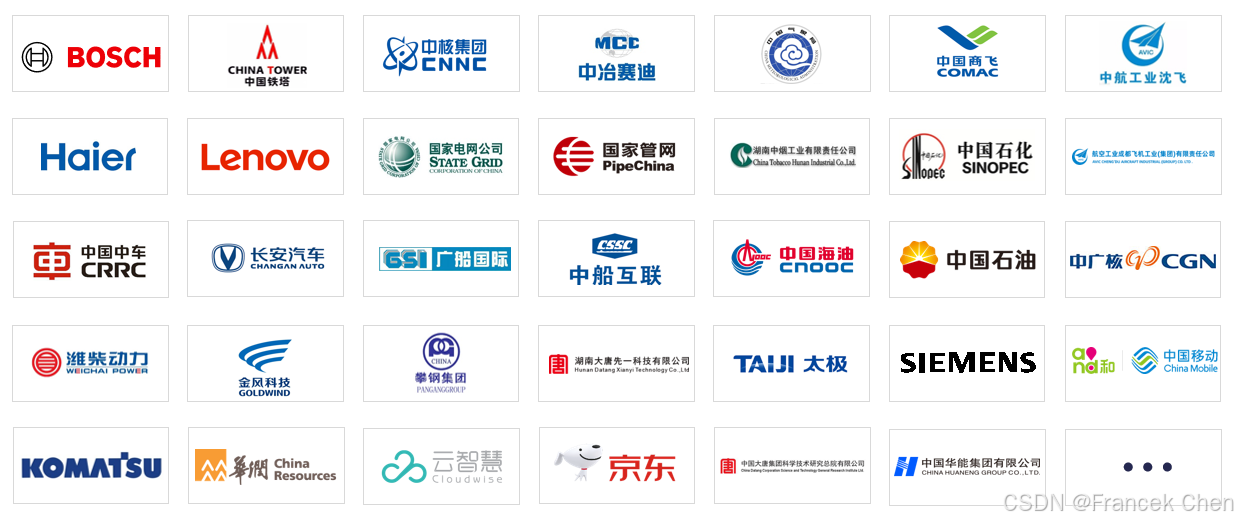 AI Visual Insight: This image highlights IoTDB’s fit for practical business scenarios. It typically shows the connections between industrial devices, edge nodes, and cloud analytics to illustrate its end-to-end advantages in hierarchy management, offline caching, compressed transfer, and unified analysis.
Compatibility with Domestic Technology Stacks Improves Enterprise Control
IoTDB is already compatible with hardware and software ecosystems such as Kunpeng, Phytium, Kylin, Tongxin UOS, and OpenCloudOS, and it supports X86, ARM, and RISC-V architectures. This means it is suitable not only for technical selection but also for infrastructure modernization under domestic technology replacement strategies.
In addition, the enterprise product TimechoDB, built on Apache IoTDB, adds capabilities such as a management console, monitoring dashboards, and cluster management, making it more suitable for large-scale governance and operations in production environments.
The Best Way to Get Started Is to Validate with the Community Edition First
Developers can usually start with the community edition in standalone mode to validate the data model, query patterns, and storage efficiency, then evaluate the enterprise edition based on SLA requirements, cluster governance, and technical support needs.
During the proof-of-concept phase, prioritize three categories of validation: sustained ingestion stability, window aggregation performance, and compressed disk usage. If your business includes edge sites with unreliable connectivity, you should also validate TsFile transfer behavior and offline caching capabilities.
The Conclusion Is That IoTDB Is More of an Industrial Time Series Foundation Than Just a Database
From its native hierarchical model and highly compressed TsFile storage to its coordinated edge-cloud architecture, Apache IoTDB’s strength does not come from a single benchmark advantage. Instead, it comes from a complete and consistent capability stack built around Industrial IoT.
If your scenario includes clear device hierarchies, massive ingestion, edge deployment, or domestic technology requirements, IoTDB is often easier to implement than general-purpose time series solutions and makes it easier to balance cost, performance, and governance.
FAQ
Which business scenarios are the best fit for IoTDB?
IoTDB is best suited for Industrial IoT, energy monitoring, connected vehicles, edge data collection, and device operations analytics. It is especially effective for data systems with clear device hierarchies, frequent writes, and a need for low-cost long-term storage.
What is the core difference between IoTDB and general-purpose databases?
The key difference lies in its native hierarchical model and TsFile storage format. The former matches industrial device structures, while the latter balances compression, transmission, and edge readiness. As a result, IoTDB is not simply an extension of a relational database approach.
What should enterprises validate first when adopting IoTDB?
Start by validating ingestion throughput, time-window aggregation, compression ratio, weak-network transmission, and edge caching capabilities. Then assess the integration cost with Spark, Flink, Grafana, and domestic hardware and software environments.
Core Summary: This article explains Apache IoTDB’s architecture, evaluation logic, and onboarding path. It focuses on its hierarchical data model, TsFile storage format, coordinated edge-cloud capabilities, and compatibility with domestic technology ecosystems, while showing its practical value in industrial hierarchy management, edge computing, and storage cost control.