The key to AI games is not model integration alone, but whether the system can support real-time decision-making, dynamic storytelling, and multi-device collaboration. HarmonyOS is better suited to building intelligent NPCs, dynamic worlds, and immersive cross-device experiences through state-driven UI, distributed capabilities, on-device AI, and a unified data flow. Keywords: HarmonyOS, AI games, state-driven architecture.
Technical specification snapshot
| Parameter | Description |
|---|---|
| Domain | AI game architecture / HarmonyOS application model |
| Core languages | ArkTS, TypeScript |
| Interaction model | State-driven, event dispatching, distributed collaboration |
| Runtime form | Multi-device coordination across phones, tablets, TVs, and watches |
| Core dependencies | ArkUI, Store state management, AI Service, Agent layer |
| Coordination protocol | Distributed device synchronization, cloud/on-device inference pipeline |
| GitHub stars | Not provided in the source content |
The core argument of this article is that AI games are dynamic systems first
Traditional mobile games often treat AI as an add-on capability: connect a large model to a dialog box, or add a reasoning interface on top of an NPC. But in real-world implementation, the bottleneck is often not the model itself. The real issue is that the original client architecture cannot absorb continuous dynamic change.
The execution flow of an AI game looks more like a continuously evolving system: player input, environmental changes, AI decisions, state updates, and multi-device feedback all happen at the same time. If the underlying architecture still relies on page navigation and local callback-driven logic, complexity quickly becomes unmanageable.
A data flow definition that better fits AI games
Player Input -> Agent Decision -> AI Service -> Action -> Store -> UIThis chain emphasizes state convergence. All inputs eventually flow into a unified Store, and the UI renders reactively from that state.
Traditional mobile game architectures usually cannot reliably support real-time AI interaction
The first problem is page-driven logic. Many mobile games or business-oriented game shells still organize logic around a click-callback-partial-refresh pattern. That model works for fixed flows, but not for continuously generated content.
The second problem is fragmented data flow. The UI, network layer, and scripting logic may all mutate data directly. As a result, AI cannot find a stable state entry point, nor can it produce actions reliably.
A typical illustration of problems in the traditional model
Page -> Click -> Business Logic -> Partial Refresh
UI mutates data / Network mutates data / Script mutates data
This kind of structure turns AI into a patch rather than a first-class part of the system.
HarmonyOS has an advantage because it provides system-level conditions for AI workloads
HarmonyOS is a better fit for AI games not because it is simply faster, but because its key capabilities align naturally with the needs of AI games: state-driven UI, distributed device collaboration, on-device intelligence, and consistent multi-device data representation.
That means developers do not have to treat AI as an external module. Instead, they can treat it as a standard input source that enters the same unified state machine alongside user input and network events.
State-driven UI makes AI output naturally visible
The value of ArkUI lies in its direct mapping from state to UI. As long as AI-generated dialogue, quests, and behavior outcomes enter the state layer, the interface updates automatically, reducing the cost of imperative refresh logic.
class GameStore {
  // Core state: current NPC dialogue
  npcDialog: string = '...'

  dispatch(action: { type: string; payload: string }) {
    if (action.type === 'NPC_SPEAK') {
      this.npcDialog = action.payload // Write AI output into state
    }
  }
}
This code shows how AI output lands in the state layer first and is then consumed automatically by the UI.
@Entry
@Component
struct NpcPanel {
  @State npcDialog: string = 'Waiting for dialogue...'

  build() {
    Column() {
      Text(this.npcDialog) // UI refreshes automatically after state changes
    }
  }
}
This UI snippet shows that ArkUI can directly absorb dynamic content such as NPC dialogue.
Distributed capabilities let AI games move beyond the limits of a single device
AI games often need to handle voice input, complex reasoning, narrative presentation, and auxiliary interaction at the same time. If everything runs on a single phone, compute power, screen space, and interaction form all become constraints.
HarmonyOS distributed capabilities are better suited to splitting device roles: the phone handles input, the tablet provides the strategy panel, the TV delivers immersive presentation, and cloud or local models handle inference.
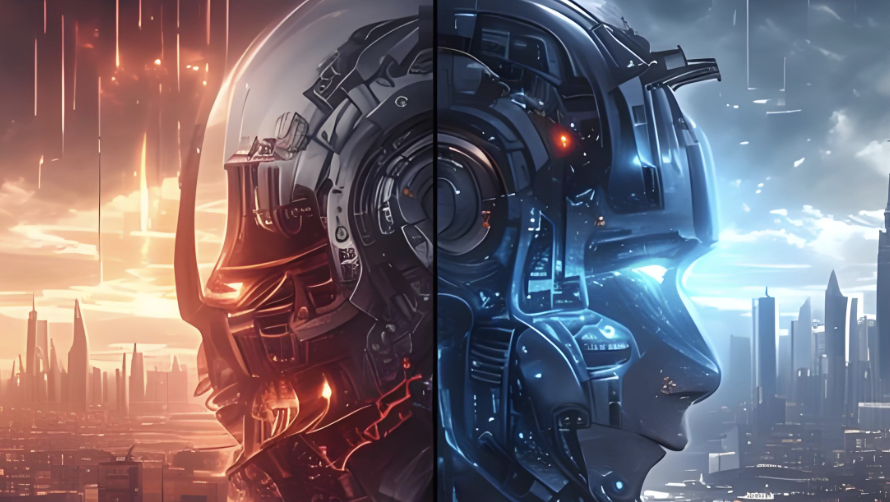 AI Visual Insight: This image serves as the conceptual visual entry point for the article. It emphasizes the integration of AI games with the HarmonyOS ecosystem, focusing on multi-device coordination, architectural evolution, and interaction upgrades rather than a single isolated feature demo.
 AI Visual Insight: This animated image works as a dynamic interaction diagram. It highlights how continuous state changes drive interface feedback, making it a strong match for real-time scenarios such as AI conversations, NPC behavior updates, or multi-device state synchronization.
The multi-device collaboration pipeline can be understood like this
Phone Voice Input -> Local/Cloud AI Inference -> TV Displays NPC Result -> Tablet Shows Quests and OptionsThis is not simple screen casting. It is systematic distribution of state and responsibilities across multiple devices.
A unified data flow is the prerequisite for maintainable AI integration
In AI games, players, AI, the network, and sensors can all become input sources. If each source bypasses the architecture and manipulates the interface directly, the system quickly loses testability and consistency.
A more reliable design is to route all input into a Service first, convert it into Actions, and finally aggregate everything into the Store. In that model, AI is just one input source among many and does not need special architectural privileges.
class NPCAgent {
  async talk(input: string) {
    const reply = await aiService.chat(input) // Call the AI service to generate a reply
    gameStore.dispatch({ type: 'NPC_SPEAK', payload: reply }) // Dispatch the state change through a unified path
  }
}
This Agent code completes the smallest closed loop of player input, AI reply, and state update.
On-device AI determines whether the experience feels immediate enough
Many AI gameplay ideas fail not because the concept is wrong, but because latency is too high. If an NPC needs two seconds to answer, or a generated story branch blocks the main flow, immersion disappears immediately.
HarmonyOS emphasizes on-device capabilities, which makes it suitable for running lightweight inference, caching strategies, and intent recognition locally while offloading high-complexity generation to the cloud. This helps balance latency, cost, and output quality.
A local-first invocation model is a better fit for games
async function inferPlayerIntent(input: string) {
  const result = await aiService.localInfer(input) // Use on-device inference first to reduce latency
  return result.action // Return an action that can enter the Store
}
This example reflects an AI service strategy of on-device first, cloud as a supplement.
The real shift is not that games become smarter, but that gameplay generation changes fundamentally
Traditional games are mostly content-driven: designers prewrite the story, and players follow a path through it. AI games move toward system-driven design: player behavior triggers state changes, and AI then generates new storylines and feedback based on the world state.
That means the development focus shifts from writing more scripts to designing more reliable state machines, clearer Agent boundaries, and stronger multi-device synchronization mechanisms. This is exactly where HarmonyOS matters most. It acts more like a foundation built for dynamic worlds.
One misconception developers must avoid
Treating the UI as the center of logic, building no Store, and never converging the data flowIf development still follows page-centric logic, even strong system capabilities cannot be turned into a stable AI game experience.
FAQ
Q1: Why are AI games still not fun after integrating a large model?
Because the problem is usually not the model, but the architecture. Without a unified state flow, stable Agent boundaries, and low-latency feedback, AI can generate content but cannot drive a sustainable game system.
Q2: Which HarmonyOS capability is the best fit for AI games?
The core advantage is not one isolated performance metric, but a combination of capabilities: ArkUI state-driven rendering, distributed device collaboration, on-device AI, and multi-device UI. Together, these capabilities determine whether the system can support a dynamic world.
Q3: How can developers transition smoothly from traditional mobile games to AI game architecture?
A practical three-step path is: first, build a Store and converge all input sources; second, move AI into the Agent/Service layer; third, gradually introduce on-device inference and multi-device collaboration. Refactor the data flow first, then expand gameplay.
Core Summary: This article analyzes from an architectural perspective why AI games are a better fit for HarmonyOS. The central conclusion is that AI games are fundamentally dynamic systems that rely on state-driven design, unified data flow across multiple input sources, on-device inference, and multi-device collaboration. ArkUI, distributed capabilities, and HarmonyOS multi-device UI provide exactly that system-level foundation.