This analysis focuses on the robotics talent market, explaining the structural logic behind job growth, rising compensation, city-level clustering, and the humanoid robot boom. It helps companies refine hiring strategies and helps professionals choose the right skill path. Keywords: robotics hiring, humanoid robots, robot trainers
Technical Snapshot
| Parameter | Details |
|---|---|
| Data Topic | 2026 Robotics Talent Supply and Demand Trends |
| Data Source | Public report content from Liepin Big Data Research Institute |
| Content Type | Industry trend analysis / talent profiling / emerging role breakdown |
| Reporting Period | Past year (2025.04-2026.03) |
| Language | Chinese |
| License | CC 4.0 BY-SA (as stated in the original source) |
| Star Count | Not applicable (not an open-source project) |
| Core Dependencies | Recruiting platform samples, job posting data, city and industry distribution statistics |
Talent demand in the robotics industry is rising systematically
The strongest signal in the report is not simply that “there are more jobs,” but that the demand structure has clearly upgraded. Over the past year, newly posted jobs in robotics increased by 75.26% year over year, while the average annual salary reached RMB 328,000. This shows that companies are using larger budgets to compete for scarce talent.
From an education perspective, bachelor-level roles grew by 79.63% year over year, master’s-level roles by 87.80%, and doctoral-level roles by 40.02%. This suggests the industry has moved beyond isolated experimentation into deep engineering execution. Companies are no longer looking only for people who can write algorithms. They also need professionals who can deliver system integration, architecture design, and product deployment.
job_growth = {
    "overall": 75.26,
    "bachelor": 79.63,
    "master": 87.80,
    "doctor": 40.02
}

# Core logic: identify the education level with the highest growth rate
fastest = max(job_growth, key=job_growth.get)
print(f"Top-growing level: {fastest}, growth: {job_growth[fastest]}%")
This code snippet quickly extracts the fastest-growing talent tier in robotics hiring.
Industry expansion has extended beyond manufacturing into AI and end-user scenarios
Growth in robotics jobs is no longer confined to traditional manufacturing. Artificial intelligence, computer software, electronics and semiconductors, and machinery all strengthened at the same time, creating momentum from the convergence of AI and hardware. Smart hardware/consumer electronics and automotive manufacturing posted especially strong growth, reaching 113.40% and 106.01%, respectively.
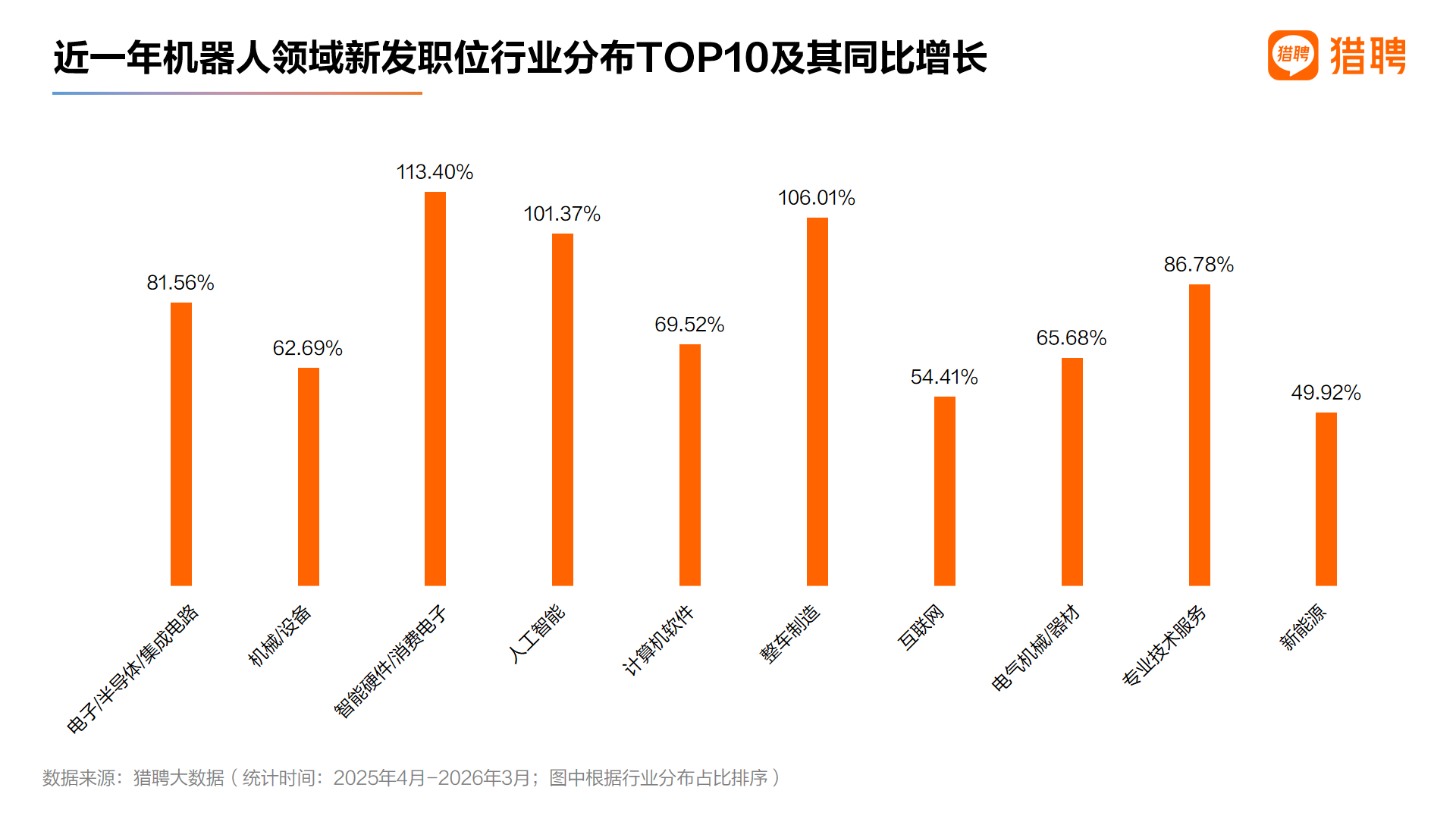 AI Visual Insight: The chart compares year-over-year growth rates for robotics jobs across multiple industries. Smart hardware, automotive manufacturing, artificial intelligence, and semiconductors all show noticeably higher bars, indicating that demand is spreading from upstream manufacturing into end-user products, automotive electronics, and AI application scenarios. This reflects coordinated growth across industries.
Robotics is evolving into a cross-industry general-purpose capability
This expansion shows that robotics is no longer just a device category. It is becoming an industrial interface that combines perception, decision-making, and execution. The companies most likely to lead commercialization are the ones that can connect models, control systems, sensors, chips, and real-world products into a complete, productized stack.
Functional demand is shifting from isolated technical roles to system-level capability competition
Algorithm engineers, embedded software engineers, and hardware engineers remain the foundation of demand. However, the more important signal is the breakout growth of systems-oriented roles. Architect roles grew by 127.06%, systems engineer roles by 121.03%, test engineer roles by 113.70%, and solution roles by 108.47%.
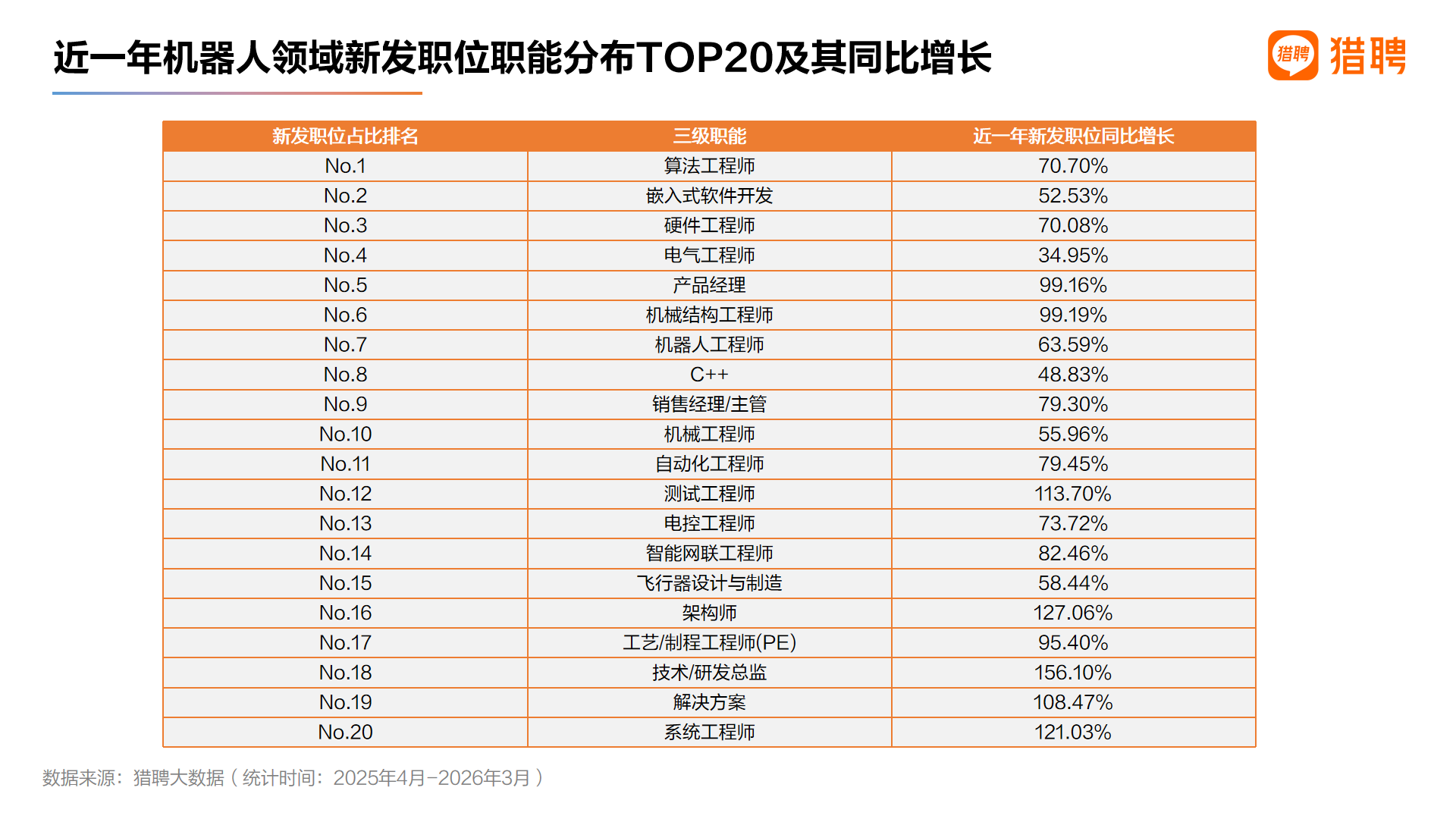 AI Visual Insight: The chart compares growth across core robotics functions. Architecture, systems, testing, and solution roles are rising faster than single-point R&D positions, showing that companies are increasingly focused on end-to-end product design, verification, and delivery rather than chasing algorithm breakthroughs alone.
roles = {
    "架构师": 127.06,
    "系统工程师": 121.03,
    "测试工程师": 113.70,
    "解决方案": 108.47
}

# Core logic: sort by growth rate to identify priority among system-oriented roles
sorted_roles = sorted(roles.items(), key=lambda x: x[1], reverse=True)
for role, growth in sorted_roles:
    print(role, growth)
This code snippet sorts growth rates across key functions to support hiring priority decisions.
The urban talent map is clustering around regions that combine manufacturing strength with the new economy
Shenzhen, Shanghai, and Beijing remain core hubs, but the fastest growth is not necessarily happening only in tier-one cities. Suzhou, Hangzhou, Wuhan, and Changsha—cities that combine manufacturing depth with AI resources—have become the fastest-growing markets. This indicates that the industry has entered a new phase in which expansion spills over from top-tier centers into hybrid cities with stronger industrial and innovation integration.
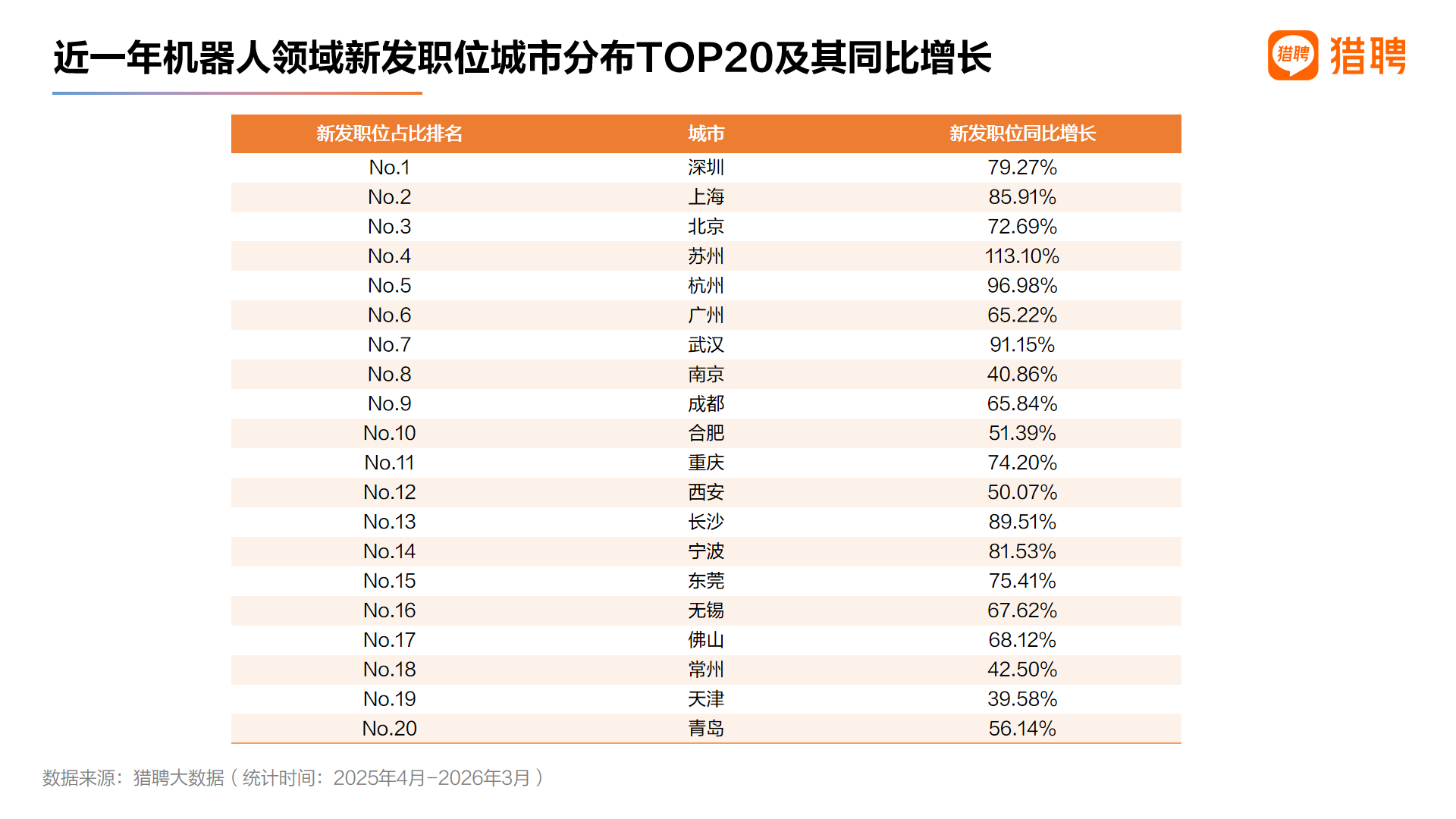 AI Visual Insight: The chart shows both demand share and growth differences across top cities. Leading cities still dominate in total volume, while second-tier cities post steeper growth curves. This suggests that the robotics industry increasingly depends on metropolitan collaboration, supply chain support, and R&D commercialization capacity rather than on headquarters resources alone.
Talent profiles show that hybrid backgrounds are becoming the norm
In academic background, mechanical engineering, computer science, electrical engineering, and automation still dominate. However, business administration, finance, and marketing have also entered the top ranks. University distribution shows a pattern led by elite universities, supported by strong engineering schools, and supplemented by institutions with industry specialization. This indicates that robotics is moving from a purely technology-driven field toward a three-track model that advances technology, engineering, and business in parallel.
Robot trainers represent a new entry point for application-layer deployment
Robot trainers earn an average annual salary of about RMB 195,000. A bachelor’s degree remains the mainstream threshold, but close to 30% of positions are open to candidates with an associate degree or below. The core of the role is not pure algorithm work. Instead, it centers on debugging, operations and maintenance, interaction training, data processing, and knowledge base maintenance. As a result, employers place greater value on job-ready execution and process discipline.
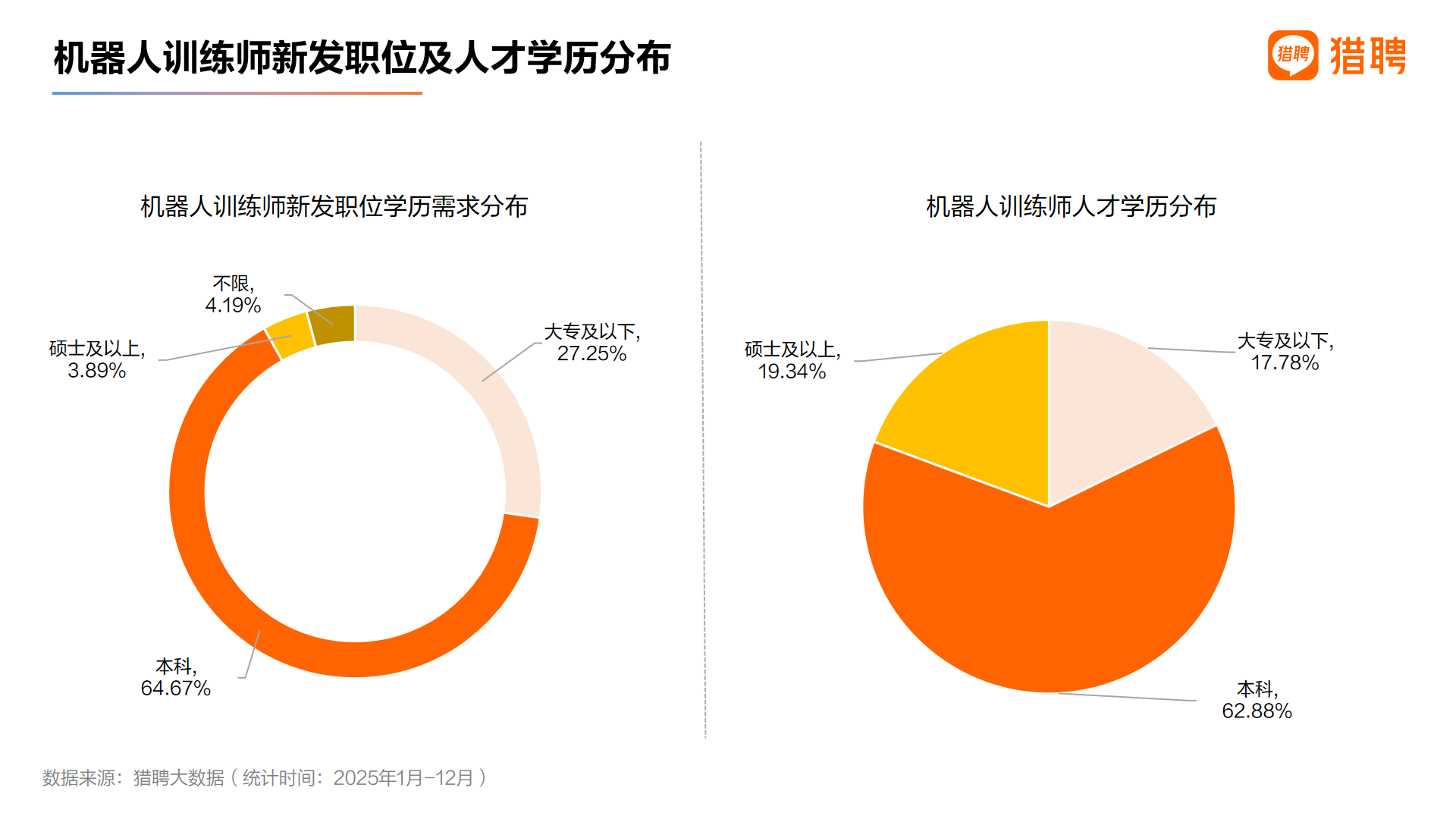 AI Visual Insight: This chart likely presents the education distribution for robot trainer roles. Bachelor’s degree holders account for the largest share, while associate degree and below also represent a meaningful portion. This suggests clear stratification in the role: higher-end positions favor stronger technical understanding, while entry-level roles focus more on training execution and data operations.
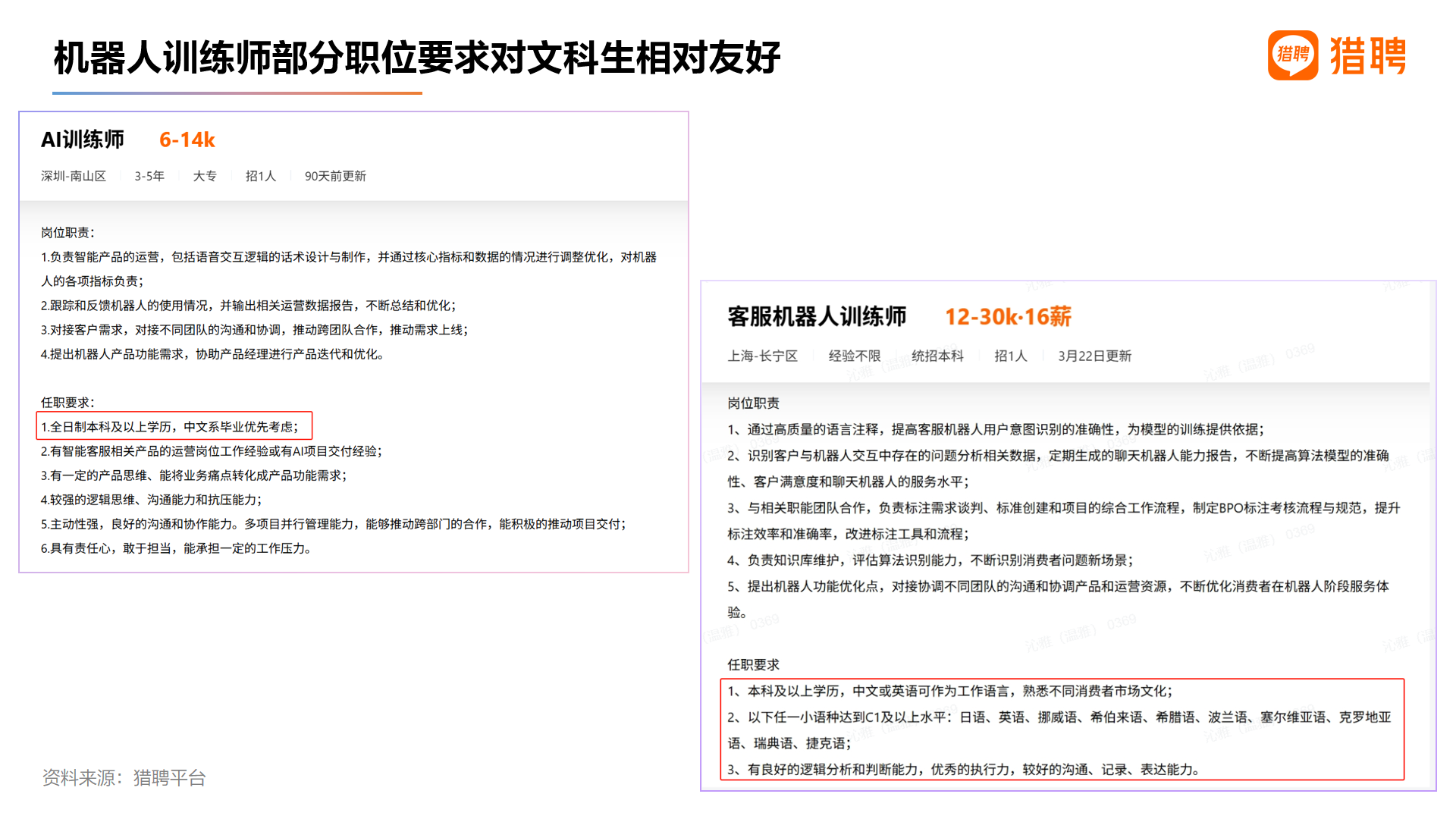 AI Visual Insight: This chart focuses on job requirements or skill composition for robot trainers. In addition to AI or robotics-related backgrounds, multilingual ability, script design, user intent recognition, and communication and coordination carry significant weight. This indicates that candidates from humanities or operations backgrounds have realistic entry opportunities in interaction-oriented roles.
trainer_skill = ["数据标注", "交互优化", "知识库维护", "沟通协同"]

# Core logic: build a capability checklist for robot trainers
for idx, skill in enumerate(trainer_skill, 1):
    print(f"{idx}. {skill}")
This code snippet abstracts the core competency model for robot trainer roles.
Humanoid robots are the strongest breakout segment right now
Over the past year, newly posted jobs in humanoid robotics increased by 215.80% year over year, with average annual salaries reaching RMB 406,100. This is the strongest growth point in the entire report. Demand is concentrated in three industry groups: artificial intelligence, smart hardware, and electronics and semiconductors. At its core, this reflects simultaneous upgrading across algorithms, hardware, and chips.
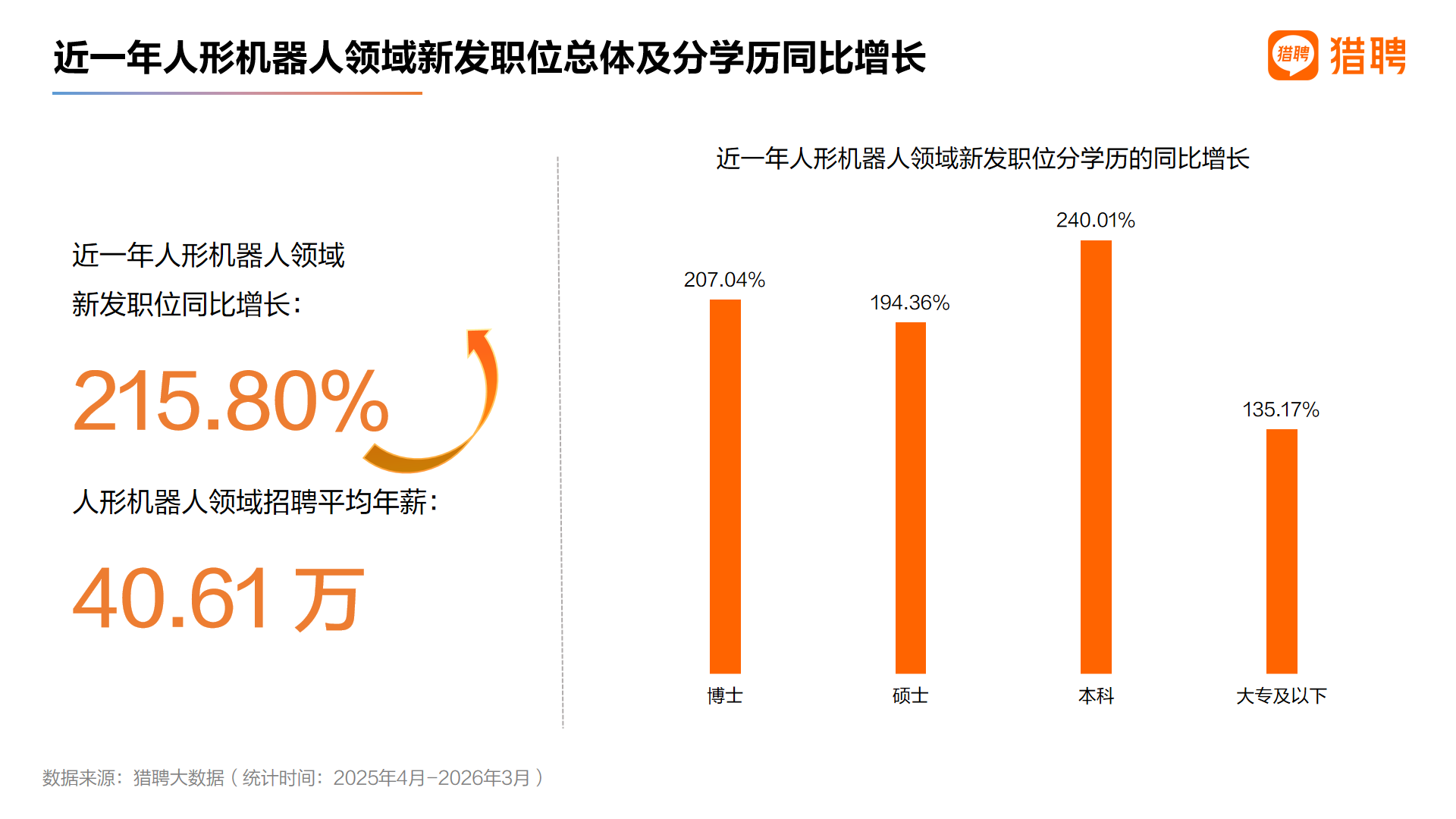 AI Visual Insight: The chart highlights both demand and salary growth for humanoid robotics roles. All education tiers are showing strong expansion, with bachelor’s, master’s, and doctoral hiring all rising sharply. This indicates that the segment needs both large-scale engineering talent and high-end research talent at the same time.
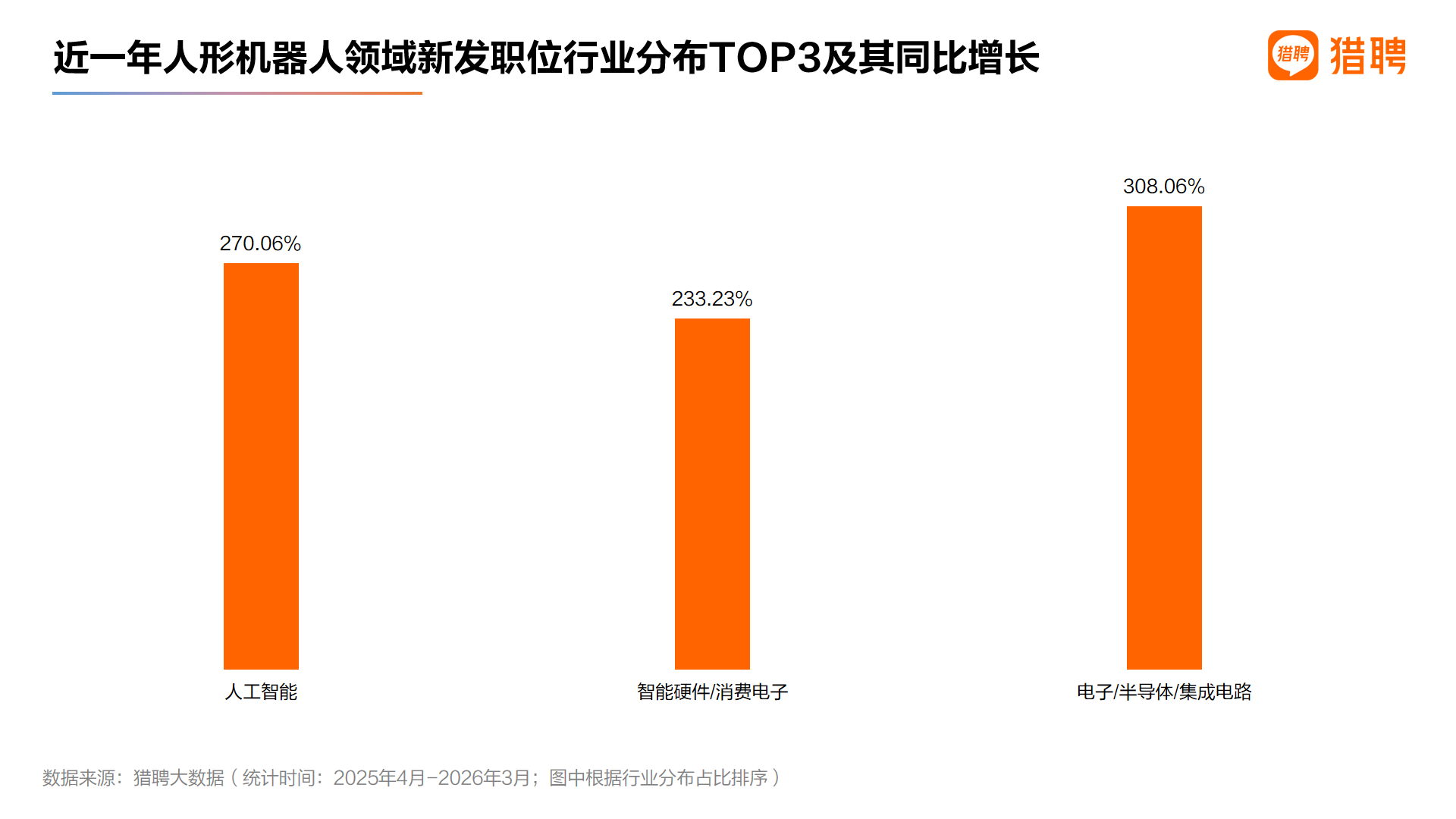 AI Visual Insight: The chart compares industry distribution and growth for humanoid robotics-related roles. AI, consumer electronics, and semiconductors account for a large share and are growing quickly, indicating that the center of gravity in the value chain has expanded from end applications to foundational capabilities such as models, sensors, compute, and chips.
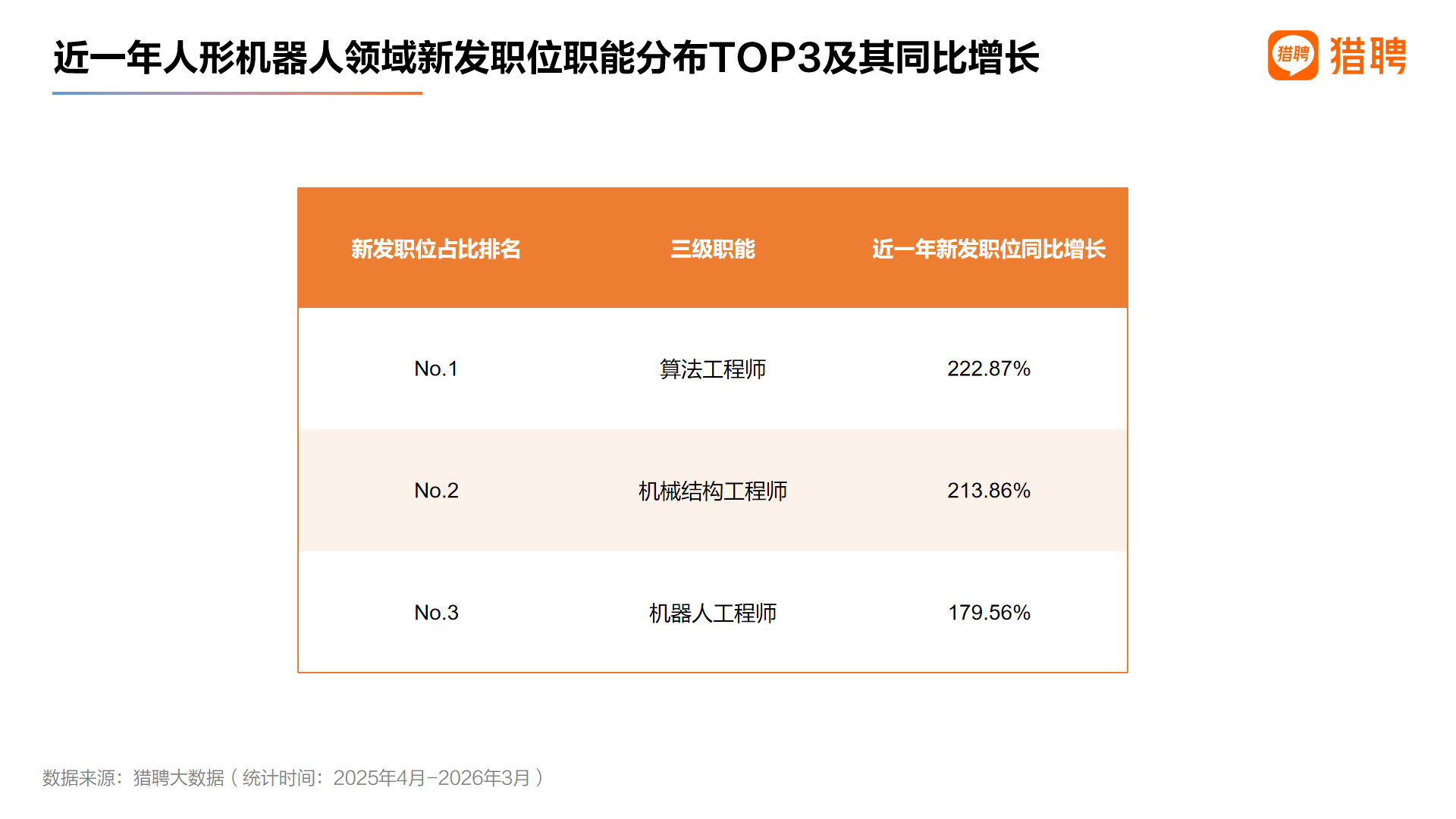 AI Visual Insight: This chart shows the functional demand structure in humanoid robotics. Algorithm engineers, mechanical structure engineers, and robotics engineers account for a high share and are growing rapidly, reflecting an industry stage in which the “intelligent brain” and the “engineered body” are advancing in parallel.
The direct implications for companies and professionals are already clear
For companies, hiring strategy can no longer stop at filling isolated engineering roles. Teams need a complete talent matrix built around system architecture, test validation, product definition, solutions, and commercial delivery. For professionals, interdisciplinary capability, engineering thinking, and scenario-level understanding will be more valuable than any single isolated skill.
FAQ
What capability is the scarcest in the robotics industry right now?
The scarcest capability is not a single algorithm skill, but a compound skill set that combines algorithms, hardware, systems integration, and productization. Competition is especially intense in architecture, systems engineering, test and validation, and solution roles.
Are robot trainer roles suitable for career switchers without a technical background?
Yes, for some subcategories. If the role focuses on customer service robots, AI training, knowledge base maintenance, script design, or multilingual interaction, candidates from humanities or operations backgrounds may have a clear advantage. If the role focuses on lower-level model optimization, however, a stronger technical foundation is still required.
Why do humanoid robotics roles show both higher salaries and faster growth?
Because the field simultaneously consumes high-end talent across algorithms, mechanical structure, embedded systems, chips, and systems engineering. Development cycles are long, trial-and-error costs are high, and commercial competition is intense. Companies therefore need to use higher compensation to secure critical talent quickly.
Core Summary: Reconstructed from the Liepin report, this article presents a full-picture view of talent supply and demand in robotics: rapid year-over-year job growth, an upward shift in education requirements, simultaneous strengthening of systems engineering and commercialization capabilities, humanoid robotics as the fastest-growing segment, and robot trainer roles as a signal of application-layer deployment and demand for hybrid skills.