This article focuses on three high-frequency knowledge domains in the Advanced Soft Exam for Information Systems Project Managers: Project Cost Management, Project Quality Management, and Project Resource Management. It addresses a common exam-prep pain point: too many concepts, easy confusion, and weak cross-topic connections. The core outcome is an integrated memorization framework that combines processes, formulas, tools, and scenarios. Keywords: Advanced Soft Exam, project management, cost, quality, resources.
Technical Specification Snapshot
| Parameter | Content |
|---|---|
| Domain | Information Systems Project Manager / Advanced Soft Exam |
| Content Type | Exam Topic Reconstruction / Structured Memory Notes |
| Language | Chinese |
| Applicable Standard | PMBOK Project Management Body of Knowledge |
| Original Platform Popularity | Approx. 285 views / 20 likes / 11 saves |
| Core Dependencies | Cost Baseline, Earned Value Analysis, Cost of Quality, RACI, Team Charter |
 AI Visual Insight: This image functions more as an article-introduction visual than a technical diagram. It reinforces learning motivation rather than technical structure itself. It typically appears at the beginning of condensed study content to create a visual pause and improve recognition of information-block transitions.
Project cost management requires a closed loop across planning, budgeting, and control
Project Cost Management includes four processes: Plan Cost Management, Estimate Costs, Determine Budget, and Control Costs. The first three belong to the Planning Process Group, while Control Costs belongs to the Monitoring and Controlling Process Group. The key is not memorizing the names in isolation, but understanding the logic: define the rules first, calculate the costs next, consolidate them into a budget, and finally correct deviations.
The project budget is the result of progressive aggregation from activities to the project level
Budget formation follows a bottom-up aggregation logic: activity costs roll up into work packages, work packages roll up into control accounts, control accounts form the cost baseline, and finally management reserves are added to produce the total project budget. Contingency reserves prepare for known risks, while management reserves address unknown risks.
Work Package Cost = Σ(Activity Cost + Activity Contingency Reserve)  # Aggregate costs at the activity level
Control Account Cost = Σ(Work Package Cost) + Control Account Contingency Reserve  # Aggregate costs at the work package level
Cost Baseline = Σ(Control Account Cost)  # Form the measurable baseline
Project Budget = Cost Baseline + Management Reserve  # Add management reserve to obtain the total budget
These formulas summarize the budget formation chain and serve as a high-frequency expression template in case-analysis and essay questions.
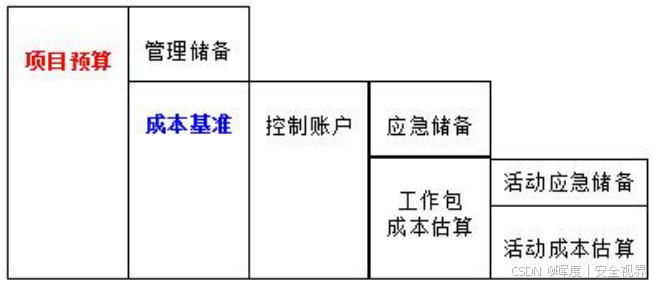 AI Visual Insight: The image shows a hierarchical budget structure, typically arranged bottom-up as activities, work packages, control accounts, cost baseline, and project budget. It emphasizes how reserves belong to different levels and provides key visual evidence that a budget is not produced through one-time guesswork.
Cost control is fundamentally about preventing variance, managing change, and enforcing funding limits
The goals of Control Costs include influencing factors that create baseline changes, processing change requests in a timely manner, monitoring cost performance, analyzing variance, ensuring spending does not exceed approved funding limits, and reporting approved changes to stakeholders. The core idea is not to memorize nine isolated points, but to focus on three main threads: variance, change, and funding.
def eva(pv, ev, ac):
    cv = ev - ac   # Cost variance: greater than 0 means cost savings
    sv = ev - pv   # Schedule variance: greater than 0 means ahead of schedule
    cpi = ev / ac if ac else 0  # Cost performance index
    spi = ev / pv if pv else 0  # Schedule performance index
    return cv, sv, cpi, spi
This code helps quickly calculate the core indicators in Earned Value Analysis and is useful for turning concepts into executable judgment.
Project quality management must cover planning, assurance, and inspection at the same time
Project Quality Management includes three processes: Plan Quality Management, Manage Quality, and Control Quality, corresponding to the Planning, Executing, and Monitoring and Controlling Process Groups. Each process has a different focus: planning defines the required quality level, management ensures that quality activities are actually carried out, and control checks whether results meet requirements.
The path to quality maturity shows that prevention is better than correction
The five levels of quality management, in ascending order of effectiveness, are: defects found by the customer, defects found through quality control, process correction through quality assurance, quality built into planning and design, and an organization-wide culture of quality. This sequence shows that the earlier quality governance moves upstream, the lower the cost and the more stable the outcome.
Cost of quality is the classification most likely to be confused on the exam
Cost of conformance refers to the cost invested to prevent failure, including prevention costs and appraisal costs. Cost of nonconformance refers to the cost incurred after failure occurs, including internal failure costs and external failure costs. Multiple-choice and judgment questions often test whether rework, scrap, warranty, and customer complaints are classified correctly.
Cost of Conformance: Prevention Costs + Appraisal Costs
Cost of Nonconformance: Internal Failure Costs + External Failure Costs
This classification is the basic decision framework for quality-management case analysis.
The distinction between quality tools must be memorized together with their use cases
Common tools in Plan Quality Management include benchmarking, brainstorming, interviews, cost-benefit analysis, cost of quality, flowcharts, matrix diagrams, and mind mapping. Manage Quality commonly uses checklists, process analysis, root cause analysis, affinity diagrams, cause-and-effect diagrams, histograms, and scatter diagrams. Control Quality leans toward check sheets, statistical sampling, performance reviews, and control charts.
Among these, a checklist emphasizes whether required actions were completed, while a check sheet emphasizes what occurred and records data. This is one of the most frequently confused points.
Project resource management focuses on clear roles, team collaboration, and dynamic allocation
Project Resource Management includes six processes: Plan Resource Management, Estimate Activity Resources, Acquire Resources, Develop Team, Manage Team, and Control Resources. The first two belong to planning, Acquire/Develop/Manage belong to executing, and Control Resources belongs to monitoring and controlling. During exam preparation, you should understand resources as both human resources and physical resources.
Conflict management and motivation theory jointly determine team performance quality
The five conflict resolution methods are withdraw/avoid, smooth/accommodate, compromise/reconcile, force/direct, and collaborate/problem solve. If a question emphasizes long-term effectiveness and a win-win outcome, collaboration is usually the best answer. If it emphasizes urgent decision-making or matters of principle, forcing is often the correct choice. For motivation theory, focus on Maslow, Herzberg, and Vroom’s Expectancy Theory.
def motivation(valence, expectancy):
    return valence * expectancy  # Motivation strength = valence × expectancy
This code corresponds to the formula in Expectancy Theory and shows that motivation is not a single-factor concept, but the product of desirability and perceived achievability.
The RACI matrix and team charter are two practical anchors for resource management
RACI defines responsibility as follows: R for Responsible, A for Accountable, C for Consulted, and I for Informed. A task can have multiple Rs, but it should usually have only one A. A team charter clarifies values, communication rules, decision processes, meeting norms, and conflict-handling methods. Its purpose is to reduce misunderstanding and improve collaboration efficiency.
R = Responsible
A = Accountable
C = Consulted
I = Informed
These definitions form the standard template for judging role boundaries and avoiding role conflict.
Resource acquisition and team development must be judged in context
Internal resources are typically acquired through coordination with a functional manager or resource manager, while external resources are obtained through procurement processes. If key personnel were committed during bidding, the project depends on proprietary skills, or team members were designated during charter development, pre-assignment should be used. Indicators of team effectiveness include improved skills, stronger team capability, lower turnover, and greater cohesion.
These three knowledge domains can be connected through one main thread
Cost management focuses on whether money is spent correctly. Quality management focuses on whether the result is produced correctly. Resource management focuses on whether people and assets are assigned correctly. In case analysis, these domains often appear together: insufficient resources can delay progress and increase costs, while poor quality control can trigger rework and waste resources.
Therefore, the high-score strategy is not isolated memorization, but building a four-layer mapping of process groups, tools, scenarios, and outcomes.
FAQ
1. What is the difference between the cost baseline and the project budget?
The cost baseline is the approved, time-phased budget used to measure performance. The project budget is the total budget after adding management reserves on top of the cost baseline. The former is used for control; the latter is used for authorization and overall funding arrangements.
2. What is the most important difference between Manage Quality and Control Quality?
Manage Quality focuses on process improvement and the execution of quality activities, emphasizing doing the work correctly. Control Quality focuses on result inspection and defect identification, emphasizing verifying whether the result is correct. One is process-oriented; the other is result-oriented.
3. How can you quickly judge a RACI matrix in case-analysis questions?
First identify who actually performs the work; that is R. Then identify who is ultimately accountable for the result; that is A. Those whose input is required are C. Those who only need status updates are I. If multiple roles all appear to be accountable, first check whether the single-A principle has been violated.
AI Readability Summary: For Information Systems Project Manager exam preparation and real-world project practice, this article reconstructs three major knowledge domains—Project Cost Management, Project Quality Management, and Project Resource Management—into a high-density memory guide. It covers process-group mapping, budget formation, earned value analysis, cost of quality, the RACI matrix, team charters, and conflict handling.