This article distills the key AI industry signals from 2026-04-25: Google may invest up to $40 billion in Anthropic with 5 GW of compute support, while DeepSeek V4 uses a 1 million-token context window and pricing as low as one-tenth of competing products to approach frontier-model performance. Competition is shifting from raw model capability to compute, ecosystems, and real-world deployment. Keywords: Anthropic, DeepSeek V4, AI compute.
Technical Specification Snapshot
| Parameter | Details |
|---|---|
| Content Type | AI industry daily brief / technical intelligence analysis |
| Primary Language | Chinese |
| Protocols Involved | API, cloud service integration, model safety governance frameworks |
| GitHub Stars | Not provided in the source |
| Core Dependencies | LLM APIs, cloud compute, MoE architecture, enterprise deployment capabilities |
| Key Vendors | Google, Anthropic, DeepSeek, Meta, Amazon, Tencent Cloud |
The AI industry narrative for this day is already clear
The AI news on April 25 was not a pile of disconnected updates. It was a concentrated breakout across three major themes: capital continues to flow toward leading model companies, the compute supply chain is starting to reorganize, and domestic Chinese models are launching direct challenges through price and context length.
For developers, the value of these updates is not the hype. It is the ability to make actionable decisions. Over the next six months, model selection, API cost control, cloud access strategy, and the pace of industry deployment may all be rewritten.
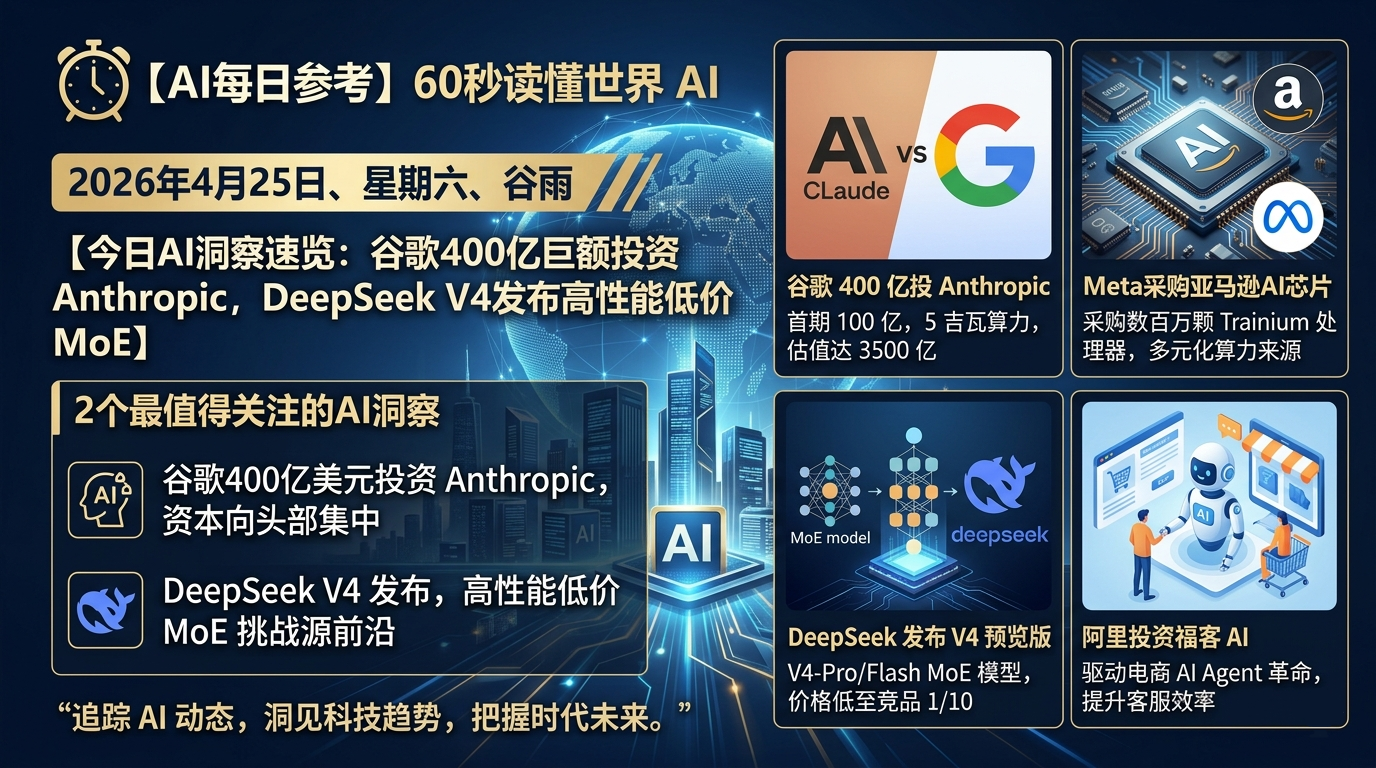 AI Visual Insight: This image summarizes the day’s AI industry events in the form of information cards, highlighting parallel international and domestic news flows. It works well as an entry point for an intelligence dashboard. The visual emphasis typically falls on major capital moves, model launches, and ecosystem partnerships, reflecting a three-layer structure of investment and financing, model iteration, and real-world adoption.
Google’s investment in Anthropic shows that compute has become the moat
Google announced that it may invest up to $40 billion in Anthropic. The first $10 billion would be paid immediately, while the remaining $30 billion would be tied to performance milestones. Google also committed 5 GW of compute support over five years. This is not a standard financial investment. It is a bundled strategy of capital, infrastructure, and strategic hedging.
Anthropic is no longer just a model startup. It has become a critical node in the global contest over AI infrastructure. Claude’s stable performance in the enterprise market means that even with Gemini, Google still needs to preserve influence over a top-tier external model provider.
news = {
    "investor": "Google",
    "target": "Anthropic",
    "max_investment_usd": 40_000_000_000,
    "initial_payment_usd": 10_000_000_000,
    "compute_support_gw": 5,  # Core logic: compute support has risen to the power-grid level
    "duration_years": 5
}

# Core logic: capital is now tied directly to compute, showing that AI competition has entered the infrastructure stage
thesis = "Competition among model companies is evolving into competition among cloud providers and compute networks"
print(thesis)
This code expresses the key variables of the deal in structured fields: capital, compute, and duration together form the strategic barrier.
Chip diversification is weakening single-vendor dominance
Meta and Amazon reached an agreement involving the purchase of millions of Trainium chips. The signal is clear: hyperscale model players are actively reducing their dependence on the NVIDIA-only ecosystem. Training and inference costs have become the core constraint on model commercialization.
This means that enterprises deploying large models can no longer compare model quality alone. They also need to evaluate underlying chip compatibility, cloud vendor coupling, and long-term cost curves. Compute procurement is shifting from “buy the strongest” to “buy the optimal mix.”
DeepSeek V4 proves that Chinese models are starting to rewrite the price-performance equation
DeepSeek released preview versions of two models, V4-Pro and V4-Flash, both based on an MoE architecture and both supporting a 1 million-token context window. V4-Pro has 1.6 trillion total parameters and 49 billion active parameters. V4-Flash has 284 billion total parameters and 13 billion active parameters.
The more important point is pricing. Its API pricing is only one-third to one-tenth that of comparable U.S. products, yet its coding and math performance is already approaching GPT-5.4-class models. For teams with tight budgets and ultra-long-context requirements, this is a highly disruptive alternative.
A 1 million-token context window will directly change how developers build systems
A 1 million-token context window is not just an impressive line item on a spec sheet. It means that large codebases, long-document knowledge bases, and multi-turn workflow state can remain intact within a single inference pass, reducing the losses introduced by chunking, retrieval, and compression.
For agents, code review, legal review, and enterprise knowledge Q&A, ultra-long context can significantly reduce engineering complexity. Systems that previously depended on complex RAG stitching may move toward an architecture that prioritizes large-context-first design.
def choose_model(task, budget_sensitive=True, long_context=True):
    # Core logic: when price-performance and ultra-long context matter, evaluate DeepSeek V4 first
    if task in ["code", "math", "agent"] and budget_sensitive and long_context:
        return "DeepSeek-V4"
    return "Frontier Closed Model"

# Example: a developer selects a model for code repository analysis
model = choose_model("code", budget_sensitive=True, long_context=True)
print(model)
This code captures a real trend: model selection will increasingly be determined by both cost and context capacity.
Tencent Cloud’s fast integration shows that ecosystem response speed is improving
Tencent Cloud TokenHub launched a preview version of DeepSeek-V4 in parallel and opened global availability through its Singapore node. This shows that domestic cloud providers can now integrate leading models quickly enough that the ecosystem layer no longer clearly lags behind the model layer.
For enterprise customers, the value of cloud platforms reselling model APIs is not just that the API is available. The real value lies in compliance, auditing, unified billing, and engineering support. For cross-border business in particular, node placement directly affects availability and latency.
Vertical scenarios and governance capability are becoming the second battleground
Another important signal from the same day is that AI deployment continues to move into deeper waters. Fuke AI received strategic investment from Alibaba, indicating that agents in e-commerce have reached a stage where scalable validation is possible. Meanwhile, Yinghe Medical Aesthetics partnered with Beijing Tiantan Hospital to launch a cranial CT-assisted reporting model, representing a shift in specialist vertical models toward clinical efficiency tooling.
At the same time, Anthropic disclosed updates to its election security safeguards, including political bias evaluation, automated detection, and trusted-information guidance mechanisms. Beyond model capability itself, governance frameworks are becoming a prerequisite for deploying large models in high-risk scenarios.
The ComfyUI and NEC cases reveal two different ecosystem expansion paths
ComfyUI’s valuation rose to $500 million, showing that professional creators place a high premium on workflow controllability. The competitive edge of tools like this does not come from general-purpose capability. It comes from node orchestration, plugin ecosystems, and reproducible processes.
Anthropic’s partnership with NEC, which deploys Claude across 30,000 employees, demonstrates another path: entering the large enterprise market through local compliance partners. One path builds a creator-platform ecosystem. The other builds an enterprise-delivery ecosystem. Both are closer to a commercial closed loop than simply adding more parameters.
Developers should now focus on three critical judgments
First, API selection should not rely on leaderboards alone. It should also account for price, context length, geographic availability, and service stability. Second, infrastructure strategy should not depend entirely on a single chip vendor or a single cloud provider. Third, success in vertical scenarios increasingly depends on industry data, compliance, and delivery capability.
If you compress the day’s news into a single sentence, it is this: AI competition has moved beyond “which model is stronger” and into “who can deploy with lower cost, a stronger ecosystem, and more reliable governance.” That is more important than any isolated model upgrade.

FAQ
1. Why does Google’s investment in Anthropic matter to developers?
Because investments like this usually come with more stable compute supply and stronger API service capacity. For teams building on Claude, stability, capacity, and enterprise-grade support could all improve.
2. Which use cases are most worth evaluating for DeepSeek V4?
Prioritize codebase analysis, long-document understanding, agent workflows, and mathematical reasoning. If your project needs both low cost and ultra-long context, DeepSeek V4 is especially worth A/B testing.
3. What do enterprises most easily overlook when deploying large models today?
The most commonly overlooked issues are infrastructure lock-in risk and governance requirements. In addition to model quality, enterprises should evaluate chip dependence, cloud platform lock-in, data compliance, auditing, and safety strategies for high-risk content.
AI Readability Summary
This article reconstructs the key AI intelligence from April 25, focusing on Google’s potential $40 billion investment in Anthropic, DeepSeek V4’s 1 million-token context window and low-price strategy, and other critical trends spanning chips, medical AI, agents, and election security. It helps developers quickly assess the future direction of models, compute, and AI industry deployment.