MyEMS is an open-source energy management system built for energy digitalization. Through microservice decoupling, time-series data storage, and stream processing, it addresses the scalability and maintenance challenges that traditional monolithic systems face in massive device connectivity, real-time analytics, and integrated energy-carbon management. Keywords: MyEMS, microservices, time-series data.
Technical Specification Snapshot
| Parameter | Description |
|---|---|
| Project Name | MyEMS |
| Core Positioning | Open-source energy management and integrated energy-carbon platform |
| Architecture Style | Microservices + time-series data-driven |
| Primary Languages | Python and React mentioned in the source material |
| Communication Protocols | Modbus RTU, OPC UA, MQTT |
| Deployment Model | Containerized, edge nodes, distributed clusters |
| Data Characteristics | High-frequency collection, real-time computation, long-term archiving |
| Core Dependencies | Message queues, time-series databases, Kubernetes/Docker Swarm |
| Community Model | Open-source community collaboration with secondary development support |
| Star Count | Not provided in the original text |
Traditional energy management systems are losing their scalability advantage
Traditional monolithic EMS platforms usually place data collection, analytics, reporting, and visualization in the same codebase. When the number of device points is low and sampling frequency is modest, this model is easy to deploy. But once connectivity scales to tens of thousands of devices, compilation, release management, troubleshooting, and capacity expansion quickly become unmanageable.
The core tension repeated throughout the source material is straightforward: energy operations naturally span devices, sites, and time horizons, while monolithic systems force every module to evolve in lockstep. As a result, a change in data collection can impact analytics services, and a new reporting requirement can slow down the release cadence of the entire platform.
services = ["collector", "processor", "analytics", "report"]
for service in services:
    deploy(service)  # Deploy each service independently to avoid full monolith releases
This snippet shows the fundamental benefit of microservices: reducing the deployment unit from the entire system to a single capability module.
MyEMS restructures energy management around domain boundaries
The key strength of MyEMS is not simply that it splits services, but that it redefines system boundaries around business domains. Device connectivity, data cleansing, energy efficiency analytics, carbon accounting, alarm management, and visualization are all treated as independently scalable capability modules.
This decomposition aligns well with Domain-Driven Design (DDD). Energy data collection focuses on protocol compatibility and connection stability. Analytics services focus on metric calculation and algorithm evolution. Reporting services focus on query aggregation and access experience. These three layers operate on entirely different iteration cycles.
The device connectivity layer handles the first level of decoupling across heterogeneous protocols
The source material explicitly states that MyEMS uses the adapter pattern in the collection layer to shield protocol differences. Industrial protocols such as Modbus RTU, OPC UA, and MQTT are first transformed into a unified internal data model before entering the downstream processing pipeline.
 AI Visual Insight: This diagram shows protocol access and adaptation in the energy system collection layer. It highlights how a unified access gateway or adapter maps multiple industrial protocols into standardized measurement-point data, reducing the impact of device replacement and protocol expansion on upper-layer business services.
class ProtocolAdapter:
    def normalize(self, payload):
        return {
            "point_id": payload["id"],      # Unified measurement point identifier
            "value": payload["value"],      # Unified value field
            "timestamp": payload["ts"]      # Unified timestamp format
        }
This code reflects the core responsibility of the collection service: translating heterogeneous protocols into a unified data object.
The plugin-based design of collection services improves field integration efficiency
When an enterprise adds new devices or replaces a gateway, it only needs to add a parsing plugin rather than modify analytics, reporting, or authorization modules. This ability to confine change locally is exactly the engineering characteristic that long-lived industrial environments need.
Time-series data storage determines the performance ceiling of the entire architecture
Energy data revolves around timestamps. It is write-heavy, read-heavy, and clearly stratified between hot and cold data. MyEMS separates time-series data from traditional relational databases and hands it to a storage engine optimized for time-series workloads. This is one of the most engineering-intensive design decisions in the original article.
 AI Visual Insight: This diagram highlights the role of a time-series database in energy scenarios, including high-frequency writes, time-window queries, historical compression, downsampling, and lifecycle management. It demonstrates the inherent advantages of time-series databases over relational databases for monitoring-oriented workloads.
The benefits of a time-series database go beyond write throughput. It also supports compression, archiving, and downsampling. Minute-level data serves real-time monitoring, while daily and monthly aggregates support audit and management reporting. That makes long-term storage costs controllable.
def choose_resolution(age_days):
    if age_days <= 30:
        return "1min"   # Keep minute-level precision for recent data
    if age_days <= 365:
        return "1hour"  # Downsample mid-term data to hourly resolution
    return "1day"       # Use daily aggregates for long-term archives
This snippet summarizes the lifecycle governance model for energy time-series data.
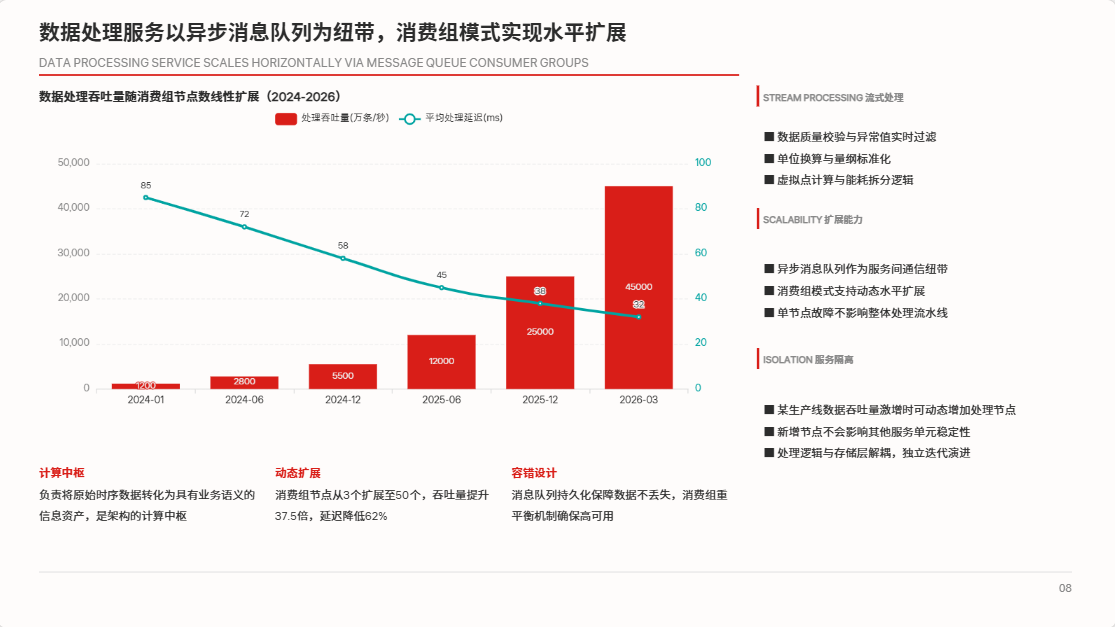
Stream processing turns data from passive records into decision drivers
MyEMS does not merely store data for later queries. It treats data as continuously flowing business events. After collection, raw measurement points go through data quality validation, anomaly filtering, unit conversion, virtual point calculation, and energy consumption decomposition before entering analytics and alarm services.
 AI Visual Insight: This diagram shows the central role of the data processing service in a microservices architecture. It typically includes message queue buffering, consumer group scaling, rule processing, and metric calculation, illustrating how the system improves throughput and stability through asynchronous decoupling.
Here, the message queue is not an auxiliary component. It is a core mechanism of system resilience. It isolates collection peaks from computation peaks, allowing processing services to scale horizontally by consumer group and preventing local traffic spikes from overwhelming the entire pipeline.
def process_point(point):
    if point["value"] is None:
        return None  # Filter null values directly
    point["value"] = round(point["value"], 2)  # Normalize data
    return point
This snippet represents the smallest closed loop in stream processing: cleanse first, then forward to downstream computation services.
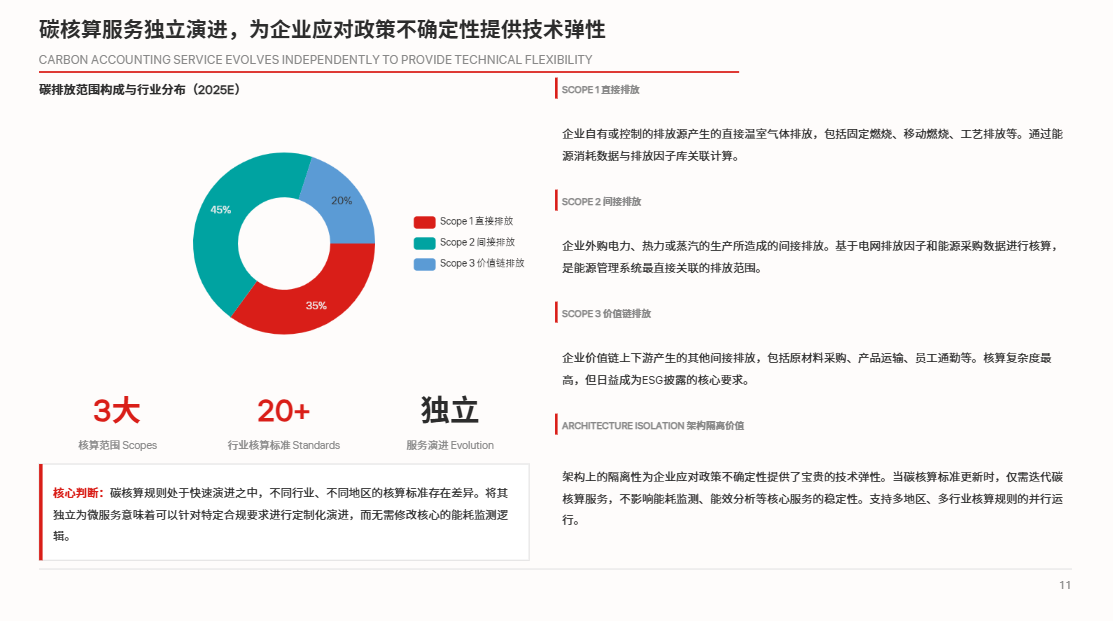
Energy efficiency analytics and carbon accounting are becoming high-value domain services
Energy efficiency analytics services handle models such as year-over-year comparison, period-over-period comparison, regression, load forecasting, and baseline benchmarking. Once isolated as an independent service, algorithms can be rolled out gradually without disrupting the production collection pipeline.
Carbon accounting services associate energy consumption data with emission factors and support Scope 1, Scope 2, and even Scope 3 accounting logic. Because regulatory rules change frequently, isolating carbon rules into a dedicated service significantly reduces the cost of compliance updates.
Visualization and reporting services must evolve independently to support multi-terminal concurrency
Large-screen dashboards, executive cockpits, mobile inspection apps, and email reports do not share the same access pattern. MyEMS treats visualization and reporting as independent services. In essence, this protects the core collection and analytics pipeline from being slowed down by the presentation layer.
 AI Visual Insight: This diagram reflects the independent deployment model for the visualization and reporting layers. In practice, these layers usually expose different API aggregation strategies for large screens, mobile clients, and management dashboards, while using caching to reduce direct pressure on core databases and analytics services.
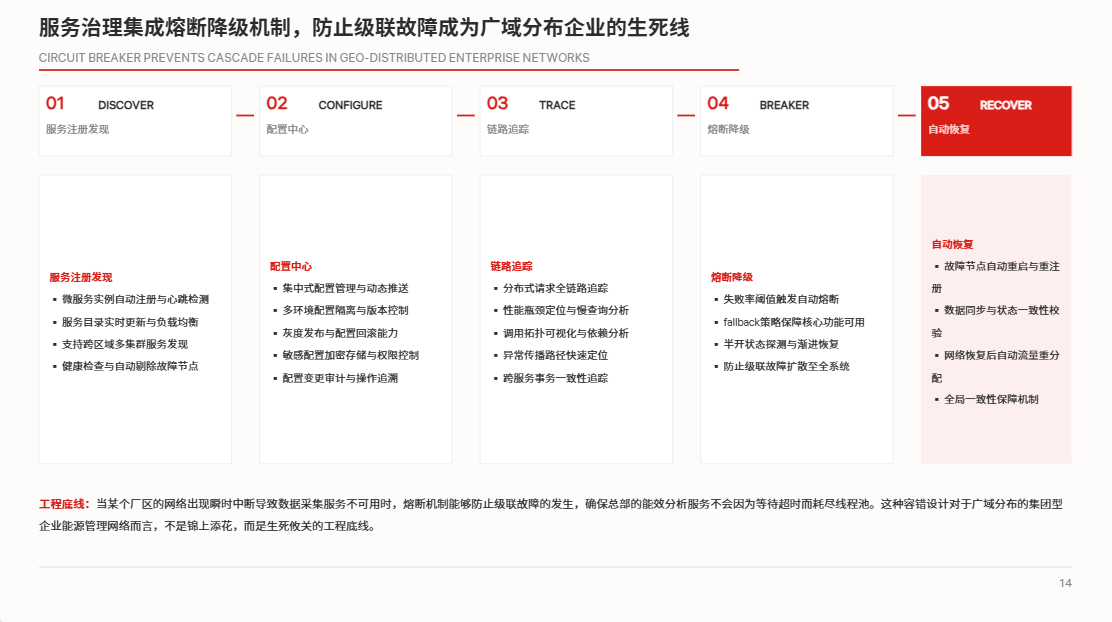
Service governance determines whether microservices are truly usable
Service discovery, centralized configuration, distributed tracing, circuit breaking, graceful degradation, and permission isolation determine whether microservices are not only decomposable, but also operationally reliable. In cross-site deployments, network jitter is normal, so fault tolerance must be designed in from the start.
def call_service(client, request):
    try:
        return client.send(request)  # Call the remote service normally
    except TimeoutError:
        return {"status": "fallback"}  # Trigger degradation logic after timeout
This snippet summarizes the fundamental fault-tolerance pattern of microservices: failures are inevitable, but they must remain controllable.
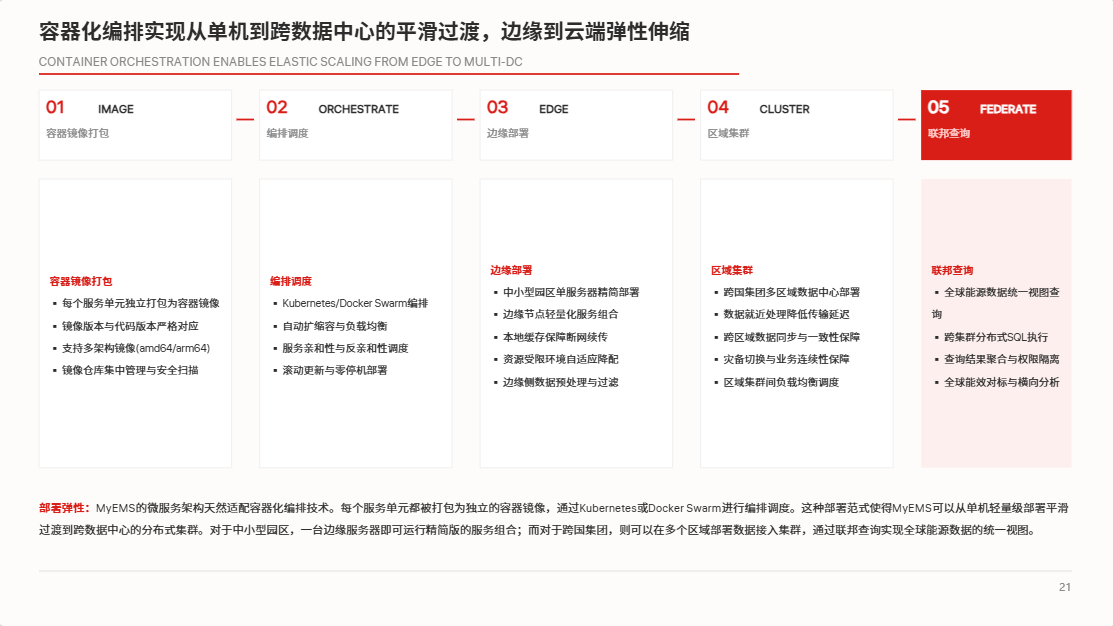
Edge-cloud collaboration and containerized deployment make the system practical in production
The source material notes that MyEMS supports lightweight collection and preprocessing on edge nodes, uploading only aggregated features or necessary raw data to the cloud. This approach supports offline buffering and retransmission in industrial environments while also meeting compliance requirements for keeping data on-site.
At the same time, every service can be packaged as a container image and orchestrated by Kubernetes or Docker Swarm. Small and medium-sized industrial parks can deploy on a single machine, while enterprise groups can build cross-region clusters and federated queries. The architecture provides a clear path for scaling.
The open-source nature of MyEMS strengthens data sovereignty and extensibility
Compared with closed-source commercial systems, the value of MyEMS is not only cost control. It also allows enterprises to understand the data model, metric algorithms, and service boundaries, avoiding lock-in to black-box platforms. For long-running energy management systems, technical sovereignty is itself a core asset.
FAQ
Why is MyEMS better suited than traditional monolithic EMS for major energy-consuming enterprises?
Because it separates collection, processing, analytics, carbon accounting, and presentation into independent services. This allows each layer to scale based on its own workload and makes the platform better suited for multi-site, multi-protocol, and high-frequency time-series data scenarios.
What key problem does the time-series database solve in MyEMS?
It solves high-frequency writes, time-range queries, historical compression, and downsampling management. That allows the system to support real-time monitoring while keeping the storage cost of multi-year historical data under control.
Which layer should enterprises build first when implementing MyEMS?
Start by standardizing device connectivity, time-series storage, and foundational data governance. Then gradually introduce energy efficiency analytics, carbon accounting, and real-time alarms. The quality of the underlying data determines the reliability of upper-layer intelligence.
Core Summary
This article reconstructs the technical landscape of the MyEMS energy management system based on the source material. It focuses on microservice decoupling, time-series databases, stream processing, edge collaboration, and multi-tenant governance, showing how MyEMS can replace traditional monolithic architectures and help major energy-consuming enterprises unify energy monitoring, energy efficiency analytics, and carbon accounting.